Published
Unions
What a Union Actually Does (and Why the Boss Hires Consultants to Stop One)
Union density fell from a 1954 peak of 28.3 percent to 10 percent in 2025. What the card buys, and the $340 million a year employers spend keeping it rare.
The story
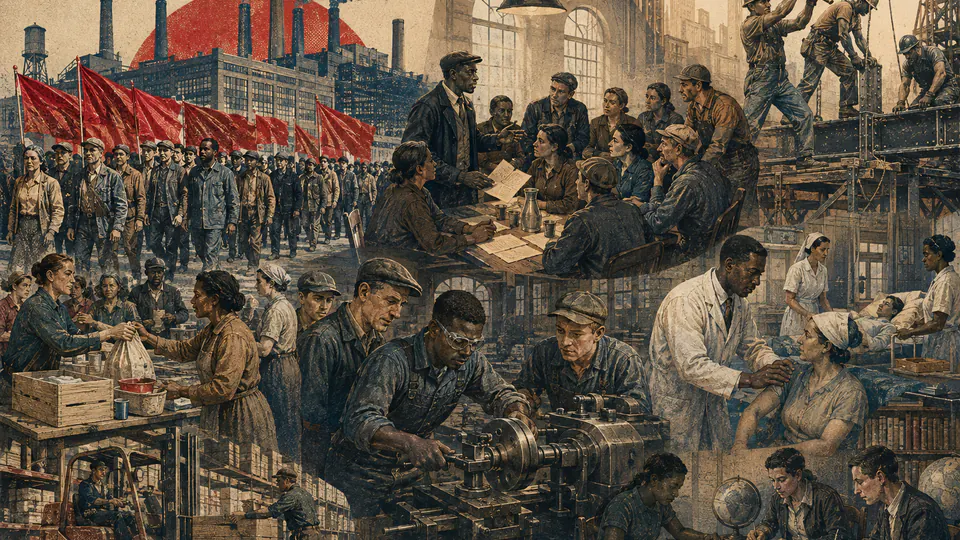
#storyTen percent of American wage and salary workers belonged to a union in 2025, about 14.7 million people. In 1954, the recorded high point, the rate was 28.3 percent of employed workers, a different measure of the workforce than today’s figure but pointed at the same decline: every version of the union density series falls from the 1950s onward, without a real interruption. A union does three specific things once workers actually get one: it bargains a contract, it enforces that contract through a grievance procedure, and it gives workers a formal voice on safety before someone gets hurt. Most of the seventy-year decline traces to what happens before any of that, at the fight over whether a workplace gets a union at all.
What the card actually buys
Once a majority of workers at a job choose a union, three things start happening that were not happening before. A bargaining committee made up of coworkers, not outside officials, sits across the table from company negotiators and writes the actual contract: pay scales, scheduling rules, health coverage, seniority. A grievance procedure gives that contract teeth after it is signed. When a manager violates or misreads it, a worker, often through a shop steward (the elected coworker who handles this job), files a formal complaint that moves up the chain and, if it stalls, ends in arbitration before a neutral outsider instead of the boss’s own judgment. And in workplaces where the job can put someone in the hospital, more contracts now write in a joint health and safety committee, workers and management walking the floor together instead of the employer inspecting itself.
None of it is automatic, and none of it is free: a union has to win a fight just to exist in the first place. Without one, the same three questions (what will I be paid, what happens if the contract gets broken, who decides whether this job is safe) get answered by the employer alone, every time.
The law that makes it possible
The right to do any of this at a private employer has been federal law only since July 5, 1935, when Franklin Roosevelt signed the National Labor Relations Act, written by Senator Robert Wagner of New York. The law commits the government to encouraging collective bargaining by protecting workers’ freedom of association, gives employees the right to organize and bargain collectively, and protects coworkers acting together over pay or conditions even where there is no union at all. It created the National Labor Relations Board to run union elections and investigate unfair labor practice charges, and it carries a right fewer people know they have: in an investigatory meeting that could lead to discipline, a worker can demand a coworker sit in the room, a protection nicknamed Weingarten rights after the Supreme Court case that created it.
This was new law, not a restatement of an old norm. Before 1935, the standard employer answer to organizing was the one Eugene Debs’s American Railway Union met in 1894: a federal injunction and the Army. Wagner’s law replaced the injunction with an election.
Twelve years later, Congress narrowed it
The law did not stay where Wagner left it. On June 23, 1947, a Republican Congress passed the Taft-Hartley Act over President Truman’s veto, and it is still the framework unions organize under today. Taft-Hartley outlawed the closed shop, a workplace where a worker had to already belong to the union to get hired, but allowed a union shop, where a new hire gets 30 days before dues start, unless a state passes its own right-to-work law banning even that; 26 states now have one. It also banned secondary boycotts, workers picketing a company that does business with the employer they are actually fighting, which is one reason a single striking workplace rarely pulls a wider one in anymore the way it briefly could during the sit-down strikes that built the United Auto Workers in the 1930s. The same law is a large part of why a walkout spreading across a whole city or industry, a general strike, has been close to nonexistent in the US since 1947, not 1937.
Where the membership went
Union density hit its recorded peak, 28.3 percent of employed workers, in 1954. The raw number of members kept climbing for another quarter century, peaking at an estimated 21.0 million people in 1979, before both measures turned down for good. By 2025 the overall rate was 10.0 percent, 14.7 million people, and the two halves of the workforce sat almost exactly even: 7.4 million union members in the private sector and 7.3 million in government jobs, nearly equal for the first time since 2020. The private-sector rate on its own, 5.9 percent, is a hundred-year low. Government unionization carried nearly all the weight the private sector used to.
The industry built to keep it that way
Part of the decline is structural: manufacturing, historically a union stronghold, shed jobs to automation and offshoring for decades. Part of it is a business. A December 2019 investigation by the Economic Policy Institute, built on federal disclosure filings employers are required to submit, put employer spending on “union avoidance” consultants at $340 million a year, with consultants billing $350 an hour or more, sometimes $2,500 a day, for one job: stop an election before it happens, or make sure workers vote no if it does. The Trump International Hotel in Las Vegas spent $569,000 on the practice between 2015 and 2016. In 2019, facing a wave of internal worker dissent, Google retained IRI Consultants, the New York Times reported, the same firm documented elsewhere compiling personal dossiers on workers (family status, finances, health problems, a one-to-five score on how likely each one was to vote union) so managers knew exactly who to talk to and about what.
More popular than joined
None of this squares with what Americans actually say about unions. Gallup’s 2025 poll put approval of labor unions at 68 percent, the fifth straight year in a stretch between 67 and 71 percent, a run the country had not sustained since the early 1960s. Approval had bottomed out at 48 percent in 2009 and has not come close to that number since. Sixty-eight percent of the country likes the idea; ten percent of it has the card.
The current wave
Some of the recent growth is coming from workplaces the labor movement had barely touched before. On December 9, 2021, workers at a Starbucks on Elmwood Avenue in Buffalo voted 19 to 8 to unionize, the first of the company’s more than 8,000 corporate US stores to do so, joining Workers United, an SEIU affiliate. Within a few years, Starbucks Workers United represented more than 655 stores in 45 states and Washington, DC, over 14,000 workers. None of those stores had a first contract yet; the union filed a bad-faith bargaining complaint against the company in December 2024, which is the honest footnote every union election needs. Winning the vote and winning a contract are two different fights, run under two different parts of the same law.
Amazon workers wrote the other headline of the wave. On April 1, 2022, warehouse workers at the JFK8 facility on Staten Island voted 2,654 to 2,131 to unionize, the first Amazon warehouse in the country to do so, organized entirely outside the traditional labor movement by the independent Amazon Labor Union under Christian Smalls, a JFK8 worker Amazon had fired in March 2020, the same day he organized a walkout over COVID-19 safety protocols. Smalls spoke to reporters the day the votes were counted:
It’s always going to be Amazon versus the people. And today, the people have spoken, and the people wanted a union.
What the numbers add up to
The Fight for $15 campaign, which started with just over 100 fast-food workers walking out in New York City on November 29, 2012, showed wages can move before a single NLRB election happens, through public pressure and state legislatures. A signed union contract does something that kind of campaign cannot: it puts the raise, the grievance procedure, and the safety committee into a document a neutral arbitrator enforces if the employer breaks it. A signed document is exactly what $340 million a year is spent trying to prevent.
Argue it
#argue4 claims about Unions you can make out loud, the best case against each one, and the answer. Every number links to where it came from.
-
Claim 1
A union card is worth real money, even by the critics' own corrected math.
The evidence
Full-time union members earned a median $1,404 a week in 2025 versus $1,174 for nonunion workers, Bureau of Labor Statistics data show, nonunion pay running at 84 percent of union pay. The U.S. Treasury Department's own causal estimate, which tries to isolate the union effect from who unions tend to represent, still puts the premium at 10 to 15 percent, largest for longer-tenured workers.
Their best case
Christopher Douglas of the Mackinac Center argues the 27 percent wage premium often cited by labor groups is inflated by structural differences between union and nonunion workforces. Correcting for occupation, geography, and Census wage-imputation bias, he puts the real premium closer to 10.2 to 14.7 percent.
The answer
Douglas's own corrected number lands almost exactly where the Treasury Department's independent causal estimate does, 10 to 15 percent. The argument on the table is how big the raise is, and both sides put it in double digits.
-
Claim 2
Union decline accounts for a fifth to a third of the rise in wage inequality since the 1970s.
The evidence
Sociologists Bruce Western and Jake Rosenfeld tracked private-sector union membership falling from 34 to 8 percent for men and 16 to 6 percent for women between 1973 and 2007, while hourly wage inequality kept rising. Accounting for unions' effect on both union and nonunion pay, they attribute about a third of that inequality growth among men, and a fifth among women, to deunionization itself.
Their best case
The U.S. Treasury lays out the plainest version of the critics' case: unions function like a labor cartel, restricting the supply of labor to a given employer so members can extract a wage above what a competitive market would set, a gain that has to come from somewhere, meaning higher prices or fewer jobs elsewhere.
The answer
If that were the whole story, nonunion wages would fall as union wages rise. Treasury finds each 1-percentage-point rise in private-sector union density lifts nonunion wages roughly 0.3 percent, largest for workers without a college degree. Western and Rosenfeld measure the entire wage distribution across three and a half decades rather than one employer's payroll, and a cartel does not raise the pay of the workers outside it.
-
Claim 3
Employers spend $340 million a year on consultants to stop unions, and get charged with breaking the law in four of every ten campaigns.
The evidence
For 76 years, the NLRB's own Babcock & Wilcox standard (1948) let an employer hold mandatory meetings pressing its views on unionizing, lawful under Section 8(c) so long as no worker was threatened, interrogated, punished, or promised a benefit. A 2019 Economic Policy Institute review of federal disclosure filings found employers spending an estimated $340 million a year on union-avoidance consultants under that standard, and charged with violating federal labor law outright in 41.5 percent of all union election campaigns.
Their best case
Section 8(c) protects an employer's free speech about unionization, and for 76 years the NLRB itself held that a mandatory meeting expressing that view was lawful persuasion, not coercion, as long as the employer stopped short of threats or bribes.
The answer
The NLRB reversed itself in November 2024, ruling in Amazon.com Services (373 NLRB No. 136) that mandatory attendance, rather than the speech itself, is what makes such a meeting coercive: Section 8(c) protects the right to speak, not the power to force a captive audience to listen on pain of discipline. EPI's 41.5 percent covers charges filed while the old standard was still in force, so the persuasion the rule protected was running alongside conduct the same agency was prosecuting.
-
Claim 4
After a state passes right-to-work, union density falls about 4 percentage points within five years.
The evidence
A 2022 NBER event study tracking five states around their own right-to-work adoption (2011-2017) found union density fell about 4 percentage points within five years, nearly 13 points in heavily unionized industries like construction and public administration, with wages down roughly 1 percent overall and more than 4 percent in those same industries.
Their best case
Mackinac Center economist Christopher Douglas argues that once you properly control for each state's fixed characteristics, right-to-work states show 1.9 percent higher average wages, not lower, reversing the older cross-state comparisons unions cite.
The answer
Douglas's critique targets a 2015 cross-sectional snapshot comparing different states at one point in time. The 2022 NBER paper answers that by design. It is an event study, tracking the same states before and after their own law changed, which controls for the fixed state traits Douglas says the older method missed, and it still finds density and wages falling right after adoption.
What people get wrong
#wrong- The myth
If you don't join the union, you're not covered by its contract. - The record
Under the NLRA's exclusive-representation rule, once a majority of workers votes a union in, the contract, and the union's duty to represent workers fairly, covers everyone in the bargaining unit, member or not. That single rule is also the source of the free-rider debate right-to-work laws turn on: a nonmember can decline to pay dues but cannot be excluded from the contract or the grievance process.
- The myth
Union approval and union membership measure the same thing, so a bigger gap between them just means people are lying to pollsters. - The record
Gallup measured 68 percent public approval of unions in 2025; BLS measured 10.0 percent actual membership the same year. The gap tracks the mechanics of organizing, not insincerity: EPI's review of federal filings found employers spending an estimated $340 million a year on union-avoidance consultants and breaking the law outright in 41.5 percent of election campaigns, a cost baked into every attempt to close the gap one workplace at a time.
The dates that matter
#dates- July 5, 1935 Franklin Roosevelt signs the National Labor Relations Act, written by Senator Robert Wagner, establishing the right to organize and creating the NLRB.
- June 23, 1947 A Republican Congress passes the Taft-Hartley Act over President Truman's veto, outlawing the closed shop, permitting state right-to-work laws, and banning secondary boycotts.
- 1954 US union density reaches its recorded peak, 28.3 percent of employed workers.
- 1979 The raw number of union members peaks at an estimated 21.0 million, even as the density rate had already begun to slide.
- December 11, 2019 The Economic Policy Institute publishes Unlawful, estimating employer spending on union-avoidance consultants at $340 million a year.
- December 9, 2021 Workers at a Starbucks on Elmwood Avenue in Buffalo vote 19 to 8 to unionize, the company's first unionized US store.
- April 1, 2022 Warehouse workers at Amazon's JFK8 facility on Staten Island vote 2,654 to 2,131 to unionize as the independent Amazon Labor Union.
- December 23, 2024 Starbucks Workers United files a bad-faith bargaining complaint against the company, still without a first contract at any store.
- August 2025 Gallup measures public approval of labor unions at 68 percent, the fifth straight year in the 67-71 percent range.
- 2025 BLS reports union density at 10.0 percent of wage and salary workers, 14.7 million people, with the private-sector rate at a hundred-year low of 5.9 percent.
Questions people ask
#faqsWhat does a union actually do?
Three concrete things once workers vote one in. A bargaining committee of coworkers negotiates a contract covering pay, hours, benefits, and seniority. A grievance procedure enforces that contract afterward, letting a worker file a formal complaint when the employer violates it, ending in arbitration before a neutral outsider if it is not resolved. And in many workplaces, a joint health and safety committee gives workers a formal say over hazards on the job.
How many Americans belong to a union?
10.0 percent of wage and salary workers, about 14.7 million people, according to 2025 Bureau of Labor Statistics data. That is down from the recorded peak of 28.3 percent of employed workers in 1954. The private-sector rate, 5.9 percent, is a hundred-year low; unionization in government jobs remains far higher.
Why do companies hire consultants to fight unions?
Because it works often enough to be worth the price. A 2019 Economic Policy Institute investigation of federal disclosure filings put employer spending on "union avoidance" consultants at $340 million a year, with consultants charging $350 an hour or more to run anti-union campaigns, from mandatory meetings to worker-by-worker dossiers scoring how likely each employee is to vote union.
Do most Americans support unions?
Yes, far more than belong to one. Gallup's 2025 poll put approval of labor unions at 68 percent, the fifth consecutive year in the 67 to 71 percent range, a level the country had not sustained since the early 1960s, nearly seven times the 10 percent of workers who are actually union members.
How do you start a union at work?
Under the National Labor Relations Act, workers petition the National Labor Relations Board for an election once enough coworkers show interest, and a majority vote wins recognition. From there the law requires the employer to bargain in good faith, though it sets no deadline for reaching a contract: Starbucks Workers United won its first election in December 2021 and was still without a signed contract anywhere three years later.
The bookshelf
#bookshelfWhere to go next. Buy from an independent bookstore, or find it at your library for nothing.
-
Fight Like Hell: The Untold History of American Labor Kim Kelly, 2022 secondary
The labor history the textbooks skip: incarcerated workers, sex workers, domestic workers, all organizing.
-
No Shortcuts: Organizing for Power in the New Gilded Age Jane McAlevey, 2016 secondary
The difference between mobilizing a rally and building the majority that wins a contract, from an organizer who has run both.
-
Which Side Are You On?: Trying to Be for Labor When It's Flat on Its Back Thomas Geoghegan, 2004 secondary
A labor lawyer's account of what Taft-Hartley's slow grind looks like from inside a union hall.
Wear it: Unions
#merchEvery design here links back to this page.
 Design proof
 A. Philip Randolph Collage Tee
$36.00 Design proof
 Bayard Rustin Collage Tee
$36.00 Design proof
 Big Bill Haywood Engraved Tee
$36.00 Design proof
 Cesar Chavez Collage Tee
$36.00 Design proof
 Dolores Huerta Collage Tee
$36.00 Design proof
 Elizabeth Gurley Flynn Engraved Tee
$36.00 Design proof
 Emma Goldman Engraved Tee
$36.00 Design proof
 Eugene V. Debs Engraved Tee
$36.00 Design proof
 Helen Keller Engraved Tee
$36.00 Design proof
 Howard Zinn Engraved Tee
$36.00 Design proof
 Joe Hill Collage Tee
$36.00 Design proof
 Mother Jones Engraved Tee
$36.00 Design proof
 Paul Robeson Engraved Tee
$36.00 Design proof
 Pete Seeger Collage Tee
$36.00 Design proof
 Woody Guthrie Collage Tee
$36.00 Design proof
 Unions Collage Tee
$36.00 Design proof
 A. J. Muste Engraved Tee
$36.00 Design proof
 Clara Lemlich Engraved Tee
$36.00 Design proof
 Dorothy Day Collage Tee
$36.00 Design proof
 Emma Tenayuca Collage Tee
$36.00 Design proof
 Larry Itliong Collage Tee
$36.00 Design proof
 Leslie Feinberg Pixel Tee
$36.00 Design proof
 Philip Vera Cruz Collage Tee
$36.00 Design proof
 Rose Schneiderman Engraved Tee
$36.00 Design proof
 Upton Sinclair Pixel Tee
$36.00 Design proof
 Walter Reuther Engraved Tee
$36.00 Design proof
 "Union pay: still 10 to 15 percent more." Tee
$36.00 Design proof
 "Union pay: still 10 to 15 percent more." Sticker
$5.00 Design proof
 "Union decline: a fifth to a third of the gap." Tee
$36.00 Design proof
 "Union decline: a fifth to a third of the gap." Sticker
$5.00 Design proof
 "$340 million a year to keep the card rare." Tee
$36.00 Design proof
 "$340 million a year to keep the card rare." Sticker
$5.00 Design proof
 "Right-to-work: density down 4 points in 5 years." Tee
$36.00 Design proof
 "Right-to-work: density down 4 points in 5 years." Sticker
$5.00Sources
#sourcesPrimary sources
The documents themselves: laws, court opinions, speeches, letters, and the numbers from the agencies that count them.
- National Labor Relations Board, "The Law" (the rights the NLRA protects, including Weingarten rights)
- National Labor Relations Board, "1935: Passage of the Wagner Act"
- National Labor Relations Board, "1947 Taft-Hartley Substantive Provisions"
- Congressional Research Service, "Union Membership Trends in the United States" (RL32553), via EveryCRSReport.com (the 1954 peak (28.3 percent of employed workers) and the 1979 peak in raw members (21.0 million))
- Gallup, "Labor Union Approval Relatively Steady at 68%" (2025)
- Celine McNicholas, Margaret Poydock, Julia Wolfe, Gordon Lafer, Lola Loustaunau, and Ben Zipperer, "Unlawful: U.S. Employers Are Charged with Violating Federal Law in 41.5% of All Union Election Campaigns" (Economic Policy Institute, December 11, 2019) (source of the $340 million annual union-avoidance spending estimate)
- WKBW, "Starbucks on Elmwood Avenue in Buffalo becomes first U.S. store to vote to unionize" (the 19-8 vote and December 9, 2021 date)
- Workers United, "Starbucks Partners, Workers United Win First Unionized Starbucks in U.S." (confirms the more-than-8,000-store count and the SEIU affiliation; the union's own release puts the vote at 18-8, one vote off the count independent outlets reported)
- Fortune, "Amazon workers win historic union election at Staten Island facility" (the JFK8 vote count and the Christian Smalls quote)
- Bureau of Labor Statistics, "Union Members - 2025" (news release, January 2026) (median weekly earnings, union $1,404 versus nonunion $1,174 in 2025)
- U.S. Department of the Treasury, "Labor Unions and the U.S. Economy" (causal union wage premium estimate (10 to 15 percent) and the nonunion wage spillover from union density)
- National Labor Relations Board, "Board Rules Captive-Audience Meetings Unlawful" (November 13, 2024), announcing Amazon.com Services LLC, 373 NLRB No. 136
Secondary sources
Written afterward, about the story.
- First Amendment Encyclopedia (Middle Tennessee State University), "Taft-Hartley Act of 1947" (the exact date, June 23, 1947, and the veto override)
- Capital Research Center, "Great union inflection point or dead cat bounce? Parsing the 2025 BLS union members survey" (2025 BLS figures: 10.0 percent overall, 5.9 percent private sector, 7.4 million private and 7.3 million government members)
- In These Times, "Five Things the New BLS Union Membership Statistics Don't Tell You" (the private-sector rate as a hundred-year low, and the 2025 membership gain)
- Salon, "U.S. employers spend $340 million annually to thwart unions" (December 12, 2019) (reports the EPI figures, consultant hourly rates, and named company examples)
- Vice, "'Lazy,' 'Money-Oriented,' 'Single Mother': How Union-Busting Firms Compile Dossiers on Employees" (IRI Consultants, retained by Google in 2019)
- Center for American Progress, "The Fight To Unionize Starbucks by the Numbers" (current store and worker counts, and the stalled first contract)
- Inland Empire Labor Council, AFL-CIO, "Glossary of Labor Terms" (definitions of negotiating committee, grievance, grievance procedure, and shop steward)
- Wikipedia, "Right-to-work law" (current count of 26 states, reflecting Michigan's 2024 repeal)
- Wikipedia, "Christian Smalls" (the March 30, 2020 firing and the walkout that preceded it)
- Wikipedia, "Fight for $15" (the November 29, 2012 New York City walkout that started the campaign)
- Christopher C. Douglas, "The union wage premium: Difficult to calculate, likely overblown," Mackinac Center (July 27, 2016)
- Bruce Western and Jake Rosenfeld, "Unions, Norms, and the Rise in U.S. Wage Inequality," American Sociological Review 76(4) (August 2011), reported by ScienceDaily (deunionization explains about a third of the rise in wage inequality among men and a fifth among women, 1973-2007)
- Jackson Lewis, "Clear the Calendar: NLRB Restricts Captive Audience Meetings" (Amazon.com Services, 373 NLRB No. 136 (November 13, 2024), and the prior Babcock & Wilcox (1948) standard)
- Nicole Fortin, Thomas Lemieux, and Neil Lloyd, "Right-to-Work Laws, Unionization, and Wage Setting," NBER Working Paper 30098 (2022), reported in the NBER Digest
- Christopher C. Douglas, "Right-to-Work States Do Not Have Lower Wages," Mackinac Center (December 20, 2024)