Published
Clara Lemlich
Clara Lemlich Called the Vote That Started the Uprising of the 20,000
Born March 28, 1886. Died July 12, 1982
Clara Lemlich survived beatings on garment picket lines, then moved the 1909 Cooper Union meeting to a general strike in Yiddish.
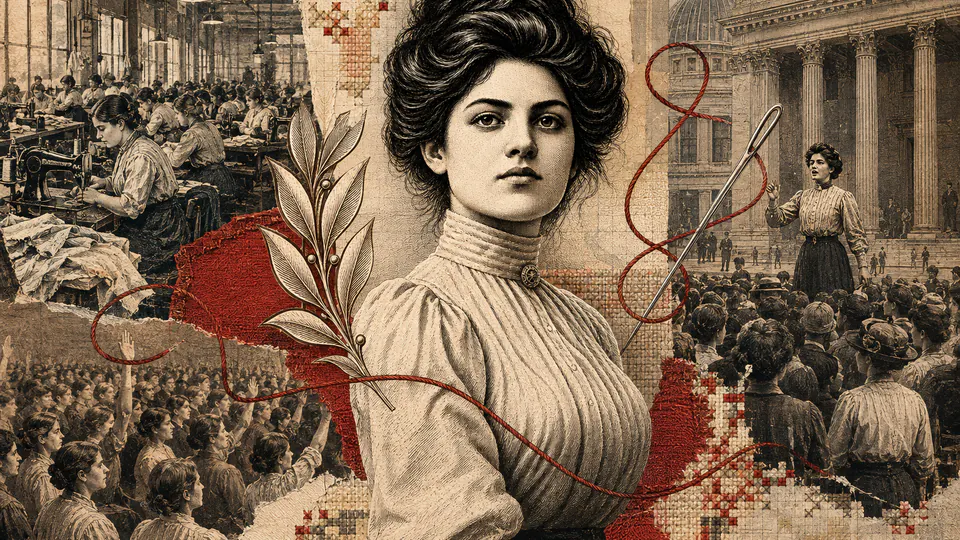
The story
#storyThe men on the Cooper Union platform had been speaking for hours when Clara Lemlich asked to be heard. It was November 22, 1909. Lemlich, a 23-year-old shirtwaist worker, had already been beaten on picket lines and carried the marks. Speaking in Yiddish, she said she had listened to enough talk and moved that the entire trade strike.
The hall voted. By the next day, thousands of mostly young immigrant women had left their sewing machines. The walkout became the Uprising of the 20,000.
Organizing at the machine
Lemlich was born in Ukraine in 1886 and came to New York in 1903 after antisemitic violence and repression in the Russian Empire. She found work in garment shops and joined Local 25 of the International Ladies’ Garment Workers’ Union.
Shirtwaist workers faced long hours, low piece rates, arbitrary fines, crowded rooms, and locked exits. Lemlich organized shop by shop. Employers hired guards and gangsters to attack picketers; police often arrested the workers being attacked. She returned after having ribs broken.
The strike and its limits
Roughly 20,000 workers joined the strike. Wealthy suffragists in the Women’s Trade Union League walked picket lines and used their status to expose police conduct. The alliance connected industrial work to women’s suffrage, though class differences never disappeared.
Most manufacturers settled by February 1910 with shorter hours, better wages, and some union recognition. The Triangle Shirtwaist Company refused the industrywide agreement. Thirteen months later, 146 workers died in the Triangle fire, where a locked exit was one of the lethal conditions workers had named.
A life after the famous minute
Union leaders later barred Lemlich from garment organizing because they considered her militancy a liability. She did not retire from other people’s trouble. After marrying Joe Shavelson and raising children, she organized working-class housewives around food prices and consumer boycotts. In the 1930s she organized tenants against evictions and rent increases.
The federal government investigated the family’s politics. During the Cold War, Lemlich’s passport was revoked. Late in life, living at the Jewish Home for the Aged in Los Angeles, she persuaded residents to join a boycott of grapes and lettuce in support of farmworkers.
Lemlich died in 1982 at 96. History often holds her at the Cooper Union microphone, which is understandable but incomplete. The motion lasted minutes. The organizing lasted nearly eighty years.
Immigration placed her inside a radical working city
Lemlich grew up in a Jewish family in territory then controlled by the Russian Empire. She pursued reading despite restrictions on girls and encountered socialist ideas before migration. Pogroms and repression helped drive the family to New York in 1903.
The Lower East Side offered political newspapers, unions, mutual aid, lectures, and cramped tenements alongside industrial exploitation. Lemlich attended classes after long shifts and read material coworkers passed among themselves.
Garment work drew young immigrant women whose wages supported households. Employers used age, language, and gender to treat them as replaceable. The same dense community that supplied labor also let organizers move news rapidly across shops and streets.
Shop strikes built the general strike from below
Before Cooper Union, Lemlich helped lead repeated walkouts and joined ILGWU Local 25. Shirtwaist production depended on piece rates, speed, unpaid materials, fines, and seasons of intense work followed by layoffs.
Organizing one shop could win improvements until an employer shifted work or competitors undercut the agreement. Workers therefore pushed toward an industrywide strike. Picketing brought police arrests and assaults by hired men. Lemlich returned after injuries, giving her call for action credibility no platform speaker could manufacture.
The famous motion worked because thousands had already discussed, struck, and prepared. Her minute at the microphone condensed months of organization.
Allies changed the public cost of police abuse
Members of the Women’s Trade Union League and wealthy suffragists joined picket lines. Their presence attracted press coverage and made police treatment harder for city officials to ignore.
The alliance brought bail, money, lawyers, and social access. It also carried class tension. Affluent supporters could leave the line for secure homes; workers risked wages, eviction, and blacklisting. Some reformers preferred mediation where workers wanted union recognition.
Coalition was useful because the participants held unequal resources, not because those differences disappeared. Lemlich insisted that workers themselves decide the strike.
The settlement improved shops without securing the whole trade
Many employers agreed to shorter hours, wage gains, and grievance arrangements. The strike strengthened the union and established young immigrant women as serious labor actors.
Not every shop accepted a full union agreement. Triangle’s owners settled parts of the dispute without recognizing the union or accepting all safety demands. When fire killed 146 workers in 1911, locked exits and weak protection demonstrated the cost of employer control.
The fire did not mean the strike had been futile. It showed the difference between partial settlements and power sufficient to enforce standards across an industry.
Union exclusion redirected rather than ended her organizing
Lemlich’s militancy and involvement in left politics made some union officials wary. After marriage and motherhood, garment institutions increasingly treated her as outside their proper field.
She organized working-class women as consumers through boycotts of high food prices. Household purchasing became collective bargaining power, and unpaid domestic labor became a base for political action rather than evidence that women had left public life.
During the Depression she organized tenants against eviction and rent increases. The target changed from factory owner to landlord, but the method remained: turn a private burden shared by many households into coordinated refusal.
Cold War punishment followed her into old age
Lemlich remained associated with communist and antifascist organizations. Federal surveillance reached the family, and the government revoked her passport during the Cold War, restricting political travel without disproving her ideas.
At the Jewish Home for the Aged in Los Angeles, she helped residents support United Farm Workers boycotts. Organizing older people in an institution completed no tidy arc; it showed that dependency and age did not remove political agency.
Lemlich died in 1982. Remembering only the Cooper Union speech repeats a gendered habit of valuing dramatic public voice over the consumer lists, tenant meetings, and nursing- home conversations that occupied the rest of her life. The strike motion mattered because she never treated a vote as the end of organizing.
In their own words
#wordsWhat Clara Lemlich actually said, where, and when. Each one links to the page it was checked against.
-
I think the women who buy and wear the beautiful clothes do not know what it is for the girl who makes them—what conditions she has—or they would care and would try to help her.
Opening line of her essay "The Inside of a Shirtwaist Factory," Good Housekeeping, March 1912, describing a Fifth Avenue shirtwaist shop. Clara Lemlich, "The Inside of a Shirtwaist Factory," Good Housekeeping 54 (March 1912), 367-369 -
The manufacturer has a vote; the bosses have votes; the foremen have votes; the inspectors have votes. The working girl has no vote.
Same March 1912 Good Housekeeping essay, making the case for woman suffrage from shop-floor experience. Clara Lemlich, "The Inside of a Shirtwaist Factory," Good Housekeeping 54 (March 1912), 367-369 -
That is why the working-woman now says that she must have the vote.
Same March 1912 Good Housekeeping essay, its closing line. Clara Lemlich, "The Inside of a Shirtwaist Factory," Good Housekeeping 54 (March 1912), 367-369 -
I think it will need the sacrifice of many more lives before, in New York, we have no more firetraps as working places for girls.
Same March 1912 essay, one year after the Triangle Shirtwaist fire of March 25, 1911. Clara Lemlich, "The Inside of a Shirtwaist Factory," Good Housekeeping 54 (March 1912), 367-369 -
And will you keep the faith? Will you swear by the old Jewish oath of our fathers?
Cooper Union meeting, New York City, November 22, 1909, calling the vote that started the general strike. Rheta Childe Dorr, What Eight Million Women Want (Small, Maynard and Company, 1910), pp. 170-171
What people get wrong
#wrong- The myth
The famous line "I have listened to all the speakers, and I have no further patience for talk" is a verbatim record of what Lemlich said at Cooper Union. - The record
The first book-length account, journalist Rheta Childe Dorr's 1910 What Eight Million Women Want, describes her speech as Yiddish, unintelligible to Gompers and the Women's Trade Union League officers on the platform, and quotes her in English only in the oath that followed: "Will you swear by the old Jewish oath of our fathers?" Whatever she said in Yiddish reached English readers in translation, and the polished line quoted today is a translation, not a transcript.
- The myth
Clara Lemlich was inside the Triangle Shirtwaist factory during the 1911 fire. - The record
Standard biographies place her organizing shop by shop in the years around the fire, not employed inside the Triangle building on March 25, 1911. Union leaders had already begun pushing her out of garment organizing over her militancy by then.
- The myth
The 1909 shirtwaist strike ended in a full industry-wide win by the end of that year. - The record
The walkout ran from late November 1909 into February 1910. Most manufacturers settled by February 1910 with shorter hours, wage gains, and some union recognition, but the Triangle Shirtwaist Company refused the full industrywide agreement, a refusal still in force when fire killed 146 of its workers thirteen months later.
The dates that matter
#dates- March 28, 1886 Born in Gorodok, Ukraine, then part of the Russian Empire.
- 1903 Immigrates with her family to New York.
- 1909 Leads shop strikes and is beaten by hired guards.
- November 22, 1909 Moves for a general strike at Cooper Union.
- February 1910 Most shops settle; Triangle's owners refuse the full union agreement.
- 1920s Organizes working-class consumers and boycotts.
- 1930s Organizes tenants in Brooklyn.
- July 12, 1982 Dies at the Jewish Home for the Aged in Los Angeles.
Questions people ask
#faqsWhat did Clara Lemlich do?
She organized garment workers and made the motion that launched the 1909 Uprising of the 20,000. She later organized consumers, tenants, and older people.
What was the Uprising of the 20,000?
It was a mass strike by New York shirtwaist workers from November 1909 into early 1910 over pay, hours, safety, and union recognition.
Did Clara Lemlich work at the Triangle factory?
She worked in the shirtwaist trade and helped organize Triangle workers, but standard biographies do not place her inside the factory during the 1911 fire.
What language did Clara Lemlich speak at Cooper Union?
She spoke in Yiddish, the first language of many workers in the hall.
The bookshelf
#bookshelfWhere to go next. Buy from an independent bookstore, or find it at your library for nothing.
-
Triangle: The Fire That Changed America David Von Drehle, 2003 secondary
The standard history of the strike, the fire, and the years between them.
-
The Triangle Fire Leon Stein, 1962 secondary
The original book-length account, built on interviews with survivors and strikers.
-
Brave Girl: Clara and the Shirtwaist Makers' Strike of 1909 Michelle Markel, 2013 secondary
A picture-book account of the Cooper Union meeting and the strike it started.
Wear it: Clara Lemlich
#merchEvery design here links back to this page.

Sources
#sourcesPrimary sources
The documents themselves: laws, court opinions, speeches, letters, and the numbers from the agencies that count them.
Secondary sources
Written afterward, about the story.
- PBS American Experience, Clara Lemlich and the Uprising of the 20,000
- National Women's History Museum, Clara Lemlich Shavelson
- Jewish Women's Archive, Clara Lemlich Shavelson
- Cornell ILR, Triangle Fire and the Uprising of the 20,000
- Wikipedia, Clara Lemlich
- Library of Congress, ILGWU research guide
- National Archives, Women's Trade Union League papers