Published
Big Bill Haywood
Big Bill Haywood: The Miner Who Founded the IWW and Is Buried in the Kremlin Wall
Born February 4, 1869. Died May 18, 1928
William Haywood called the IWW's founding convention to order in 1905, beat a murder charge in 1907, and died in Moscow in 1928 with his ashes split in two.
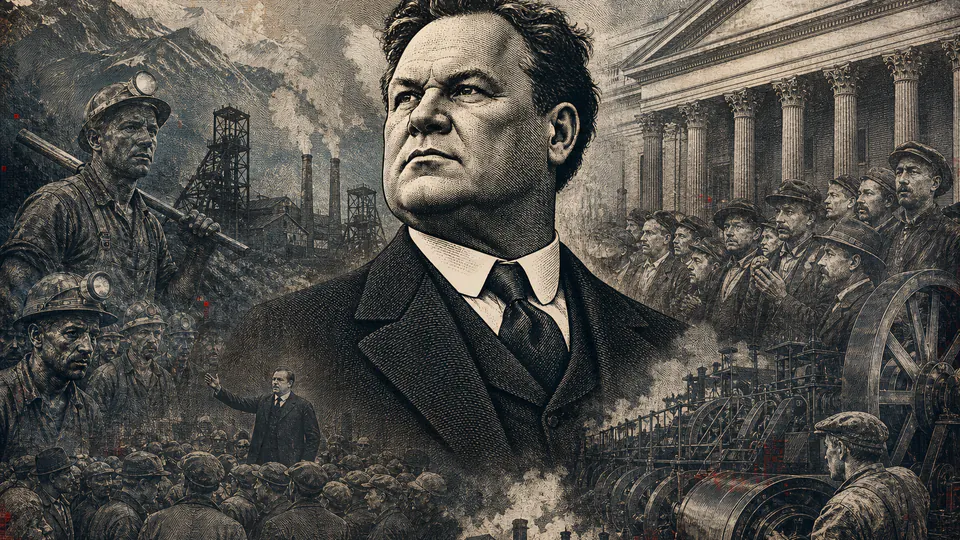
The story
#storyOn the morning of June 27, 1905, William D. Haywood stood at the podium of Brand’s Hall in Chicago and called roughly two hundred delegates to order. Haywood was thirty-six, blind in one eye, and already known nationally as the secretary-treasurer of the Western Federation of Miners. What he said next named the union that was about to be born:
This is the Continental Congress of the working class. We are here to confederate the workers of this country into a working class movement that shall have for its purpose the emancipation of the working class from the slave bondage of capitalism.
The union born that week was the Industrial Workers of the World, still nicknamed the Wobblies. Haywood chaired its founding convention, beat a murder charge two years later, became its most recognized face through the First World War, and died in a Moscow hospital in 1928 with half his ashes bound for the Kremlin Wall.
Salt Lake City to the miners’ union
Haywood was born on February 4, 1869, in Salt Lake City. His father, a former Pony Express rider, died of pneumonia when Haywood was three, and at nine he blinded himself in one eye whittling a slingshot, the detail every newspaper profile of him mentioned later. He was working underground within a few years and stayed a miner into his twenties, moving through mining camps in Nevada, Utah, and Idaho.
He joined the Western Federation of Miners in the 1890s and rose fast: a seat on its general executive board by 1900, then secretary-treasurer, the union’s second-ranking office, in 1902. The job put him at the center of the Colorado Labor Wars of 1903 and 1904, when the WFM’s strikes against the Cripple Creek district’s mine owners turned into gun battles and bombings that killed dozens of people on both sides. Haywood came out of it certain that craft unions, one for carpenters, another for machinists, another for miners, could never match an employer able to shut down an entire operation by replacing a single trade. His answer was one union for every worker in an industry, skilled or not: One Big Union.
The Continental Congress of the working class
The manifesto calling the Chicago convention had gone out five months earlier, over the signatures of Haywood and roughly thirty other radicals and union officers, Eugene Debs and Mother Jones among them, who considered the American Federation of Labor’s craft unionism a dead end. Debs rose to address the delegates two days into the proceedings, arguing for one union that could out-organize the AFL by refusing to split workers by trade. Lucy Parsons, widow of the Haymarket anarchist Albert Parsons, also spoke, warning the delegates in terms drawn from the other side’s own organizing:
Let us take example from them. We see the capitalist class fortifying themselves today behind their Citizens’ Associations and Employers’ Associations in order that they may crush the American labor movement.
Out of eleven days of argument came the Industrial Workers of the World, and Haywood spent most of the rest of his working life inside it.
A murder charge built on one man’s word
On December 30, 1905, a bomb wired to the gate of Frank Steunenberg’s home on Dearborn Street in Caldwell, Idaho killed the former governor instantly. Steunenberg had declared martial law and called in federal troops against the WFM in 1899, after miners destroyed the Bunker Hill company’s mill at Wardner, and the union had not forgiven him. A hired bomber using the name Harry Orchard (his real name was Albert Horsley) was caught with the bomb-making evidence, and under questioning from Pinkerton detective James McParland he signed a long confession naming Haywood, WFM president Charles Moyer, and Haywood’s friend George Pettibone as the men who had ordered the killing.
Idaho did not wait on ordinary extradition. Haywood, Moyer, and Pettibone had never left Colorado while the killing was planned, but Idaho law treated conspirators as legally present at the crime scene regardless. On that theory, the three were arrested in Denver on secretly issued Idaho warrants on February 17, 1906, and put on a special train to Boise under armed guard before their own lawyers knew they were gone. Their challenge to the maneuver reached the U.S. Supreme Court.
The trial opened in Boise on May 9, 1907, with Clarence Darrow defending Haywood and an Idaho lawyer named William Borah, later a long-serving U.S. senator, prosecuting. The state’s case was Orchard’s word alone, and Darrow spent weeks establishing that Orchard had drawn pay from the Mine Owners’ Association and the Pinkertons before he ever claimed to work for the WFM’s “inner circle.” When a second man whose statement was supposed to corroborate Orchard recanted it, the prosecution had nothing left standing. On July 28, 1907, the jury acquitted Haywood.
Recalled from the party, kept the union
Acquittal did not settle the movement’s arguments. The WFM cut ties with the IWW by 1908, and Haywood’s own formal role in the miners’ union ended that April. He stayed the IWW’s best-known organizer and won election to the Socialist Party’s National Executive Committee in 1912, the same year the party’s convention voted to expel any member who endorsed sabotage or crime as a tactic. Haywood would not disavow direct action on the shop floor, and in February 1913 the party recalled him from the committee. He kept the union.
Twenty years for opposing the war
The IWW’s wartime record made it a target. It would not endorse the draft or a no-strike pledge, and the government treated that refusal as sabotage of its own. By the time Joe Hill, the union’s best-known songwriter, faced a Utah firing squad on November 19, 1915, Haywood was the man he wired a goodbye to, as the IWW’s general secretary. On September 5, 1917, Justice Department agents raided 48 IWW halls across the country and arrested 165 members, an operation carried out with President Wilson’s approval.
Haywood and one hundred codefendants went on trial in Chicago in April 1918 before Judge Kenesaw Mountain Landis, in a case that ran five months, the longest federal criminal trial the country had yet seen. Haywood spent three days on the stand defending the union’s record. On August 17, 1918, the jury convicted all 101 defendants after 65 minutes of deliberation. Landis handed down the sentences two weeks later: fifteen men, Haywood among them, got the legal maximum of twenty years, thirty-three got ten, thirty-one got five, eighteen got lesser terms, and among the whole group the fines added up to more than two million dollars.
Bail, Moscow, and a coal colony that failed
An appeal to the Supreme Court failed. Rather than begin the twenty years, Haywood jumped the bond a Chicago backer had posted for him and, on March 31, 1921, sailed for Soviet Russia instead of Leavenworth. The Bolshevik government welcomed him as a symbol of the American labor movement. He reached Moscow that September as one of three organizers negotiating a deal to send foreign workers and machinery to Kuzbass, a coal and steel region in Siberia, and by July 1922 he was in Kemerovo himself, trying to run the colony day to day.
It went badly. He did not speak Russian; in 1926 he married a Russian woman who did not speak English. Visitors who saw him in those years described a man who was homesick and depressed. Time magazine’s obituary the week he died put the colony in one sentence: “They put him in charge of a mining enterprise at Kuznetsk, which he managed so badly that it failed.”
Dead in a Kremlin hospital, split in half
Haywood died on May 18, 1928, at 59, of a stroke, his health worn down by drinking and diabetes. Time’s obituary opened without ceremony: “In a small room of the Kremlin Hospital, Moscow, Big Bill Haywood died last week.” It closed by measuring the distance he had traveled from the man who once terrified American mine owners: “In Russia, Big Bill’s vast radicalism seemed faintly conservative; he was a prophet no longer and he became slowly almost without honor.”
The lawyer who had won his freedom in 1907 did not mourn him. Clarence Darrow’s reaction, printed in the same obituary: “I’m glad to hear he is dead … He was unhappy.”
His body was cremated. Half his ashes went into the Kremlin Wall in Moscow, one of only a handful of Americans buried there. The other half were shipped to Chicago and buried near the Haymarket Martyrs’ Monument, where four men hanged in 1887 already lay, in what is now Forest Home Cemetery.
The Industrial Workers of the World is still headquartered in Chicago today, organizing on the same premise Haywood read out at Brand’s Hall in 1905: one union, every worker, no craft lines. Half of the man who read it out loud is still in the Kremlin Wall.
In their own words
#wordsWhat Big Bill Haywood actually said, where, and when. Each one links to the page it was checked against.
-
I was back of the house trying to cut a handle from a scrub-oak, when the knife slipped and penetrated my eye. They sent me to Salt Lake immediately for medical attention, and for months I was kept in a dark room. But the sight was gone.
In his autobiography, on blinding his right eye whittling a slingshot near Ophir, Utah at nine years old. William D. Haywood, Bill Haywood's Book: The Autobiography of William D. Haywood (International Publishers, 1929) -
This is the Continental Congress of the working class. We are here to confederate the workers of this country into a working class movement that shall have for its purpose the emancipation of the working class from the slave bondage of capitalism.
Opening the founding convention of the Industrial Workers of the World, Brand's Hall, Chicago, June 27, 1905. Minutes of the First Convention of the Industrial Workers of the World (1905), Chapter 1 -
Yes, I felt toward him much as I did toward you and others who were responsible for martial law and the bull-pen in the Coeur d'Alenes.
Answering prosecutor William Borah's cross-examination question about his feelings toward Governor Steunenberg, on the witness stand at the Boise murder trial, 1907. William D. Haywood, Bill Haywood's Book: The Autobiography of William D. Haywood (International Publishers, 1929) -
All class conscious members of the Industrial Workers of the World are conscientiously opposed to spilling the life blood of human beings, not for religious reasons, as are the Quakers and Friendly Societies, but because we believe that the interests and welfare of the working class in all countries are identical.
Writing as the IWW's general secretary-treasurer in the union's monthly bulletin, April 1917, the month the United States entered World War I. William D. Haywood, Bill Haywood's Book: The Autobiography of William D. Haywood (International Publishers, 1929)
What people get wrong
#wrong- The myth
A jury convicted Big Bill Haywood of murdering Governor Frank Steunenberg. - The record
A Boise jury found him not guilty on July 28, 1907. Clarence Darrow's defense left the state with nothing but the word of Harry Orchard, the confessed assassin, uncorroborated once a second witness recanted.
- The myth
All of Big Bill Haywood's ashes are buried in the Kremlin Wall. - The record
Per his own request, his ashes were divided in two after his 1928 death: half went into the Kremlin Wall in Moscow, and half were sent to Chicago and buried in Waldheim, now Forest Home, Cemetery near the graves of the Haymarket martyrs.
- The myth
The IWW was founded as a Communist organization loyal to Moscow. - The record
The union's founding convention met in Chicago in June 1905, twelve years before the Bolshevik Revolution of October 1917, and its preamble names no foreign government. Haywood's own turn toward Soviet Russia came only in 1921, after he jumped bail rather than serve a 1918 Espionage Act sentence.
The dates that matter
#dates- February 4, 1869 Born in Salt Lake City, Utah Territory; his father, a former Pony Express rider, dies of pneumonia when Haywood is three.
- 1878 Blinds his right eye whittling a slingshot at age nine and starts mine work not long after.
- 1902 Becomes secretary-treasurer of the Western Federation of Miners, the union's second-highest office.
- 1903-1904 The WFM's Colorado strikes turn violent; the Cripple Creek district's mine wars kill dozens on both sides.
- June 27, 1905 Calls the founding convention of the Industrial Workers of the World to order at Brand's Hall in Chicago.
- December 30, 1905 Former Idaho governor Frank Steunenberg is killed by a bomb at his Caldwell home; hired bomber Harry Orchard's confession names Haywood.
- February 17, 1906 Arrested in Denver on secretly issued Idaho warrants and taken to Boise by special train under armed guard.
- July 28, 1907 A jury acquits Haywood after Clarence Darrow's defense, ending the Steunenberg murder trial.
- 1912 Elected to the Socialist Party's National Executive Committee, the same year the party moves to expel members who endorse sabotage.
- February 1913 The Socialist Party recalls Haywood from its executive committee over his refusal to disavow direct action.
- September 5, 1917 Justice Department agents raid 48 IWW halls nationwide and arrest 165 members under the new Espionage Act.
- August 17, 1918 A Chicago jury convicts all 101 Espionage Act defendants after five months of trial; Judge Landis sentences Haywood to twenty years.
- March 31, 1921 Jumps bail and sails for Soviet Russia rather than begin his sentence.
- May 18, 1928 Dies of a stroke in a Moscow hospital at 59; his ashes are later split between the Kremlin Wall and Chicago's Haymarket Martyrs' Monument.
Questions people ask
#faqsWho was Big Bill Haywood?
William Dudley Haywood (1869-1928) was an official of the Western Federation of Miners who chaired the 1905 founding convention of the Industrial Workers of the World in Chicago. He was acquitted of murder in 1907, convicted under the Espionage Act in 1918, and died in Moscow in 1928 after jumping bail for the Soviet Union.
Why was Big Bill Haywood put on trial for murder?
In 1907 he stood trial in Boise, Idaho for the assassination of former governor Frank Steunenberg, killed by a bomb at his Caldwell home in December 1905. The state's case rested on the confession of a hired bomber, Harry Orchard, who named Haywood as one of the men who ordered the killing. Clarence Darrow defended him, and the jury acquitted him on July 28, 1907, after the recantation of a second witness left Orchard uncorroborated.
What happened to Big Bill Haywood in the 1918 IWW trial?
Federal prosecutors charged Haywood and 100 other IWW members under the Espionage Act, arguing the union's wartime stance obstructed the draft. A Chicago jury convicted all 101 defendants on August 17, 1918, and Judge Kenesaw Mountain Landis sentenced Haywood to twenty years, the maximum the case allowed.
Why did Big Bill Haywood flee to Russia?
His appeal failed, and rather than begin a twenty-year federal sentence, he jumped bail on March 31, 1921 and sailed for Soviet Russia, where the Bolshevik government welcomed him as a symbol of the American labor movement.
How did Big Bill Haywood die, and where is he buried?
He died of a stroke in a Moscow hospital on May 18, 1928, at 59, after years spent trying to run a failing Soviet mining colony. His ashes were split in two: half were placed in the Kremlin Wall in Moscow, and half were sent to Chicago and buried near the Haymarket Martyrs' Monument.
The bookshelf
#bookshelfWhere to go next. Buy from an independent bookstore, or find it at your library for nothing.
-
Bill Haywood's Book: The Autobiography of William D. Haywood William D. Haywood, 1929 primary
His own account, finished by his publishers after he died in Moscow.
-
Roughneck: The Life and Times of Big Bill Haywood Peter Carlson, 1983 secondary
The standard biography, from the mining camps to the Kremlin Wall.
-
Big Trouble: A Murder in a Small Western Town Sets Off a Struggle for the Soul of America J. Anthony Lukas, 1997 secondary
The Steunenberg assassination and the Boise trial, at nearly nine hundred pages.
-
We Shall Be All: A History of the Industrial Workers of the World Melvyn Dubofsky, 1969 secondary
The archive-based history of the union Haywood chaired into being.
Wear it: Big Bill Haywood
#merchEvery design here links back to this page.

Sources
#sourcesPrimary sources
The documents themselves: laws, court opinions, speeches, letters, and the numbers from the agencies that count them.
- Minutes of the First Convention of the Industrial Workers of the World (1905), Chapter 1 (verbatim text of Haywood's opening address to the convention)
- Eugene V. Debs, Speech at the Founding Convention of the IWW (June 29, 1905)
- "Radicals: Death of Haywood," Time (1928) (contemporary obituary; source of the Darrow quote and the Kuznetsk line)
- William D. Haywood, Bill Haywood's Book: The Autobiography of William D. Haywood (International Publishers, 1929)
Secondary sources
Written afterward, about the story.
- "The Legacy of the IWW," International Socialist Review, Issue 86 (on Lucy Parsons and other founding-convention speakers)
- Douglas O. Linder, "The Trial of William 'Big Bill' Haywood: The Verdict," Famous Trials, University of Missouri-Kansas City School of Law
- Wikipedia, "Bill Haywood"
- Wikipedia, "Kuzbass Autonomous Industrial Colony"
- Wikipedia, "Frank Steunenberg"