Published
Eugene V. Debs
Eugene Debs: The Man Who Ran for President From Prison
Born November 5, 1855. Died October 20, 1926
Who Eugene Debs was, why a speech in Canton, Ohio put him in an Atlanta cell under the Espionage Act, and how he won 913,693 votes for president from inside it.
The story
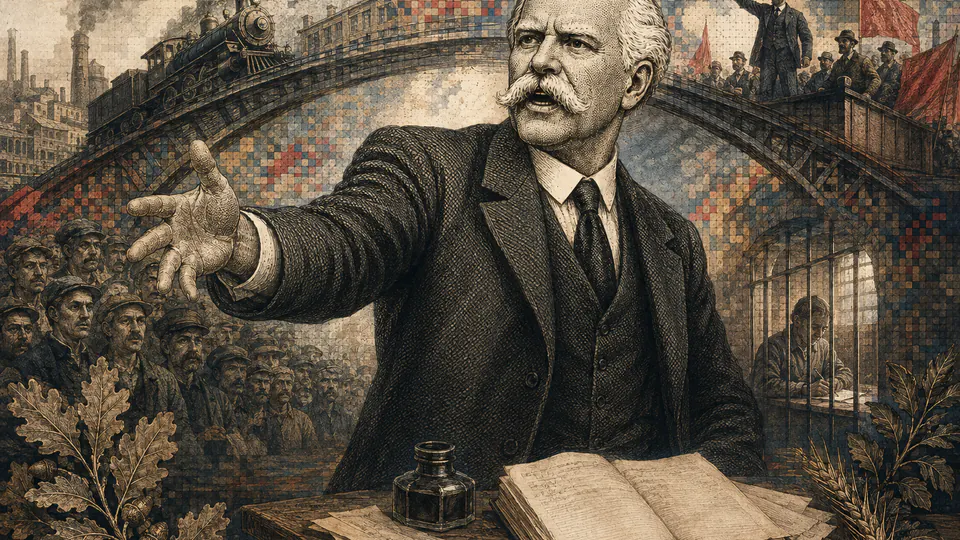
#storyIn 1920, the Socialist Party’s candidate for president of the United States was federal prisoner number 9653, and he won 913,693 votes without leaving the Atlanta Federal Penitentiary. His campaign buttons read “For President: Convict No. 9653.” The government allowed him one 500-word statement to the press per week, so he campaigned in 500-word installments. Eugene Victor Debs was sixty-five years old, serving ten years for a speech.
Nobody else in American history has done this. To understand how a railroad fireman from Terre Haute, Indiana got there, you have to start with the trains.
Terre Haute and the railroad
Debs was born on November 5, 1855, the son of French immigrants who ran a small grocery. He left school at fourteen and went to work for the Vandalia Railroad, scraping paint off railcars, and moved up to locomotive fireman, the man who shovels coal into the firebox. In 1875 he helped charter the Terre Haute lodge of the Brotherhood of Locomotive Firemen, and by 1880 he was the national union’s secretary-treasurer and the editor of its magazine.
The young Debs was respectable. He served as Terre Haute’s city clerk, and in 1885 he sat one term in the Indiana legislature as a Democrat, an experience that soured him on the statehouse for good. The brotherhoods of that era were craft unions: the firemen had one, the engineers another, the brakemen a third, and the railroads beat them one craft at a time.
Debs drew the obvious conclusion, which no one had yet organized. In June 1893 he founded the American Railway Union, one big union for every railroad worker regardless of craft. Within a year it had won its first fight, an eighteen-day strike against James J. Hill’s Great Northern Railway in April 1894, and workers were joining by the thousand.
Pullman, 1894
The town of Pullman, Illinois was owned whole by the Pullman Palace Car Company: the houses, the church, the shops, the water. Through the depression winter of 1893-94 the company cut wages roughly a quarter while holding the rents it charged those same workers exactly where they were. In May 1894 the Pullman workers walked out, and in June the ARU’s convention voted, over Debs’s own caution, to refuse to handle any train pulling a Pullman car.
The boycott stopped roughly 250,000 workers across 27 states, and it stopped the mail with them, which gave Washington its opening. Attorney General Richard Olney, a former railroad lawyer who still sat on railroad boards, obtained a sweeping federal injunction on July 2. President Cleveland sent the Army into Chicago over the loud objection of Illinois governor John Peter Altgeld. Around thirty people were killed in the violence that followed nationwide, the boycott broke, and Debs and the ARU’s officers went to jail for contempt of the injunction: six months for Debs, in Woodstock, Illinois.
What he read in Woodstock jail
Debs went into Woodstock a union man and came out something else, though he was honest that the change took years to finish. Sympathizers mailed him books, and Victor Berger, the Milwaukee socialist, came to the jail in person and left him a set of Marx’s Capital, a visit Debs later credited with delivering “the first impassioned message of Socialism I had ever heard.” Writing in 1902 about the boycott’s collapse, Debs put the lesson in one sentence:
In the gleam of every bayonet and the flash of every rifle the class struggle was revealed.
By 1897 he was calling himself a socialist in public. He helped found the Social Democratic Party in 1898 and, through a merger in 1901, the Socialist Party of America, the party of the rose that the American left still wears.
Five campaigns
Debs ran for president in 1900, 1904, 1908 (barnstorming the country aboard a chartered train his campaign called the Red Special), 1912, and 1920. The 1912 run was the high-water mark of American socialism at the ballot box: 901,551 votes, about six percent, in the four-way race Woodrow Wilson won. In those years the party held over a thousand elected offices across the country, from Milwaukee’s city hall to the Oklahoma statehouse.
He was the opposite of a machine politician. He turned down the 1916 nomination and ran for a House seat from Indiana instead, and lost. What he could do, better than anyone alive, was speak. People who heard him described a tall, balding man who leaned out over the crowd and pointed at individual faces. What he said next is why his story turns.
Canton, Ohio, June 16, 1918
The United States entered World War I in April 1917, and the Socialist Party declared its opposition the same month. Congress passed the Espionage Act that June, and by 1918 socialists were already in prison for saying the war was a rich man’s war. On June 16, 1918, Debs spoke for two hours to about 1,200 people at the Ohio Socialist convention in Canton’s Nimisilla Park, directly across from the workhouse where three of those convicted socialists were held. He had just visited them, and he knew federal agents were in the crowd taking notes. He gave the speech anyway:
The master class has always declared the wars; the subject class has always fought the battles. The master class has had all to gain and nothing to lose, while the subject class has had nothing to gain and all to lose,especially their lives.
Two weeks later he was arrested in Cleveland. At his trial that September he offered no real defense; the speech said what he meant. On September 18, 1918, before sentencing, he gave the statement American radicals have quoted at their own trials ever since:
Your Honor, years ago I recognized my kinship with all living beings, and I made up my mind that I was not one bit better than the meanest on earth. I said then, and I say now, that while there is a lower class, I am in it, and while there is a criminal element I am of it, and while there is a soul in prison, I am not free.
The sentence was ten years. In March 1919 the Supreme Court upheld it without a single dissent, in Debs v. United States, written by Oliver Wendell Holmes. That November, in Abrams v. United States, Holmes himself began dissenting toward the broader speech protection American courts use today, too late to do Debs any good.
Convict No. 9653
Debs entered the state prison at Moundsville, West Virginia in April 1919 and was transferred to the Atlanta Federal Penitentiary that June. The Socialist Party nominated him for president a fourth consecutive time in 1920, and a delegation held the notification ceremony inside the prison. Campaigning at the rate of 500 words a week, he drew 913,693 votes on November 2, 1920, while women voted for president for the first time and Warren Harding won in a landslide.
Woodrow Wilson, whose administration had prosecuted him, blocked every clemency recommendation that reached his desk. His own secretary, Joseph Tumulty, recorded Wilson’s verdict: “This man was a traitor to his country and he will never be pardoned during my administration.”
Christmas 1921
Harding thought otherwise, and on December 23, 1921 he commuted the sentence to time served, effective Christmas Day. As Debs walked out of Atlanta on December 25, the warden opened the cell house doors, and by Ray Ginger’s account in The Bending Cross, some 2,300 prisoners pressed against the front windows of the penitentiary and roared for him while Debs stood in the road, hat raised, tears on his face. The next day he stopped at the White House at Harding’s invitation. By the accounts of the meeting, Harding greeted him with, “Well, I’ve heard so damned much about you, Mr. Debs, that I am now glad to meet you personally.”
Prison had wrecked him. He spent much of his last five years in and out of the Lindlahr Sanitarium in Elmhurst, Illinois, where he died of heart failure on October 20, 1926, at seventy. Congress had stripped his citizenship with the conviction; it was restored posthumously in 1976, fifty years after his death.
Why he still gets quoted
Debs lost every race he ran for president and the union he built was crushed inside two years. What survived was the example: an American who said exactly what he believed with the prosecutors in the room, took the ten years, and polled nearly a million votes from a cell. His Terre Haute house is a museum now, run by the Eugene V. Debs Foundation. Bernie Sanders produced a half-hour documentary about him in 1979 and has kept a portrait of him on the office wall through every job since. When someone on the left says there is a soul in prison, they are quoting a man who meant it from inside one.
In their own words
#wordsWhat Eugene V. Debs actually said, where, and when. Each one links to the page it was checked against.
-
I am not disposed to shrink from the fullest responsibility for my acts. I have had time for meditation and reflection and I have no hesitancy in declaring that under the same circumstances I would pursue precisely the same policy. So far as my acts are concerned, I have neither apology nor regrets.
Battery D armory, Chicago, November 22, 1895, in a speech marking his release from six months in the Woodstock, Illinois jail after the Pullman boycott. Eugene V. Debs, "Liberty: Speech at Battery D, Chicago, On Release from Woodstock Jail" (November 22, 1895) -
I would rather a thousand times be a free soul in jail than to be a sycophant and coward in the streets.
Canton, Ohio, June 16, 1918, the speech that led to his Espionage Act conviction. Eugene V. Debs, "The Canton, Ohio, Speech" (June 16, 1918) -
When I rise it will be with the ranks, and not from the ranks.
Canton, Ohio, June 16, 1918, later in the same speech. Eugene V. Debs, "The Canton, Ohio, Speech" (June 16, 1918) -
I am opposing a social order in which it is possible for one man who does absolutely nothing that is useful to amass a fortune of hundreds of millions of dollars, while millions of men and women who work all the days of their lives secure barely enough for a wretched existence.
Before a federal court in Cleveland, Ohio, September 18, 1918, in his statement before being sentenced to ten years under the Espionage Act. Eugene V. Debs, "Statement to the Court" (September 18, 1918) -
I can see the dawn of the better day for humanity. The people are awakening. In due time they will and must come to their own.
The same September 18, 1918 statement to the court, near its close. Eugene V. Debs, "Statement to the Court" (September 18, 1918)
What people get wrong
#wrong- The myth
Debs wanted to overthrow the government through violent revolution. - The record
In his September 18, 1918 statement to the court, Debs said he wanted a fundamental change in the social order and wanted it brought about by peaceable and orderly means. He ran for president five times in open elections and never organized an armed uprising.
- The myth
Debs was convicted under the Espionage Act, so he must have been spying for Germany. - The record
The charge rested on one speech, delivered in Canton, Ohio on June 16, 1918. The Supreme Court's unanimous opinion in Debs v. United States asked only whether his words tended to obstruct military recruiting and enlistment. Prosecutors never alleged contact with a foreign government.
- The myth
Debs was a lifelong radical, a socialist from the start. - The record
By his own account he knew practically nothing about socialism through his twenties and thirties, when he served as a union magazine editor, Terre Haute's city clerk, and a one-term Democratic state legislator. He dated his turn toward socialism to the six months he spent in the Woodstock, Illinois jail after the 1894 Pullman boycott collapsed.
The dates that matter
#dates- November 5, 1855 Born in Terre Haute, Indiana, to French immigrant parents.
- 1869 Leaves school at fourteen to scrape paint off railcars for the Vandalia Railroad; later becomes a locomotive fireman.
- 1875 Charter member of the Terre Haute lodge of the Brotherhood of Locomotive Firemen; by 1880 he is its national secretary-treasurer and magazine editor.
- June 1893 Founds the American Railway Union, one of the first industrial unions in the country, open to all white railroad workers regardless of craft.
- April 1894 The ARU beats James J. Hill's Great Northern Railway in an eighteen-day strike, its first major victory.
- June 26, 1894 The ARU boycott of Pullman cars begins; roughly 250,000 workers across 27 states stop the trains.
- 1895 Serves six months in the Woodstock, Illinois jail for contempt of the federal injunction that broke the boycott.
- 1900 First presidential run as a socialist. He runs again in 1904, 1908, and 1912, when he wins 901,551 votes, about six percent.
- June 16, 1918 Delivers the anti-war speech in Canton, Ohio that leads to his arrest under the Espionage Act two weeks later.
- September 1918 Convicted and sentenced to ten years; tells the court that while there is a soul in prison, he is not free.
- November 2, 1920 Wins 913,693 votes for president from a cell in the Atlanta Federal Penitentiary.
- December 25, 1921 Released after President Harding commutes the sentence to time served; meets Harding at the White House the next day.
- October 20, 1926 Dies at the Lindlahr Sanitarium in Elmhurst, Illinois.
Questions people ask
#faqsWho was Eugene Debs?
Eugene Victor Debs (1855-1926) was an Indiana railroad worker who became the most famous labor organizer and socialist in American history. He founded the American Railway Union, led the 1894 Pullman boycott, helped found the Socialist Party of America, and was its presidential candidate in 1900, 1904, 1908, 1912, and 1920.
Why was Eugene Debs imprisoned?
Twice. In 1895 he served six months in Woodstock, Illinois for defying a federal injunction during the Pullman boycott. In 1918 he was sentenced to ten years under the Espionage Act for a speech in Canton, Ohio urging resistance to the World War I draft. The Supreme Court upheld the conviction unanimously in Debs v. United States (1919).
Did Eugene Debs really run for president from prison?
Yes. In 1920 he campaigned as Convict No. 9653 from the Atlanta Federal Penitentiary, where the government allowed him one 500-word statement to the press each week. He received 913,693 votes, about 3.4 percent of the national total.
What did Eugene Debs believe?
Industrial unionism (one union for all workers in an industry, skilled and unskilled together), public ownership of railroads and major industries, and a working class that votes as a class. He opposed American entry into World War I, which is the belief that put him in prison.
How did Eugene Debs die?
His health collapsed in prison and never recovered. He died of heart failure at the Lindlahr Sanitarium in Elmhurst, Illinois on October 20, 1926, at age 70.
The bookshelf
#bookshelfWhere to go next. Buy from an independent bookstore, or find it at your library for nothing.
-
Walls and Bars Eugene V. Debs, 1927 primary
His own account of American prisons, from what he saw in Woodstock, Moundsville, and Atlanta.
-
The Bending Cross: A Biography of Eugene Victor Debs Ray Ginger, 1949 secondary
The standard biography and the source for the scene of his release from Atlanta.
-
Eugene V. Debs: A Graphic Biography Paul Buhle, Steve Max, and Noah Van Sciver, 2019 secondary
The whole life in comics form, dates intact.
Wear it: Eugene V. Debs
#merchEvery design here links back to this page.

Sources
#sourcesPrimary sources
The documents themselves: laws, court opinions, speeches, letters, and the numbers from the agencies that count them.
- Eugene V. Debs, "The Canton, Ohio, Speech" (June 16, 1918) (full text of the speech that led to his arrest)
- Eugene V. Debs, "Statement to the Court" (September 18, 1918) (the sentencing statement, verbatim)
- Eugene V. Debs, "How I Became a Socialist," The Comrade (April 1902) (Debs's own account of Woodstock)
- Debs v. United States, 249 U.S. 211 (1919) (the unanimous opinion by Justice Holmes)
- Joseph P. Tumulty, Woodrow Wilson As I Know Him (1921) (source of Wilson's remark refusing a pardon)
- Eugene V. Debs, "Liberty: Speech at Battery D, Chicago, On Release from Woodstock Jail" (November 22, 1895)
- Eugene V. Debs, "How I Became a Socialist," The Comrade (April 1902)
Secondary sources
Written afterward, about the story.
- Britannica, "Eugene V. Debs"
- PBS American Experience, "Eugene Debs"
- AFL-CIO, "Eugene V. Debs"
- Ray Ginger, The Bending Cross: A Biography of Eugene Victor Debs (Rutgers University Press, 1949) (the standard biography; source for the release scene at Atlanta)
- Eugene V. Debs Foundation, Terre Haute (Debs's house, now a museum and National Historic Landmark)
- The First Amendment Encyclopedia, "Debs v. United States (1919)"