Published
Howard Zinn
Howard Zinn and the History the Textbooks Wouldn't Print
Born August 24, 1922. Died January 27, 2010
Howard Zinn flew bombing runs over France, got fired by Spelman College for backing the sit-ins, and rewrote American history from the bottom up in 1980.
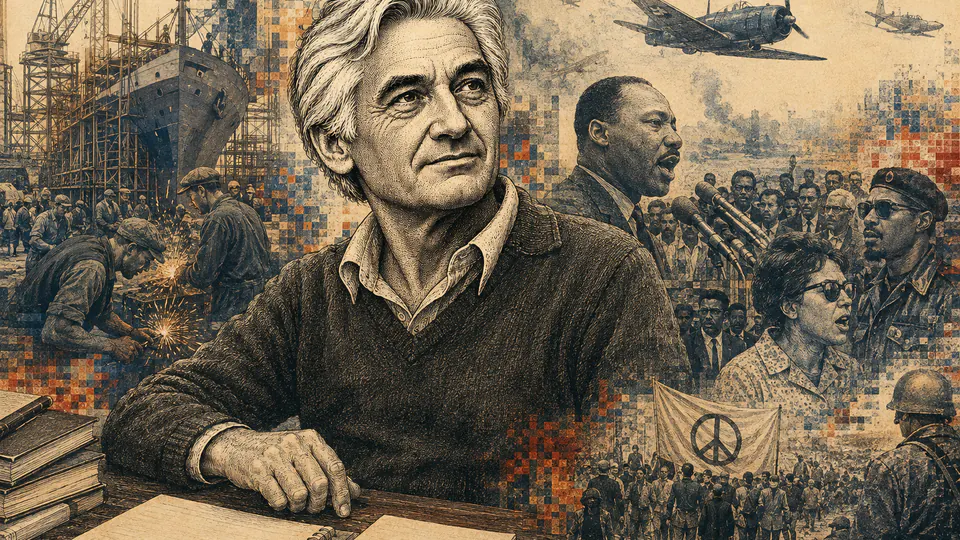
The story
#storyThe letter Spelman College sent Howard Zinn in June 1963 gave no reason. It read only that the college had decided his services would not be required for the 1963-1964 academic year, though Zinn chaired the history department and was five years into a tenured contract. He had spent seven years at Spelman backing students who sat in at Atlanta lunch counters, and he was an adult adviser to the Student Nonviolent Coordinating Committee. Forty-two years later the same college gave him an honorary degree and had him deliver its commencement address. In between, Zinn flew bombing runs over France, wrote a bestselling history book a sitting governor later tried to get out of his state’s schools, and kept finding the documents the official record left out, including, eventually, the ones about his own firing.
Brooklyn to the Navy Yard
Zinn was born in Brooklyn, New York, on August 24, 1922, the son of Jewish immigrants. His father worked factory jobs, dug ditches, washed windows, and eventually ran a candy store to keep the family fed. Zinn finished at Thomas Jefferson High School and in 1940, at eighteen, apprenticed as a ship fitter at the Brooklyn Navy Yard. In a 2008 oral history interview, he remembered exactly where the union stopped: the skilled tradesmen, who alone could join, looked at the apprentices doing the yard’s dirtiest and most dangerous work, split further by race, and said, in Zinn’s retelling, “We’re the skilled workers who belong to the union. These are the unwashed, unskilled, interlopers.” He earned fourteen dollars a week and gave ten of it to his parents. He organized the apprentices into their own association instead, his first organizing, and later called it the most rewarding part of a job that was, by his own account, “not a satisfying experience.” He also watched a coworker crushed to death when a bulkhead door closed on him, one more fact of the union shop the yard did not put on a recruiting poster.
A napalm raid, and the paperwork after
In 1943 Zinn left the Navy Yard for the Army Air Forces and trained as a bombardier, the crewman who aims and releases the bombs from a B-17’s Plexiglas nose. He married Roslyn Shechter, whom he called Roz, that October, then flew combat missions over Europe. His last one, in mid-April 1945, about three weeks before Germany surrendered, sent his squadron over Royan, a French resort town on the Atlantic coast where a few thousand German troops sat out the war’s end in a coastal pocket the Allies had otherwise bypassed. The bombers carried canisters of jellied gasoline, napalm, used on a European target for the first time. Zinn’s biographer, Dave Zirin, puts the toll at 3,000 civilians against 23 German soldiers killed, a lopsided ratio whose precise count historians still dispute.
Zinn did not ask why at the time. Twenty-two years later, in 1967, he and Roz drove from Paris to the rebuilt town, interviewed survivors, and read the paperwork himself:
We found an additional motive for that senseless slaughter , the need of both the French and the American military for one more victory before the war ended.
He wrote that in his 1994 memoir, You Can’t Be Neutral on a Moving Train, by which point he had spent decades making a habit of exactly this: checking the file, then printing what it actually said. Elsewhere in the same book he described mustering out and packing his Air Medal, his ribbons, and his old navigation logs into a folder. Without thinking, he wrote two words on it: “Never again.”
The seven years that got him fired
Zinn joined Spelman College in Atlanta in 1956 as chair of its history and social sciences department, teaching at the historically Black women’s college through the years the Civil Rights Movement built its Southern base. His students included Marian Wright Edelman, later founder of the Children’s Defense Fund, and the young Alice Walker. He advised the group alongside Ella Baker, tipped off reporters ahead of student sit-ins, and let students meet in his living room.
The letter came anyway. Zinn had earned what employment law calls de facto tenure, and no misconduct sat on his record; the American Association of University Professors took up his case and agreed the college had violated its own rules, but the inquiry stalled and Zinn never got his job back. He moved to Boston University the following year and taught political science until he retired in 1988, leaving his last class early to join a nursing school picket line. At Boston University he found a second version of the same fight: university president John Silber called him an example of the professors who would “poison the well of academe,” and when the campus struck in 1979, Zinn stayed on the picket line side of the door.
Spelman did not apologize, exactly. In 2005, forty-two years after firing him, the college’s faculty and trustees voted to invite Zinn back, and on May 15 he received an honorary doctor of humane letters and delivered the commencement address.
The people’s history
Zinn spent the years between activism writing: a first history of SNCC in 1964, a case against the Vietnam War in 1967, and, in January 1968, during the Tet Offensive, a trip to Hanoi with the Jesuit priest Daniel Berrigan to receive three American airmen, the first US prisoners of war North Vietnam released. Then, in 1980, came the book that outlasted all of it. A People’s History of the United States opened with an argument about method, not a chronology:
I prefer to try to tell the story of the discovery of America from the viewpoint of the Arawaks, of the Constitution from the standpoint of the slaves, of Andrew Jackson as seen by the Cherokees … of the rise of industrialism as seen by the young women in the Lowell textile mills … of the Second World War as seen by pacifists, the New Deal as seen by blacks in Harlem.
Harper and Row published it as a footnoted history book for general readers, and it became a classroom fixture anyway. A 2004 documentary about Zinn’s life, narrated by Matt Damon, borrowed its title from a line Zinn used on his students for decades: you can’t be neutral on a moving train. By its publisher’s count, A People’s History has sold more than four million copies since.
The book they tried to pull after he died
Zinn died of a heart attack in a swimming pool in Santa Monica, California, on January 27, 2010, at eighty-seven. Less than two weeks later, on February 9, 2010, Indiana Governor Mitch Daniels emailed his state’s top education officials with a request. “This terrible anti-American academic has finally passed away,” Daniels wrote, calling A People’s History “a truly execrable, anti-factual piece of disinformation that misstates American history on every page,” and asking, “Can someone assure me that it is not in use anywhere in Indiana? If it is, how do we get rid of it before more young people are force-fed a totally false version of our history?” The emails went to state superintendent Tony Bennett and stayed private for three years, until the Associated Press pried them loose in July 2013, turning an attempted book ban into public record itself.
Zinn spent his career arguing that the documents historians get to keep usually survive because someone with power wanted them kept. Daniels’s emails survived because Indiana’s records law made them survive, over his own evident preference, which is the exact kind of paperwork accident Zinn spent a lifetime tracking down.
In their own words
#wordsWhat Howard Zinn actually said, where, and when. Each one links to the page it was checked against.
-
We're the skilled workers who belong to the union. These are the unwashed, unskilled, interlopers.
Recalling, in a December 8, 2008 oral history interview, how the Brooklyn Navy Yard's skilled tradesmen described the apprentices, himself included, who were barred from their union. "Howard Zinn Describes Work in the Navy Yards," Brooklyn Navy Yard oral history interview by Daniella Romano (December 8, 2008) -
We found an additional motive for that senseless slaughter, the need of both the French and the American military for one more victory before the war ended.
You Can't Be Neutral on a Moving Train (1994), describing his 1967 return trip to Royan, France to research the napalm raid he had flown as a bombardier in 1945. Howard Zinn, "A Veteran Against War," excerpt from You Can't Be Neutral on a Moving Train (1994) -
I collected some photos, old navigation logs, and some other mementos, my Air Medal and ribbons with two battle stars, put them into a folder and without thinking wrote on the folder, "Never again."
You Can't Be Neutral on a Moving Train (1994), on mustering out of the Army Air Forces after his final combat mission. Howard Zinn, "A Veteran Against War," excerpt from You Can't Be Neutral on a Moving Train (1994) -
I prefer to try to tell the story of the discovery of America from the viewpoint of the Arawaks, of the Constitution from the standpoint of the slaves, of Andrew Jackson as seen by the Cherokees
The introduction to A People's History of the United States (1980), laying out the book's method. Howard Zinn, A People's History of the United States (Harper and Row, 1980), introduction
What people get wrong
#wrong- The myth
Howard Zinn refused to serve in World War II or was some kind of pacifist objector to the fight against Nazi Germany. - The record
He left the Brooklyn Navy Yard in 1943 to join the Army Air Forces and trained as a B-17 bombardier, flying combat missions over Europe through the spring of 1945. His skepticism about the war's methods, including the April 1945 napalm raid on Royan, came from a return visit and research trip he made in 1967, documented in his 1994 memoir, not from any wartime refusal to fight.
- The myth
Spelman College fired Zinn in 1963 for a specific documented offense, such as poor teaching or breaking a rule. - The record
The college's June 1963 letter, preserved in Zinn's papers, told him only that his services would not be required the following year; it names no cause. Zinn had de facto tenure, and the American Association of University Professors found Spelman had violated its own procedures, though the finding never got him reinstated.
- The myth
Governor Mitch Daniels succeeded in getting A People's History banned from Indiana public schools. - The record
Daniels's February 9, 2010 emails asked state education officials how to remove the book, but there is no record the state acted on the request, and the emails stayed out of public view for three years until the Associated Press obtained them through a public-records request in July 2013. The attempt became public knowledge only after it had already failed to produce a ban.
The dates that matter
#dates- August 24, 1922 Born in Brooklyn, New York, to Jewish immigrant parents; his father works factory jobs, ditch-digging, and window-washing to support the family.
- 1940 Becomes an apprentice ship fitter at the Brooklyn Navy Yard, where apprentices are barred from the union, and organizes an apprentices' association instead.
- 1943 Leaves the Navy Yard to join the Army Air Forces and trains as a B-17 bombardier.
- October 1944 Marries Roslyn Shechter.
- Mid-April 1945 Flies his final combat mission, the Allied napalm raid on Royan, France, about three weeks before Germany's surrender.
- 1956 Joins Spelman College in Atlanta as chair of the history and social sciences department.
- Early 1960s Is an adult adviser to the Student Nonviolent Coordinating Committee alongside Ella Baker and backs Spelman students' sit-ins.
- June 1963 Spelman College notifies Zinn by letter that his services will not be required the following year, ending his tenured position with no stated cause.
- 1964 Joins Boston University as a professor of political science.
- January 1968 Travels to Hanoi with Father Daniel Berrigan during the Tet Offensive to receive three American airmen, the first US prisoners of war North Vietnam released.
- 1980 Publishes A People's History of the United States.
- 1994 Publishes the memoir You Can't Be Neutral on a Moving Train.
- May 15, 2005 Delivers Spelman College's commencement address and receives an honorary degree, 42 years after his firing.
- January 27, 2010 Dies of a heart attack in a swimming pool in Santa Monica, California, at 87.
Questions people ask
#faqsWho was Howard Zinn?
Howard Zinn (1922-2010) was a historian, WWII veteran, and Civil Rights-era professor best known for A People's History of the United States (1980), which retold American history from the perspective of the people usually left out of it: the colonized, the enslaved, the working poor. He chaired the history department at Spelman College and later taught political science at Boston University, and was fired from the first for backing student activism.
Why was Howard Zinn fired from Spelman College?
In June 1963, Spelman's president wrote to Zinn, then chair of its history department, that his services would not be required the following year, despite Zinn being five years into a tenured contract. The letter gave no reason. Zinn had spent seven years supporting Spelman students' Civil Rights sit-ins and was an adult adviser to the Student Nonviolent Coordinating Committee. The college invited him back to deliver its commencement address in 2005.
What is A People's History of the United States about?
Published in 1980, it retells American history from the point of view of people usually left out of the textbook version: the Arawaks Columbus met, the enslaved people the Constitution counted as three-fifths of a person, the Cherokees Andrew Jackson removed, the young women who worked the Lowell textile mills. Zinn stated the method in his introduction: telling the story from the side of the people it happened to, not the side of the state. It has sold more than four million copies since.
Did Howard Zinn regret being a bombardier in World War II?
Yes. Zinn flew as a B-17 bombardier, including the April 1945 napalm raid on Royan, France, weeks before Germany's surrender. In his 1994 memoir he wrote that Royan, along with Hiroshima, was central to his rethinking of what he had once accepted without question. In 1967 he returned to Royan, interviewed survivors, and concluded the raid had served the military's need for one more victory before the war ended, not military necessity.
Why did Indiana try to remove Howard Zinn's book from schools?
In a February 9, 2010 email, less than two weeks after Zinn's death, Indiana Governor Mitch Daniels told state education officials that A People's History was a truly execrable, anti-factual piece of disinformation and asked how to get it out of Indiana classrooms. The emails stayed private until the Associated Press obtained them under a public-records request in 2013.
The bookshelf
#bookshelfWhere to go next. Buy from an independent bookstore, or find it at your library for nothing.
-
A People's History of the United States Howard Zinn, 1980 primary
The book itself: American history run through the people it usually leaves out, footnoted the whole way.
-
You Can't Be Neutral on a Moving Train: A Personal History of Our Times Howard Zinn, 1994 primary
His own memoir, Royan and Spelman and the picket lines included, in his own voice.
-
The People's Historian: The Outsized Life of Howard Zinn Dave Zirin, 2026 secondary
The newest biography, written with the family's cooperation and access to Zinn's papers; not yet listed on Open Library, so no ISBN here until it is.
Wear it: Howard Zinn
#merchEvery design here links back to this page.

Sources
#sourcesPrimary sources
The documents themselves: laws, court opinions, speeches, letters, and the numbers from the agencies that count them.
- Howard Zinn, "A Veteran Against War," excerpt from You Can't Be Neutral on a Moving Train (1994) (the Royan return-trip quote and the "Never again" folder)
- "Howard Zinn Describes Work in the Navy Yards," Brooklyn Navy Yard oral history interview by Daniella Romano (December 8, 2008)
- Howard Zinn, A People's History of the United States (Harper and Row, 1980), introduction (full text of the "viewpoint of the Arawaks" passage)
Secondary sources
Written afterward, about the story.
- "The Archive Speaks: Howard Zinn and the Spelman Dismissal," NYU Tamiment Library Special Collections (April 16, 2014) (the dismissal letter, quoted from Zinn's papers)
- Biography, Howard Zinn
- "Howard Zinn, A.A.U.P., and the Battle for Academic Freedom," AAUP Academe Blog (April 18, 2015) (the AAUP's de facto tenure finding)
- "Howard Zinn at Spelman: Hope," Facing South (2005)
- Dave Zirin, The People's Historian: The Outsized Life of Howard Zinn (Dutton, 2026), excerpted in Literary Hub (August 12, 2026) (the Royan casualty figure)
- The People's Historian, Penguin Random House (publisher's sales figure for A People's History)
- Daniel Berrigan, Wikipedia (the January 1968 Hanoi trip and the three released airmen)
- "E-mails Reveal that Mitch Daniels, as Governor, Tried to Ban Howard Zinn Book," Inside Higher Ed (July 16, 2013)
- "Former Indiana Gov. Mitch Daniels Sought To Ban Howard Zinn in Public Schools," Zinn Education Project (exact email date and recipient)