Published
Ella Baker
Ella Baker: "Strong People Don't Need Strong Leaders"
Born December 13, 1903. Died December 13, 1986
Ella Baker ran the NAACP's Southern branches, built the SCLC's Atlanta office from nothing, and convened the 1960 conference that founded SNCC.
The story
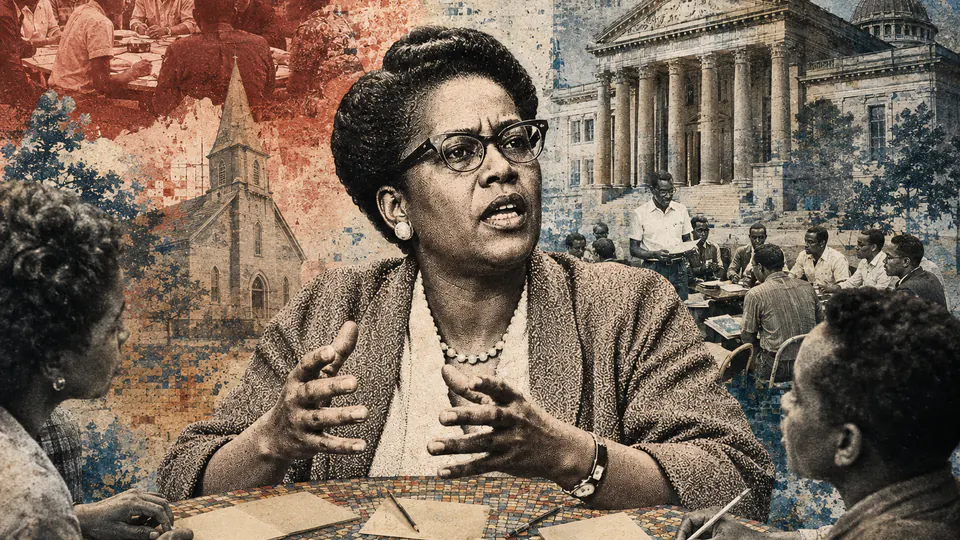
#story“Strong people don’t need strong leaders.” The line is everywhere online: posters, course syllabi, at least one nonprofit’s break room wall, credited to Ella Baker and nothing else. No date, no stage, no audience, and that part is accurate. Baker said it in an interview that researchers Ellen Cantarow and Susan Gushee O’Malley printed in their 1980 book, Moving the Mountain: Women Working for Social Change. It survives because two people wrote it down, not because a crowd heard her say it from a podium. The missing stage was not an accident.
Baker spent five decades building the organizations of the civil rights movement instead of leading them from the front. She organized for the NAACP through the 1940s, ran the Southern Christian Leadership Conference’s Atlanta office as its first paid staff member from 1957 to 1960, and then convened the Shaw University conference that founded the Student Nonviolent Coordinating Committee (SNCC) in April 1960. How one woman ends up present at the start of three of the era’s central organizations is a question about what she thought a leader was for, and that question is exactly where the sourcing of the quote points.
Before the movement had a name
Ella Josephine Baker was born December 13, 1903, in Norfolk, Virginia, and grew up in Littleton, North Carolina, in a family that had bought back part of the land her grandparents had worked as slaves. She graduated valedictorian from Shaw University in Raleigh in 1927 and moved to New York City, where a factory job was the best a Black woman with a college degree could get. She refused to go into teaching, the expected path, and threw herself into Harlem’s political life instead: editorial jobs at two Black newspapers between 1929 and 1932, and, during the Depression, national director of the Young Negroes’ Cooperative League, which set up buying clubs so poor Black families could pool their money for groceries. In November 1935, writing with Marvel Cooke for The Crisis (the magazine W. E. B. Du Bois had founded as the NAACP’s editorial voice), she published “The Bronx Slave Market,” an investigation into the corner where white housewives bid Black women down to a few cents an hour for a day’s domestic work. Baker had gone undercover as a domestic worker herself to get the material.
What the NAACP paid her to do
In 1941 the NAACP hired her as an assistant field secretary, sending her through Florida, Alabama, Georgia, and Virginia to organize new branches and membership drives. In 1943 she became the NAACP’s national director of branches, and almost immediately started criticizing the organization that employed her. She thought the national office had gone stale and too cautious, so focused on courtroom victories that its own membership of 400,000 people had almost no say in setting strategy. “Any branch which says it has nothing around which it can build a program,” she wrote in an internal 1942 memo, “is simply too lazy to concern itself with things on its own doorstep.” In 1944 she launched a series of regional leadership conferences to train local organizers instead of waiting on instructions from New York; one attendee was Rosa Parks, eleven years before she refused to give up her Montgomery bus seat. Baker left the national staff in 1946.
The SCLC’s whole office was her purse
In the mid-1950s Baker helped organize In Friendship with Bayard Rustin and Stanley Levison, a fundraising network that sent money south to activists facing economic retaliation, including leaders of the Montgomery bus boycott. That effort helped produce the Southern Christian Leadership Conference, founded in 1957 with Martin Luther King Jr. as president. Baker went south planning to stay a few weeks. She stayed two and a half years as the SCLC’s first paid staff member, and for a long stretch its only one; at the start, she used to say, the whole office was her purse and the nearest pay phone. She ran the voter registration drives that made up most of SCLC’s early program, working off contacts she had built over a decade of NAACP travel, while getting almost nowhere with her own ideas about where the organization should go. She wanted SCLC into the rural counties where Black people were not voting at all, and she wanted it to trust women and young people with real organizing work, not support roles. She was blunt about why she got neither: “I had known … that there would never be any role for me in a leadership capacity with SCLC. Why? First, I’m a woman. Also, I’m not a minister.”
Shaw University, Easter weekend 1960
When college students across the South began sitting down at segregated lunch counters in February 1960, Baker saw a wave of disconnected local protests and moved to give it a coordinating structure before the SCLC, the NAACP, or the Congress of Racial Equality (CORE) folded the students into their own chains of command. She persuaded the SCLC to put up $800, then sent invitations to student groups across the South. On April 15, 1960, about 150 student leaders from 10 states arrived at Shaw University in Raleigh, her own alma mater, for the Southwide Youth Leadership Conference on Nonviolent Resistance to Segregation. Each of the three adult organizations had come hoping to recruit the students into itself. Baker argued the opposite case, at one point walking out of an SCLC staff meeting where the strategy under discussion was folding the new group into SCLC, and by the end of the weekend the students had voted to stay independent, forming a temporary Student Nonviolent Coordinating Committee with an office in Atlanta and a newsletter called The Student Voice. Baker wrote up what she had heard for the Southern Patriot that June under the title “Bigger Than a Hamburger,” naming what she saw in the room:
This inclination toward group-centered leadership, rather than toward a leader-centered group pattern of organization, was refreshing indeed to those of the older group who bear the scars of the battle, the frustrations and the disillusionment that come when the prophetic leader turns out to have heavy feet of clay.
What group-centered leadership meant in practice
The phrase held for the rest of SNCC’s active life. The organization that grew out of Shaw went into rural counties in Mississippi and Alabama that older civil rights groups avoided, put women and teenagers in charge of local projects far more readily than those established organizations did, and deliberately kept individual organizers out of the press. “You’re organizing people to be self-sufficient,” Baker said, describing the method, “rather than to be dependent upon the charismatic leader.” She saw dependence on one visible leader as a structural risk, not a personal failing: ”… the charismatic leader usually becomes a leader because he has found a spot in the public limelight. It usually means that the media made him, and the media may undo him.” The men she organized alongside became household names. Baker, by her own design, did not.
Fundi
Baker resigned from the SCLC in 1960 to work as an adviser to SNCC, a role with no formal authority that let her keep asking the Socratic questions younger organizers remembered decades later, questions as plain as what is our purpose here and what are we trying to accomplish. She helped SNCC organize the Mississippi Freedom Democratic Party in 1964 and its challenge to the state’s all-white delegation at that year’s Democratic National Convention. Organizers who passed through her orbit, including Mary King and Casey Hayden, carried her methods into the era’s early feminist organizing. Along the way she picked up the nickname “Fundi,” Swahili for a person who passes a craft down to the next generation, later the title of Joanne Grant’s 1981 documentary about her life. Baker died in New York City on December 13, 1986, her 83rd birthday.
The quote on the posters is real. What usually goes missing is that Baker meant it as an operating instruction, not a slogan: build the organization so it outlasts you, and keep the cameras off any one face. She ran three organizations on that instruction and then declined to become the story of any of them, which is exactly why her most famous sentence turned up in an interview transcript instead of a monument.
In their own words
#wordsWhat Ella Baker actually said, where, and when. Each one links to the page it was checked against.
-
This inclination toward group-centered leadership, rather than toward a leader-centered group pattern of organization, was refreshing indeed to those of the older group who bear the scars of the battle, the frustrations and the disillusionment that come when the prophetic leader turns out to have heavy feet of clay.
From "Bigger Than a Hamburger," her own essay in the Southern Patriot on the April 1960 Shaw University conference, June 1960. Ella J. Baker, "Bigger Than a Hamburger," Southern Patriot, vol. 18 (June 1960) -
much bigger than a hamburger or even a giant-sized coke
Her description of what the 1960 student sit-ins were about, from "Bigger Than a Hamburger," June 1960. SNCC Digital Gateway, "Ella Baker", reproducing the "Bigger Than a Hamburger" essay -
strong people don't need strong leaders
From an interview printed in Ellen Cantarow and Susan Gushee O'Malley's book Moving the Mountain, 1980. SNCC Digital Gateway, "Ella Baker" -
Adult Freedom Fighters will be present for counsel and guidance, but the meeting will be youth centered.
From the call to the Southwide Youth Leadership Conference at Shaw University, which she co-signed with Martin Luther King Jr., spring 1960. SNCC Digital Gateway, "Founding of SNCC"
What people get wrong
#wrong- The myth
Strong people don't need strong leaders was a line from a famous Ella Baker speech. - The record
She said it in an interview, not from a podium. Charles Payne's 1989 essay in Signs traces the line to Ellen Cantarow and Susan Gushee O'Malley's Moving the Mountain: Women Working for Social Change, 1980, page 53.
- The myth
Ella Baker founded SNCC. - The record
She organized and funded the April 1960 Shaw University conference and pushed the students to build their own organization rather than join SCLC, the NAACP, or CORE. The roughly 150 students who arrived at Shaw on April 15 made that decision themselves before the weekend was out.
The dates that matter
#dates- December 13, 1903 Born in Norfolk, Virginia; raised in Littleton, North Carolina.
- 1927 Graduates valedictorian from Shaw University in Raleigh and moves to New York City.
- 1929-1932 Works on the editorial staffs of two Harlem newspapers and becomes national director of the Young Negroes' Cooperative League.
- November 1935 Publishes "The Bronx Slave Market" with Marvel Cooke in The Crisis, after going undercover as a domestic worker to document how white employers underpaid Black women.
- 1941 Hired by the NAACP as an assistant field secretary, organizing branches and membership drives across the South.
- 1943 Named the NAACP's national director of branches; launches regional leadership conferences the following year, one attended by Rosa Parks.
- 1946 Leaves the NAACP's national staff.
- mid-1950s Helps organize In Friendship with Bayard Rustin and Stanley Levison to fund Southern activists facing economic retaliation.
- 1957 Attends the founding of the SCLC and moves to Atlanta as its first paid staff member.
- April 15, 1960 Convenes the Southwide Youth Leadership Conference at Shaw University; about 150 students from 10 states found SNCC.
- June 1960 Publishes "Bigger Than a Hamburger" in the Southern Patriot, naming the group-centered leadership she saw at Shaw.
- 1960 Resigns from the SCLC to work as an adviser to SNCC.
- 1964 Helps organize the Mississippi Freedom Democratic Party and its challenge to the state's delegation at the Democratic National Convention.
- December 13, 1986 Dies in New York City, on her 83rd birthday.
Questions people ask
#faqsWho was Ella Baker?
Ella Josephine Baker (1903-1986) was a civil rights organizer who built organizations rather than led them from the front: NAACP field secretary and national director of branches in the 1940s, the Southern Christian Leadership Conference's first paid staff member from 1957 to 1960, and the person who convened the April 1960 Shaw University conference that founded the Student Nonviolent Coordinating Committee (SNCC).
Did Ella Baker found SNCC?
She convened it. Baker persuaded the SCLC to fund a conference of student sit-in leaders at Shaw University in Raleigh in April 1960, then argued that the students should form their own independent organization rather than become a wing of the SCLC, the NAACP, or CORE. About 150 students from 10 states were there when SNCC was founded that weekend.
What did Ella Baker mean by 'strong people don't need strong leaders'?
She meant that a movement built around one visible, charismatic leader is fragile, because, in her words, 'the media made him, and the media may undo him.' Her method, group-centered leadership, aimed to build the capacity to act into a community rather than into a single spokesperson. The line itself comes from an interview printed in a 1980 book, not a public speech.
What was Ella Baker's job at the NAACP?
She joined the NAACP as an assistant field secretary in 1941, traveling the South to organize branches and membership drives, and became the organization's national director of branches in 1943. She left the national staff in 1946 after growing critical of its caution and its distance from its own membership.
Why is Ella Baker called 'Fundi'?
Fundi is a Swahili word for someone who teaches a craft to the next generation, and it became Baker's nickname among the young organizers she trained. Joanne Grant used it as the title of her 1981 documentary Fundi: The Story of Ella Baker.
The bookshelf
#bookshelfWhere to go next. Buy from an independent bookstore, or find it at your library for nothing.
-
Moving the Mountain: Women Working for Social Change Ellen Cantarow and Susan Gushee O'Malley, 1980 primary
The book that printed the interview the "strong people don't need strong leaders" line comes from.
-
Ella Baker and the Black Freedom Movement: A Radical Democratic Vision Barbara Ransby, 2003 secondary
The standard biography, built on decades of interviews with Baker and the people who organized with her.
-
Ella Baker: Freedom Bound Joanne Grant, 1998 secondary
Written by an organizer who worked alongside Baker and later made the documentary Fundi.
Wear it: Ella Baker
#merchEvery design here links back to this page.
Sources
#sourcesPrimary sources
The documents themselves: laws, court opinions, speeches, letters, and the numbers from the agencies that count them.
- Ella J. Baker, "Bigger Than a Hamburger," Southern Patriot, vol. 18 (June 1960) (full text of the essay that names group-centered leadership)
Secondary sources
Written afterward, about the story.
- Charles Payne, "Ella Baker and Models of Social Change," Signs, vol. 14, no. 4 (Summer 1989) (peer-reviewed essay; its own footnotes trace the "strong people" line to Cantarow and O'Malley, 1980, p. 53)
- SNCC Digital Gateway, "Ella Baker"
- SNCC Digital Gateway, "Founding of SNCC"
- North Carolina Department of Natural and Cultural Resources, "SNCC's Raleigh Roots" (2016)
- NCpedia, "Baker, Ella"
- Encyclopedia.com, "Baker, Ella Jo"
- Wikipedia, "Ella Baker"
- Wikipedia, "Southern Christian Leadership Conference"