Published
Black Liberation
Black Liberation Is a History of Power, Not One Organization
Black liberation politics has joined abolition, self-defense, labor, voting, internationalism, culture, land, and community control in changing forms.
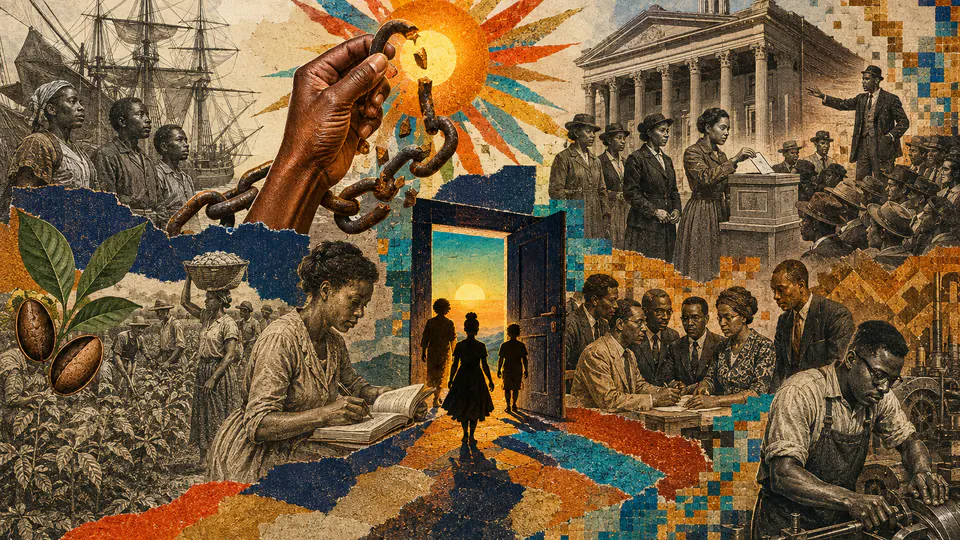
The story
#storyBlack liberation names the struggle to end systems that subordinate Black people and to build power over the institutions governing Black life. It is broader than the Black Power slogan of the 1960s and older than the modern civil-rights movement. No single party, leader, or tactic owns it.
Freedom required institutions
Before the Civil War, Black abolitionists organized conventions, newspapers, schools, churches, vigilance committees, and escape networks. Frederick Douglass argued through print and politics; Harriet Tubman carried people out and later worked for the Union Army. Reconstruction expanded Black voting, officeholding, and public education before white terror and federal retreat crushed much of the political order.
Civil rights and power
Twentieth-century organizations fought segregation and disfranchisement through litigation, labor, boycotts, migration, and mass protest. Malcolm X emphasized Black self-determination and international human rights. SNCC organizers moved toward Black Power after years facing local violence. The Black Panther Party joined armed self-defense rhetoric to breakfasts, health clinics, political education, and anti-police organizing.
The movements argued among themselves over integration, nationalism, socialism, capitalism, elections, nonviolence, gender, and sexuality. Those disagreements were politics, not proof that the tradition had no center.
Liberation kept expanding its own question
Black feminists including Claudia Jones and later the Combahee River Collective showed how a movement could reproduce domination inside itself if it ignored women, queer people, workers, or the poor. Environmental, housing, prison, and disability campaigns carried the question into new institutions.
The recurring test is control. Equal access to a harmful system may satisfy a narrow rule. Liberation asks who designed the system, who benefits from it, and what people could build instead.
That test produces concrete disputes. Community control of schools asks who selects curriculum and leadership. Self-defense asks whose violence the state recognizes as legitimate. Economic programs ask whether jobs provide income alone or a claim on the wealth and land a community produces. Internationalism asks why U.S. freedom should be separated from colonial rule abroad. Different organizations answered differently, and some answers failed. The shared contribution was to move discussion beyond better treatment by existing authorities toward Black capacity to set priorities and govern.
Liberation begins before an organization names it
Enslaved people escaped, rebelled, built family and religious life, and forced emancipation into the Civil War. Free Black communities created conventions, newspapers, schools, mutual-aid societies, and abolition networks. These institutions made freedom a collective practice rather than a gift from government.
After slavery, Black political participation during Reconstruction helped establish public schools and civil-rights law. White terror, disfranchisement, convict leasing, land theft, and national retreat attacked that power. The next generation inherited constitutional rights alongside institutions designed to prevent their use.
Black liberation is therefore broader than one era or ideology. It describes struggles for the capacity to live, organize, govern, work, learn, and defend community outside white domination.
Migration changed the geography of power
Millions of Black southerners moved to northern and western cities during the Great Migration. Leaving could escape a landlord or sheriff, but segregation followed through housing covenants, redlining, job discrimination, school boundaries, and police power.
Urban concentration also built voting blocs, union membership, newspapers, churches, business districts, and cultural institutions. Harlem, Chicago, Detroit, Los Angeles, Oakland, and other cities became bases for national organizing.
This dual process matters. Migration was neither simple escape nor proof that racism belonged only to the South. It rearranged the terrain on which Black residents could exercise economic and political bargaining power.
Civil rights law and Black power asked different scales of question
The mid-century civil-rights movement attacked segregation and disfranchisement through boycotts, direct action, litigation, voter registration, and federal legislation. The Civil Rights Act and Voting Rights Act removed major legal barriers and created enforcement tools.
Black Power organizers asked what formal access meant when wealth, police authority, land, schools, and business investment remained outside Black control. The slogan did not carry one program. SNCC organizers emphasized independent political power; nationalists developed cultural and economic programs; the Black Panther Party joined self-defense to community services and radical analysis.
These approaches overlapped with civil-rights work rather than replacing it on a single date. Many organizers moved between them as local conditions and government response changed.
Self-defense challenged the state’s account of violence
Nonviolent campaigns exposed state and mob violence while imposing discipline on participants. Other organizers maintained that Black communities had a right to armed self-defense, especially where police would not protect them.
Robert F. Williams in North Carolina, the Deacons for Defense, Malcolm X, and Panthers developed distinct positions. Self-defense could deter attack and assert dignity. It could also invite overwhelming repression or substitute the image of a weapon for the slower work of building accountable organization.
The debate cannot be resolved by treating one side as brave and the other as reckless. It asks who controls force, how a community decides its use, and why official violence is so often described as order.
Community programs were claims on public resources
Free breakfast, health clinics, liberation schools, tenant work, prisoner support, and food programs met immediate needs while making a political claim. People denied decent services could administer care and demand that public wealth support life rather than policing.
Such programs risked becoming substitutes for government or depending on exhausting unpaid labor. Their strongest form joined provision to organizing: a meal brought families together, a clinic documented neglect, and a school taught history needed for collective action.
Women carried much of this work and challenged male authority inside movements. Queer Black organizers also contested a liberation politics that reproduced gender and sexual hierarchy in the name of unity.
Repression targeted infrastructure as well as individuals
Federal, state, and local agencies surveilled, infiltrated, prosecuted, and disrupted Black organizations. COINTELPRO sought to exploit conflict, spread suspicion, and prevent durable coalitions. Police raids killed leaders including Fred Hampton and destroyed offices and records.
Organizations also made internal errors involving hierarchy, sexism, strategy, and accountability. State repression and internal failure can both be true. Treating every conflict as government invention denies organizers responsibility; ignoring documented repression accepts the state’s account of neutral law enforcement.
The destruction of infrastructure has effects beyond one arrest. A closed clinic, frightened donor, divided committee, or missing archive limits what the next campaign can inherit.
Internationalism changed the frame of citizenship
Black organizers connected U.S. racism to African and Caribbean anticolonial struggles, Asian liberation movements, and global human-rights forums. W. E. B. Du Bois, Claudia Jones, Malcolm X, SNCC activists, and Panthers developed different forms of this internationalism.
The global frame challenged the idea that U.S. authorities alone should judge U.S. freedom. It also brought difficult alliances with governments and movements whose own records required scrutiny.
Black liberation remains a field of debate over integration, autonomy, redistribution, abolition, electoral power, labor, culture, and care. The common measure is practical: whether Black people possess the organized power to determine the conditions of their own lives and whether that power expands freedom for those most exposed to domination.
What people get wrong
#wrong- The myth
Black Power meant reverse racism and violence against white people. - The record
SNCC's own digital archive describes Black Power, as Stokely Carmichael laid it out in his 1966 essay "What We Want," as a call for Black communities' economic and political self-determination through programs like the Lowndes County Freedom Organization and the Mississippi Freedom Labor Union. The "anti-white, violent" characterization came from politicians and reporters attacking SNCC, not from the program itself.
- The myth
Black Power began the moment Stokely Carmichael used the phrase during the 1966 Meredith March. - The record
SNCC's own account traces the underlying ideas, community control, economic self-determination, political education, to the organization's educational and cultural work as early as 1965, before Carmichael's 1966 speech popularized the slogan.
- The myth
Organized labor unions were natural allies to Black workers from the start. - The record
The National Archives documents that "trade unions organized by white workers generally excluded blacks": by 1930, only about 50,000 of 1.5 million Black workers in transportation, mining, and manufacturing belonged to a union, pushing Black workers to build separate organizations such as the 1869 Colored National Labor Union.
- The myth
The CIO excluded Black workers just as the AFL did. - The record
The Congress of Industrial Organizations, founded in 1935, explicitly organized industrial workers "regardless of race or ethnic background," a documented break from the AFL's practice of leaving the decision to exclude Black workers to individual member unions.
The dates that matter
#dates- 1830s Black conventions debate abolition, rights, education, migration, and independent institutions.
- 1865-1877 Reconstruction expands Black voting, officeholding, schools, and civic institutions.
- 1905 The Niagara Movement demands full civil and political rights.
- 1919 The New Negro movement and organized self-defense answer a year of racist violence.
- 1966 Black Power becomes a national slogan and the Black Panther Party forms.
- 1970s Black feminist organizations sharpen analysis of race, sex, class, and sexuality.
Questions people ask
#faqsWhat does Black liberation mean?
It means ending the political, economic, and social systems that subordinate Black people and building power over the institutions shaping Black life. Different movements disagree about strategy and end goals.
Is Black liberation the same as civil rights?
They overlap. Civil-rights work often emphasizes equal legal protection and access; liberation politics more often emphasizes power, self-determination, economic structure, and institutional control.
Was Black Power only about armed self-defense?
No. Black Power politics included electoral campaigns, community programs, labor, education, culture, land, international solidarity, institution building, and self-defense.
How should Black Liberation be evaluated?
Separate the immediate result from the institutions, tactics, exclusions, and enforcement record that followed it.
The bookshelf
#bookshelfWhere to go next. Buy from an independent bookstore, or find it at your library for nothing.
-
Black Power: The Politics of Liberation Kwame Ture (Stokely Carmichael) and Charles V. Hamilton, 1967 primary
The book-length statement of the politics behind the slogan, from the man who popularized it.
-
Women, Race & Class Angela Y. Davis, 1981 primary
A participant-scholar's own analysis of how liberation politics fractures when it ignores gender and class.
-
Race, Reform, and Rebellion: The Second Reconstruction and Beyond in Black America Manning Marable, 1984 secondary
The standard survey connecting Reconstruction, civil rights, and Black Power into one continuous struggle over power.
-
Waiting 'Til the Midnight Hour: A Narrative History of Black Power in America Peniel E. Joseph, 2006 secondary
Traces Black Power's roots earlier and its programs wider than the slogan's famous moment on the Meredith March.
Wear it: Black Liberation
#merchEvery design here links back to this page.
 Design proof
 Angela Davis Collage Tee
$36.00 Design proof
 Ella Baker Collage Tee
$36.00 Design proof
 Fred Hampton Collage Tee
$36.00 Design proof
 Malcolm X Collage Tee
$36.00 Design proof
 Paul Robeson Engraved Tee
$36.00 Design proof
 W. E. B. Du Bois Engraved Tee
$36.00 Design proof
 Audre Lorde Pixel Tee
$36.00 Design proof
 bell hooks Engraved Tee
$36.00 Design proof
 Bobby Seale Collage Tee
$36.00 Design proof
 Brad Lomax Pixel Tee
$36.00 Design proof
 Claudia Jones Collage Tee
$36.00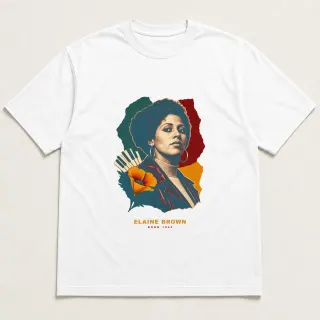 Design proof
 Elaine Brown Engraved Tee
$36.00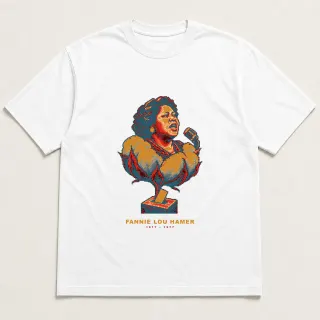 Design proof
 Fannie Lou Hamer Pixel Tee
$36.00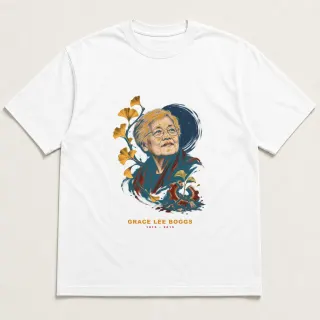 Design proof
 Grace Lee Boggs Engraved Tee
$36.00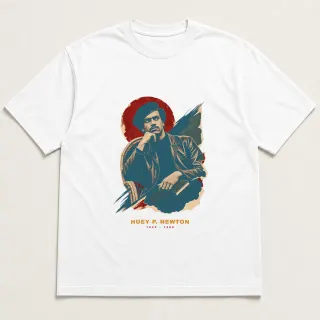 Design proof
 Huey P. Newton Collage Tee
$36.00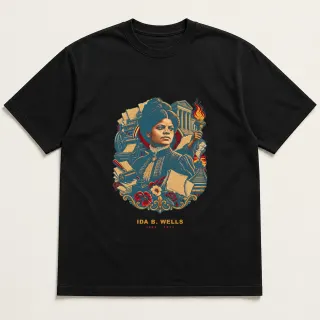 Design proof
 Ida B. Wells Pixel Tee
$36.00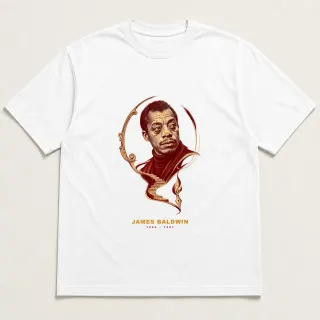 Design proof
 James Baldwin Engraved Tee
$36.00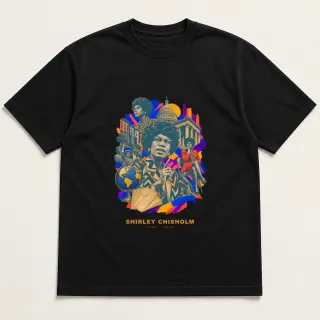 Design proof
 Shirley Chisholm Engraved Tee
$36.00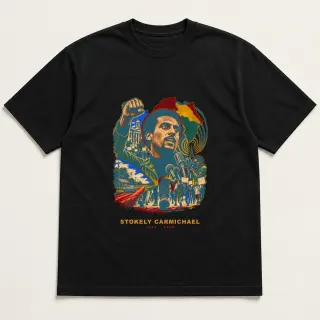 Design proof
 Stokely Carmichael Pixel Tee
$36.00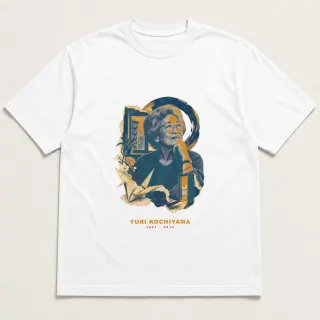 Design proof
 Yuri Kochiyama Collage Tee
$36.00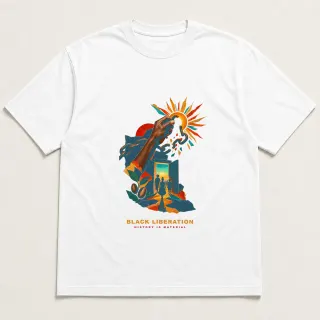 Design proof
 Black Liberation Collage Tee
$36.00Sources
#sourcesPrimary sources
The documents themselves: laws, court opinions, speeches, letters, and the numbers from the agencies that count them.
Secondary sources
Written afterward, about the story.
- National Archives, African Americans and the American Labor Movement
- National Park Service, Women in the African American Civil Rights Movement
- Smithsonian NMAAHC, The Black Power Era
- Library of Congress, African American history resources
- SNCC Digital Gateway, Black Power
- National Archives, Black Power records