Published
Black Panther Party
Ten Points and Free Breakfast: What the Black Panther Party Actually Did
The Black Panther Party, founded in Oakland in October 1966: the Ten-Point Program, the free breakfasts and clinics, and the FBI memo about the eggs.
The story
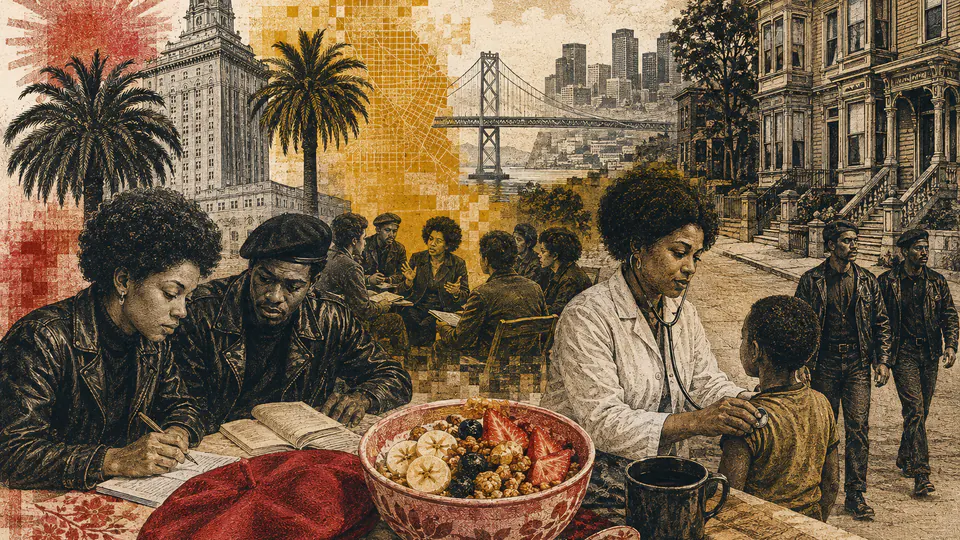
#storyEleven children sat down to breakfast at St. Augustine’s Episcopal Church in West Oakland one morning in late January 1969. By the end of that week, 135 children were eating there every day. By the end of the year the Black Panther Party counted 20,000 children fed before school in cities around the country, and J. Edgar Hoover had put the breakfast program in an FBI memo as the most dangerous thing the party was doing.
The party was founded in Oakland on October 15, 1966 by Huey P. Newton and Bobby Seale. The photographs everyone has seen are the armed patrols, the berets, the leather. The daily work, for most of the party’s sixteen years, was food, medicine, and school.
The panther came from Alabama
Organizers founded the Lowndes County Freedom Organization in Alabama in 1965, and state election law required every party on the ballot to carry an emblem. The Alabama Democratic Party’s emblem was a white rooster over the slogan White Supremacy. The Lowndes County group picked a black panther, chosen, Stokely Carmichael said, for the strength and dignity of the animal. Newton and Seale took the same cat to Oakland under the founding name Black Panther Party for Self-Defense. There was never a formal organizational tie between the two.
What the Ten-Point Program said
Newton and Seale wrote the platform in October 1966 and set it in two columns, one headed What We Want and one headed What We Believe. Ten numbered demands: freedom and the power to determine the destiny of the Black community; full employment; an end to the economic robbery of that community; decent housing; an education that tells the truth about American society; exemption from military service; an end to police brutality; freedom for Black people held in prisons and jails; juries drawn from the defendant’s own community; and point ten.
We want land, bread, housing, education, clothing, justice and peace.
The document ran in every issue of the party newspaper, The Black Panther, which published from April 25, 1967 to September 16, 1980. Point 7 is the one that got photographed.
We want an immediate end to police brutality and murder of black people.
The method behind point 7 was a law book. Party members carried loaded guns, which California’s open-carry law then allowed, watched police behavior in their own neighborhoods, and when officers confronted them, cited the statutes back and promised to sue any officer who violated their rights. California closed that door fast. Assemblyman Don Mulford of Oakland introduced a ban on carrying loaded firearms in public on April 5, 1967, a delegation of armed Panthers walked into the state capitol in Sacramento on May 2 to protest it, and Governor Ronald Reagan signed the Mulford Act on July 28, 1967. The law was drafted to disarm men who had read the penal code carefully.
Eleven children, then 135, then 20,000
Ruth Beckford-Smith, a parishioner at St. Augustine’s, ran the first breakfast program. Working with Father Earl A. Neil, she built a menu and a kitchen that would pass a health inspection. Children got some combination of eggs, grits, bacon, toast, pancakes, sausage, and milk or juice, before school, free, with no form to fill out.
Eleven came the first morning. By the end of the week, 135 were coming every day. The party’s own count for 1969, repeated since by National Geographic among others, was 20,000 children fed in 19 cities through 23 local affiliates, and by 1971 at least 36 breakfast programs were running.
The federal government had been piloting school breakfasts since 1966 and moving slowly. Congress permanently authorized the School Breakfast Program in 1975, by which point most of the Panther kitchens had been shut down. Whether the Panthers pushed Washington into it is an open question. The sequence is on the calendar either way: six years of church basements first, then a permanent federal program.
The clinics, the ambulance, the school
Newton called them survival programs. By the sociologist Alondra Nelson’s count in Body and Soul, the party ran free health clinics in 13 cities in the late 1960s and early 1970s, testing for lead poisoning and high blood pressure and treating people who had no doctor.
In the early 1970s the party began screening for sickle cell anemia, a disease that mostly affects people of African descent and that American medicine had largely ignored. At the party’s Boston clinic, a Harvard student named Mary Bassett set up a screening program around a test that was not yet in wide use. On May 16, 1972, Richard Nixon signed the National Sickle Cell Anemia Control Act.
The rest of the list is long and mostly unglamorous: clothing distribution, classes in politics and economics, self-defense and first aid instruction, rides to upstate prisons for the families of people locked up, drug and alcohol rehabilitation, an emergency-response ambulance service. The Winston-Salem chapter in North Carolina ran the ambulance, and no other chapter had one.
In 1973 the party opened the Oakland Community School at 6118 East 14th Street, directed by Ericka Huggins. It enrolled more than 150 children at its height and kept a waiting list that included children not yet born.
The food traveled, too. In April 1977, disabled activists occupied the federal building at 50 UN Plaza in San Francisco to force the government to enact Section 504, and the local Black Panther Party fed them for the duration: one hot meal delivered every day, plus supplies for two more. The 504 sit-in held for 26 days on Panther cooking.
Why the FBI cared about breakfast
Of the 295 counterintelligence actions the FBI has documented against Black political organizations, 233 were aimed at the Black Panther Party. The clearest sentence in that paperwork is about eggs. On May 15, 1969, Hoover sent a memo to field offices about the Breakfast for Children Program, saying it
represents the best and most influential activity going for the BPP and, as such, is potentially the greatest threat to efforts by authorities to neutralize the BPP and destroy what it stands for.
Field offices went to work on a meal. In Richmond, Virginia, agents told parents the Panthers would teach their children racism. In San Francisco, parents heard the food carried venereal disease. In Chicago, police broke into a church that hosted a breakfast, destroyed the food, and urinated on it.
Publicly, Hoover called the party the greatest threat to the internal security of the country, a line PBS dates to June 15, 1969. The public statement named the security of the United States. The internal memo, a month earlier, named a breakfast line.
December 4, 1969
At 4:45 in the morning on December 4, 1969, Chicago police raided an apartment at 2337 West Monroe Street and killed Fred Hampton, who was 21, chairman of the party’s Illinois chapter and a deputy chairman of the national party. William O’Neal, the FBI’s informant inside that chapter, had drawn the Bureau a floor plan of the apartment. A coroner’s jury ruled the deaths of that morning justifiable homicide on January 21, 1970. Thirteen years later the federal government, Cook County, and the City of Chicago settled the survivors’ civil suit for $1.85 million, each paying a third to nine plaintiffs.
Who was actually in the party
The picture in most people’s heads is a man in a beret. A survey Bobby Seale ran in 1969 put membership at more than 60 percent women, a figure carried in the scholarship on women in the party; a Smithsonian account of the rank and file puts the share closer to half, with an average member age of 19. Both estimates describe the same organization, and both point at the people who cooked the breakfasts, staffed the clinics, taught the school, and did the administration. Malika Adams, a former Panther, said it directly:
Women ran the BPP pretty much. I don’t know how it got to be a male’s party or thought of being a male’s party. Because those things, when you really look at it in terms of society, those things are looked on as being woman things, you know, feeding children, taking care of the sick.
Elaine Brown chaired the party from 1974 to 1977, the only woman to lead it. Seale ran for mayor of Oakland in 1973, finished second in a field of nine with 20 percent to the incumbent John Reading’s 50, and lost the runoff. Brown ran for Oakland City Council that year and took 30 percent, then ran again in 1975 and took 44.
Angela Davis worked with the party’s Los Angeles branch, directing political education, while keeping her Communist Party membership. She was arrested in October 1970, held for 16 months, and acquitted of all charges on June 4, 1972.
How it ended
By the late 1970s the party had contracted to Oakland, with members in prison, in exile, or dead. The Oakland Community School closed in 1982 and the party dissolved the same year, sixteen years after two men in Oakland wrote down ten demands ending in the words land, bread, housing, education, clothing, justice and peace. Some accounts date the school’s final year to 1981.
Both sides wrote it down. The party printed its ten demands in every issue of its own newspaper for thirteen years. The Bureau typed up its assessment of eggs and grits on May 15, 1969 and filed it. The argument about what the Black Panther Party did has two paper trails, and they agree about the breakfast.
What people get wrong
#wrong- The myth
The Black Panther Party was mainly known for armed confrontation, not social programs. - The record
By the party's own 1969 count, repeated in National Geographic's reporting, it fed 20,000 children before school in 19 cities through 23 local affiliates, alongside free clinics, a sickle cell screening program, and a school, a daily operation far larger than its armed street patrols.
- The myth
The Black Panther Party and the Lowndes County Freedom Organization, which used the same panther symbol, were formally connected. - The record
The Lowndes County group adopted the black panther as its 1965 Alabama ballot emblem, and Newton and Seale took the same image to Oakland in 1966, but the histories of the logo, including Lincoln Cushing's, describe borrowing the image, not a formal organizational tie between the two groups.
- The myth
The party's membership and leadership were mostly men in berets. - The record
A 1969 survey Bobby Seale ran put the party at more than 60 percent women, and a Smithsonian account of the rank and file puts the share closer to half with an average member age of 19. Elaine Brown chaired the national party from 1974 to 1977.
- The myth
Hoover called the party the greatest threat to the country because of its armed patrols. - The record
Hoover's internal May 15, 1969 memo to FBI field offices named the Breakfast for Children Program specifically as "the greatest threat to efforts by authorities to neutralize the BPP," a month before his public greatest-threat statement about the party overall.
The dates that matter
#dates- October 15, 1966 Huey P. Newton and Bobby Seale found the Black Panther Party for Self-Defense in Oakland and write the Ten-Point Program the same month.
- April 5 - July 28, 1967 California bans carrying loaded guns in public. Armed Panthers protest at the state capitol on May 2; Governor Ronald Reagan signs the Mulford Act on July 28.
- April 25, 1967 First issue of the party newspaper, The Black Panther. Every issue carries the ten points.
- Late January 1969 The first free breakfast is served at St. Augustine's Episcopal Church in West Oakland: 11 children on day one, 135 daily by the end of the week.
- May 15, 1969 Hoover tells FBI field offices the Breakfast for Children Program is the party's most influential activity and orders it disrupted.
- 1969 Hoover publicly calls the party the greatest threat to the internal security of the country. PBS dates the statement to June 15.
- December 4, 1969 Chicago police raid 2337 West Monroe Street at 4:45 a.m. and kill Fred Hampton, 21, chairman of the Illinois chapter.
- End of 1969 The party counts 20,000 children fed before school in 19 cities through 23 local affiliates.
- 1971 At least 36 free breakfast programs are running nationwide.
- May 16, 1972 Richard Nixon signs the National Sickle Cell Anemia Control Act, after the party had spent the early 1970s screening for the disease itself.
- 1973 The Oakland Community School opens at 6118 East 14th Street. Bobby Seale finishes second of nine for mayor of Oakland, forcing a runoff he loses.
- 1974-1977 Elaine Brown chairs the party, the only woman to lead it.
- 1975 Congress permanently authorizes the federal School Breakfast Program.
- April 1977 The party feeds the disabled activists occupying the federal building at 50 UN Plaza in San Francisco for 26 days.
- 1982 The Oakland Community School closes and the party dissolves. The Chicago raid's civil suit settles for $1.85 million the same year.
Questions people ask
#faqsWhat did the Black Panther Party actually do?
Armed police patrols in Oakland from 1966, and then a national network of free programs the party called survival programs: free breakfast for schoolchildren from late January 1969, free health clinics in 13 cities, sickle cell anemia screening in the early 1970s, clothing distribution, classes in politics and economics, rides to upstate prisons for families of the incarcerated, drug and alcohol rehabilitation, a free ambulance service run by the Winston-Salem chapter, and the Oakland Community School from 1973.
What was the Ten-Point Program?
The party's founding platform, written by Newton and Seale in October 1966 in two columns headed What We Want and What We Believe. The ten demands covered self-determination, full employment, an end to economic exploitation of Black communities, decent housing, honest education, exemption from military service, an end to police brutality, freedom for Black prisoners, juries drawn from the defendant's own community, and, in point ten, land, bread, housing, education, clothing, justice and peace.
Did the Black Panthers really feed children breakfast?
Yes. The first program began at St. Augustine's Episcopal Church in West Oakland in late January 1969 with 11 children; 135 were being served daily by the end of that week. The party's count for 1969 was 20,000 children fed in 19 cities through 23 local affiliates, and at least 36 breakfast programs were running by 1971.
Why did the FBI target the Black Panther Party?
J. Edgar Hoover called the party the greatest threat to the internal security of the country in 1969, and the Bureau's counterintelligence program treated it accordingly: 233 of 295 documented COINTELPRO actions against Black political organizations were aimed at the Panthers. A May 15, 1969 Hoover memo singled out the free breakfast program specifically, and field offices spread rumors that the food was poisoned or diseased and raided the sites.
When did the Black Panther Party end?
1982. The party had contracted to Oakland through the late 1970s, and its last program, the Oakland Community School, closed that year. Some accounts date the school's final year to 1981.
The bookshelf
#bookshelfWhere to go next. Buy from an independent bookstore, or find it at your library for nothing.
-
Revolutionary Suicide Huey P. Newton, 1973 primary
The co-founder's own account of the party's founding and his life inside it.
-
Seize the Time: The Story of the Black Panther Party and Huey P. Newton Bobby Seale, 1970 primary
The other co-founder's own history, written from inside the party's earliest years.
-
Body and Soul: The Black Panther Party and the Fight against Medical Discrimination Alondra Nelson, 2011 secondary
The scholarship this article's own account of the free clinics and sickle cell screening draws on.
-
Black against Empire: The History and Politics of the Black Panther Party Joshua Bloom and Waldo E. Martin Jr., 2013 secondary
The standard academic history of the party's rise, programs, and repression.
Wear it: Black Panther Party
#merchEvery design here links back to this page.
Sources
#sourcesPrimary sources
The documents themselves: laws, court opinions, speeches, letters, and the numbers from the agencies that count them.
- "October 1966 Black Panther Party Platform and Program," The Sixties Project, University of Virginia (primary text of the Ten-Point Program, What We Want and What We Believe)
- "Black Panther's Ten-Point Program," Marxists Internet Archive (dates the platform to October 15, 1966; reproduced from Huey P. Newton, War Against the Panthers (1980))
- Richard Nixon, "Statement on Signing the National Sickle Cell Anemia Control Act" (May 16, 1972), The American Presidency Project
Secondary sources
Written afterward, about the story.
- Wikipedia, "Free Breakfast for Children" (St. Augustine's, Ruth Beckford-Smith, Father Earl A. Neil, the 11 and 135 counts)
- National Geographic, "The Black Panthers: Revolutionaries, free breakfast pioneers" (the 1969 totals (20,000 children, 19 cities, 23 affiliates) and the May 1969 Hoover memo)
- HISTORY, "How the Black Panthers' Breakfast Program Both Inspired and Threatened the Government" (FBI disruption tactics in Richmond, San Francisco and Chicago; the 1975 federal authorization)
- TIME, "What School Didn't Teach You About the Black Panthers" (Alondra Nelson's count of free clinics in 13 cities; Mary Bassett and sickle cell screening)
- PBS, "A Huey P. Newton Story: J. Edgar Hoover" (the public greatest-threat statement, dated there to June 15, 1969)
- PBS, "A Huey P. Newton Story: COINTELPRO" (233 of 295 documented actions against Black groups aimed at the party)
- Leela Yellesetty et al., "Women in the Black Panther Party," International Socialist Review #111 (Bobby Seale's 1969 membership survey; the Malika Adams quote)
- Smithsonian Magazine, "The Rank and File Women of the Black Panther Party and Their Powerful Influence" (the lower estimate of women's share of membership and the average age of 19)
- National Park Service, "504 Protest: Disability, Community, and Civil Rights" (the party delivered one hot meal a day plus supplies for two more to the occupiers)
- KQED, "Celebrating The Black Panthers' Oakland Community School" (opened 1973 at 6118 E. 14th Street, closed 1982, Ericka Huggins directing)
- Lincoln Cushing, "Origin of the Black Panther Party logo," Docs Populi (the Lowndes County ballot emblem and Carmichael's account of the choice)
- Wikipedia, "Mulford Act" (introduced April 5, 1967, signed by Reagan July 28, 1967, drafted to disarm the party)
- Wikipedia, "The Black Panther (newspaper)" (published April 25, 1967 to September 16, 1980; every issue carried the ten points)
- Wikipedia, "Killing of Fred Hampton" (the December 4, 1969 raid, William O'Neal's floor plan, the 1982 settlement)
- Wikipedia, "Black Panther Party" (the open-carry patrols, the survival programs list, dissolution in 1982)
- Wikipedia, "Lowndes County Freedom Organization" (founded 1965; the ballot emblems, black panther against white rooster)
- Wikipedia, "Black Panther Party, Winston-Salem, North Carolina Chapter" (the free ambulance service, which no other chapter operated)
- Wikipedia, "Bobby Seale" (the 1973 Oakland mayoral result and runoff)
- Wikipedia, "Elaine Brown" (chair of the party 1974-1977; the 1973 and 1975 Oakland City Council runs)
- Wikipedia, "Angela Davis" (her work with the party's Los Angeles branch; arrest, 16 months held, acquittal June 4, 1972)