Published
Fred Hampton
How Fred Hampton Died: The Raid the FBI Helped Plan
Born August 30, 1948. Died December 4, 1969
Fred Hampton was 21 when Chicago police killed him on December 4, 1969. An FBI informant drew the floor plan. The raid record and settlement documents survive.
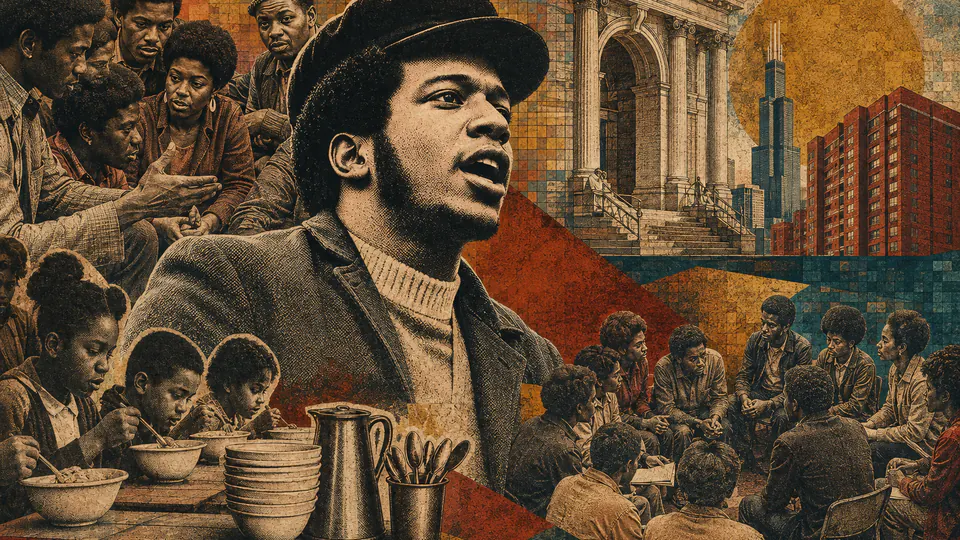
The story
#storyAt about 4:30 in the morning on December 4, 1969, fourteen Chicago police officers assigned to the Cook County State’s Attorney’s office went through the door of a first-floor apartment at 2337 West Monroe Street. Nine members of the Illinois chapter of the Black Panther Party were inside. When the shooting stopped, the chapter’s chairman, Fred Hampton, was dead in the back bedroom at twenty-one, Mark Clark was dead in the front room at twenty-two, and four other people had been shot. The National Archives states the ballistics finding in one line: Chicago police fired ninety-nine shots, and the people in the apartment fired one.
The raiders had a floor plan of the place. The opinion of the United States Court of Appeals for the Seventh Circuit in Hampton v. Hanrahan, decided April 23, 1979, describes FBI Special Agent Roy Mitchell meeting an informant named William O’Neal and, “with O’Neal’s aid,” constructing “a floorplan of the apartment at 2337 West Monroe Street to which Hampton recently had moved.” O’Neal was the Illinois chapter’s chief of security. He had joined the party at the Bureau’s direction. Shortly after the raid, the same opinion records, “a three hundred dollar bonus was approved.”
Maywood, and the swimming pool
Hampton was born on August 30, 1948 and grew up in Maywood, the village just west of Chicago. He graduated with honors from Proviso East High School in 1966. Before any of the rest of it, he ran the NAACP’s West Suburban Youth Council and built it to roughly five hundred members, and the fight he picked there was over a swimming pool. Maywood did not have one. Black kids who wanted to swim got driven out to Brookfield, because the pool closest to home, in Melrose Park, was for white swimmers. He organized rallies for a village pool that anyone could use.
He joined the Chicago chapter of the Black Panther Party in November 1968, by the National Archives’ dating. Inside a year he was chairman of the Illinois chapter and deputy chairman of the national party, which made him one of the most watched political organizers in the country at an age when most people are finishing college.
Five breakfasts and a coalition
Under Hampton the Illinois chapter ran five Free Breakfast for Children programs on Chicago’s West Side, feeding more than four hundred children every morning. It was the local edition of the survival programs the party had started at St. Augustine’s Episcopal Church in West Oakland in January 1969, and it worked well enough that the city of Chicago answered with a federally funded hot breakfast program of its own.
J. Edgar Hoover put his assessment of feeding children in writing in a 1969 FBI memorandum:
The [Program] represents the best and most influential activity going for the BPP and, as such, is potentially the greatest threat to efforts by authorities to neutralize the BPP and destroy what it stands for.
The other thing Hampton built that year was an alliance across three neighborhoods that had never been asked to share anything. In the spring of 1969 the Illinois Panthers, the Young Lords Organization out of Puerto Rican Lincoln Park, and the Young Patriots Organization, poor white Southern migrants in Uptown, went public as the Rainbow Coalition and worked together on police brutality, rent, and hunger. The historian Jakobi Williams, who wrote the history of the Illinois chapter, credits the Panther organizer Bob Lee as the coalition’s most active organizer, the one doing the work behind the press conferences. Speaking at Olivet Church in Chicago that same year, Hampton gave the argument in a sentence:
We say you don’t fight racism with racism,we’re gonna fight racism with solidarity.
The state’s case: $71 of ice cream
While that was going on, Cook County was prosecuting Hampton over ice cream. The charge was robbing an ice cream truck driver of $71 worth of bars on a Maywood school playground and handing them out to neighborhood kids. The trial judge had signaled probation. After State’s Attorney Edward Hanrahan went after Hampton in the press, the sentence came back as two to five years, and in May 1969 he was sent downstate to the penitentiary at Menard. Circuit Court Judge Sidney A. Jones then refused to set an appeal bond and said why on the record, as L. F. Palmer Jr. reported in The Nation of July 28, 1969:
This defendant admits to me that he advocates armed revolution. I cannot take the responsibility of allowing him to remain at large.
Hampton’s own review of the evidence, in the same article:
I may be a pretty big mother, but I can’t eat no 710 ice-cream bars.
He was released on an appeal bond in late August 1969 and came home to Chicago. He had a little more than three months left.
What the Bureau had written down
The FBI had been running a counterintelligence program against Black political organizations since 1967. Reviewing the Hampton case a decade later, the Seventh Circuit quoted the Bureau’s own long-range goals for it: prevent a coalition of militant black nationalist groups, and prevent the rise of a messiah who could unify and electrify the militant nationalist movement. The memorandum setting those goals named Malcolm X, murdered in 1965, as the sort of figure it had in mind. Hampton was doing the first thing on the list and being accused of the second, and he was twenty-one.
O’Neal’s information moved from him to Agent Mitchell to Hanrahan’s office. In the documents produced years later in the civil case, the Bureau described that information as being of “tremendous value” and called the raid a “success.”
One question in the file has never been settled. The Cook County chemist who tested Hampton’s blood reported barbiturates in it; an FBI chemist testing the same material reported none. The National Archives account states that the informant slipped a sleeping drug into Hampton’s drink. The two laboratory results sit in the record side by side, and readers should know that is where the matter stands.
The account fell apart inside a week
Hanrahan’s office said the officers had walked into an ambush and praised them for it:
We wholeheartedly commend the police officers for their bravery, their remarkable restraint, and their discipline in the face of this vicious Black Panther attack, and we expect every decent citizen of our community to do likewise.
A week after the raid, the Chicago Tribune published photographs supplied by the State’s Attorney’s office, circles drawn around what the captions called holes made by Panther gunfire. The Panthers had left the apartment open and were walking reporters and neighbors through it, so the checking took about an afternoon. As TIME reported on December 19, 1969, the holes in the door jamb turned out to be nail heads. The Chicago Sun-Times ran the correction on its front page.
Thirteen years in court
On January 30, 1970 a grand jury indicted the seven survivors of the raid on counts ranging from attempted murder to illegal possession of firearms. On May 8 the state dropped all of them, after FBI ballistics work failed to support the claim that anyone inside had been shooting. A federal grand jury reported on May 15, 1970 and returned no indictments. Hanrahan and thirteen others were indicted on state charges of obstructing justice in 1971, acquitted at a bench trial in 1972, and that November the voters of Cook County retired him.
The families and survivors sued. Their trial began on January 5, 1976 and ran about eighteen months, at which point the judge dismissed the case and taxed the plaintiffs $100,000 in costs. On April 23, 1979 the Seventh Circuit reversed him, holding that a jury should hear the evidence of a conspiracy “designed to subvert and eliminate the Black Panther Party” and that the federal defendants’ failure to hand over documents had obstructed the grand jury investigation. In 1982 the case settled for $1.85 million to nine plaintiffs, among them Hampton’s mother and Clark’s, paid in equal thirds by the federal government, Cook County, and the City of Chicago. Thirteen years, and no jury ever returned a verdict on any of it.
The pool got built
Fred Hampton Jr. was born on December 29, 1969, twenty-five days after the raid, to Akua Njeri, who was Deborah Johnson then and was in the bed when the shooting started. William O’Neal died by suicide on January 15, 1990. The building at 2337 West Monroe is still standing, and on August 30, 2025, which would have been Hampton’s seventy-seventh birthday, Chicago hung an honorary sign on the street outside it: Chairman Fred Hampton Sr. Way.
Maywood built its swimming pool. It carries his name, and the children who swim in it were born decades after the argument he made for it.
In their own words
#wordsWhat Fred Hampton actually said, where, and when. Each one links to the page it was checked against.
-
It's a class struggle, godamnit! It's a class struggle.
From a speech at Northern Illinois University, November 1969, printed as a pamphlet by the Illinois chapter of the Black Panther Party. Fred Hampton, speech at Northern Illinois University (November 1969) -
You can jail a revolutionary, but you can't jail the revolution.
From the same Northern Illinois University speech, November 1969, weeks before the raid that killed him. Fred Hampton, speech at Northern Illinois University (November 1969) -
Capitalism comes first and next is racism.
From the same Northern Illinois University speech, November 1969. Fred Hampton, speech at Northern Illinois University (November 1969) -
The Breakfast For Children program is a socialistic program.
From a speech at Olivet Church, Chicago, 1969. Fred Hampton, speech at Olivet Church, Chicago (1969) -
You don't fight capitalism with no black capitalism; you fight capitalism with socialism.
From the same Olivet Church speech, Chicago, 1969. Fred Hampton, speech at Olivet Church, Chicago (1969)
What people get wrong
#wrong- The myth
The December 4, 1969 raid was a shootout, and the Panthers fired first. - The record
The National Archives puts the ballistics plainly: Chicago police fired ninety-nine shots and the people inside the apartment fired one. The photographs the State's Attorney's office handed the Chicago Tribune, captioned as bullet holes from Panther gunfire, turned out under inspection to be nail heads, as TIME reported within weeks.
- The myth
The FBI's role was limited to watching the Illinois Black Panther Party, not the raid itself. - The record
The Seventh Circuit's opinion in Hampton v. Hanrahan describes FBI Special Agent Roy Mitchell building the floor plan of Hampton's apartment with the help of the informant William O'Neal, and records a three hundred dollar bonus approved for O'Neal shortly after the raid.
- The myth
Hampton's story is a story about guns. - The record
Under him the Illinois chapter ran five Free Breakfast for Children programs that fed more than four hundred children a morning. In spring 1969 he built the Rainbow Coalition with the Young Lords Organization and the Young Patriots Organization, tying Black, Puerto Rican, and poor white Chicago into one bloc.
The dates that matter
#dates- August 30, 1948 Born; raised in Maywood, the village just west of Chicago.
- 1966 Graduates with honors from Proviso East High School. Leads the NAACP's West Suburban Youth Council, building it to roughly 500 members.
- November 1968 Joins the Chicago chapter of the Black Panther Party, by the National Archives' dating.
- Spring 1969 Announces the Rainbow Coalition with the Young Lords Organization and the Young Patriots Organization.
- 1969 The Illinois chapter runs five Free Breakfast for Children programs on the West Side, serving more than 400 children a morning.
- May 1969 Sentenced to two to five years for the robbery of an ice cream truck driver and sent downstate to Menard.
- Late August 1969 Released on an appeal bond and returns to Chicago.
- November 1969 Speaks at Northern Illinois University, a month before his death; the Illinois chapter prints the speech as a pamphlet.
- December 4, 1969 Fourteen officers raid 2337 West Monroe Street at about 4:30 a.m. Hampton, 21, and Mark Clark, 22, are killed; four others are wounded.
- December 29, 1969 Fred Hampton Jr. is born to Akua Njeri, then Deborah Johnson, who survived the raid.
- May 1970 The state drops all charges against the seven survivors after FBI ballistics fail to support the police account; a federal grand jury reports on May 15 and returns no indictments.
- 1971-1972 Hanrahan and thirteen others are indicted on state charges of obstructing justice and acquitted at a bench trial. Hanrahan loses the November 1972 election.
- April 23, 1979 The Seventh Circuit reverses the dismissal of the family's civil case in Hampton v. Hanrahan.
- 1982 The case settles for $1.85 million, split evenly among the federal government, Cook County, and the City of Chicago.
Questions people ask
#faqsHow did Fred Hampton die?
He was shot in his bed during a pre-dawn police raid on December 4, 1969. Fourteen Chicago police officers assigned to the Cook County State's Attorney's office entered his apartment at 2337 West Monroe Street on the West Side. Hampton, aged twenty-one, and Mark Clark, aged twenty-two, were killed and four other people were wounded. Ballistics put nearly every shot on the police side: the National Archives counts ninety-nine shots by police and one from inside the apartment.
Was Fred Hampton assassinated by the FBI?
The shots came from Chicago police officers working for State's Attorney Edward Hanrahan, and no federal agent was in the apartment. What the record establishes is that the FBI supplied the floor plan through its informant inside the party and approved a three hundred dollar bonus for him afterward, and that the Seventh Circuit held in 1979 that a jury should hear evidence of a conspiracy to subvert and eliminate the Black Panther Party. The case settled in 1982 without a trial verdict.
How old was Fred Hampton when he died?
Twenty-one. He was born on August 30, 1948 and killed on December 4, 1969. He had led the Illinois chapter of the Black Panther Party since he was twenty.
What was Fred Hampton's Rainbow Coalition?
An alliance Hampton announced in the spring of 1969 between the Illinois Black Panthers, the Young Lords Organization of Puerto Rican Lincoln Park, and the Young Patriots Organization, poor white Southern migrants in Uptown. Later groups joined. They worked together on police brutality, housing, and poverty in one of the most segregated cities in the country.
Who was William O'Neal?
An FBI informant who joined the Illinois chapter of the Black Panther Party at the Bureau's direction and rose to be its chief of security. He gave his handler the information used to build the floor plan of Hampton's apartment, and the Bureau approved a three hundred dollar bonus for him after the raid. He died by suicide on January 15, 1990.
The bookshelf
#bookshelfWhere to go next. Buy from an independent bookstore, or find it at your library for nothing.
-
The Black Panthers Speak Philip S. Foner, editor, 1970 primary
The party's own newspaper writings and program documents, collected in one volume.
-
From the Bullet to the Ballot: The Illinois Chapter of the Black Panther Party and Racial Coalition Politics in Chicago Jakobi Williams, 2013 secondary
The fullest history of Hampton's own chapter and of the Rainbow Coalition he built.
-
The Assassination of Fred Hampton: How the FBI and the Chicago Police Murdered a Black Panther Jeffrey Haas, 2009 secondary
Written by one of the People's Law Office attorneys who litigated the family's civil case.
Wear it: Fred Hampton
#merchEvery design here links back to this page.
Sources
#sourcesPrimary sources
The documents themselves: laws, court opinions, speeches, letters, and the numbers from the agencies that count them.
- Hampton v. Hanrahan, 600 F.2d 600 (7th Cir. 1979) (the appellate opinion; source for the raid time, the fourteen officers, the O'Neal floor plan, the $300 bonus, and the trial's length)
- National Archives, "Fred Hampton" (source for the November 1968 party membership date and the ninety-nine-shots-to-one ballistics figure)
- L. F. Palmer Jr., "Prelude to a Murder," The Nation (July 28, 1969) (contemporary reporting on the ice cream conviction, the denied appeal bond, and Judge Jones's stated reason)
- Fred Hampton, speech at Olivet Church, Chicago (1969), printed as a pamphlet by the Illinois Chapter of the Black Panther Party (source of the racism and solidarity line)
- Fred Hampton, speech at Northern Illinois University (November 1969), printed as a pamphlet by the Illinois Chapter of the Black Panther Party (delivered a month before the raid)
- "Police and Panthers: Growing Paranoia," TIME (December 19, 1969) (contemporary account of the Tribune photographs and the nail heads)
Secondary sources
Written afterward, about the story.
- Roy Wilkins and Ramsey Clark, Search and Destroy: A Report by the Commission of Inquiry into the Black Panthers and the Police (Harper & Row, 1973) (introduction, with the nine occupants, the wounds, the January 1970 indictments of the survivors, and their dismissal on May 8, 1970)
- People's Law Office, "The Murder of Fred Hampton" (from the firm that brought the civil case)
- People's Law Office, "The Assassination of Fred Hampton: 47 Years Later" (source of the FBI bonus memo language quoted here)
- Newberry Library, "The Forming of Chicago's First Rainbow Coalition"
- "Hanrahan's life transcended '69 Panther raid," Wednesday Journal (June 16, 2009) (source of Hanrahan's commendation statement)
- "Street sign honors Black Panther leader Fred Hampton Sr., slain in '69 police raid," Chicago Sun-Times (August 31, 2025)