Published
Claudia Jones
Claudia Jones Turned Deportation Into a London Newspaper and Carnival
Born February 21, 1915. Died December 24, 1964
Claudia Jones linked race, sex, class, and peace in U.S. communist politics before deportation; in London she built a Black newspaper and carnival.
The story
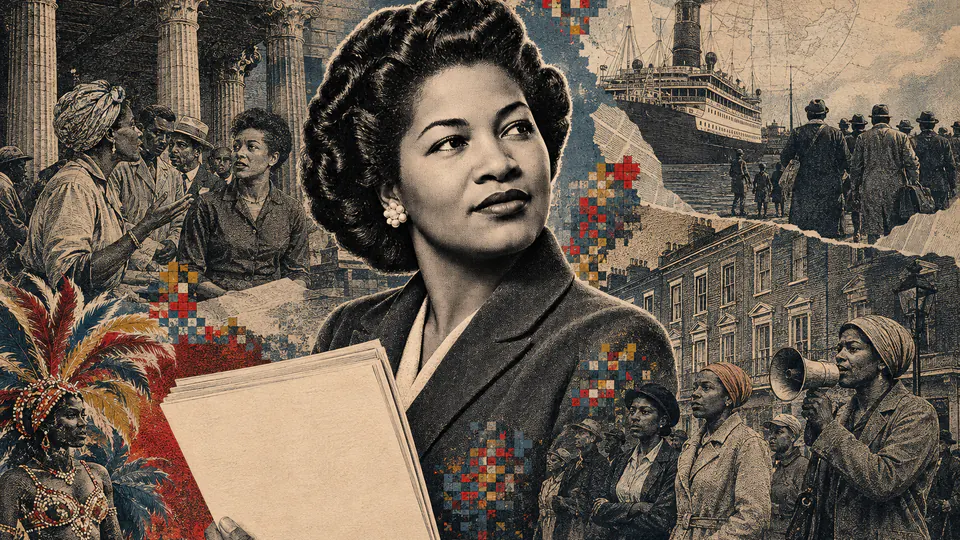
#storyThe United States deported Claudia Jones in 1955 after imprisoning her for Communist Party activity. Britain received a 40-year-old journalist with serious heart disease. Within three years she had founded the West Indian Gazette, and within four she was organizing Caribbean carnival in London.
Deportation removed Jones from Harlem. It did not remove the politics.
Harlem and a theory built from position
Jones was born Claudia Cumberbatch in Trinidad in 1915 and moved to New York as a child. Poverty and tuberculosis ended her formal education early and damaged her health. She joined the Communist Party in 1936, wrote and edited party publications, and organized around housing, war, colonialism, Scottsboro defendants, and Black women’s conditions.
Her 1949 essay An End to the Neglect of the Problems of the Negro Woman argued that Black women faced joined exploitation as workers, women, and Black people. That position made their leadership central to any serious coalition. Jones wrote this before the language later used for intersecting oppression had entered universities.
The government used immigration law
Federal agents arrested Jones during the Cold War and the government prosecuted her under the Smith Act with other Communist Party leaders. She served a prison sentence and was deported because she had never received U.S. citizenship. Trinidad remained a British colony, so Britain became the destination.
A paper answered racist violence
In London, Jones founded the West Indian Gazette in 1958. After racist attacks in Notting Hill and Nottingham, she helped organize an indoor Caribbean carnival in January 1959. The events continued during her life and helped create the cultural ground from which later outdoor carnival grew.
Jones died on Christmas Eve 1964 and was buried beside Karl Marx in Highgate Cemetery. The location is almost too tidy. Her actual record crossed Harlem rent fights, Black liberation, women’s organizing, colonial freedom, and Caribbean London. The government moved the organizer. The organizer opened another office.
Poverty made her analysis concrete
Jones’s family joined the movement of Caribbean migrants to Harlem in the 1920s. Her mother died while Jones was young, and tuberculosis interrupted her schooling. She worked in laundries, factories, and retail rather than following the academic route her ability might have opened under different conditions.
Those facts mattered to her politics. Black women were concentrated in low-paid work, charged with sustaining households, and exposed to discrimination within labor and political organizations that needed their participation. Jones rejected any program that asked them to wait while race, class, or sex was solved first.
The Scottsboro case helped draw her toward organized communism. Nine Black teenagers had been accused in Alabama through proceedings shaped by mob pressure and racist justice. Communist-led legal defense and protest showed Jones an organization willing to place state violence and Black defendants at the center of national work.
Journalism was part of party organization
Jones wrote for and edited Communist Party publications, including the Daily Worker and Political Affairs. Party journalism supplied a national distribution network and an audience trained to act through clubs, campaigns, and unions. It also subjected writers to party discipline and the strategic changes of an international movement.
Her work pressed the party on its own neglect. The 1949 essay for which she is best known argued that the super-exploitation of Black women placed them in a leading position in democratic struggle. The point was organizational, not a request to add a paragraph about representation. A coalition that failed Black women would misunderstand the labor force, family life, racist violence, and its own base.
Jones applied the analysis to domestic workers, high prices, peace, voting, child care, housing, and discrimination. Her writing did not treat Black women as one uniform group. It identified a social position from which connected systems became visible.
Cold War prosecution turned speech into a removal case
The Smith Act allowed federal prosecution over advocacy of overthrow, and the government used it against Communist Party leaders during the Cold War. Jones was arrested repeatedly, convicted with other party members, and imprisoned. Her poor health made incarceration especially dangerous.
Immigration law supplied a second punishment. Jones had lived in the United States from childhood but was not a citizen. Deportation converted political prosecution into banishment and split her from the Harlem networks she had spent decades building.
The case shows why formal speech rights can be uneven. A citizen and a noncitizen may say the same thing while facing different consequences. Surveillance, employment loss, prison, and removal can narrow political life without a government having to win a public argument about the ideas themselves.
London required a new Black public sphere
Postwar Caribbean migration changed British cities while migrants encountered job discrimination, housing exclusion, and racist attacks. Jones founded the West Indian Gazette as a newspaper for a community that mainstream British publications often described from the outside or ignored.
The paper covered independence movements, local discrimination, culture, labor, and international politics. It linked Caribbean London to struggles across Africa, the Caribbean, the United States, and Britain. Advertising and circulation were persistent problems, but the office became a political meeting point as well as a newsroom.
That institution mattered during racist violence in Nottingham and Notting Hill in 1958. A newspaper could collect testimony, dispute official minimization, announce meetings, and make an injured neighborhood visible to itself.
Carnival was culture with an organizing address
Jones helped organize a Caribbean carnival at St Pancras Town Hall in January 1959, with later events held indoors. Music, performance, food, and beauty answered racist violence without pretending it had vanished. Ticket sales also supported the struggling newspaper.
These events were predecessors of the later outdoor Notting Hill Carnival, not a single founding moment that erases other organizers. Rhaune Laslett’s neighborhood festival and Caribbean street traditions contributed to the outdoor form that emerged in the 1960s. Jones’s role is substantial without needing a tidier origin myth.
Carnival made a Black public claim on the city. It offered pleasure and political confidence, built relationships, and refused a picture of migrants defined only by injury. Jones understood culture as part of how a community gathers the strength to fight.
Her two cities belong to one political life
Jones died in London in 1964 at forty-nine. Years of illness, poverty, surveillance, prison, and relentless work had shortened her life. Her burial near Karl Marx is often used as a closing image, but the more useful connection runs between institutions she built.
In Harlem, party newspapers and clubs gave political analysis an audience. In London, the West Indian Gazette and carnival created a meeting place for a new migrant public. Both projects joined communication to organization. Deportation changed the city, legal setting, and immediate constituency. It did not break the method: find the people official politics has placed at the edge, make their position central, and give them a paper and a room in which to answer back.
In their own words
#wordsWhat Claudia Jones actually said, where, and when. Each one links to the page it was checked against.
-
The bourgeoisie is fearful of the militancy of the Negro woman, and for good reason.
From An End to the Neglect of the Problems of the Negro Woman, published in Political Affairs, June 1949. Claudia Jones, An End to the Neglect of the Problems of the Negro Woman (1949) -
Negro women-as workers, as Negroes, and as women-are the most oppressed stratum of the whole population.
The central claim of An End to the Neglect of the Problems of the Negro Woman, 1949. Claudia Jones, An End to the Neglect of the Problems of the Negro Woman (1949) -
The negligible participation of Negro women in progressive and trade-union circles is thus all the more startling.
From An End to the Neglect of the Problems of the Negro Woman, 1949, on their absence from the unions and the organized left. Claudia Jones, An End to the Neglect of the Problems of the Negro Woman (1949) -
It is merely lip service for progressive unionists to speak of organizing the unorganized without turning their eyes to the serious plight of the domestic worker.
From An End to the Neglect of the Problems of the Negro Woman, 1949, on the union drives that skipped domestic work. Claudia Jones, An End to the Neglect of the Problems of the Negro Woman (1949) -
The responsibility for overcoming these special forms of white chauvinism rests, not with the 'subjectivity' of Negro women, as it is often put, but squarely on the shoulders of white men and white women.
From An End to the Neglect of the Problems of the Negro Woman, 1949. Claudia Jones, An End to the Neglect of the Problems of the Negro Woman (1949) -
You dare not, gentlemen of the prosecution, assert that Negro women can think and speak and write!
From her statement to the court before sentencing under the Smith Act, at Foley Square, New York, in early 1953. Claudia Jones, statement before being sentenced (1953)
What people get wrong
#wrong- The myth
Claudia Jones founded the Notting Hill Carnival. - The record
Jones organized indoor Caribbean carnivals, televised by the BBC, starting at St Pancras Town Hall in January 1959, after the racist attacks in Notting Hill and Nottingham the previous year. Today's outdoor Notting Hill Carnival grew during the 1960s out of Rhaune Laslett's neighborhood festival and Caribbean street traditions. Jones built the predecessor, not the parade.
- The myth
The Smith Act conviction that sent Claudia Jones to prison is also the law that deported her. - The record
Her 1953 Smith Act conviction, for Communist Party advocacy, was a separate case from her deportation. The government first detained her in 1948 and again in October 1950 under the Internal Security Act of 1950, and it was the newly enacted McCarran-Walter Act of 1952, which made noncitizens with a record of Communist Party membership deportable as subversive, that supplied the actual legal ground. She left under a voluntary-departure agreement on December 9, 1955, 31 years after her family moved to Harlem.
- The myth
Intersectionality starts with Kimberle Crenshaw in 1989. - The record
Crenshaw coined the word in her 1989 article Demarginalizing the Intersection of Race and Sex. Forty years earlier, Jones's 1949 essay argued that Black women's oppression as workers, as Negroes, and as women could not be pulled apart, and that the combined position put their leadership at the center of the movement. The word is Crenshaw's. The argument was already in print.
The dates that matter
#dates- February 21, 1915 Born Claudia Cumberbatch in Port of Spain, Trinidad.
- 1924 Moves with her family to Harlem.
- 1936 Joins the Communist Party USA.
- 1949 Publishes An End to the Neglect of the Problems of the Negro Woman.
- 1951 Arrested with other Communist Party leaders under the Smith Act.
- 1955 Deported to Britain.
- 1958 Founds the West Indian Gazette.
- December 24, 1964 Dies in London.
Questions people ask
#faqsWho was Claudia Jones?
Claudia Jones was a Trinidad-born Black communist journalist and organizer active in Harlem and, after U.S. deportation, London.
Why was Claudia Jones deported?
The federal government prosecuted her Communist Party activity under the Smith Act and used her noncitizen status to deport her in 1955.
Did Claudia Jones start Notting Hill Carnival?
She organized televised indoor Caribbean carnivals beginning in 1959, an important predecessor. The outdoor Notting Hill Carnival developed through related but distinct neighborhood events in the 1960s.
How should Claudia Jones be evaluated?
Separate the immediate result from the institutions, tactics, exclusions, and enforcement record that followed it.
The bookshelf
#bookshelfWhere to go next. Buy from an independent bookstore, or find it at your library for nothing.
-
Claudia Jones: Beyond Containment, Autobiographical Reflections, Essays, and Poems Claudia Jones, edited by Carole Boyce Davies, 2011 primary
Her own essays, poems, and prison and deportation writing, collected in one volume.
-
Left of Karl Marx: The Political Life of Black Communist Claudia Jones Carole Boyce Davies, 2007 secondary
The standard modern biography, from the Harlem organizing through the Smith Act case, the deportation, and London.
Wear it: Claudia Jones
#merchEvery design here links back to this page.

Sources
#sourcesPrimary sources
The documents themselves: laws, court opinions, speeches, letters, and the numbers from the agencies that count them.
- Claudia Jones Archive
- New York Public Library, Claudia Jones collection
- Claudia Jones, An End to the Neglect of the Problems of the Negro Woman (1949)
- Claudia Jones, statement before being sentenced (1953)
- Kimberle Crenshaw, Demarginalizing the Intersection of Race and Sex, University of Chicago Legal Forum (1989)
Secondary sources
Written afterward, about the story.