Published
Grace Lee Boggs
Grace Lee Boggs Spent Seventy Years Revising the Detroit Question
Born June 27, 1915. Died October 5, 2015
Grace Lee Boggs moved from Marxist theory and Black labor politics to neighborhood organizing, education, gardens, and Detroit's future.
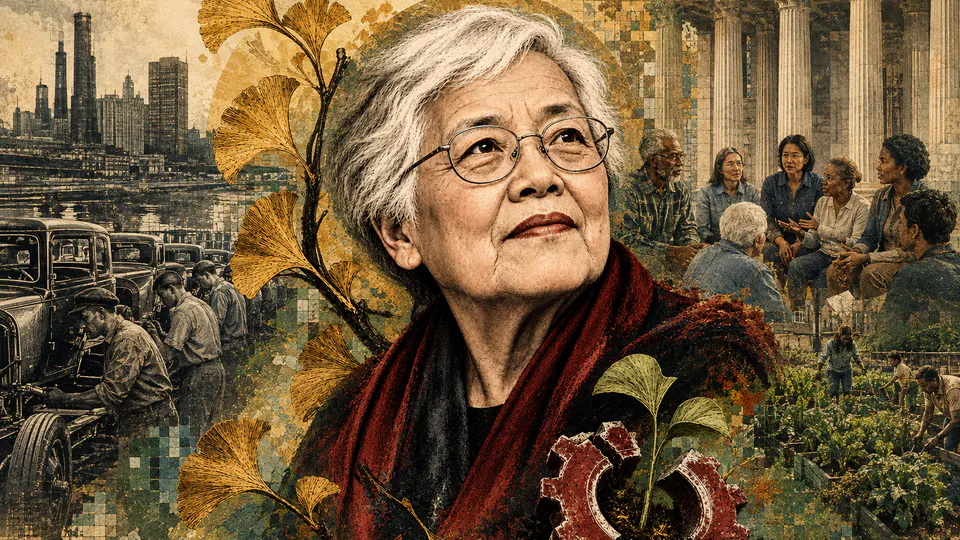
The story
#storyGrace Lee Boggs earned a doctorate in philosophy in 1940 and found that American universities had little interest in hiring a Chinese American woman. She worked at a department store library for ten dollars a week. The country had trained a philosopher and assigned her to the basement.
Boggs spent the next 75 years making theory answer to streets, factories, and neighborhoods, mostly in Detroit.
From Hegel to the tenants’ committee
Born in Rhode Island in 1915, Boggs studied at Barnard and Bryn Mawr. In Chicago she encountered Black tenants fighting rat-infested housing and joined left organizing. She worked with C.L.R. James and Raya Dunayevskaya in a Marxist tendency that studied worker self-activity and opposed Stalinism.
Boggs moved to Detroit in 1953 and married autoworker and writer James Boggs. Their political partnership examined automation, Black worker leadership, colonialism, and the limits of established labor organizations. They later broke with James’s group and built independent Detroit organizations.
Detroit after the factory promise
The city’s auto economy had created union jobs and a powerful Black working class. Automation, plant relocation, segregation, and disinvestment then removed jobs while leaving neighborhoods to absorb the loss. The Boggses argued that organizing could not wait for the old factory system to return.
Grace Boggs supported Malcolm X’s 1963 Grass Roots Leadership Conference and later worked through Detroit groups focused on community power. After James died in 1993, the Boggs Center carried their papers and political work forward.
Gardens, youth, and a changed scale
In 1992 Boggs helped launch Detroit Summer, which joined young people with elders on murals, gardens, housing, and neighborhood projects. Her later writing emphasized local food, education, care, and ecological responsibility. Critics sometimes heard retreat from national power; Boggs saw a changed field after industrial collapse.
She died in 2015 at 100. Longevity can make a political life look consistent from far away. Boggs kept revising. The through line was a question: what can people build with the conditions and one another actually present, after the previous answer stops working?
Philosophy met the color line in an ordinary search for work
Grace Lee was born in Providence in 1915 to Chinese immigrant parents and grew up in New York. She earned a doctorate in philosophy at Bryn Mawr, studying Hegel, but universities offered few openings to an Asian American woman.
In Chicago, low-paid library work placed her near Black tenants organizing against poor housing and rat infestations. The distance between philosophical freedom and segregated urban life became impossible to treat as an academic problem.
Lee joined the Workers Party, a small Trotskyist organization, and worked with the theorist C. L. R. James and Raya Dunayevskaya. Their Johnson-Forest Tendency studied worker self-activity, race, colonialism, and the limits of Soviet state power. She translated and interpreted difficult theory while learning from organizers outside universities.
Detroit changed the center of her political life
Lee moved to Detroit and married autoworker, writer, and activist James Boggs in 1953. Detroit’s factories had drawn Black migrants and generated both union power and deep racial division. Housing segregation, police violence, and discrimination inside plants shaped the city’s freedom struggle.
The Boggses worked in radical publications and organizations, including Correspondence and later Facing Reality. They argued that workers were more than followers of a party line and that Black struggle could transform U.S. politics beyond the factory.
James Boggs’s analysis of automation pushed them to reconsider a left politics that assumed industrial employment would keep expanding. Machines could increase production while removing workers from the jobs around which unions and socialist strategy had been built.
Black Power sharpened questions of leadership and belonging
During the 1960s, the Boggses participated in Detroit organizing and Black radical networks. Grace Lee Boggs supported Black self-determination while occupying a complex position as a Chinese American woman in a movement centered on Black experience.
Her marriage and decades of work did not make that position identical. Coalition required accountability rather than a claim to stand above racial difference. Her later influence among Asian American organizers also showed how Black freedom struggle had opened political space for other groups without making their histories interchangeable.
The 1963 Grassroots Leadership Conference in Detroit, where Malcolm X delivered his Message to the Grass Roots speech, reflected a local politics more radical than the usual national story of the March on Washington. Detroit contained labor strength, nationalist organizing, church networks, and police conflict at once.
Rebellion and deindustrialization changed the strategic question
The 1967 Detroit uprising brought state and federal force into Black neighborhoods. Boggs understood the anger as rooted in segregation and police power, but she later distinguished rebellion from a revolution capable of creating new institutions.
Factory closures and population loss then transformed the city. An organizing model centered only on winning power at the point of industrial production could not answer vacant land, disappearing tax revenue, unemployment, school crisis, and neighborhood abandonment.
Boggs increasingly asked what residents could build where capital had withdrawn. This was neither a claim that government and corporations no longer mattered nor a simple celebration of local volunteer work. It was a search for forms of power available to people whom an older economic order had discarded.
Detroit Summer turned youth work toward place
In 1992, Boggs and other organizers began Detroit Summer, an intergenerational program involving neighborhood projects, art, gardens, housing work, and political education. Young people were treated as makers of the city rather than as a social problem to be managed.
Urban agriculture became one part of this work. A garden could provide food, reclaim land, build relationships, and teach practical responsibility. It could not by itself replace wages, public services, or democratic control of investment. Boggs’s strongest later arguments kept local creation connected to a larger criticism of the growth economy.
The James and Grace Lee Boggs School, opened in Detroit in 2013, carried this emphasis into place-based education. As with any institution bearing a movement name, its value depends on practice rather than tribute.
Revision was her form of consistency
Boggs lived to one hundred and remained active in Detroit until her death in 2015. She had moved through Marxism, labor radicalism, Black Power, community organizing, and ecological thought. Each transition drew criticism from people who saw departure from the prior stage.
Her revisions followed changed conditions. Industrial workers remained important, but the industrial city around her had been dismantled. National politics mattered, but residents needed ways to act before a national program arrived. Rebellion could expose an intolerable order, but people still needed practices for governing life afterward.
That record resists conversion into a cheerful slogan about small change. Boggs asked for transformation in values, production, education, and relationship to the earth. Her question was demanding because it denied organizers the comfort of repeating a strategy after the world that produced it had changed.
In their own words
#wordsWhat Grace Lee Boggs actually said, where, and when. Each one links to the page it was checked against.
-
I don't see any leaders, and I think we have to rethink the concept of "leader." 'Cause "leader" implies "follower."
Interview with Bill Moyers, Bill Moyers Journal, PBS, broadcast June 15, 2007. Bill Moyers Journal, "Grace Lee Boggs" transcript (June 15, 2007) -
We in Detroit called it the rebellion.
The same 2007 Moyers interview, on why she rejected the word "riot" for the Detroit uprising of July 1967. Bill Moyers Journal, "Grace Lee Boggs" transcript (June 15, 2007) -
A garden does all sorts of things. It helps young people to relate to the Earth in a different way.
The same 2007 interview, on urban agriculture and Detroit Summer. Bill Moyers Journal, "Grace Lee Boggs" transcript (June 15, 2007) -
I feel so sorry for people who are not living in Detroit. People are always striving for size, to be a giant, and this is a symbol of how giants fall. Keep recognizing that reality is changing and that your ideas have to change. Don't get stuck in old ideas.
From the trailer for the 2013 documentary about her life, replayed on Democracy Now's June 30, 2015 broadcast marking her 100th birthday. Democracy Now, Grace Lee Boggs 100th-birthday broadcast (June 30, 2015) -
One of the difficulties when you're coming out of oppression is that you get a concept of the messiah. You have to get to that point that we are the leaders we've been looking for. We are the children of Martin and Malcolm.
From a 2008 Amy Goodman interview, replayed on Democracy Now's June 30, 2015 broadcast marking her 100th birthday. Democracy Now, Grace Lee Boggs 100th-birthday broadcast (June 30, 2015)
What people get wrong
#wrong- The myth
Boggs stayed a doctrinaire Marxist-Leninist for her whole political life. - The record
By her own account she kept revising her politics as conditions changed, moving from the Johnson-Forest Tendency's Marxism through Black Power organizing to the community-centered, ecological politics of her later decades. Her own rule against fixed doctrine, stated in 2015, was plain: keep recognizing that reality is changing and that your ideas have to change, and do not get stuck in old ideas.
- The myth
"We are the leaders we've been looking for" means Boggs rejected the idea of leadership. - The record
In the interview where she used the line, she said the problem was the messiah concept, expecting one leader to arrive and solve everything, not the existence of leadership itself. Her stated fix was to rethink the leader-follower relationship, not to declare movements leaderless.
- The myth
As a Chinese American organizer, Boggs's activism stayed inside Asian American politics. - The record
The documented record runs the other way: seven decades of work in civil rights and Black Power organizing, labor, environmental justice, and feminist movements in Detroit, alongside collaborators including Malcolm X's brother Wilfred and Angela Davis, who said in 2015 that Boggs had made more contributions to the Black struggle than most Black people have.
The dates that matter
#dates- June 27, 1915 Born in Providence, Rhode Island.
- 1940 Earns a doctorate in philosophy from Bryn Mawr.
- 1940s Works with the group around C.L.R. James and Raya Dunayevskaya.
- 1953 Moves to Detroit and marries James Boggs.
- 1963 Helps organize the Grass Roots Leadership Conference in Detroit.
- 1992 Helps begin Detroit Summer, a youth community program.
- 1995 The Boggs Center is founded in Detroit.
- October 5, 2015 Dies in Detroit at age 100.
Questions people ask
#faqsWho was Grace Lee Boggs?
Grace Lee Boggs was a Chinese American philosopher, writer, and organizer who spent most of her political life in Detroit.
Was Grace Lee Boggs a Marxist?
She began in Marxist and Trotskyist organizations and worked closely with C.L.R. James. Her politics changed over decades toward community-based transformation and ecological thought.
Who was James Boggs?
James Boggs was a Black autoworker, writer, and organizer. He and Grace married in 1953 and became long-term political collaborators in Detroit.
What did the Boggs Center do?
Founded in the 1990s, the James and Grace Lee Boggs Center supported community leadership, education, local production, environmental work, and intergenerational organizing.
The bookshelf
#bookshelfWhere to go next. Buy from an independent bookstore, or find it at your library for nothing.
-
Living for Change: An Autobiography Grace Lee Boggs, 1998 primary
Her own account of the path from a Bryn Mawr philosophy doctorate to Detroit organizing.
-
The Next American Revolution: Sustainable Activism for the Twenty-First Century Grace Lee Boggs with Scott Kurashige, 2011 primary
Her late synthesis, written in her nineties, on what organizing looks like after the factory era.
-
Revolution and Evolution in the Twentieth Century James Boggs and Grace Lee Boggs, 1974 primary
The Boggses' joint theoretical statement on automation, Black political power, and American revolution.
-
In Love and Struggle Stephen M. Ward, 2016 secondary
The standard dual biography, drawing on the couple's papers at Wayne State.
Wear it: Grace Lee Boggs
#merchEvery design here links back to this page.

Sources
#sourcesPrimary sources
The documents themselves: laws, court opinions, speeches, letters, and the numbers from the agencies that count them.
Secondary sources
Written afterward, about the story.