Published
Fannie Lou Hamer
Fannie Lou Hamer Made Mississippi's Voting System Testify on Television
Born October 6, 1917. Died March 14, 1977
Fannie Lou Hamer survived eviction, jailhouse beating, and voter suppression, then challenged Mississippi's all-white delegation in 1964.
The story
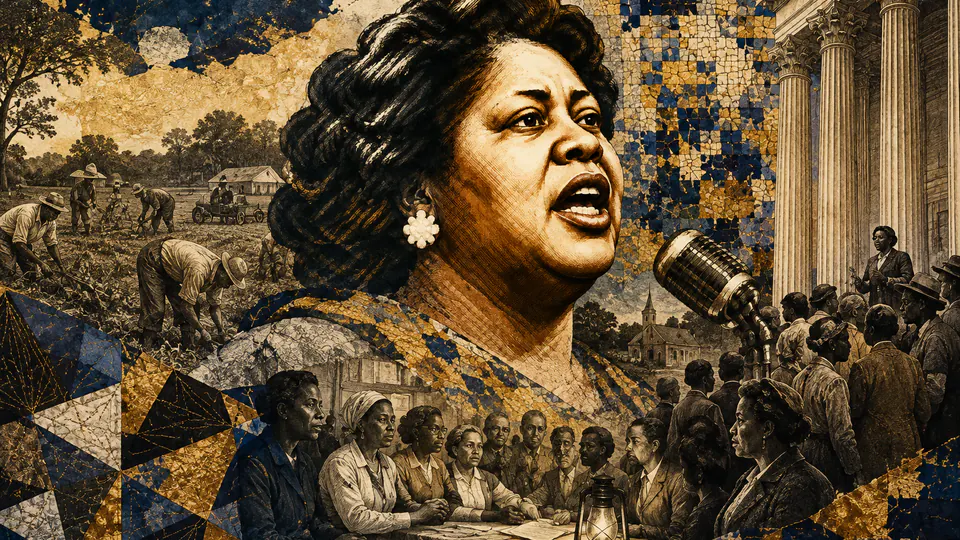
#storyFannie Lou Hamer told the Democratic National Convention’s credentials committee how Mississippi blocked Black citizens from voting and how police had ordered prisoners to beat her. President Lyndon Johnson called an unscheduled press conference while she spoke, pushing the testimony off live television. The networks replayed it that night. The interruption became part of the story Johnson wanted interrupted.
Registration cost her home and job
Hamer was born in 1917, the youngest of 20 children in a sharecropping family. She left school early to work and later kept plantation records. In August 1962 she joined a bus of people trying to register in Indianola. The plantation owner demanded that she withdraw her application. Hamer refused and was evicted.
She became a Student Nonviolent Coordinating Committee organizer. In June 1963, police arrested Hamer and others in Winona after they returned from citizenship training. Officers forced Black prisoners to beat her with a club. The injuries affected her health for the rest of her life.
A party that represented the voters
Mississippi’s regular Democratic organization excluded Black participation. Hamer helped create the Mississippi Freedom Democratic Party during Freedom Summer and challenged the all-white state delegation at the 1964 national convention.
Party leaders offered two at-large seats rather than replace the segregationist delegation. The MFDP rejected the compromise. It lost the immediate vote but exposed the national party’s bargain with segregation. By 1968, convention rules had changed and Hamer joined Mississippi’s official delegation.
Voting rights needed groceries
Hamer ran for Congress, organized against forced sterilization, and connected voting to material independence. In 1969 she founded the Freedom Farm Cooperative. It bought land, supported food production, and helped families obtain housing and livestock.
Hamer died in 1977 at 59. Her convention testimony is remembered because it was plain and unbearable. Her farm work supplied the other half of the argument: a ballot could remove a sheriff, but people evicted for registering still needed land on which to stand.
The plantation used citizenship as an employment condition
Hamer grew up in a sharecropping family in the Mississippi Delta. She picked cotton as a child and left school to work. As an adult at the Marlow plantation, she performed field labor and kept time and plantation records because she could read and calculate.
Sharecropping tied housing, credit, food, and employment to a landowner. A person who challenged white political rule could lose all of them at once. When Hamer tried to register in 1962, the plantation owner told her to withdraw the application or leave. She left.
That retaliation explains why voter-registration numbers cannot be separated from economic power. A registrar’s test blocked the application at the courthouse. The landowner punished the attempt at home. White-owned banks, stores, and employers could extend the penalty across a county.
SNCC turned local courage into organized repetition
Hamer joined the Student Nonviolent Coordinating Committee as a field secretary. She traveled, sang at meetings, taught political rights, and asked neighbors to risk the same registration process that had cost her a job. Organizing meant returning after a failed attempt, accompanying applicants, finding transportation, and supporting people after retaliation.
Her singing was not decoration before the serious work. Freedom songs steadied people in jail, made a meeting participatory, and carried political language to those who might never read a platform. Hamer’s voice could shift a frightened room from listening to acting.
The Winona jail beating in 1963 showed the system outside the registrar’s office. Police arrested a group returning from citizenship training and ordered incarcerated Black men to beat Hamer. State violence enlisted prisoners under threat, spreading responsibility while keeping officers in command. Hamer later described the attack in public rather than let shame isolate her.
The MFDP tested the national party’s rules
The Mississippi Freedom Democratic Party held meetings and selected delegates through a process open to Black residents. Its challenge at the 1964 Democratic National Convention was therefore both moral and procedural: which delegation had a democratic claim to represent Mississippi?
Hamer’s credentials testimony described eviction, registration barriers, gunfire, and the Winona beating. President Johnson’s surprise press conference diverted live coverage, but television networks replayed her statement. Attempted suppression gave reporters another reason to show it.
National party leaders feared losing white southern officials and offered the MFDP two at-large seats without votes. Accepting would have left the segregationist delegation in place and allowed party leaders to choose which challengers could enter. The MFDP rejected the offer.
The immediate loss was painful, and movement participants argued over whether refusal had been wise. Later convention rules required more representative delegations. Hamer joined Mississippi’s official delegation in 1968. Institutional change followed, but only after the excluded delegation had made the old rule publicly indefensible.
Freedom Summer joined registration to parallel institutions
Freedom Summer brought volunteers to a movement already built by Mississippi organizers. Projects included registration, Freedom Schools, community centers, and the MFDP. The murder of James Chaney, Andrew Goodman, and Michael Schwerner drew national attention that earlier Black victims had not received, revealing racism inside the news value assigned to death.
Hamer welcomed useful support without surrendering local authority. Outside volunteers could bring press attention and connections; local residents would remain when the summer ended. A campaign that treated Mississippi as a temporary moral classroom for northern students would reproduce the hierarchy it claimed to oppose.
Her congressional candidacy also challenged the rule that experience belonged only to officeholders. Hamer knew agricultural policy, poverty, policing, and elections from the receiving end. The campaign made that knowledge a qualification.
Bodily autonomy belonged in the freedom agenda
Years before her voting-rights work, Hamer underwent surgery for a uterine tumor and was sterilized without her informed consent. She later spoke about the prevalence of involuntary sterilization of Black women in Mississippi.
The experience connected racial and reproductive control. A government could deny a Black woman the vote while medical institutions denied her authority over whether to have children. Poverty programs and hospitals could offer needed services while using coercion against patients considered unfit.
Hamer’s politics therefore cannot be limited to access to the ballot. Bodily autonomy, health, family, and freedom from official violence were citizenship questions too. Later reproductive justice organizing would give that connection a broader framework.
Freedom Farm made independence material
Hamer founded the Freedom Farm Cooperative in 1969. The project acquired land, grew food, supported housing, and used a pig program to help families improve nutrition and income. Land reduced a white landowner’s ability to make political obedience the price of shelter and work.
The cooperative faced unstable funding, debt, and the immense difficulty of building an alternative economy inside a poor region. It helped families without escaping the credit, market, and public-policy structures around it. That limit is part of the lesson rather than evidence that the effort was beside the point.
Hamer died in 1977 after years of injuries and illness. Her record connects a registration form to a plantation ledger, a jail cell, a convention credential, a medical chart, and a farm deed. Each document carried a different kind of power over Black life. She organized until the people named in those records could write and enforce terms of their own.
In their own words
#wordsWhat Fannie Lou Hamer actually said, where, and when. Each one links to the page it was checked against.
-
I didn't register for you, I was trying to register for myself.
On her August 1962 attempt to register to vote, from "We're On Our Way," Indianola, Mississippi, September 1964. Fannie Lou Hamer, "We're On Our Way" (September 1964) -
How can you treat a human being like this?
On the June 1963 Winona jail beating, from the same Indianola speech, September 1964. Fannie Lou Hamer, "We're On Our Way" (September 1964) -
America is not the land of the free and the home of the brave.
From "We're On Our Way," Indianola, Mississippi, September 1964. Fannie Lou Hamer, "We're On Our Way" (September 1964) -
We shall overcome means something to me tonight.
From "We're On Our Way," Indianola, Mississippi, September 1964. Fannie Lou Hamer, "We're On Our Way" (September 1964) -
We want ours and we want ours now.
From "We're On Our Way," Indianola, Mississippi, September 1964. Fannie Lou Hamer, "We're On Our Way" (September 1964)
What people get wrong
#wrong- The myth
The Democratic Party offered the Mississippi Freedom Democratic Party a real seat at the 1964 convention. - The record
The offer Hubert Humphrey brokered on Lyndon Johnson's behalf was two non-voting at-large seats and a promise of reform by 1968. The MFDP turned it down.
- The myth
Hamer's convention testimony was pulled off the air and never reached the country. - The record
Johnson called an impromptu press conference in the White House East Room, thirty governors standing with him, while her testimony to the Credentials Committee was going out live on August 22, 1964. The networks ran her testimony in full that evening anyway.
- The myth
Hamer left the plantation in 1962 the way sharecroppers left plantations, because times were hard. - The record
The plantation owner, Marlowe, told her to withdraw her voter registration application or get off his land. She refused and was put off that day.
The dates that matter
#dates- October 6, 1917 Born in Montgomery County, Mississippi.
- August 31, 1962 Travels to Indianola to register to vote and loses her plantation job.
- June 1963 Beaten in the Winona jail after returning from citizenship training.
- 1964 Co-founds the Mississippi Freedom Democratic Party.
- August 22, 1964 Testifies to the Democratic convention credentials committee.
- 1968 Becomes part of Mississippi's convention delegation after party rules change.
- 1969 Begins the Freedom Farm Cooperative.
- March 14, 1977 Dies in Mound Bayou, Mississippi.
Questions people ask
#faqsWho was Fannie Lou Hamer?
Fannie Lou Hamer was a Mississippi sharecropper who became an organizer with SNCC and a co-founder of the Mississippi Freedom Democratic Party.
Why did Lyndon Johnson interrupt Hamer's testimony?
Johnson called an unscheduled press conference while she testified, apparently to keep her account from a live national audience. Television networks replayed it later.
What was the MFDP?
The Mississippi Freedom Democratic Party was an interracial party organized in 1964 to challenge the state's segregationist Democratic delegation.
What was Freedom Farm Cooperative?
Hamer founded it in 1969 to help Black families gain access to land, food, housing, and economic independence.
The bookshelf
#bookshelfWhere to go next. Buy from an independent bookstore, or find it at your library for nothing.
-
The Speeches of Fannie Lou Hamer: To Tell It Like It Is Maegan Parker Brooks and Davis W. Houck, editors, 2010 primary
Her own speeches, collected and annotated.
-
Walk with Me: A Biography of Fannie Lou Hamer Kate Clifford Larson, 2021 secondary
The most recent full biography, written from archives that opened after the earlier accounts.
-
This Little Light of Mine: The Life of Fannie Lou Hamer Kay Mills, 1993 secondary
The standard earlier biography, still widely cited.
Wear it: Fannie Lou Hamer
#merchEvery design here links back to this page.
Sources
#sourcesPrimary sources
The documents themselves: laws, court opinions, speeches, letters, and the numbers from the agencies that count them.
Secondary sources
Written afterward, about the story.