Published
Ida B. Wells
Ida B. Wells Counted the Lynchings and Checked the Excuses
Born July 16, 1862. Died March 25, 1931
Ida B. Wells used reporting, statistics, and organizing to expose lynching, fight segregation, and press a suffrage movement that sidelined Black women.
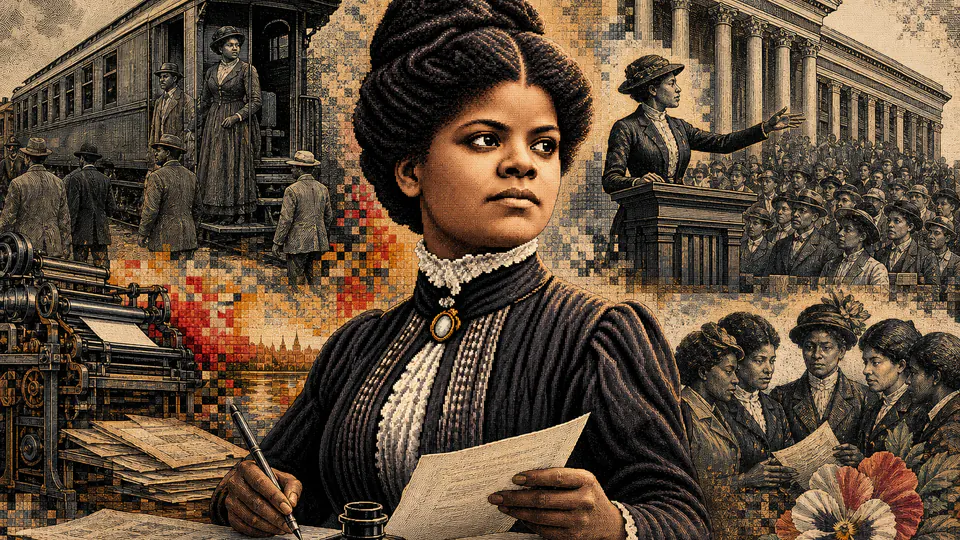
The story
#storyIda B. Wells investigated the claim that lynching punished sexual violence and found it repeatedly contradicted by the record. White mobs killed Black people who competed in business, asserted rights, or had consensual relationships across the color line, then newspapers printed an accusation as if it were a verdict.
Wells answered with names, dates, places, and counts. Outrage came with a spreadsheet.
A train case opened a newspaper career
Born enslaved in Mississippi in 1862, Wells lost her parents and a sibling to yellow fever and became a teacher to support younger children. In 1884 a railroad crew removed her from a first-class car. She sued and won in a lower court before the Tennessee Supreme Court reversed the judgment.
Wells began writing about segregated schools and transportation and became co-owner of the Memphis Free Speech. In 1892 a mob murdered her friend Thomas Moss and his business partners Calvin McDowell and Henry Stewart after their grocery competed with a white-owned store.
The office was destroyed, the reporting continued
Wells urged Black Memphians to leave the city and boycott streetcars. While she was away, a mob destroyed the newspaper office and threatened her life. She continued from New York and published Southern Horrors and A Red Record, using white newspapers’ own reports to expose the system.
She took the campaign to Britain, helping make U.S. racial violence an international question. In Chicago she built women’s clubs, worked in civil-rights organizations, opposed school segregation, and fought for women’s suffrage when white leaders treated Black participation as negotiable.
Wells died in 1931. The federal government did not make lynching a specific federal crime until 2022. Her reporting had established the case 130 years earlier. The delay was never a shortage of evidence.
Her method began by checking the alibi
White newspapers commonly presented lynching as an immediate response to an alleged crime. The formula protected the mob from scrutiny: print the accusation, omit the trial that never occurred, and describe collective murder as community defense. Wells read across reports and compared those stories with facts the same newspapers had published before the killing.
The comparison revealed economic competition, labor conflict, political assertion, and consensual interracial relationships hidden beneath claims of protecting white womanhood. Wells did not argue that the accused deserved a better newspaper hearing. She argued that mob killing was a system of racial control whose public excuse often collapsed under elementary investigation.
Her pamphlets used cases, tabulations, editorials, and direct argument. Statistics did not drain the violence of human meaning. They showed repetition. A single lynching could be dismissed as local passion; a documented pattern implicated officials, editors, railroads, businesses, and voters across jurisdictions.
Memphis taught the economic reach of a boycott
Thomas Moss, Calvin McDowell, and Henry Stewart operated the People’s Grocery in a Black Memphis neighborhood. Their business competed with a white-owned store. After an armed conflict and arrests, a mob removed the three men from jail and murdered them in March 1892.
Wells urged Black residents to leave Memphis when possible and to withhold fares from the streetcar system. Migration and boycott answered racial violence with economic consequences. The tactic recognized that city leaders who would not protect Black lives might still notice lost labor, rent, customers, and transit revenue.
The response also showed the price of truth-telling. A white mob destroyed the Memphis Free Speech office while Wells was away and warned her not to return. Exile cost her a newspaper and home base. It also turned a local journalist into a national organizer whose evidence traveled farther than the threat intended.
Britain changed the audience for an American crime
Wells toured Britain in 1893 and 1894, speaking to reformers, religious groups, and reporters. International attention embarrassed U.S. leaders who described the country as a model republic. British anti-lynching committees could pressure American churches and newspapers while circulating information that domestic outlets suppressed.
The tours required political care. European audiences could condemn U.S. racism while ignoring violence within the British Empire. Wells used the platform without handing them moral innocence. Her purpose was to create external pressure on a system whose local officials protected the mob.
The campaign also exposed a divide among reformers. Frances Willard of the Woman’s Christian Temperance Union had repeated racist claims about Black men and did not welcome Wells’s public challenge. Wells refused to keep coalition peace by allowing a white leader’s words to pass unexamined.
Chicago organizing went well beyond journalism
After marrying attorney Ferdinand Barnett, Wells made Chicago her base while keeping her name in public work. She helped establish the city’s first Black kindergarten, organized women’s clubs, opposed segregated schools, investigated racial violence, and helped build institutions including the Negro Fellowship League.
In 1909 she attended the meeting from which the NAACP developed, though conflicts over leadership and tactics left her outside the organization’s central structure. That distance did not mean withdrawal. Wells had a recurring suspicion of institutions that sought her evidence while limiting her authority.
During the 1908 Springfield violence in Illinois, her organizing again connected reporting to protection and political pressure. She also investigated the treatment of Black soldiers after the Brownsville affair. The subjects changed; the method did not. Identify whose testimony the government had discounted, establish the record, and organize a public capable of forcing an answer.
Suffrage did not excuse segregation
Wells understood the vote as protection against officials who tolerated racial terror. She helped found Chicago’s Alpha Suffrage Club in 1913 to develop Black women as voters and political actors. The club worked in local elections as well as the national suffrage campaign.
At the 1913 suffrage procession in Washington, organizers sought to place Black women at the rear to accommodate white southern participants. Wells refused the assigned position and joined the Illinois delegation during the march. The episode captured her approach to coalition: cooperation could not require accepting the hierarchy the movement claimed to oppose.
The Nineteenth Amendment barred denial of voting rights on account of sex, but Jim Crow rules and violence continued to disfranchise Black women across the South. Wells’s politics had anticipated that limit. A constitutional rule mattered; enforcement, organization, and protection determined who could use it.
The federal delay was a political choice
Wells and other activists pressed for anti-lynching law while opponents claimed murder belonged under state authority. States had often failed because sheriffs surrendered prisoners, juries would not convict, and officials shared the mob’s politics. The jurisdictional argument turned deliberate nonenforcement into a reason for more delay.
The House passed the Dyer Anti-Lynching Bill in 1922, but southern senators blocked it. Similar efforts failed for decades. Federal civil-rights prosecution and later law provided some tools, yet a specific federal anti-lynching statute did not arrive until the Emmett Till Antilynching Act of 2022.
Wells did not live to see even the earlier federal measures. She died in Chicago in 1931. Her achievement was not that she made denial impossible. Denial remained politically useful. She made it costly, documented, and available for the next organizer to confront with the receipts already in order.
In their own words
#wordsWhat Ida B. Wells actually said, where, and when. Each one links to the page it was checked against.
-
Nobody in this section of the country believes the old thread-bare lie that Negro men rape white women.
From the Memphis Free Speech editorial a mob cited when it destroyed her newspaper office in May 1892, republished in Southern Horrors, 1892. Ida B. Wells-Barnett, Southern Horrors: Lynch Law in All Its Phases (1892) -
There are many white women in the South who would marry colored men if such an act would not place them at once beyond the pale of society.
From Southern Horrors, 1892. Ida B. Wells-Barnett, Southern Horrors: Lynch Law in All Its Phases (1892) -
White men lynch the offending Afro-American, not because he is a despoiler of virtue, but because he succumbs to the smiles of white women.
From Southern Horrors, 1892, stating the argument her counts were built to prove. Ida B. Wells-Barnett, Southern Horrors: Lynch Law in All Its Phases (1892) -
By the right exercise of his power as the industrial factor of the South, the Afro-American can demand and secure his rights, the punishment of lynchers, and a fair trial for accused rapists.
From Southern Horrors, 1892, in the chapter urging boycott and migration after the Memphis lynchings. Ida B. Wells-Barnett, Southern Horrors: Lynch Law in All Its Phases (1892) -
A Winchester rifle should have a place of honor in every black home, and it should be used for that protection which the law refuses to give.
From Southern Horrors, 1892, on armed self-defense against mob violence. Ida B. Wells-Barnett, Southern Horrors: Lynch Law in All Its Phases (1892)
What people get wrong
#wrong- The myth
Lynching in the Jim Crow South was primarily punishment for the rape of white women. - The record
In Southern Horrors, Wells tallied that only about one third of 728 lynching victims counted over the preceding eight years had even been accused of rape. She traced the rest to economic competition, political activity, minor disputes, or consensual interracial relationships that mobs recast as assault after the fact.
- The myth
White suffrage leaders welcomed Wells and other Black women as equal marchers in the 1913 Washington suffrage parade. - The record
National American Woman Suffrage Association organizers asked the Illinois delegation to leave its Black members out of the march, worried that white southern suffragists would otherwise refuse to participate. Wells refused the place at the back. Once the parade began she stepped out of the crowd and marched with the Illinois delegation the rest of the way.
- The myth
Wells helped found the NAACP and then helped run it alongside W.E.B. Du Bois. - The record
She was one of seven Black signers of the 1909 Call that produced the NAACP, and organizers then dropped her from an early founders list, putting a white woman's name in its place. Wells objected and her name went back on. She never held a lasting seat in the association's central leadership.
The dates that matter
#dates- July 16, 1862 Born enslaved in Holly Springs, Mississippi.
- 1878 Yellow fever kills her parents and a sibling; Wells becomes a teacher.
- 1884 Removed from a first-class train car and sues the railroad.
- 1889 Becomes co-owner and editor of the Memphis Free Speech.
- March 9, 1892 A mob murders Thomas Moss, Calvin McDowell, and Henry Stewart.
- 1892 Publishes Southern Horrors and loses her newspaper office to a mob.
- 1895 Publishes A Red Record.
- March 25, 1931 Dies in Chicago.
Questions people ask
#faqsWho was Ida B. Wells?
Ida B. Wells was an investigative journalist, anti-lynching organizer, suffragist, and civil-rights institution builder.
Why did Ida B. Wells investigate lynching?
After a white mob murdered her friend Thomas Moss and two business partners in Memphis, Wells examined newspaper reports and court records and challenged the false claims used to justify lynching.
Was Ida B. Wells a suffragist?
Yes. She organized Black women in Chicago and challenged racist exclusion within the larger suffrage movement.
How should Ida B. Wells be evaluated?
Separate the immediate result from the institutions, tactics, exclusions, and enforcement record that followed it.
The bookshelf
#bookshelfWhere to go next. Buy from an independent bookstore, or find it at your library for nothing.
-
Southern Horrors: Lynch Law in All Its Phases Ida B. Wells-Barnett, 1892 primary
Her own pamphlet: the cases and the counts behind her argument that lynching answered Black success, not the crime it claimed to punish.
-
Crusade for Justice: The Autobiography of Ida B. Wells Ida B. Wells, edited by Alfreda M. Duster, 1970 primary
Her own account of her life, compiled from her manuscript and published posthumously by her daughter.
-
Ida: A Sword Among Lions: Ida B. Wells and the Campaign Against Lynching Paula J. Giddings, 2008 secondary
The standard modern biography, as detailed on the fights with white allies as on the anti-lynching campaign itself.
Wear it: Ida B. Wells
#merchEvery design here links back to this page.
Sources
#sourcesPrimary sources
The documents themselves: laws, court opinions, speeches, letters, and the numbers from the agencies that count them.
Secondary sources
Written afterward, about the story.
- National Park Service, Ida B. Wells
- Library of Congress, Ida B. Wells in Chronicling America
- Library of Congress, Ida B. Wells-Barnett
- Library of Congress, Woman Journalist Crusades Against Lynching
- Wikipedia, Ida B. Wells
- Smithsonian, Ida B. Wells
- National Women's History Museum, Ida B. Wells
- National Park Service, Teaching Suffrage: Ida Wells and the Suffrage Procession
- Wikipedia, NAACP