Published
Frederick Douglass
Frederick Douglass Made Freedom an Argument America Could Not Evade
Born c. February 1818. Died February 20, 1895
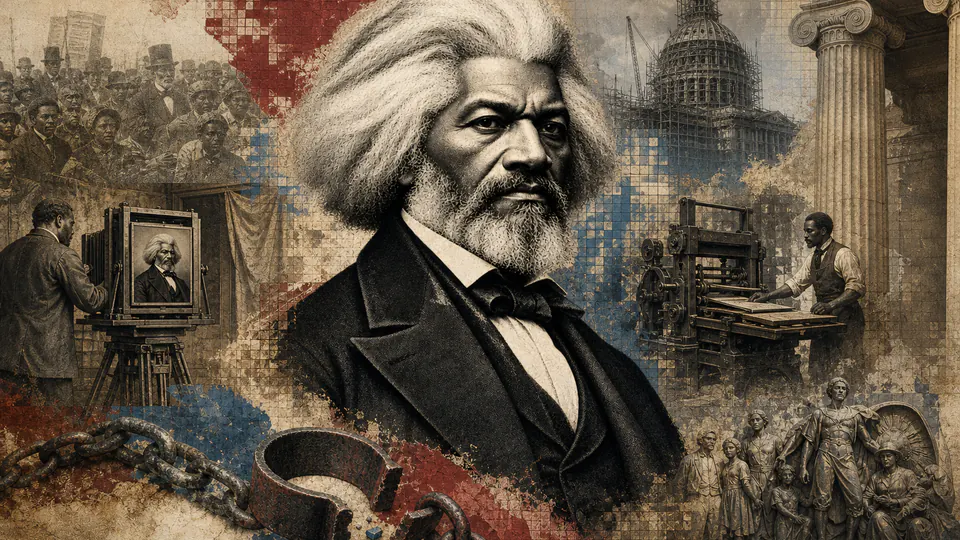
Frederick Douglass escaped slavery, became a leading abolitionist writer and speaker, and pressed the United States to match citizenship with equal rights.
The story
#storyFrederick Douglass escaped slavery and spent the rest of his life denying the country every excuse for it. He described the system from inside, analyzed the law that held it up, and argued that Black freedom required political power rather than sympathy.
Born on Maryland’s Eastern Shore around 1818, Douglass learned to read despite laws and customs meant to prevent it. He later treated literacy as a route to resistance, not a gentle path out of conflict. After escaping in 1838, he joined the abolitionist lecture circuit and published his first autobiography in 1845.
He refused the role assigned to a witness
White abolitionists sometimes wanted Douglass to recount suffering while leaving theory to them. He broke that division. He founded The North Star, split with William Lloyd Garrison over political strategy, and read the Constitution as a document that could be turned against slavery.
During the Civil War, Douglass pressed for emancipation and recruited Black men for the Union Army, including his sons. He met Abraham Lincoln to demand equal treatment for Black soldiers. Military service, he argued, made the claim to citizenship harder for the government to deny.
After emancipation, Douglass defended Reconstruction, voting rights, and federal enforcement against white terror. He also supported women’s suffrage, beginning at Seneca Falls, even as fights over the order of voting amendments divided former allies.
Douglass changed his views as the political ground changed. The consistent point was that freedom had to be exercised: in print, at the ballot box, in public office, and through organized pressure. A right left at the level of praise was a right waiting to be taken away.
Publication brought a danger as well as a platform. The detail in Douglass’s first autobiography helped prove authorship to skeptical white readers, but it also exposed his identity after escape. He traveled to Britain, where supporters raised money to purchase his legal freedom. Douglass accepted the purchase while insisting that no human being could rightfully own him. The transaction captures an abolitionist problem in miniature: people had to maneuver within property law while denying its claim to moral validity.
Literacy became both a tool and a punishable claim
Douglass was born enslaved on Maryland’s Eastern Shore around 1818 and separated from his mother as a child. In Baltimore, Sophia Auld began teaching him letters before her husband stopped the lessons. Douglass continued by exchanging bread for help from white boys and studying print around him.
Reading revealed the political structure of his condition while making daily obedience harder to bear. Literacy let him study antislavery argument, forge passes, and teach other enslaved people. Slaveholders understood that knowledge threatened the order they enforced.
After the overseer Edward Covey tried to break him through violence, Douglass fought back. Covey did not beat him again. The encounter did not make Douglass legally free, but it restored a sense of self-possession that shaped his later account of escape.
Escape created a new problem of public identity
Douglass escaped in 1838 with assistance and documents from Anna Murray, a free Black woman whom he soon married. In New Bedford he worked, joined an abolitionist community, and encountered William Lloyd Garrison’s newspaper.
His speeches gave audiences direct testimony, but racist listeners doubted that an eloquent man could have been enslaved. Publishing the 1845 Narrative answered the doubt by naming places and people. It also exposed him to recapture.
He traveled in Britain and Ireland while supporters arranged the purchase of his legal freedom. Douglass accepted the document as protection while rejecting the idea that the sale had created his actual freedom. The contradiction was imposed by law, not by a failure in his argument.
A newspaper gave him authority independent of allies
Douglass founded The North Star in Rochester in 1847 despite objections from some Garrisonians who preferred him on the lecture circuit. Editing a paper let him set an agenda, publish other Black writers, debate strategy, and build an institution not controlled by white abolitionist patrons.
He moved away from Garrison’s rejection of electoral politics and came to argue that the Constitution could be used against slavery. The change reflected a broader dispute over whether abolition required moral separation from a compromised state or a fight for control of its law.
Douglass also supported women’s suffrage and attended the Seneca Falls convention. His alliances with women reformers were substantial, though later arguments over the Fifteenth Amendment exposed conflict about race, sex, and political priority.
The Civil War had to become an emancipation war
At the war’s start, Lincoln prioritized preservation of the Union. Douglass pressed for emancipation and Black military enlistment, arguing that a nation asking Black men to fight could not deny their claim to citizenship.
After enlistment opened, he recruited for Black regiments, including the 54th Massachusetts. His sons Lewis and Charles served. Black soldiers faced unequal pay, discriminatory treatment, and the threat of enslavement or execution if captured.
Douglass met Lincoln and criticized the administration while supporting the war against the Confederacy. His relationship to presidential power was neither worship nor simple opposition. He used access to carry demands generated outside the White House.
Reconstruction made federal protection the central question
After slavery’s abolition, Douglass argued for Black male suffrage and federal enforcement against white violence. The Fifteenth Amendment prohibited racial discrimination in voting but left sex outside its text. Douglass supported the measure as an urgent defense of freedmen while continuing to endorse women’s voting rights.
The split with Elizabeth Cady Stanton and Susan B. Anthony became bitter, especially when some white suffragists used racist arguments against Black male enfranchisement. The episode resists a clean ranking of rights. Black communities faced organized terror, and Black women remained excluded on both grounds in practice.
Federal retreat allowed disfranchisement and Jim Crow to advance. Douglass kept warning that constitutional text without enforcement would not protect citizenship.
Office did not absorb the independent critic
Douglass held federal posts, including marshal and recorder of deeds in Washington, and later represented the United States in Haiti. These appointments marked a striking change from fugitive status. They also placed him inside a government whose policies he sometimes opposed.
His Haiti service came amid U.S. pressure for access to Mole Saint-Nicolas. Douglass resisted treating the Black republic as a convenient strategic possession. His international outlook linked U.S. racism to colonial and national power beyond its borders.
He died in Washington in 1895 after attending a women’s-rights meeting. His many photographs, speeches, newspapers, autobiographies, and public offices gave him unusual control over a historical record. The central achievement was not simply rising from slavery to prominence. He used each platform to dispute the conditions on which the platform had admitted him.
In their own words
#wordsWhat Frederick Douglass actually said, where, and when. Each one links to the page it was checked against.
-
From that moment, I understood the pathway from slavery to freedom.
Boston, Massachusetts, 1845, in the Narrative of the Life of Frederick Douglass, recalling the day his enslaver Hugh Auld forbade Sophia Auld from teaching him to read as a boy in Baltimore. Frederick Douglass, Narrative of the Life of Frederick Douglass, an American Slave (Boston, 1845), Documenting the American South -
It had given me a view of my wretched condition, without the remedy.
In the same 1845 Narrative, on what learning to read did to him as a boy enslaved in Baltimore. Frederick Douglass, Narrative of the Life of Frederick Douglass, an American Slave (Boston, 1845), Documenting the American South -
Men and women, old and young, married and single, were ranked with horses, sheep, and swine.
In the same 1845 Narrative, on the appraisal and division of enslaved people after the death of his enslaver Aaron Anthony, near Easton, Maryland. Frederick Douglass, Narrative of the Life of Frederick Douglass, an American Slave (Boston, 1845), Documenting the American South -
This Fourth July is yours, not mine. You may rejoice, I must mourn.
Corinthian Hall, Rochester, New York, July 5, 1852, in the address What to the Slave Is the Fourth of July?, delivered to the Rochester Ladies' Anti-Slavery Society. Frederick Douglass, What to the Slave Is the Fourth of July? (Rochester, 1852), Frederick Douglass Papers Project digital edition -
Slavery does away with fathers, as it does away with families.
Rochester, New York, 1855, in My Bondage and My Freedom, describing his separation from his parents as a child enslaved in Talbot County, Maryland. Frederick Douglass, My Bondage and My Freedom (Rochester, 1855), Documenting the American South -
"You can shoot me," said a slave to Rigby Hopkins, "but you can't whip me," and the result was he was neither whipped nor shot.
Talbot County, Maryland, recounted in Life and Times of Frederick Douglass (Hartford, 1881), on an enslaved man who refused the overseer Rigby Hopkins. Frederick Douglass, Life and Times of Frederick Douglass (Hartford, 1881), Documenting the American South
What people get wrong
#wrong- The myth
Douglass owed his freedom to the money British supporters paid for him in 1846. - The record
He had already freed himself eight years earlier, escaping unaided from Baltimore in 1838. The 1846 payment, just over $700 raised by British admirers, bought Hugh Auld's signature on manumission papers and removed the legal threat of recapture.
- The myth
Douglass was only a speaker and writer, never a government officeholder. - The record
He held three federal appointments after the Civil War: U.S. Marshal for the District of Columbia from 1877 to 1881, Recorder of Deeds for the District of Columbia from 1881 to 1886, and Minister Resident and Consul General to Haiti from 1889 to 1891.
- The myth
Douglass ran for vice president in 1872 on Victoria Woodhull's Equal Rights Party ticket. - The record
Woodhull named Douglass her running mate without his knowledge or consent and never informed him of it. He never acknowledged the nomination and campaigned that year for Ulysses S. Grant's re-election instead.
The dates that matter
#dates- c. February 1818 Born enslaved on Maryland's Eastern Shore.
- September 1838 Escapes slavery and soon marries Anna Murray.
- 1841 Joins the Massachusetts Anti-Slavery Society lecture circuit.
- 1845 Publishes his first autobiography.
- 1847 Begins publishing The North Star in Rochester.
- 1863 Recruits Black soldiers for the Union and meets with President Lincoln.
- 1872 Moves to Washington, D.C., after his Rochester home burns.
- February 20, 1895 Dies after attending a women's-rights meeting.
Questions people ask
#faqsHow did Frederick Douglass escape slavery?
In 1838 he traveled north using borrowed identification papers from a free Black sailor, then settled with Anna Murray in Massachusetts.
What newspaper did Frederick Douglass publish?
He founded The North Star in Rochester, New York, in 1847. It later merged with another paper and became Frederick Douglass' Paper.
Did Frederick Douglass support women's suffrage?
Yes. He attended the Seneca Falls convention and remained a supporter, though arguments over the Fifteenth Amendment strained the movement's alliances.
How should Frederick Douglass be evaluated?
Separate the immediate result from the institutions, tactics, exclusions, and enforcement record that followed it.
The bookshelf
#bookshelfWhere to go next. Buy from an independent bookstore, or find it at your library for nothing.
-
Narrative of the Life of Frederick Douglass, an American Slave Frederick Douglass, 1845 primary
His own account of enslavement in Maryland and the escape north, published seven years after he made it.
-
Frederick Douglass: Autobiographies Frederick Douglass, 1994 primary
All three of his autobiographies in one Library of America volume, 1845 to 1892.
-
Frederick Douglass: Prophet of Freedom David W. Blight, 2018 secondary
The Pulitzer Prize-winning biography, built on a private archive of Douglass family papers other historians had not seen.
-
The Slave's Cause: A History of Abolition Manisha Sinha, 2016 secondary
Places Douglass inside the wider abolition movement he spent his life arguing within and against.
Wear it: Frederick Douglass
#merchEvery design here links back to this page.
Sources
#sourcesPrimary sources
The documents themselves: laws, court opinions, speeches, letters, and the numbers from the agencies that count them.
- Library of Congress, Frederick Douglass Papers
- Library of Congress, Frederick Douglass newspapers
- Frederick Douglass, Narrative of the Life of Frederick Douglass, an American Slave (Boston, 1845), Documenting the American South
- Frederick Douglass, What to the Slave Is the Fourth of July? (Rochester, 1852), Frederick Douglass Papers Project digital edition
- Frederick Douglass, My Bondage and My Freedom (Rochester, 1855), Documenting the American South
- Frederick Douglass, Life and Times of Frederick Douglass (Hartford, 1881), Documenting the American South
Secondary sources
Written afterward, about the story.
- National Park Service, Frederick Douglass
- National Park Service, Frederick Douglass National Historic Site
- Smithsonian, Frederick Douglass
- Wikipedia, Frederick Douglass
- Frederick Douglass Papers Project, Douglass Timeline
- Harvard Gazette, "1872 election: Victoria Woodhull picks Frederick Douglass as VP"