Published
Sojourner Truth
Sojourner Truth Put Race, Gender, Labor, and Freedom in the Same Speech
Born c. 1797. Died November 26, 1883
Sojourner Truth escaped slavery, won her son's return in court, and built a public life around abolition, women's rights, and material independence.
The story
#storySojourner Truth was born Isabella Baumfree in a Dutch-speaking slaveholding community in New York. Her life unsettles the convenient idea that slavery was a southern exception. New York did not complete gradual emancipation until 1827, and owners could sell people away while freedom was supposedly approaching.
Truth escaped with her infant daughter in 1826. When her son Peter was sold illegally to Alabama, she went to court and secured his return. A formerly enslaved Black woman used the law against a white man and won. That victory came before the speaking career that made her nationally known.
The remembered speech is not the recorded one
In 1843 she chose the name Sojourner Truth and traveled as a religious speaker. She joined abolitionism to women’s rights, arguing from work she had performed, children she had borne, violence she had survived, and freedom she had claimed.
At an 1851 convention in Akron, Ohio, Truth answered objections to women’s equality. The familiar “Ain’t I a Woman” version appeared twelve years later in dialect that did not match Truth’s Dutch-accented speech. The earliest newspaper report is different. The myth simplified a real intervention that needed no improvement.
During the Civil War, Truth recruited Black soldiers and aided people escaping slavery. Afterward she pressed the government to provide western land to formerly enslaved families. That campaign failed, but its premise was exact: legal freedom without land, wages, or protection could leave old power largely intact.
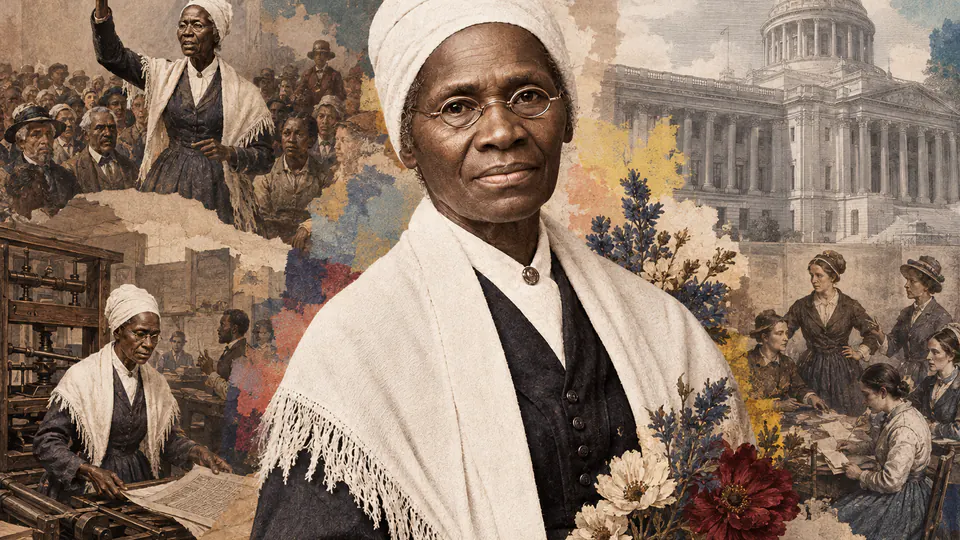
Truth also managed how the public saw her. She sold photographic portraits bearing a caption that connected her image to self-ownership, using the proceeds to support her work. The photographs countered racist caricature with a composed, self-directed public presence. Her literacy was limited, so the Narrative and later accounts were produced with collaborators, raising the same question as the Akron transcript: who records a Black woman’s words, and what do they add? Reading the versions together restores Truth as a strategist in print and image rather than a single borrowed line.
Northern slavery shaped every later argument
Isabella Baumfree was born in Ulster County, New York, where Dutch was her first language. She was sold away from her family as a child and passed through several households. New York’s gradual-emancipation law scheduled freedom by age and date, leaving owners years of forced labor to extract.
She married Thomas, an enslaved man, and had children whose lives remained exposed to an owner’s decisions. When John Dumont failed to honor a promise of early freedom, Baumfree left with her infant daughter Sophia in 1826. She described the act as walking away rather than running because she believed the labor agreement had already been broken by the owner.
The escape took place before statewide emancipation was complete. It places northern law inside the history of slavery, rather than treating freedom as a line waiting just across a southern border.
Recovering Peter made the courthouse a battleground
Baumfree learned that her young son Peter had been sold south in violation of New York law. With assistance from the Van Wagenen family and lawyers, she pursued his return. The proceedings required a formerly enslaved Black woman with limited English literacy to insist that a white buyer and seller answer to law.
She won, and Peter returned. The victory did not erase the trauma he had suffered or make courts generally safe for Black families. It showed Baumfree’s readiness to learn an institution’s procedures and force it to recognize a claim it preferred to ignore.
That same practical intelligence marked her later public life. Religious conviction did not pull her away from material questions. It supplied authority for demands about family, wages, bodily safety, and public power.
Choosing a name created a public vocation
In 1843, she took the name Sojourner Truth and began traveling as a preacher. She joined abolitionist communities, including the Northampton Association in Massachusetts, where she encountered reformers and supported herself through work and speaking.
Her Narrative, first published in 1850 through collaboration with Olive Gilbert, raised funds and carried her life to readers she could not meet. Because Truth did not write the book herself, the text requires attention to the recorder’s decisions. It still preserves experiences and arguments that slavery had tried to keep outside print.
Truth used wit, biblical interpretation, physical presence, song, and personal history. Hostile audiences might deny an abstract claim; she forced them to answer a Black woman standing in front of them who had performed hard labor, borne children, escaped, and recovered a son.
Akron became famous through a later rewrite
At the Ohio Women’s Rights Convention in 1851, Truth responded to arguments that women were too weak or intellectually unfit for equal rights. Marius Robinson published an account soon afterward. Frances Dana Gage issued a more dramatic version twelve years later, using a southern dialect and the repeated question now attached to Truth.
Truth’s first language was Dutch, not the dialect Gage supplied. The later text may capture themes from the intervention, but it should not be presented as a verbatim transcript. Comparing the accounts reveals how editors can improve a speech into historical inaccuracy.
The correction does not reduce the event. It restores a northern formerly enslaved speaker making an argument in her own context. It also warns against using one famous line as a substitute for decades of work across abolition, women’s rights, war, and land.
Civil War service led to a demand for land
During the Civil War, Truth recruited Black soldiers, gathered supplies, and worked with people escaping slavery. She met Abraham Lincoln in 1864 and later challenged segregation on Washington streetcars. The meeting is often pictured as recognition from a president; her daily work among freedpeople says more about her priorities.
After the war, she supported western land grants for formerly enslaved families. Freedom without land left people dependent on former owners, hostile employers, and public relief administered by white officials. Truth’s proposal aimed at a material base from which legal citizenship could be exercised.
The campaign failed. Its failure helps explain the fragility of Reconstruction. The federal government had redistributed neither enough land nor enough power to protect families when national enforcement retreated.
A photograph claimed ownership of representation
Truth sold cartes de visite to finance her speaking and living expenses. The portrait cards presented her seated, carefully dressed, and engaged in domestic work. Their caption connected the sale of her image to ownership of herself.
The transaction reversed a central condition of slavery, under which owners could sell a person and control representation of Black life. Truth now selected the pose, circulated the image, and received the proceeds. Photography became income, public argument, and evidence of an authored political identity.
She died in Battle Creek, Michigan, in 1883. The speech, court case, narrative, land campaign, and portraits all ask the same archival question: who gets to record a Black woman’s meaning? Truth could not control every later version. She built enough of her own record that readers can compare, correct, and hear a politics larger than the line textbooks assigned her.
In their own words
#wordsWhat Sojourner Truth actually said, where, and when. Each one links to the page it was checked against.
-
As for intellect, all I can say is, if women have a pint and man a quart - why can't she have her little pint full?
Akron, Ohio, May 1851, from the earliest transcription of her women's-rights convention speech, published by Marius Robinson, who was present, in the Anti-Slavery Bugle, June 21, 1851. Marius Robinson's 1851 transcription, reproduced by the Sojourner Truth Project -
I have as much muscle as any man, and can do as much work as any man. I have plowed and reaped and husked and chopped and mowed, and can any man do more than that?
Akron, Ohio, May 1851, from the same Anti-Slavery Bugle transcription. Marius Robinson's 1851 transcription, reproduced by the Sojourner Truth Project -
I cant read, but I can hear.
Akron, Ohio, May 1851, from the same Anti-Slavery Bugle transcription. Marius Robinson's 1851 transcription, reproduced by the Sojourner Truth Project -
No, I did not run away; I walked away by day-light, and all because you had promised me a year of my time.
Recalling her 1826 escape from enslaver John Dumont in Ulster County, New York, as dictated in the Narrative of Sojourner Truth, 1850. Narrative of Sojourner Truth (1850, 1884 edition) -
I'll have my child again.
On deciding to go to court after her son Peter was sold illegally into Alabama, 1828, as dictated in the Narrative of Sojourner Truth. Narrative of Sojourner Truth (1850, 1884 edition) -
I felt so tall within, I felt as if the power of a nation was with me!
On how she felt after a New York court ordered her son Peter returned to her in 1828, as dictated in the Narrative of Sojourner Truth. Narrative of Sojourner Truth (1850, 1884 edition)
What people get wrong
#wrong- The myth
The famous "Ain't I a Woman" refrain and Southern dialect are what Sojourner Truth actually said at the 1851 Akron women's-rights convention. - The record
The earliest transcription, by Marius Robinson, who sat on the platform and printed it in the Anti-Slavery Bugle on June 21, 1851, contains no "Ain't I a Woman" refrain and no dialect. The familiar dialect-heavy version, with the refrain, was published by Frances Dana Gage in the New York Independent on April 23, 1863, twelve years later, reconstructed from memory.
- The myth
Sojourner Truth grew up enslaved in the South and spoke in the Southern dialect later attached to her most famous speech. - The record
She was born and enslaved in Ulster County, New York, under Dutch enslavers, and Dutch was her first language. The Southern dialect in the Gage version of her 1851 speech does not match a New Yorker whose English was a second language.
- The myth
Sojourner Truth wrote her own narrative and later speeches herself. - The record
She never learned to read or write. Her Narrative was dictated to Olive Gilbert and published in 1850, and her speeches were composed out loud and written down afterward by other people. That is why two rival texts of the 1851 Akron speech exist.
The dates that matter
#dates- c. 1797 Born Isabella Baumfree into slavery in Ulster County, New York.
- 1826 Escapes with her infant daughter Sophia.
- 1828 Wins a court action returning her son Peter from Alabama.
- 1843 Takes the name Sojourner Truth and begins traveling as a preacher.
- 1850 Publishes the Narrative of Sojourner Truth.
- May 1851 Speaks at the Ohio Women's Rights Convention in Akron.
- 1864 Meets President Abraham Lincoln and works with the National Freedmen's Relief Association.
- November 26, 1883 Dies in Battle Creek, Michigan.
Questions people ask
#faqsWhat was Sojourner Truth's birth name?
She was born Isabella Baumfree in Ulster County, New York, around 1797.
Did Sojourner Truth say Ain't I a Woman?
She gave a major women's-rights speech in Akron in 1851, but the familiar dialect version and refrain were published twelve years later. An earlier account uses different wording.
What did Sojourner Truth do during the Civil War?
She recruited Black troops, collected supplies, worked with freedpeople, and met President Abraham Lincoln.
How should Sojourner Truth be evaluated?
Separate the immediate result from the institutions, tactics, exclusions, and enforcement record that followed it.
The bookshelf
#bookshelfWhere to go next. Buy from an independent bookstore, or find it at your library for nothing.
-
Narrative of Sojourner Truth Sojourner Truth, dictated to Olive Gilbert, 1850 primary
Her own account, in her own words as dictated, of enslavement, escape, and the fight to recover her son.
-
Sojourner Truth: A Life, A Symbol Nell Irvin Painter, 1996 secondary
The standard modern biography, and the most careful about separating the record from the symbol built after her death.
-
Sojourner Truth: Slave, Prophet, Legend Carleton Mabee, 1993 secondary
A second modern biography, tracing how the Gage version of the 1851 speech overtook the Robinson transcription.
Wear it: Sojourner Truth
#merchEvery design here links back to this page.
Sources
#sourcesPrimary sources
The documents themselves: laws, court opinions, speeches, letters, and the numbers from the agencies that count them.
Secondary sources
Written afterward, about the story.