Published
Reconstruction
Reconstruction Was America's First Experiment in Multiracial Democracy
Reconstruction rewrote the Constitution, created public institutions, and brought Black voters and officials into southern government before a violent counterattack narrowed its gains.
The story
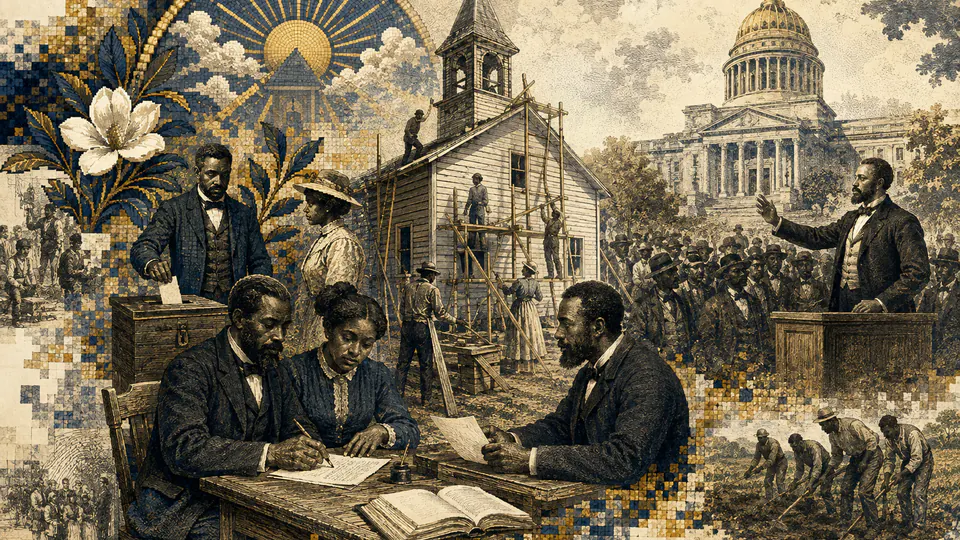
#storyReconstruction was the period when the United States briefly tried to build democracy after slavery. Formerly enslaved people voted, held office, created schools, reunited families, negotiated wages, and helped write new state constitutions. Democracy threatened the old ruling order, which organized an attack on the experiment.
The constitutional changes were enormous. The Thirteenth Amendment ended legal slavery except as punishment for crime. The Fourteenth established birthright citizenship and equal protection. The Fifteenth barred racial discrimination in voting. Congress created the Freedmen’s Bureau and passed civil-rights and enforcement laws over President Andrew Johnson’s obstruction.
Freedom moved into institutions
Black southerners held conventions, organized Republican clubs, founded schools and churches, and entered government at every level. Reconstruction administrations expanded public education and public services. Their coalitions included Black voters, white southern Republicans, and migrants from the North.
Land remained the central unresolved question. Most freed families did not receive the land they had worked. Sharecropping and debt tied many to white landowners under new contracts. Freedom in law met dependence in the field.
The counterattack was organized
The Ku Klux Klan and related groups used murder, whipping, economic retaliation, and election violence to break Black political power. Federal Enforcement Acts and troops suppressed some terror, but commitment weakened. Court rulings narrowed federal authority, northern politicians retreated, and the settlement following the disputed 1876 election removed remaining troops in 1877.
White southern governments then built disfranchisement and Jim Crow. Calling this a failure of Reconstruction mistakes the victim for the cause. Multiracial democracy worked long enough to identify its enemies and what they feared: votes, public institutions, federal protection, and Black control over labor and family life. The later civil-rights movement fought to recover ground abandoned after 1877.
Public education shows both the achievement and the conflict. Freedpeople had built schools during and immediately after the war, and Reconstruction governments created statewide systems where none had existed. Tax-supported schooling threatened an order that had reserved education and political knowledge for a narrow class. Black officeholders also worked on roads, hospitals, labor rules, and civil rights, making government visible in daily life. Later propaganda recast these administrations as uniquely corrupt while treating the violence used to overthrow them as background. That story helped justify the regime that replaced democracy with disfranchisement.
Emancipation created freedom without settled terms
The Civil War destroyed slavery, but formerly enslaved people still needed family reunification, land, wages, schools, legal standing, and protection from former owners. They left plantations, negotiated labor, formed churches, searched for relatives, and made political demands before federal policy had a stable answer.
The Freedmen’s Bureau supported schools, contracts, relief, and legal work while operating with limited resources and local resistance. Its record mixed genuine aid with pressure to return freedpeople to plantation labor.
Freedom was therefore a contest over authority. Former slaveholders sought labor control; freedpeople pursued independence; federal officers decided which claims they would enforce.
Black Codes tried to restore control without legal ownership
Southern legislatures enacted Black Codes regulating movement, contracts, vagrancy, and work. The laws avoided the name of slavery while using criminal and civil power to limit Black autonomy.
Vagrancy enforcement could turn unemployment or movement into arrest, fines, and coerced labor. Apprenticeship rules threatened Black family authority. Contract law favored employers who wanted a bound agricultural workforce.
These measures helped drive congressional Republicans toward stronger federal action. The Civil Rights Act of 1866 declared national citizenship and equal civil rights, over President Andrew Johnson’s veto.
Constitutional amendments remade the legal nation
The Fourteenth Amendment established birthright citizenship, due process, and equal protection. The Fifteenth prohibited denial of the vote on account of race, color, or previous servitude. Together with the Thirteenth, they changed the Constitution after a war caused by slavery.
The language was large; coverage was incomplete. The Fifteenth Amendment did not bar sex discrimination, producing conflict within abolitionist and suffrage coalitions. Equal protection needed courts and officials willing to read it against private and public racial power.
The amendments later became foundations for many civil-rights claims. Their reach came from Reconstruction, not from a Constitution that had been complete at the founding.
Republican government depended on Black political organization
Black men registered and voted in large numbers where federal protection made it possible. They served in constitutional conventions, local offices, state legislatures, the House, and the Senate. Churches, Union Leagues, conventions, and community networks provided political education and mobilization.
Reconstruction governments established public-school systems and acted on roads, taxation, labor, and civil rights. Coalitions included Black voters, white southern Republicans, and northern migrants. They contained disagreements and corruption, as governments do, but the later claim of uniquely incompetent Black rule was propaganda for overthrow.
Participation gave formerly enslaved people a direct role in writing state constitutions and budgets. That was the democratic fact opponents found intolerable.
Land remained the material question the settlement avoided
Some wartime policies temporarily placed abandoned or confiscated land under Black control. President Johnson restored much of it to former Confederates. Most freed families received no land grant.
Sharecropping offered access to land and a portion of the crop while leaving families exposed to debt, manipulated accounts, crop liens, and landlord power. Without capital or secure title, legal freedom could coexist with severe economic dependence.
The failure to redistribute land did not make political rights meaningless. It made them easier to punish. An employer or landlord could turn a vote into eviction and lost credit.
Organized terror attacked elections and institutions
The Ku Klux Klan and related groups used assault, murder, arson, and threats against Black voters, officeholders, teachers, and white Republicans. Violence was not random lawlessness. It had political targets and an electoral purpose.
Congress passed Enforcement Acts, and the federal government prosecuted some groups. Where enforcement was sustained, it disrupted terror. National attention later moved elsewhere, courts narrowed federal tools, and white paramilitary organizations adopted new forms.
Massacres in places including Colfax demonstrated that local authorities could be participants rather than neutral protectors. A right to vote meant little when armed opponents controlled the road to the polls.
Retreat was a process, not one closed-door bargain
Reconstruction’s end is often dated to the Compromise of 1877 and removal of remaining federal troops. The retreat had already advanced through court decisions, northern fatigue, economic crisis, Democratic electoral violence, and the restoration of white control state by state.
The following decades brought disfranchising constitutions, segregation, convict leasing, and lynching. Courts approved or ignored much of the new order. The federal government that had created enforcement tools chose not to use them at needed scale.
Calling the era a failure can hide who defeated it and how. An experiment in interracial democracy faced a sustained counterrevolution.
Memory helped maintain the settlement that terror won
The Lost Cause recast the Confederacy as honorable and Reconstruction as corrupt occupation. Textbooks, monuments, films, and public ceremony made white restoration look like rescue.
Black historians, communities, archives, and civil-rights organizers preserved another record. The twentieth-century freedom movement drew on Reconstruction amendments and returned to the federal enforcement question the country had abandoned.
Reconstruction remains unfinished in a precise sense. Its citizenship rules endure, and conflicts over voting, federal power, public education, criminal punishment, and the meaning of equal protection still run through the institutions it remade.
What people get wrong
#wrong- The myth
Reconstruction governments failed because Black officeholders were corrupt and incompetent. - The record
This is the Dunning School's founding claim, and it drove the segregationist history taught in most American schools for half a century. Historian Eric Foner counts roughly 2,000 Black Americans holding local, state, and federal office during Reconstruction, and found that graft, where it existed, was mostly the work of white businessmen and officials, not "the Negro voter." Foner and other historians describe the Dunning School's account as a distortion that ignored the era's constructive achievements, including the South's first statewide public school systems.
- The myth
Freedpeople received "forty acres and a mule" as a lasting land grant. - The record
General William T. Sherman's Special Field Order No. 15 set aside 400,000 acres on the South Carolina, Georgia, and Florida coast for freed families in January 1865, and roughly 40,000 people settled on it by June. President Andrew Johnson revoked the order that fall, pardoned the original owners, and had almost all of the land returned to them, dispossessing the Black families who had settled it. No comparable federal land grant followed.
- The myth
Black Americans did not vote or hold office in the South until the 1960s civil rights movement. - The record
Black men voted in large numbers and held office across the South during Reconstruction, decades before Jim Crow shut them out. Hiram Revels and Blanche K. Bruce served as U.S. senators from Mississippi in the 1870s, and Black representatives sat in the House the same decade, alongside roughly 2,000 Black officeholders at every level of government. Disfranchisement that followed in the 1890s was a rollback of rights already exercised, not the absence of them.
The dates that matter
#dates- 1865 The Thirteenth Amendment ends legal slavery; the Freedmen's Bureau begins operating.
- 1866 Congress passes the Civil Rights Act over President Andrew Johnson's veto.
- 1867 Reconstruction Acts place former Confederate states under military administration and set terms for readmission.
- 1868 The Fourteenth Amendment establishes birthright citizenship and equal protection.
- 1870 The Fifteenth Amendment bars racial discrimination in voting, though enforcement remains contested.
- 1870-1871 Congress passes Enforcement Acts against Klan terror.
- 1877 Federal troops withdraw from the South as part of a political settlement.
- 1890s Southern states entrench disfranchisement and Jim Crow rule.
Questions people ask
#faqsWhen was Reconstruction?
The usual dates are 1865 to 1877, though its constitutional legacy and the counterattack against it extend far beyond those years.
What did Black people achieve during Reconstruction?
Black communities built schools and churches, reunited families, negotiated labor, voted, held public office, wrote state constitutions, and defended civil and political rights.
Why did Reconstruction end?
White supremacist violence, court decisions, northern retreat, economic conflict, and the 1877 political settlement weakened federal enforcement and returned southern government to former Confederates and their allies.
How should Reconstruction be evaluated?
Separate the immediate result from the institutions, tactics, exclusions, and enforcement record that followed it.
The bookshelf
#bookshelfWhere to go next. Buy from an independent bookstore, or find it at your library for nothing.
-
Life and Times of Frederick Douglass Frederick Douglass, 1892 primary
Douglass lived through Reconstruction and its betrayal, and his own final autobiography says so directly.
-
Reconstruction: America's Unfinished Revolution, 1863-1877 Eric Foner, 1988 secondary
The standard history of the period, and the book that broke the Dunning School's hold on the textbooks.
-
Black Reconstruction in America, 1860-1880 W. E. B. Du Bois, 1935 secondary
The first full study centering Black political action, decades ahead of the historians who caught up to it.
Wear it: Reconstruction
#merchEvery design here links back to this page.
Sources
#sourcesPrimary sources
The documents themselves: laws, court opinions, speeches, letters, and the numbers from the agencies that count them.
Secondary sources
Written afterward, about the story.
- National Park Service, Reconstruction Era
- U.S. Senate, Civil Rights During Reconstruction
- National Archives, African American Voting-Rights Leaders
- Wikipedia, "Dunning School" (the school's claims about Republican state governments and Foner's rebuttal)
- Time, "Black Politicians Elected in the South After the Civil War" (Foner's estimate of about 2,000 Black officeholders during Reconstruction)
- Wikipedia, "Forty acres and a mule" (Special Field Order No. 15's terms and Johnson's 1865 reversal)