Published
Abolitionism
Abolitionism Made Slavery a System to Destroy, Not Improve
Abolitionism joined resistance by enslaved people to Black organizing, newspapers, churches, escape networks, political campaigns, and direct action against slavery.
The story
#storyAbolitionism named slavery as a system that had to end. That sounds plain now because the movement changed what could be said in public. For much of U.S. history, national politics treated slaveholders’ property claims as normal and immediate emancipation as dangerous extremism.
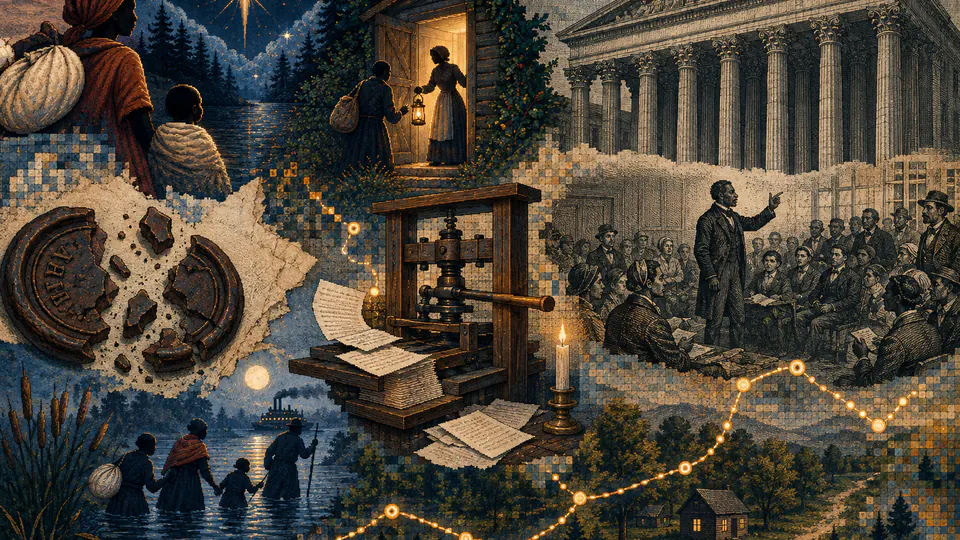
The movement did not begin when white reformers noticed slavery. Enslaved people fled, rebelled, preserved families, withheld labor, and passed information. Free Black communities built churches, mutual-aid societies, conventions, newspapers, and legal defense networks. White allies joined a movement whose knowledge and stakes were already Black.
A national system required national resistance
Antislavery organizers disagreed over voting, political parties, moral persuasion, women’s leadership, the Constitution, and force. Frederick Douglass moved from Garrisonian rejection of electoral politics toward using the Constitution and federal power. John Brown concluded that armed struggle was necessary. Harriet Tubman built freedom trip by trip.
The 1850 Fugitive Slave Act showed why slavery could not be quarantined in the South. It enlisted federal officers and residents of free states in recapture while denying accused fugitives basic protections. Resistance included rescues, vigilance committees, new routes to Canada, and open defiance of federal law.
Emancipation came through war and pressure
The Civil War began as a war to preserve the Union. Enslaved people changed its meaning by reaching Union lines, providing intelligence, refusing plantation labor, and joining the military when permitted. The Emancipation Proclamation made freedom a Union war aim in Confederate-held territory. The Thirteenth Amendment abolished slavery nationally, with an exception for punishment after conviction.
Abolition won a constitutional break, not a finished freedom. The next fights concerned land, wages, voting, education, family reunification, and protection from organized white violence. Those fights became Reconstruction, and the counterattack against them showed why ending ownership was necessary but insufficient.
Enslaved people created the crisis from inside
Slavery depended on forced labor and surveillance, which meant resistance occurred wherever the system operated. People slowed work, broke tools, preserved prohibited religious practices, learned to read, negotiated family ties, escaped temporarily or permanently, and sometimes organized revolt. These acts differed in scale and intent, but each contested an owner’s claim to command a whole person.
Escape produced knowledge networks. Free Black sailors, laborers, church members, boardinghouse keepers, and families passed warnings and arranged shelter. The Underground Railroad was not one hidden line or a single white-led organization. It was a shifting collection of routes and local relationships, with fugitives making decisions under danger.
Published narratives by people including Frederick Douglass and Harriet Jacobs attacked slavery’s public story. They documented physical violence, family separation, sexual coercion, stolen labor, and the intellectual work required to escape. A first-person account could answer politicians who discussed slavery as an abstract constitutional balance.
Print made a movement across distance
Black newspapers, abolitionist papers, pamphlets, lectures, petitions, and antislavery fairs moved evidence and money. Editors reprinted notices, speeches, and reports so a local case could become part of a national pattern. Postal circulation also provoked suppression. Southern officials tried to keep abolitionist material out of the mails, and mobs attacked presses and speakers in northern cities.
The murder of editor Elijah Lovejoy in 1837 showed that antislavery speech could be fatal outside a slave state. Mob violence sought to make abolition socially and financially impossible before it ever reached a legislature.
Black conventions developed positions on education, migration, political action, and self-defense. Churches and mutual-aid associations supplied meeting rooms, leadership, fundraising, and support for travelers. The movement’s communications system existed because ordinary organizations maintained it between famous speeches.
Strategy divided allies who shared the goal
William Lloyd Garrison and allies emphasized moral suasion and regarded the Constitution as compromised by slavery. Others formed antislavery parties, believing elections and federal office could restrict slavery and change law. Douglass changed his view and came to argue that the Constitution could be used against the institution.
Women raised funds, circulated petitions, wrote, and spoke publicly, then encountered men who accepted their labor but resisted their leadership. The 1840 split in the American Anti-Slavery Society concerned political strategy and women’s authority. Those disputes helped feed the organized women’s suffrage movement, while also exposing racial divisions that persisted after emancipation.
Debate over violence sharpened after the Fugitive Slave Act and the expansion of slavery. Some communities physically rescued detained fugitives. John Brown planned an armed seizure at Harpers Ferry. Harriet Tubman carried a revolver, guided people out of slavery, and later supported a Union military raid. Abolitionism contained pacifists and armed insurgents because the violence of slavery made every theory of change answer a hard question about force.
The Fugitive Slave Act erased the safe-state fiction
The 1850 law strengthened federal recapture and denied alleged fugitives ordinary procedural protections. Officials received authority to compel assistance, and the law threatened people who aided escape. A free Black resident could be seized on an owner’s claim and denied meaningful testimony in defense.
Resistance made northern streets part of the national conflict. Vigilance committees mobilized lawyers, crowds, transport, and money. Rescues in places such as Boston, Syracuse, and Wisconsin openly challenged federal officers. Other captives were returned under military guard, showing the power the national government devoted to property in people.
The law also sent more freedom seekers to Canada, beyond the reach of U.S. statute. It radicalized some people who had imagined slavery could remain geographically contained. Federal enforcement demonstrated that a system backed by national law could not be answered only by personal disapproval.
War opened emancipation, and enslaved people forced the opening
When the Civil War began in 1861, the Lincoln administration’s stated objective was preserving the Union. Enslaved people who reached U.S. lines created an immediate policy problem. Returning them aided the Confederate war effort; accepting them weakened it. The government first used the language of contraband, treating people as seized enemy property even as those people acted for their own freedom.
Congress passed confiscation measures, abolitionists pressed the administration, and Black leaders demanded the right to fight. The Emancipation Proclamation took effect on January 1, 1863, declaring freedom in areas in rebellion and authorizing Black military service. It did not immediately free every enslaved person, but it changed the legal and military purpose of the war.
Nearly 200,000 Black men served in the Union Army and Navy. Their service added force to the demand for citizenship while their families pursued freedom, wages, schooling, and reunion. Emancipation was a military policy, a presidential act, congressional work, and mass self-liberation at once. Removing any part produces a false story.
Constitutional abolition left the terms of freedom unsettled
The Thirteenth Amendment abolished slavery and involuntary servitude except as punishment for crime. Former slave states used Black Codes, vagrancy enforcement, convict leasing, debt, and labor coercion to recover control. The amendment destroyed legal ownership but did not distribute land or guarantee an independent livelihood.
Reconstruction brought the Fourteenth and Fifteenth Amendments, public schools, Black officeholding, and federal civil-rights enforcement. It also met organized terror and a national retreat from protection. Former abolitionists divided over suffrage, party loyalty, labor, and how long federal power should confront white rule.
The prison exception remains part of the Constitution and current debate over forced labor. That continuity does not mean slavery never ended. It means abolition was a specific and immense legal victory whose unfinished terms became new fields of struggle. The movement’s durable question is not whether an institution can be made kinder. It is who has the power to end it, and what material freedom must follow.
What people get wrong
#wrong- The myth
The Emancipation Proclamation freed every enslaved person in the United States the moment it took effect. - The record
It applied only to areas still in rebellion against the Union on January 1, 1863, and by its own text exempted Union-loyal border states and Confederate areas already under Northern control. Freedom in those excluded places came later, through state action or the Thirteenth Amendment's ratification on December 6, 1865.
- The myth
The Underground Railroad was a literal network of hidden tunnels. - The record
The National Park Service documents it as a shifting set of routes, safe houses, and human relationships among enslaved people fleeing bondage and the free people who sheltered them, not a built underground structure.
- The myth
White reformers organized the abolitionist movement, and Black abolitionists mainly followed their lead. - The record
The National Park Service counts roughly 300 Black abolitionists regularly working as speakers, writers, and antislavery-office managers, with thousands more organizing on the Underground Railroad, crediting leaders such as Frederick Douglass, Henry Highland Garnet, and Martin Delany with broadening the movement into what the agency calls America's first civil-rights movement.
- The myth
The Thirteenth Amendment abolished slavery with no exceptions. - The record
Its text bans slavery and involuntary servitude "except as a punishment for crime whereof the party shall have been duly convicted," an exception Southern states used to build convict leasing after 1865 and that remains part of current debate over forced prison labor.
The dates that matter
#dates- 1775 The Pennsylvania Abolition Society forms from an earlier antislavery association.
- 1808 A federal ban on importing enslaved people takes effect while domestic slavery continues.
- 1831 William Lloyd Garrison begins publishing The Liberator; Nat Turner leads a revolt in Virginia.
- 1840s-1850s Black vigilance committees, Underground Railroad networks, and antislavery parties expand.
- 1850 The Fugitive Slave Act compels federal and local participation in recapture.
- January 1, 1863 The Emancipation Proclamation declares enslaved people free in areas under Confederate control.
- December 6, 1865 The Thirteenth Amendment is ratified, abolishing slavery except as punishment for crime.
Questions people ask
#faqsWhat was abolitionism?
Abolitionism was the movement to end slavery, built through enslaved people's resistance, Black institutions, print, petitions, escape networks, political organizing, and in some cases armed action.
Did Abraham Lincoln start the abolitionist movement?
No. Black and white abolitionists had organized for decades before Lincoln's presidency, and enslaved people forced emancipation onto the Civil War's agenda through escape, intelligence, labor withdrawal, and military service.
Did the Thirteenth Amendment end all forced labor?
It abolished slavery and involuntary servitude except as punishment for crime. That exception helped enable convict leasing and remains part of current prison-labor debates.
How should Abolitionism be evaluated?
Separate the immediate result from the institutions, tactics, exclusions, and enforcement record that followed it.
The bookshelf
#bookshelfWhere to go next. Buy from an independent bookstore, or find it at your library for nothing.
-
Narrative of the Life of Frederick Douglass, an American Slave Frederick Douglass, 1845 primary
His own account of slavery and escape, written to answer people who doubted a former slave could write it.
-
Gateway to Freedom: The Hidden History of the Underground Railroad Eric Foner, 2015 secondary
Traces the Underground Railroad through New York's vigilance committee records, not folklore.
-
The Slave's Cause: A History of Abolition Manisha Sinha, 2016 secondary
Puts Black abolitionists and enslaved resistance at the center of the movement's history.
-
Freedom National: The Destruction of Slavery in the United States, 1861-1865 James Oakes, 2013 secondary
How emancipation actually moved through Congress, the army, and the courts during the war.
Wear it: Abolitionism
#merchEvery design here links back to this page.
Sources
#sourcesPrimary sources
The documents themselves: laws, court opinions, speeches, letters, and the numbers from the agencies that count them.
Secondary sources
Written afterward, about the story.