Published
Thomas Paine
Thomas Paine Made Independence a Mass Argument
Born February 9, 1737. Died June 8, 1809
Thomas Paine wrote political arguments for ordinary readers, then pushed beyond independence toward democratic government and economic security.
The story
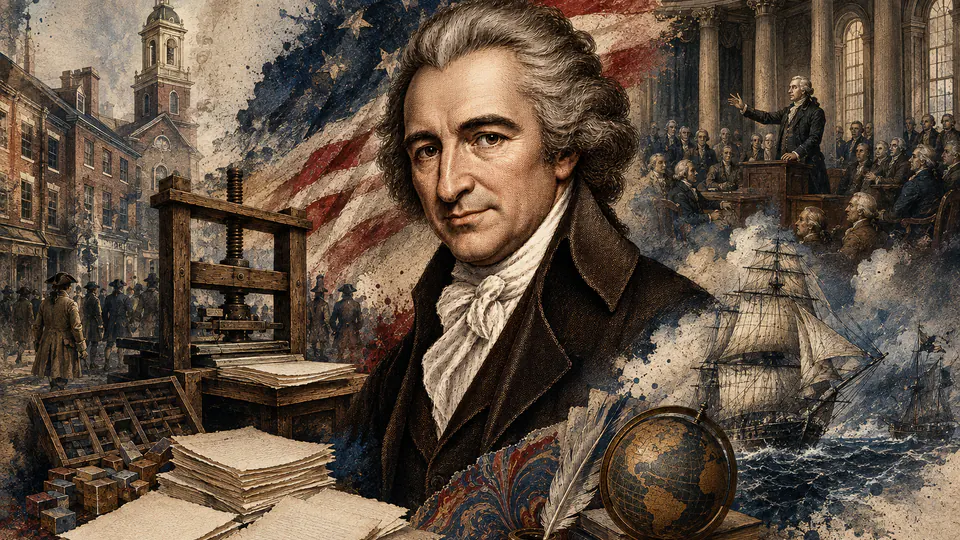
#storyThomas Paine wrote as if politics belonged to the people reading the pamphlet, not the officials named in it. Common Sense attacked monarchy in plain language and made independence feel like a decision colonists could argue about at a tavern table. Its reach helped turn a disputed break with Britain into a mass political demand.
Paine did not stop once independence had a flag. Rights of Man defended the French Revolution against Edmund Burke and rejected hereditary government as organized inequality. The British government prosecuted Paine for seditious libel, and he fled to France.
Rights needed material support
In France, Paine sat in the National Convention but opposed executing Louis XVI. That stand helped put him in prison during the Terror. His politics were democratic, but not obedient to whichever faction spoke in democracy’s name.
Agrarian Justice carried the argument into economic life. Paine said private land ownership had deprived people of a common inheritance. He proposed taxing estates to fund a payment at adulthood and an annual pension in old age. It was not modern democratic socialism, but it treated poverty as a political problem rather than a personal defect.
Paine died with few public mourners. His ideas had become less lonely: government by the living rather than the dead, rights without hereditary rank, and social provision owed as a matter of citizenship. He made radical demands portable. A cheap pamphlet could cross a workshop, a ship, or a border before authority caught up.
His reach also created enemies beyond government. The Age of Reason criticized organized religion and defended deism, costing Paine support among readers who had accepted his republican politics. He returned to the United States in 1802 to a far colder reception than the author of Common Sense might have expected. The reversal reveals a boundary in his popular method: writing for everyone did not mean telling everyone what they wanted to hear. Paine kept applying the same suspicion of inherited authority to kings, churches, and property arrangements.
Failure and debt came before the pamphlets
Paine was born in Thetford, England, in 1737, the son of a staymaker. He worked at his father’s trade, went to sea briefly, served as an excise officer, and experienced business failure and personal loss. He organized fellow excise officers for better pay and wrote a petition explaining how low salaries encouraged corruption.
That early campaign joined an administrative problem to a public argument. Paine learned to collect grievances, state a remedy, and write for readers with no reason to defer to him. After losing his excise position, he met Benjamin Franklin, whose letter of introduction helped him emigrate to Philadelphia in 1774.
In colonial print culture, Paine found the audience his English station had denied him. He edited the Pennsylvania Magazine and wrote on political and social questions. His new position did not make him a detached philosopher. He depended on printers, sales, patrons, and political allies like every other working writer.
Common Sense changed the scale of the argument
Published in January 1776, Common Sense attacked monarchy, hereditary succession, and reconciliation with Britain. Paine shifted the burden of proof. Instead of asking whether resistance to a king could be justified, he asked why an island and a hereditary ruler should govern a continent.
The pamphlet circulated widely in multiple editions. Exact sales totals are difficult to establish, but its reach was extraordinary for the colonies. Direct language, biblical reference, and a low price let the argument travel through taverns, workshops, homes, camps, and committees.
Paine published anonymously at first and did not secure wealth proportionate to the pamphlet’s fame. During the war he wrote the American Crisis series to support morale. Political writing worked as part of mobilization, not commentary delivered after events were settled.
Independence did not settle who belonged to the republic
Paine attacked hereditary government and supported a broad male political public by the standards of his time. His record on slavery is less simple than later admirers sometimes claim. An antislavery essay long attributed to him has disputed authorship, and he did not make abolition the center of his radical work.
That limit matters. A republic could reject a king while protecting slave ownership, excluding women, and dispossessing Indigenous nations. Paine’s universal language created tools later reformers could use against those exclusions, but language alone did not make his own program complete.
The same distinction applies to democracy. Paine believed ordinary people could judge government, yet political independence rested on military alliance, taxation, and new state institutions. A mass argument still had to be translated into durable rules.
Rights of Man made Britain answer the French Revolution
Edmund Burke’s attack on the French Revolution defended inherited institutions and warned against abstract rights. Paine answered with Rights of Man in 1791 and 1792, arguing that government came from the living people rather than ancestral settlement.
The second part moved from constitutional argument to social provision. Paine proposed tax changes and public support for poor families, education, older people, and those seeking work. Political rights required institutions that reduced dependence and gave ordinary people room to exercise judgment.
British authorities prosecuted him for seditious libel. Paine fled to France and was convicted in his absence. The government also pursued printers and sellers. A cheap pamphlet frightened authority because repression had to follow the text through an entire distribution network.
Revolution placed him on both sides of a prison door
France elected Paine to the National Convention even though he spoke limited French. He supported the republic but opposed executing Louis XVI, arguing instead for exile. When the Jacobins gained power, Paine’s association with their opponents and his stand on the king placed him in danger.
He was imprisoned during the Terror and narrowly escaped execution. The Age of Reason, written around this period, defended deism and criticized organized religion. Paine applied his rejection of inherited authority to churches as well as crowns.
That consistency cost support. Many American readers who admired Common Sense saw his religious criticism as an attack on social order. A writer who had helped create a national consensus became politically lonely when he kept using the same method on institutions the new republic considered safe.
Agrarian Justice treated poverty as a property question
In Agrarian Justice, Paine distinguished improvements created by labor from the land itself, which he regarded as a common inheritance. Private ownership had created wealth but also dispossessed people of access to that inheritance.
His remedy was a tax on inherited estates funding a capital grant at adulthood and annual payments for older people. The proposal was neither charity nor a full program of common ownership. It was compensation owed by a property system to every person excluded from the natural inheritance on which it rested.
The plan anticipates later arguments over social insurance, universal grants, and basic income without fitting neatly inside any one of them. Paine supplied an enduring test: if a legal system creates concentrated wealth and dependence, formal equality before that law is not enough.
He returned to the United States in 1802 and died in New York in 1809 with few mourners. His remains were later removed from the grave and lost. The physical memorial failed; the portable argument survived. A worker with a printer could challenge a king, and a republic that accepted the first pamphlet still had to answer the next one.
In their own words
#wordsWhat Thomas Paine actually said, where, and when. Each one links to the page it was checked against.
-
Society in every state is a blessing, but Government, even in its best state, is but a necessary evil; in its worst state an intolerable one...
Opening "Common Sense," January 1776, distinguishing society from government before making the case against monarchy. Thomas Paine, "Common Sense" (1776) -
Poverty, therefore, is a thing created by that which is called civilized life.
In "Agrarian Justice," 1797, arguing that landlessness, not nature, produced poverty. Thomas Paine, "Agrarian Justice" (1797) -
It is a position not to be controverted that the earth, in its natural, cultivated state was, and ever would have continued to be, the common property of the human race.
The same 1797 essay, laying out the premise behind his proposed inheritance tax and citizen's grant. Thomas Paine, "Agrarian Justice" (1797) -
Every proprietor, therefore, of cultivated lands, owes to the community a ground-rent for the land which he holds.
The same 1797 essay, stating the obligation his plan was meant to collect on. Thomas Paine, "Agrarian Justice" (1797)
What people get wrong
#wrong- The myth
Agrarian Justice proposed abolishing private property. - The record
Paine explicitly separated the land itself, which he called common inheritance, from the improvements a person's labor added to it; he wanted proprietors to pay ground-rent on the first while keeping full ownership of the second, financing fixed payments rather than redistributing land.
- The myth
Paine was a consistent abolitionist whose writing put slavery at the center of his politics. - The record
An early antislavery essay long credited to Paine has disputed authorship, and none of his major works, Common Sense, Rights of Man, or Agrarian Justice, makes abolition a central demand; his universal language about rights was used by later reformers more than it was aimed by him at slavery specifically.
- The myth
Paine's radicalism was rewarded with lasting popularity in the country he helped win independence for. - The record
The Age of Reason's attack on organized religion cost him support among readers who had cheered Common Sense, and he returned to the United States in 1802 to a hostile reception; he died in New York in 1809 with few public mourners.
The dates that matter
#dates- February 9, 1737 Born in Thetford, England.
- 1774 Arrives in Philadelphia with a letter of introduction from Benjamin Franklin.
- January 1776 Publishes Common Sense.
- 1776-1783 Publishes The American Crisis essays during the war for independence.
- 1791-1792 Publishes the two parts of Rights of Man.
- 1793-1794 Imprisoned in France during the Terror.
- 1797 Publishes Agrarian Justice.
- June 8, 1809 Dies in New York.
Questions people ask
#faqsWhat did Thomas Paine write?
His major works include Common Sense, The American Crisis, Rights of Man, The Age of Reason, and Agrarian Justice.
Was Thomas Paine a socialist?
He lived before modern socialism took shape. His attack on inherited power and his plan for social payments made him an important precursor, but the later label should not erase the differences.
Why was Thomas Paine imprisoned?
During the French Revolution, Paine opposed executing Louis XVI and fell out with the Jacobin government. He was jailed during the Terror.
How should Thomas Paine be evaluated?
Separate the immediate result from the institutions, tactics, exclusions, and enforcement record that followed it.
The bookshelf
#bookshelfWhere to go next. Buy from an independent bookstore, or find it at your library for nothing.
-
Common Sense Thomas Paine, 1776 primary
The pamphlet that turned a dispute with Britain into a mass argument for independence.
-
Rights of Man Thomas Paine, 1791 primary
His defense of the French Revolution and case against hereditary government, in two parts.
-
Tom Paine: A Political Life John Keane, 1995 secondary
The standard biography, tracking him across three revolutions and the enemies each one earned him.
Wear it: Thomas Paine
#merchEvery design here links back to this page.

Sources
#sourcesPrimary sources
The documents themselves: laws, court opinions, speeches, letters, and the numbers from the agencies that count them.
Secondary sources
Written afterward, about the story.