Published
Bernie Sanders
Bernie Sanders Before the Presidential Runs: Ten Votes and the Burlington Years
Born September 8, 1941
Bernie Sanders won Burlington's mayoralty by ten votes on March 3, 1981 and held it four terms. The early career, from a 1963 Chicago arrest to the Senate.

The story
#storyBernie Sanders lost four statewide races in Vermont between 1972 and 1976 and never cleared seven percent in any of them. On March 3, 1981 he won the mayor’s office in Burlington by ten votes, and he kept it for four terms. He has been a United States senator since 2007 and was Vermont’s lone member of the House for sixteen years before that, but the eight years running Burlington are where the politics got built and tested.
Brooklyn, then Chicago
Sanders was born in Brooklyn on September 8, 1941. His father, Eliasz Sanders, was a Jewish immigrant from Słopnice in Poland; his mother, Dorothy Glassberg, was born in New York. He went to P.S. 197 and to James Madison High School, where he captained the track team, spent a year at Brooklyn College, and transferred to the University of Chicago, taking a political science degree in 1964.
He joined the campus chapter of the Congress of Racial Equality in the fall of 1961 and was voted its chairman before that school year was out. In January 1962 students had established that the university, whose dormitories were integrated, owned off-campus apartment buildings that were not. Sanders spoke to about two hundred students on the administration building steps and then led a few dozen of them inside to sit down on the fifth floor outside the president’s office. The Associated Press has his line from that afternoon:
We feel it is an intolerable situation, when Negro and white students of the university cannot live together in university-owned apartments.
The sit-in ran fifteen days. The university ended racial segregation in its private housing by the summer of 1963.
On August 12, 1963, by the Chicago Tribune’s count, police arrested fifty-six people at a protest in Englewood against the Willis wagons, the mobile classroom trailers that schools superintendent Benjamin Willis parked outside crowded Black schools rather than bus the children to better-resourced schools in white neighborhoods. Dick Gregory was one of the fifty-six. So was Sanders, then twenty-one, charged with resisting arrest, found guilty, and fined $25. Sixteen days later he was in the crowd at the March on Washington. The photograph of his arrest sat unidentified in the paper’s archive until reporters dug it out in 2016, during his first presidential campaign.
Four losing campaigns and one record album
Sanders moved to Vermont in 1968 and settled in Stannard. In the 1970s he ran four times for statewide office on the ticket of the Liberty Union Party, and the results were: 1,571 votes in the 1972 special election for Senate, 2.2 percent; 2,175 for governor that November, 1.1 percent; 5,901 for Senate in 1974, 4.1 percent; and 11,317 for governor in 1976, 6.1 percent. Then he stopped running for a while.
What he did next was make a record about a man who lost five presidential elections. Working as director of the American People’s Historical Society, a small operation he ran out of Burlington, Sanders wrote and produced a half-hour documentary on Eugene V. Debs, and Folkways Records released the audio as album FH 5571 in 1979. The Smithsonian, which absorbed the Folkways catalog, still carries it.
Ten votes
Gordon Paquette had been mayor of Burlington for ten years and was running for a sixth term. The Burlington Free Press projected he would win by more than thirty points. Sanders came at him on property taxes:
After 10 years as mayor and 13 years as an alderman, I am rather amazed that the only idea he can come up with for raising revenue is to increase the tax on homeowners.
The coalition behind him was an odd one for a socialist. Sanders has described it as women’s groups, housing advocates, and the Burlington Patrolmen’s Association, which represented the city’s police officers. A third candidate, Richard Bove, drew 1,091 votes after failing to get the Democratic nomination. On election night, March 3, 1981, Sanders led by twenty-two votes out of 9,880 cast. His people woke Superior Court Judge Edwin Amidon at two in the morning to impound the paper ballots. The recount brought the margin down to ten, and Paquette let it stand.
The aldermen fired his secretary
Sanders was sworn in on April 6, 1981 with eleven of the thirteen aldermen against him. They fired the secretary he had brought with him, on the grounds that he had skipped the hiring procedure. They rejected his appointments to city posts outright and rode over his vetoes. John Franco Jr., who served as an assistant city attorney under Sanders, described the first stretch to the Boston Globe in 2015:
It was like Omaha Beach. They kept driving us back into the sea again and again.
He governed anyway. His new treasurer turned up a $1.9 million surplus buried in the existing budget. The city bought a fleet of snowplows and repaved its streets, and one of the administration’s first programs, Operation Snow Shovel, sent young people out to clear snow for elderly and disabled residents.
He fixed the board at the ballot box. In March 1982 a coalition of independents and Citizens Party candidates took three aldermanic seats, giving Sanders five of thirteen, one more than he needed to make a veto stick. A year later he was re-elected with 6,942 votes and 52 percent, running against a Democrat and a Republican at the same time. He won again in 1985 and 1987 and left the office on April 4, 1989.
What eight years in city hall built
After the 1983 re-election Sanders set up the Community and Economic Development Office, which handled housing, small business, jobs, and public access to the waterfront, and Neighborhood Planning Assemblies, ward-level meetings with small budgets and a voice in how federal block grant money got spent.
The durable one is housing. In 1984 the city put $200,000 of surplus money into the new Burlington Community Land Trust, the first municipally funded community land trust in the United States. The mechanism is simple: the trust holds the land permanently, the buyer owns the building, and the resale formula keeps the price within reach of the next buyer instead of handing the appreciation to the last one. It operates today as the Champlain Housing Trust, with roughly 2,800 affordable units by The Nation’s 2015 count. Sanders picks the land trust himself: he has called creating it one of his proudest accomplishments as mayor.
The waterfront, and the part that gets told wrong
In October 1983 the Alden Corporation bought twelve acres of Burlington’s rail waterfront and proposed to fill it with condominiums, offices, retail space, a hotel, and a parking garage. Sanders backed the plan. He argued it was the best deal the city was going to get for a derelict waterfront, and he campaigned for the bond it needed. In December 1985 the bond won a majority of Burlington voters and fell short of the two-thirds it required, beaten by environmentalists including Rick Sharp, Bea Bookchin, and Sandy Baird, and by a school board that came out against it shortly before the vote.
The bike path, the public beach, the community boathouse, and the science center that sit on that ground today were built afterward, by Sanders and by his successor Peter Clavelle, once the private plan was dead. The often-told version, that Sanders saved the waterfront from the developers, compresses two different fights into one. The Nation’s 2015 account credits him with beating back an earlier, larger private plan for the same shoreline; Molly Walsh’s reporting in Seven Days documents that when the Alden plan came, he backed it, campaigned for its bond, and lost. Both are true of different proposals, and the public waterfront got built out of the wreckage of the second one.
A mayor with a foreign policy
Burlington’s mayor also wrote to presidents. In October 1983, with the CIA funding the contras in Nicaragua, Sanders sent Ronald Reagan a letter preserved with his mayoral papers at the University of Vermont:
At a time when your administration has imposed horrendous cutbacks to the American people in such areas as housing, aid to education, environmental protection and health care, I am appalled that you are using taxpayers’ money to destroy the government of a small nation.
The Board of Aldermen approved a sister city arrangement with Puerto Cabezas, Nicaragua, in 1984. In July 1985 Sanders flew to Managua for the sixth anniversary of the Sandinista government and was, according to Seven Days, the only U.S. government official present. On October 14, 1988 he signed a sister city agreement with Alexander Ryabkov, the mayor of Yaroslavl in the Soviet Union. The letters and the trip records sit with his mayoral papers at the University of Vermont.
Washington
Sanders ran for governor of Vermont as an independent in 1986 and took 14.4 percent. He ran for the state’s single House seat in 1988 and lost to Republican Peter Plympton Smith by about three points. He ran again in 1990 and won with 117,522 votes, 56 percent to Smith’s 39.5, then co-founded the Congressional Progressive Caucus in 1991. Sixteen years in the House, and then the Senate seat in 2006 with 171,638 votes and about 65 percent. He is the longest serving independent in the history of the United States Congress.
On September 13, 2017 he introduced the Medicare for All Act, S. 1804, with sixteen Senate cosponsors. The single-payer bill was referred to the Committee on Finance, and no version of it has become law. He ran for the Democratic presidential nomination in 2016 and 2020 and finished second both times, the second campaign under the slogan Not me, us. He describes himself as a democratic socialist. Burlington elected him four times.
The Debs record is still in the Smithsonian Folkways catalog under the name Bernard Sanders: a Vermont man who had just lost four elections in a row, telling the life of a man who lost five. He made it in 1979. Two years later he won one, by ten votes.
In their own words
#wordsWhat Bernie Sanders actually said, where, and when. Each one links to the page it was checked against.
-
The American people understand, as I do, that health care is a human right, not a privilege and that we must end the international embarrassment of the United States being the only major country on earth that does not guarantee health care to all of its citizens.
Press conference introducing the Medicare for All Act outside the U.S. Capitol, Washington, D.C., April 29, 2025. Sanders, Jayapal, Dingell, Hundreds of Health Care Workers Introduce Medicare for All (press release) -
It is not acceptable to me, nor to the American people, that over 85 million people today are either uninsured or underinsured.
Same April 29, 2025 press conference introducing the Medicare for All Act. Sanders, Jayapal, Dingell, Hundreds of Health Care Workers Introduce Medicare for All (press release) -
Do we stand with Lincoln's vision of America or do we allow this country to move to a government of the billionaires, by the billionaires and for the billionaires?
Senate floor speech, "What the Oligarchs Really Want," Washington, D.C., February 11, 2025. Prepared Remarks: Sanders on the Senate Floor: "What the Oligarchs Really Want" -
The rich get richer. The middle class shrinks. Poverty increases.
The Speech, an eight-and-a-half-hour Senate floor speech against extending the Bush tax cuts, Washington, D.C., December 10, 2010. Bernard Sanders, The Speech: A Historic Filibuster on Corporate Greed and the Decline of Our Middle Class (Congressional Record, December 10, 2010)
What people get wrong
#wrong- The myth
Sanders single-handedly saved Burlington's waterfront from developers. - The record
As mayor, Sanders backed the Alden Corporation's 1983 plan to fill twelve acres of the waterfront with condominiums, offices, a hotel, and a parking garage, and he campaigned for the bond it needed. Burlington voters rejected that bond in December 1985. The bike path, public beach, boathouse, and science center on that land were built afterward, once the private plan was dead.
- The myth
Sanders has been a registered Democrat throughout his career. - The record
Sanders won Burlington's mayoralty in 1981 and every office since as an independent, including the 1990 House race and the 2006 Senate race. He caucuses with Senate Democrats and sought the party's presidential nomination in 2016 and 2020, but he has never registered as a Democrat.
- The myth
Sanders's Medicare for All bill would end private insurance the day it passed. - The record
S. 1804, the Medicare for All Act of 2017 that Sanders introduced on September 13, 2017, phased coverage in over four years: it lowered the Medicare eligibility age to 55 in the first year and 45 in the second, with full enrollment beginning January 1 of the fourth calendar year after enactment.
The dates that matter
#dates- September 8, 1941 Born in Brooklyn, New York, to Eliasz Sanders, a Jewish immigrant from Słopnice, Poland, and Dorothy Glassberg.
- January 1962 As chairman of the University of Chicago CORE chapter, leads a fifteen-day sit-in outside the university president's office over segregation in university-owned apartments.
- August 12, 1963 Arrested with fifty-five others, including Dick Gregory, at a Chicago school segregation protest in Englewood. Charged with resisting arrest and fined $25.
- 1968 Moves to Vermont, settling in Stannard.
- 1972-1976 Runs four statewide races for the Liberty Union Party: 1,571 votes for Senate in the 1972 special election, 2,175 for governor that November, 5,901 for Senate in 1974, and 11,317 for governor in 1976.
- 1979 Folkways Records releases his documentary on Eugene V. Debs, written and produced through the American People's Historical Society in Burlington.
- March 3, 1981 Defeats Mayor Gordon Paquette in Burlington by twenty-two votes on election night, cut to ten by the recount.
- April 6, 1981 Sworn in as mayor with eleven of the thirteen aldermen opposed to him.
- 1983 Re-elected with 52 percent; creates the Community and Economic Development Office and the ward-level Neighborhood Planning Assemblies.
- 1984 The city seeds the Burlington Community Land Trust with $200,000, the first municipally funded community land trust in the country.
- December 1985 The waterfront development bond Sanders campaigned for wins a majority of voters but falls short of the two-thirds it needed.
- April 4, 1989 Leaves the mayor's office after four terms.
- November 6, 1990 Elected to the U.S. House with 117,522 votes, 56 percent, defeating Republican Peter Plympton Smith.
- November 7, 2006 Elected to the U.S. Senate with 171,638 votes, about 65 percent.
Questions people ask
#faqsWho is Bernie Sanders?
Bernie Sanders (born September 8, 1941, in Brooklyn) is a United States senator from Vermont, in office since January 2007. He was mayor of Burlington from 1981 to 1989, Vermont's lone member of the House of Representatives for sixteen years starting in 1990, and a candidate for the Democratic presidential nomination in 2016 and 2020. He describes himself as a democratic socialist.
What did Bernie Sanders do before he was a senator?
He organized with the Congress of Racial Equality as a University of Chicago student, moved to Vermont in 1968, and lost four statewide races on the Liberty Union ticket between 1972 and 1976. In 1979 he wrote and produced a documentary about Eugene V. Debs. In 1981 he was elected mayor of Burlington by ten votes, and he held that job for four terms before entering Congress in 1991.
Was Bernie Sanders arrested during the civil rights movement?
Yes. On August 12, 1963, Chicago police arrested fifty-six people, including Dick Gregory and the 21-year-old Sanders, at a protest in Englewood against the mobile classroom trailers known as Willis wagons. Sanders was charged with resisting arrest, found guilty, and fined $25. A photograph of the arrest was identified in the Chicago Tribune's archive in 2016.
How did Bernie Sanders win his first election?
By ten votes. On March 3, 1981, running as an independent against five-term Democratic mayor Gordon Paquette, Sanders led by twenty-two votes out of 9,880 cast in Burlington. A recount reduced the margin to ten. Paquette did not contest the result.
What is Bernie Sanders's Medicare for All bill?
On September 13, 2017, Sanders introduced the Medicare for All Act of 2017, S. 1804, with sixteen Senate cosponsors. It proposed a single national health insurance program covering every resident of the United States. The bill was referred to the Committee on Finance, and no version of it has become law.
The bookshelf
#bookshelfWhere to go next. Buy from an independent bookstore, or find it at your library for nothing.
-
Our Revolution: A Future to Believe In Bernie Sanders, 2016 primary
His own account of the 2016 campaign and the policy program behind it.
-
It's OK to Be Angry About Capitalism Bernie Sanders with John Nichols, 2023 primary
His fullest statement of the economic argument he has made since the 1970s.
-
Bernie for Burlington Dan Chiasson, 2026 secondary
A full account of the Burlington years this article covers, Brooklyn childhood through the 1990 House win.
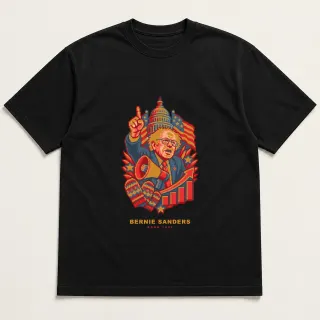
Wear it: Bernie Sanders
#merchEvery design here links back to this page.
Sources
#sourcesPrimary sources
The documents themselves: laws, court opinions, speeches, letters, and the numbers from the agencies that count them.
- Bernard Sanders, Eugene V. Debs (Folkways Records FH 5571, 1979), Smithsonian Folkways Recordings (the liner notes credit the historical narrative to Bernard Sanders, director of the American People's Historical Society, Burlington, Vermont)
- S. 1804, Medicare for All Act of 2017, 115th Congress, as introduced (U.S. Government Publishing Office) (the bill text: introduced September 13, 2017 by Mr. Sanders with sixteen cosponsors, referred to the Committee on Finance)
- Sanders, Jayapal, Dingell, Hundreds of Health Care Workers Introduce Medicare for All (press release)
- Prepared Remarks: Sanders on the Senate Floor: "What the Oligarchs Really Want"
- Bernard Sanders, The Speech: A Historic Filibuster on Corporate Greed and the Decline of Our Middle Class (Congressional Record, December 10, 2010)
Secondary sources
Written afterward, about the story.
- Sara Burnett, "In Chicago, Bernie Sanders found his place in civil rights movement," Associated Press (February 25, 2016) (source of the January 1962 sit-in quote, the CORE chairmanship, and the $25 fine)
- "Today in Chicago History: Bernie Sanders arrested during South Side protest," Chicago Tribune (syndicated on Yahoo News) (the August 12, 1963 Englewood arrest, the Willis wagons, and the Tribune's contemporaneous count of fifty-six arrests)
- Wikipedia, "Bernie Sanders" (birth and family, schooling, the 1962 sit-in outcome, the 1968 move to Vermont, and the House and Senate service)
- Wikipedia, "Electoral history of Bernie Sanders" (vote counts for every race from 1972 through 2006)
- Wikipedia, "1981 Burlington, Vermont mayoral election" (9,880 ballots cast, the recount, and the Free Press projection)
- Wikipedia, "Mayoralty of Bernie Sanders" (the board of aldermen fights, the 1982 coalition wins, and the Yaroslavl agreement of October 14, 1988)
- "This Day in History: Bernie Sanders elected mayor of Burlington," WCAX (March 3, 2026) (source of the 1981 campaign line about the tax on homeowners)
- Sally Jacobs, "As Vermont official, Sanders 'got things done'," The Boston Globe (October 31, 2015) (source of the John Franco Jr. quote, the fired secretary, the $1.9 million surplus, and Operation Snow Shovel)
- Peter Dreier and Pierre Clavel, "What Kind of Mayor Was Bernie Sanders?" The Nation (June 2, 2015) (CEDO, the Neighborhood Planning Assemblies, the land trust, and the built waterfront)
- Molly Walsh, "Flashback: Did Bernie Sanders Really Save the Burlington Waterfront?" Seven Days (June 17, 2015) (documents that Sanders campaigned for the Alden plan and that the bond failed the two-thirds test)
- "Sanders Siempre: What Bernie Learned in Nicaragua," Seven Days (the October 1983 letter to Reagan, the Puerto Cabezas affiliation, and the July 1985 trip; cites the mayoral papers at the University of Vermont)
- "Bernie Sanders Made Burlington's Land Trust Possible," Slate (January 2016) (the $200,000 seed grant and the first-in-the-nation claim)