Published
Karl Marx
Karl Marx in Plain English: What He Actually Argued
Born May 5, 1818. Died March 14, 1883
What Karl Marx actually argued about wages, profit and history, quoted from the books, plus the four expulsion orders and the slogans he never wrote.
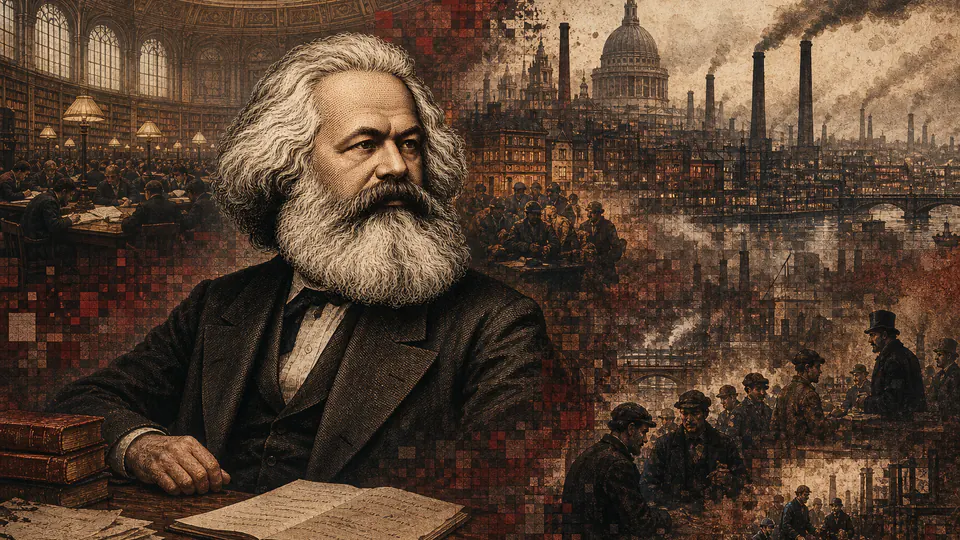
The story
#storyKarl Marx argued that profit comes out of unpaid working time. A worker sells an employer the use of a day. The day produces more value than the wage costs. The employer keeps the difference, which Marx named surplus value, and the rest of his working life went into documenting it, much of it out of the British government’s own factory inspection reports. Class, crisis, the state, what comes after capitalism: all of it hangs off that one claim about where the money comes from.
He was born in Trier on May 5, 1818 and died in London on March 14, 1883. In between, three governments put it in writing, four separate times, that he had to leave the country. The Communist Manifesto, written with Friedrich Engels, was printed in London in February 1848. Volume One of Capital came off the presses in Hamburg on September 14, 1867. A good deal of what gets quoted as Marx was published by somebody else after he was dead.
Where the profit comes from
The trade at the centre of Capital looks fair, and Marx insisted on treating it as fair. A worker owns nothing to sell but the capacity to work. An employer owns money. They exchange a day’s labour-power for a day’s wage at the going rate, no fraud, no thumb on the scale. His move was to point out that labour-power is a peculiar commodity: buying it costs one amount, using it produces another, and the second amount is bigger. If six hours of work covers the wage and the day runs twelve, the employer has six hours for free. Profit on this account comes off the shop floor rather than out of the marketplace, made before anybody sells anything.
That is why the book spends hundreds of pages inside factories instead of in the counting house: shift lengths, night work, the ages of the children, all of it lifted from the state’s own inspectors and commissions. It is also where he wrote the sentence that has outrun the rest of the book.
Capital is dead labour, that, vampire-like, only lives by sucking living labour, and lives the more, the more labour it sucks.
At the graveside in 1883, Engels called the discovery of surplus value the second of Marx’s two great finds, the one that “suddenly threw light on the problem” earlier economists had been groping at in the dark.
History runs on what people have to eat
The other big claim is about history. How a society organizes production, who owns the tools, who works them and on what terms, shapes its politics, its law and its ideas rather than the other way round. He set it down in a preface signed in London in January 1859:
The mode of production of material life conditions the general process of social, political and intellectual life. It is not the consciousness of men that determines their existence, but their social existence that determines their consciousness.
Engels compressed the same thought into one sentence at Highgate Cemetery on March 17, 1883:
Just as Darwin discovered the law of development of organic nature, so Marx discovered the law of development of human history: the simple fact, hitherto concealed by an overgrowth of ideology, that mankind must first of all eat, drink, have shelter and clothing, before it can pursue politics, science, art, religion, etc.
What the Manifesto actually demands
The pamphlet is shorter and stranger than its reputation. It closes with ten measures the authors expected to be “pretty generally applicable” in the most advanced countries, and the ordinary ones sit right beside the alarming ones. “A heavy progressive or graduated income tax” is the second measure; the tenth bundles “Free education for all children in public schools” with “Abolition of children’s factory labour in its present form.” Much of the rest has aged less comfortably, among it the confiscation of the property of all emigrants and rebels.
The blueprint he never wrote
Marx produced almost nothing on how a socialist economy would actually run. No plan, no schedule, no draft constitution, and no interest in supplying one. When a Paris journal complained about exactly that, he answered in the afterword to the second German edition of Capital, signed in London on January 24, 1873:
Thus the Paris Revue Positiviste reproaches me in that, on the one hand, I treat economics metaphysically, and on the other hand , imagine , confine myself to the mere critical analysis of actual facts, instead of writing receipts (Comtist ones?) for the cook-shops of the future.
That empty space is why so much fits under his name. The Socialist Party that ran Eugene Debs for president five times and the governments that nationalized whole economies were quoting the same author, and the democratic socialists who claim him now are arguing over a man who left them almost no instructions. In a letter of August 5, 1890, Engels reported what Marx used to say about the French Marxists of the late 1870s:
“All I know is that I am not a Marxist.”
Two lines everybody misquotes
Start with the one on the shirts, ours included. Every symbol the left prints came from a particular place and year, and the Manifesto’s last line turns out to have an editor. Publishing the 1888 English text that Engels himself approved, the Marxists Internet Archive files this note under the final page:
The famous final phrase of the Manifesto, “Working Men of All Countries, Unite”, in the original German is: “Proletarier aller Länder, vereinigt euch” Thus, a more correct translation would be “Proletarians of all countries, Unite”
“Workers of the World, Unite. You have nothing to lose but your chains” is a popularisation of the last three sentences, and is not found in any official translation. Since this English translation was approved by Engels, we have kept the original intact.
The two sentences immediately before the call are Marx’s, and they are the better writing:
The proletarians have nothing to lose but their chains. They have a world to win.
Then there is from each according to his ability, to each according to his needs. People quote it as his definition of communism, which is close enough, and almost nobody quotes the condition attached to it. The line sits in a set of furious marginal notes he wrote in April or early May 1875 on the draft programme of the merging German workers’ parties, and he was specific that the formula belongs to a higher phase of communist society, after the division of labour and the shortage have gone, and not to the morning after. He never published the notes. Engels put an abridged version into Die Neue Zeit in 1890 and 1891, eight years after the funeral.
Four expulsion orders
Engels, at the grave, on what governments made of his friend:
And, consequently, Marx was the best hated and most calumniated man of his time. Governments, both absolutist and republican, deported him from their territories.
The paperwork backs him. On January 16, 1845, under Prussian pressure, France ordered Marx out; he moved to Brussels the next month and formally renounced his Prussian citizenship on December 1, 1845, leaving himself a stateless man for the last thirty-seven years of his life. On March 3, 1848 the King of Belgium gave him twenty-four hours to go, and the following night Brussels police held him and Jenny for eighteen hours before the family was put on the road to France. Editing the Neue Rheinische Zeitung in Cologne through the German revolutions of 1848 and 1849, he was handed a Prussian order to leave on May 16, 1849, and the paper printed its last issue three days later. France expelled him again on August 23, 1849 with another twenty-four hours’ notice. He reached London on August 26 and stayed for good.
Broke in Soho
Through the Soho years the author of the Manifesto lived on Dean Street, first at number 64 and then in shabby second-floor rooms at number 28 from 1850 to 1856, with a family that kept shrinking. Heinrich Guido, born in London on November 5, 1849, died on November 19, 1850. Franziska, born on March 28, 1851, died on April 14, 1852. Edgar, the only son to reach school age, died in 1855 at eight. What kept the household fed was Engels, who joined his father’s Manchester firm in November 1850 and from then on sent money south, plus a wage from an improbable employer.
From 1852 to 1861, by Engels’s own accounting at the funeral, Karl Marx filed copy to the New-York Tribune. The American Civil War ended the arrangement, and on December 28, 1862, writing from the family’s house in Kentish Town to Ludwig Kugelmann in Hanover, Marx explained what he had tried next:
In 1861, I lost my chief source of income, the New-York Tribune, as a result of the American Civil War. My contributions to that paper have remained in abeyance up till the present. Thus, I have been, and still am, forced to undertake a large amount of hackwork to prevent myself and my family from actually being relegated to the streets. I had even decided to become a ‘practical man’ and had intended to enter a railway officer at the beginning of next year. Luckily , or perhaps I should say unluckily? , I did not get the post because of my bad handwriting.
The man writing the anatomy of the wage could not get hired for one. He went back to the manuscript, and Volume One came out in 1867.
Highgate
Marx died at home in London on March 14, 1883 and was buried at Highgate Cemetery three days later. At least thirteen mourners can be named from the record, and a report in The People on March 25 counted 25 to 30. Engels spoke in English and closed:
His name will endure through the ages, and so also will his work.
The grave people photograph today is a later construction. In November 1954 the remains of Marx, Jenny, their daughter Eleanor, a grandson and the family’s housekeeper Helene Demuth were lifted and reburied about a hundred yards away beside a main path, and in 1956 the Communist Party of Great Britain unveiled Laurence Bradshaw’s bronze head on a marble pedestal over them. The front of the pedestal reads Workers of all lands unite. Under it, also on the front, sits the eleventh of eleven notes on Feuerbach that Marx jotted in the spring of 1845 and never printed, which Engels edited lightly and published in 1888:
The philosophers have only interpreted the world, in various ways; the point is to change it.
Bradshaw chose the texts and the lettering himself, and his carving slips in a word the printed translation does not have: on the stone, the point however is to change it. That leaves the Manifesto’s last line reaching the visitor in a fourth English wording, picked by a sculptor in 1956, cut into a monument a political party paid for, above a grave that had to be dug up and moved to get it nearer the path. The German has read the same five words since February 1848.
In their own words
#wordsWhat Karl Marx actually said, where, and when. Each one links to the page it was checked against.
-
Capital is dead labour, that, vampire-like, only lives by sucking living labour, and lives the more, the more labour it sucks.
Capital, Volume One (1867), chapter 10, "The Working-Day," on why a working day has no natural limit under capital. Karl Marx, Capital, Volume One (1867), ch. 10, "The Working-Day" -
The mode of production of material life conditions the general process of social, political and intellectual life. It is not the consciousness of men that determines their existence, but their social existence that determines their consciousness.
Preface to A Contribution to the Critique of Political Economy, signed London, January 1859, laying out what historians call his materialist conception of history. Karl Marx, Preface to A Contribution to the Critique of Political Economy (London, January 1859) -
confine myself to the mere critical analysis of actual facts, instead of writing receipts (Comtist ones?) for the cook-shops of the future
Afterword to the second German edition of Capital, signed London, January 24, 1873, answering a Paris journal's complaint that he offered no plan for a future economy. Karl Marx, Afterword to the Second German Edition of Capital, signed London, January 24, 1873 -
The philosophers have only interpreted the world, in various ways; the point is to change it.
Thesis XI of the Theses on Feuerbach, written in Brussels in spring 1845 as a private notebook entry and first published by Engels in 1888. Karl Marx, Theses on Feuerbach (spring 1845), first published by Engels in 1888 -
In 1861, I lost my chief source of income, the New-York Tribune, as a result of the American Civil War. My contributions to that paper have remained in abeyance up till the present. Thus, I have been, and still am, forced to undertake a large amount of hackwork to prevent myself and my family from actually being relegated to the streets. I had even decided to become a 'practical man' and had intended to enter a railway officer at the beginning of next year. Luckily, or perhaps I should say unluckily?, I did not get the post because of my bad handwriting.
Letter to Ludwig Kugelmann, written from the family's house in Kentish Town, London, December 28, 1862. Karl Marx to Ludwig Kugelmann, London, December 28, 1862 -
The proletarians have nothing to lose but their chains. They have a world to win.
The Communist Manifesto (1848), chapter 4, the two sentences immediately before the closing call to unite, in the 1888 English edition Engels approved. Karl Marx and Frederick Engels, Manifesto of the Communist Party (1848), ch. 4
What people get wrong
#wrong- The myth
Marx wrote the blueprint for how a socialist or communist economy should actually be run, the plan later governments like the Soviet Union followed. - The record
Marx refused to do this on the record. In the 1873 afterword to Capital's second edition he said he confined himself to critical analysis of facts "instead of writing receipts...for the cook-shops of the future," and his one detailed sketch of a post-capitalist distribution rule, in the 1875 Critique of the Gotha Programme, was a private set of notes he never published; Engels printed an abridged version eight years after Marx's death. No government's planning apparatus is in his own published work.
- The myth
Marx's line that religion is "the opium of the masses" means he saw religious believers as foolish and beneath contempt. - The record
The full 1843 passage is more sympathetic than the fragment suggests: "Religious suffering is, at one and the same time, the expression of real suffering and a protest against real suffering. Religion is the sigh of the oppressed creature, the heart of a heartless world, and the soul of soulless conditions. It is the opium of the people." Marx is naming religion as a response to real conditions, not mocking the people who hold it.
- The myth
"Workers of the world, unite. You have nothing to lose but your chains" is the sentence Marx and Engels actually wrote. - The record
The German reads Proletarier aller Länder, vereinigt euch, "Proletarians of all countries, unite." The Marxists Internet Archive's note on its own authorized 1888 English text (translated by Samuel Moore, edited by Engels) states the popular English line is "a popularisation of the last three sentences" and "is not found in any official translation," though the archive kept it because Engels had approved that English edition.
- The myth
Marx was a theorist who never held paid work and lived entirely off Engels's money. - The record
Marx filed newspaper copy for the New-York Tribune from 1852 to 1861 (his own December 28, 1862 letter to Ludwig Kugelmann describes losing that income when the American Civil War ended the arrangement) and earlier edited the Neue Rheinische Zeitung in Cologne through 1849. Engels's remittances were real and necessary, but they supplemented paid journalism, not the whole of it.
The dates that matter
#dates- May 5, 1818 Born in Trier, in the Kingdom of Prussia, to the barrister Heinrich Marx and his wife Henriette.
- January 16, 1845 Under Prussian pressure, the French government orders Marx to leave France. He moves to Brussels the following month.
- December 1, 1845 Renounces his Prussian citizenship as police pressure mounts, and is stateless for the remaining thirty-seven years of his life.
- February 1848 The Communist Manifesto, written with Friedrich Engels, is printed in London as a German pamphlet.
- March 3, 1848 The King of Belgium orders him out of the country within twenty-four hours; Brussels police hold him and his wife Jenny for eighteen hours the following night.
- May 16, 1849 Prussian authorities hand him a government order to leave. The Neue Rheinische Zeitung, which he edited in Cologne, prints its last issue three days later.
- August 23, 1849 France expels him again with twenty-four hours' notice. He reaches London on August 26 and lives there for the rest of his life.
- November 19, 1850 His son Heinrich Guido dies in London at one year old, during the family's Soho years.
- 1852-1861 Writes for the New-York Tribune, his main source of income until the American Civil War ends the arrangement.
- January 1859 Signs the preface arguing that social existence determines consciousness, not the other way round.
- September 28, 1864 The International Working Men's Association is founded at St Martin's Hall in London. Marx is elected to its provisional committee.
- September 14, 1867 Volume One of Capital comes off the presses in Hamburg.
- March 14, 1883 Dies at home in London. Buried at Highgate Cemetery three days later, with Engels speaking.
- 1954-1956 The family's remains are moved about a hundred yards within Highgate and Laurence Bradshaw's monument goes up over them.
Questions people ask
#faqsWhat did Karl Marx actually believe?
Two things, mainly. First, that profit under capitalism comes from the gap between what a worker produces in a day and what the day's wage costs, which he called surplus value and documented across Volume One of Capital (1867). Second, that how a society organizes production shapes its politics, law and ideas rather than the reverse, which he set out in an 1859 preface. He wrote very little about what should replace capitalism.
What is surplus value in simple terms?
An employer buys a day of a worker's labour at the going rate. Using that day produces more value than buying it cost. If six hours of work covers the wage and the day runs twelve, the employer gets six hours free, and that unpaid time is where profit comes from. Marx's point was that this happens even when nobody cheats and the wage is fully paid.
Did Karl Marx say workers of the world unite?
Not quite. In German the Communist Manifesto closes on the line Proletarier aller Länder, vereinigt euch, and the 1888 English edition that Engels personally approved, translated by Samuel Moore, renders it as Working Men of All Countries, Unite. The Marxists Internet Archive, which publishes that authorized text, notes that the popular English version is a popularisation of the last three sentences and is found in no official translation.
Was Karl Marx poor?
For long stretches, yes. Through the 1850s he lived with his family in rented rooms at 28 Dean Street in Soho, where two of his children died in infancy and a third died at eight. His income was newspaper work for the New-York Tribune and money from Friedrich Engels, who joined his father's Manchester firm in November 1850, which let him send regular help to the Marx household. When the Tribune work dried up in 1861 Marx applied for a railway post and was turned down over his handwriting.
Where is Karl Marx buried?
Highgate Cemetery in north London. He was buried there on March 17, 1883, but not in the spot tourists visit. In November 1954 his remains and those of his wife Jenny, his daughter Eleanor, a grandson and the family's housekeeper Helene Demuth were moved about a hundred yards to a site beside a main path, where the Communist Party of Great Britain unveiled Laurence Bradshaw's bronze monument in 1956.
The bookshelf
#bookshelfWhere to go next. Buy from an independent bookstore, or find it at your library for nothing.
-
Capital, Volume One Karl Marx, 1867 primary
The Penguin Classics edition, translated by Ben Fowkes: the surplus-value argument in full, factory-inspector evidence and all.
-
The Communist Manifesto Karl Marx and Friedrich Engels, 1848 primary
Twenty-some pages. Read it once past the shirt slogan and the ten measures at the end are the surprise.
-
Karl Marx: A Nineteenth-Century Life Jonathan Sperber, 2013 secondary
The standard modern biography, written against treating Marx as a prophet of the twentieth century rather than a man of his own.
-
Karl Marx: A Life Francis Wheen, 1999 secondary
The readable one: Soho poverty, boils, and duns alongside the ideas, without softening either.
Wear it: Karl Marx
#merchEvery design here links back to this page.
Sources
#sourcesPrimary sources
The documents themselves: laws, court opinions, speeches, letters, and the numbers from the agencies that count them.
- Karl Marx and Frederick Engels, Manifesto of the Communist Party (1848), ch. 2, English edition of 1888 translated by Samuel Moore and edited by Engels (the ten measures, including the graduated income tax and free public schooling)
- Karl Marx and Frederick Engels, Manifesto of the Communist Party (1848), ch. 4, with the Marxists Internet Archive note on translations of the closing line
- Karl Marx, Capital, Volume One (1867), ch. 10, "The Working-Day" (source of the dead labour passage, and of the factory inspectors' evidence)
- Karl Marx, Afterword to the Second German Edition of Capital, signed London, January 24, 1873
- Karl Marx, Preface to A Contribution to the Critique of Political Economy (London, January 1859)
- Karl Marx, Critique of the Gotha Programme, part I (written April or early May 1875) (first published, abridged, by Engels in Die Neue Zeit in 1890-91)
- Karl Marx, Theses on Feuerbach (spring 1845), first published by Engels in 1888
- Frederick Engels, Speech at the Grave of Karl Marx, Highgate Cemetery, March 17, 1883
- Frederick Engels to Conrad Schmidt, London, August 5, 1890 (Engels reporting Marx's remark about the French Marxists)
- Karl Marx to Ludwig Kugelmann, London, December 28, 1862 (the lost Tribune income and the railway post he did not get)
- Karl Marx, Contribution to the Critique of Hegel's Philosophy of Right, Introduction (1843)
Secondary sources
Written afterward, about the story.
- Karl Marx: His Life and Work, Outstanding Dates (Progress Publishers chronology) (source for the expulsion dates, the children's dates, and the Capital publication date)
- English Heritage, "Karl Marx: the London connections" (the Dean Street addresses and the move north to Kentish Town)
- Wikipedia, "Tomb of Karl Marx" (the 1954 reburial, the 1956 monument, the inscriptions, and the funeral attendance figures)