Published
Michael Harrington
Michael Harrington Found the Poverty Hidden Inside Affluent America
Born February 24, 1928. Died July 31, 1989
Michael Harrington's 1962 book The Other America put poverty into national debate and shaped a democratic socialist strategy for decades.
The story
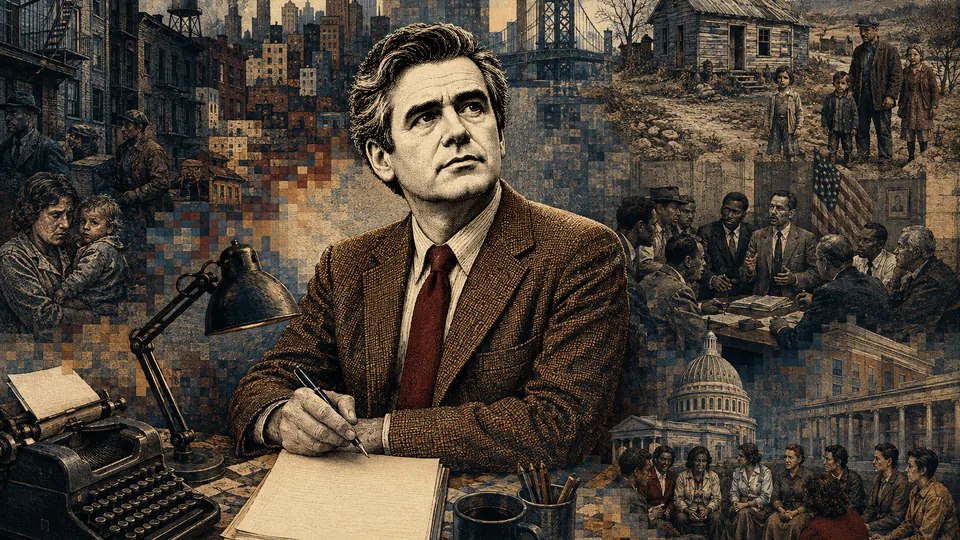
#storyMichael Harrington’s The Other America opened with a problem hidden by the national success story: tens of millions of people were poor inside the richest country on earth, and the comfortable majority rarely saw them. Published in 1962, the book was short enough to read in a sitting and sharp enough to enter White House arguments.
Harrington did not discover poverty. Poor people knew where they lived. Organizers, social workers, unions, and Black newspapers had documented it for generations. His achievement was forcing an affluent national audience to look at people whom its statistics, suburbs, and television sets had placed outside the frame.
From the Catholic Worker to the socialist movement
Harrington was born in St. Louis on February 24, 1928, studied at Holy Cross, Yale Law School, and the University of Chicago, and arrived in New York looking for a life larger than a law career. In 1951 he joined Dorothy Day and the Catholic Worker community, living near the Bowery and writing for its penny newspaper.
The stay was brief. Harrington moved away from Catholic belief and toward the Young People’s Socialist League. He joined the circle around Max Shachtman, whose members opposed both capitalism and Soviet rule. That anti-Stalinist socialism shaped nearly every later argument Harrington made: democracy was the method as well as the goal.
The book that found an audience
The Other America: Poverty in the United States described older people surviving outside Social Security’s adequate reach, farm laborers, residents of Appalachia, Black families confined by discrimination, and people whose illness or disability made regular work impossible. Harrington argued that modern poverty had become less visible as middle-class families moved away from it and mass culture sold abundance as the common condition.
The book did not begin as a bestseller. Dwight Macdonald devoted a long 1963 New Yorker essay to it, which widened its audience. Policymakers in the Kennedy and Johnson administrations read it as poverty moved up the federal agenda. Lyndon Johnson announced the War on Poverty in 1964.
Harrington’s book belongs in that history, but the verbs matter. It influenced the debate. It did not single-handedly write the Economic Opportunity Act, organize poor communities, or create the political pressure behind federal action. The people who did those things should not become footnotes to one well-placed author.
The left wing of what could happen
Harrington’s political strategy grew from the Socialist Party’s small numbers and the strength of the labor and civil-rights movements. He argued that socialists should keep their own organization and program while working in a broad coalition with unions, Black freedom organizations, feminists, liberals, and the Democratic Party. He later called the goal the left wing of the possible.
That approach angered socialists who saw the Democratic Party as a barrier rather than a field of work. Harrington’s support for Johnson over the Republican Barry Goldwater in 1964, and his faction’s handling of the Socialist Party’s later splits, made the disagreement organizational, not academic. He could explain coalition politics for hours because the coalition itself was always having an argument.
Harrington helped form the Democratic Socialist Organizing Committee in 1973. In 1982 it merged with the New American Movement to create Democratic Socialists of America. Harrington became its first chair.
A public socialist in the television age
Harrington wrote more than a dozen books and became a familiar debate guest, lecturer, and magazine contributor. He discussed poverty with conservatives on television and spoke to union halls and college audiences. That public role made him an interpreter of socialism to people who had been taught the word meant Soviet government.
He also changed positions. Harrington initially supported aspects of U.S. policy in Vietnam before becoming an opponent of the war. He argued with the New Left, then worked beside parts of it. His socialism remained democratic, electoral, and tied to labor institutions even as those institutions weakened.
Diagnosed with esophageal cancer in 1987, Harrington kept writing and speaking until shortly before his death on July 31, 1989. DSA remained small for decades after him, then grew during Bernie Sanders’s 2016 campaign in a world its founder never saw.
The durable part of Harrington’s work is less a slogan than a reporting instruction: when a country announces prosperity, check who vanished from the picture. In 1962, he did, and the picture could no longer pass as complete.
The sequence changes the argument
Accounts often compress Michael Harrington into the author whose book caused a war on poverty. The chronology makes a larger claim. Harrington passed through Catholic radicalism and the labor-oriented socialist movement before becoming a national public intellectual. The Other America described poverty hidden from an affluent society but depended on a framing that critics sometimes found paternalistic. Neither fact is background decoration. Together they explain why the conflict took the form it did and why participants did not treat patience as a serious answer.
A widely read review helped the book reach policymakers, though no single text created the War on Poverty. Harrington argued that poverty was structural and required public planning, full employment, services, and organized political power. The work depended on meetings, transportation, money, printed material, trusted messengers, and people willing to absorb retaliation. Public memory usually preserves the microphone or the confrontation. Organization lived in the less photogenic decisions that made a crowd, vote, strike, or policy demand possible.
Power worked through institutions
The central dispute concerned how democratic socialists could expose deprivation, organize institutions, and act inside a political system they wanted to change. That question could not be settled by a good argument alone. Employers, public officials, courts, parties, unions, churches, and newspapers controlled different resources. Organizers had to identify which body could change a rule, which ally could move it, and what pressure could make delay more expensive than action.
He opposed the Vietnam War while disputing strategy with parts of the New Left and refusing politics he thought isolated radicals from working people. He helped lead Democratic Socialist Organizing Committee and later Democratic Socialists of America. Those outcomes belong in the same account. A movement can gain public sympathy and still lose an immediate demand. It can win a statute while leaving people outside its coverage. It can build an institution that later becomes cautious. Calling one moment a victory or defeat without naming the measure hides more than it explains.
The limits were part of the result
His realignment strategy sought to work through labor and civil-rights forces inside the Democratic coalition rather than build a small electoral sect. That choice created influence and recurring disputes about independence, compromise, and whose movements set the agenda. These limits were not footnotes added by later critics. Participants argued about them at the time, often from unequal positions. Race, gender, citizenship, occupation, geography, and access to money affected who took the greatest risk and who received authority after a campaign became respectable.
This is why coalition should be treated as work rather than a photograph. Groups can share an opponent while wanting different remedies. They can cooperate on a march and disagree about a contract, a party, a war, or the pace of change. The useful question concerns the rules that allowed people to decide together, what resources they shared, and whose objections were easier to ignore.
What the record lets us say
The source trail matters because later retellings reward drama and erase maintenance. Government records show what officials claimed and enforced. Organizational papers show plans, budgets, arguments, and revisions. Oral histories recover work that formal minutes often omit, though memory recorded years later has its own limits. Newspapers capture public language while reflecting the interests and racial habits of editors. Reading those records against one another makes uncertainty visible instead of filling it with a convenient quotation.
The durable lesson of Michael Harrington is practical. Rights need procedures, money, institutions, and people able to enforce them after attention moves elsewhere. A law can change the field without ending the contest. A lost campaign can train organizers, expose an alliance, or leave a demand that later movements can use. History becomes more useful when it preserves both the achievement and the bill that remained unpaid.
In their own words
#wordsWhat Michael Harrington actually said, where, and when. Each one links to the page it was checked against.
-
The poor are increasingly slipping out of the very experience and consciousness of the nation.
The Other America: Poverty in the United States (1962), on why postwar prosperity had made poverty harder to see. Michael Harrington, The Other America (MIT primary source collection excerpt) -
This poverty twists and deforms the spirit. The American poor are pessimistic and defeated.
The Other America: Poverty in the United States (1962), describing the psychological toll of poverty rather than only its material shortage. Michael Harrington, The Other America (MIT primary source collection excerpt) -
The people of the other America do not, by far and large, belong to unions, to fraternal organizations, or to political parties. They are without lobbies of their own.
The Other America: Poverty in the United States (1962), on why the poor had no organized voice in national politics. Michael Harrington, The Other America (MIT primary source collection excerpt) -
There were millions and even tens of millions of Americans who were poor, who were miserable, in body and in spirit.
Interviewed on 1962: Past and Prologue, WNDT (National Educational Television), December 31, 1962. American Archive of Public Broadcasting, Michael Harrington Describes Poverty in The Other America
What people get wrong
#wrong- The myth
The Other America single-handedly caused the War on Poverty. - The record
Harrington's book widened its readership after Dwight Macdonald's long 1963 New Yorker review and reached policymakers under Kennedy and Johnson, but organizers, social workers, unions, and Black newspapers had documented poverty for generations before it, and Johnson's 1964 announcement drew on a wider set of political pressures than one book.
- The myth
Harrington founded Democratic Socialists of America on his own. - The record
DSA formed in 1982 through a merger of the Democratic Socialist Organizing Committee, which Harrington helped form in 1973, and the New American Movement. He became the new organization's first chair, not its sole founder.
- The myth
Harrington treated the Democratic Party as the enemy, the way some socialists did. - The record
He argued the opposite: that a small socialist movement should keep its own organization while working inside a coalition with labor, civil-rights groups, and the Democratic Party. He backed Lyndon Johnson over Barry Goldwater in 1964, a position that put him at odds with socialists who saw the party as a barrier rather than a field of work.
The dates that matter
#dates- February 24, 1928 Born in St. Louis, Missouri.
- 1951 Joins Dorothy Day's Catholic Worker community in New York.
- 1952 Leaves the Catholic Worker and joins the Young People's Socialist League.
- 1962 Publishes The Other America: Poverty in the United States.
- 1964 The Johnson administration launches the War on Poverty.
- 1973 Helps form the Democratic Socialist Organizing Committee.
- 1982 Becomes the founding chair of Democratic Socialists of America.
- July 31, 1989 Dies of esophageal cancer in Larchmont, New York.
Questions people ask
#faqsWho was Michael Harrington?
Michael Harrington was an American socialist writer and organizer best known for The Other America and for helping found Democratic Socialists of America.
Did The Other America start the War on Poverty?
The book helped move poverty into national debate, especially after Dwight Macdonald reviewed it in The New Yorker. The War on Poverty had many authors and political causes, so crediting one book alone would turn influence into authorship.
What was Michael Harrington's political strategy?
He argued for an independent socialist organization that worked inside a broader coalition of labor, civil-rights groups, liberals, and the Democratic Party rather than relying on a small separate electoral party.
Did Michael Harrington found DSA?
He was a principal founder and the first chair of Democratic Socialists of America, formed in 1982 by a merger of the Democratic Socialist Organizing Committee and the New American Movement.
The bookshelf
#bookshelfWhere to go next. Buy from an independent bookstore, or find it at your library for nothing.
-
The Other America: Poverty in the United States Michael Harrington, 1962 primary
The book itself, the 1997 anniversary edition with his later essays on poverty added.
-
The Other American: The Life of Michael Harrington Maurice Isserman, 2000 secondary
The standard biography, by a historian who also introduced later editions of Harrington's own book.
Wear it: Michael Harrington
#merchEvery design here links back to this page.
Sources
#sourcesPrimary sources
The documents themselves: laws, court opinions, speeches, letters, and the numbers from the agencies that count them.
- New York University, Michael Harrington Papers
- American Archive of Public Broadcasting, Michael Harrington Describes Poverty in The Other America
- Library of Congress, Michael Harrington papers
- New York University, Michael Harrington papers
- Michael Harrington, The Other America (MIT primary source collection excerpt) (verbatim passages from the 1962 text)
Secondary sources
Written afterward, about the story.