Published
New Deal
What the New Deal Built, and Who Its Bargains Left Out
The New Deal created jobs, labor rights, Social Security, and financial rules while exclusions and local control preserved racial inequality.
The story
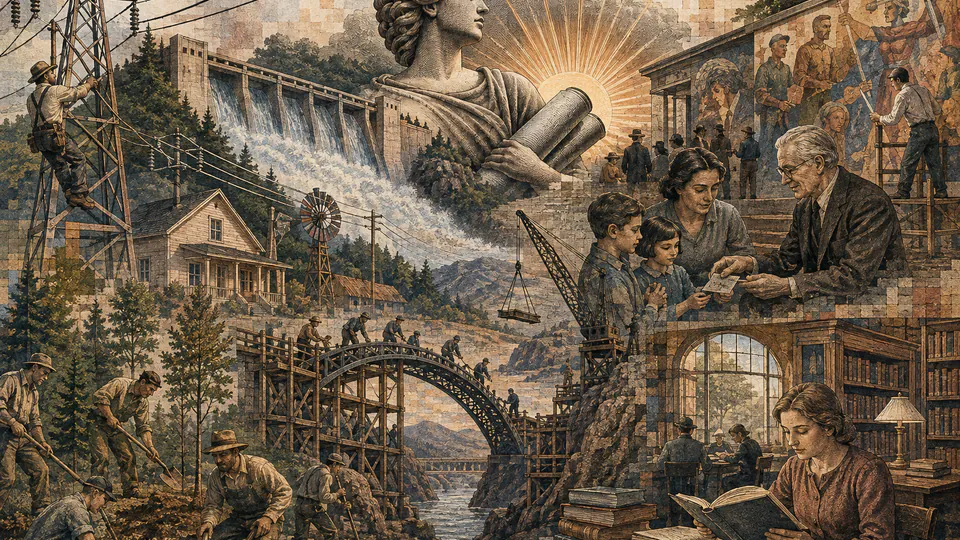
#storyThe New Deal was the federal government’s many-part answer to economic collapse after Franklin Roosevelt took office in 1933. It insured bank deposits, hired unemployed people, regulated securities, backed farm prices, built dams and schools, protected organizing, created old-age insurance, and set wage and hour rules. It also preserved segregation, excluded whole occupations, and handed local officials enough power to distribute federal relief unequally.
Both statements belong in the first paragraph. The New Deal changed the country. Its bargains also marked who could be sacrificed to get a bill through Congress.
The emergency came first
Roosevelt entered office amid bank runs and mass unemployment. Congress moved at a speed modern legislatures reserve for naming post offices. The first hundred days produced emergency banking law, relief for states, public works, farm policy, the Tennessee Valley Authority, and the Civilian Conservation Corps.
The programs mixed purposes. Relief agencies sent money or work to people who needed it now. Recovery plans tried to raise prices and restart production. Reform laws rewrote the rules that had helped turn a crash into a general disaster. Those goals could conflict. Paying farmers to reduce output, for example, could improve landowner income while costing tenant farmers and sharecroppers their work and homes.
A government became an employer
Public employment was the New Deal’s most visible promise. The Civilian Conservation Corps put young men to work on parks, forests, and soil projects. The Public Works Administration financed large construction. The Works Progress Administration hired millions for roads, schools, airports, sewing rooms, theater, writing, art, and local records projects.
The jobs left physical evidence across the country. They also operated inside a segregated labor market. The CCC housed Black enrollees in segregated units and kept many leadership posts white. Women had fewer routes into work programs. Local control let local discrimination ride along with federal money.
Workers gained a legal instrument
Section 7(a) of the 1933 National Industrial Recovery Act promised employees a right to organize, but its enforcement was weak. When the Supreme Court struck that act down in 1935, Senator Robert Wagner’s stronger bill was already moving. The Wagner Act protected collective bargaining for many private- sector workers and created an independent labor board.
The law helped mass-production workers build the CIO and win recognition through strikes such as the Flint sit-down. Union membership rose sharply. Agricultural and domestic workers were excluded, as were public workers and railway employees governed by another law. Southern lawmakers had defended a labor order that depended on Black farm and household workers remaining outside the new federal system.
The second New Deal lasted longer
The programs most people still carry in their wallets came in 1935 and after. Social Security created old-age insurance, unemployment- insurance support, and public-assistance programs. The Fair Labor Standards Act of 1938 established a federal minimum wage, overtime rules, and child-labor restrictions for covered jobs.
Frances Perkins, the labor secretary, helped drive both. Neither law covered everyone. The first Social Security Act excluded many farm and domestic workers. The wage law also omitted major occupations. Coverage expanded in later amendments, which means any honest account of the original achievement must include the later repair work.
What survived the court fights
The Supreme Court invalidated early New Deal laws, most famously the industrial recovery act in 1935 and the first Agricultural Adjustment Act in 1936. Roosevelt’s 1937 plan to add judges to the Court failed politically. The Court nevertheless began upholding later economic regulation, including the Wagner Act and Social Security.
Other institutions endured: the Federal Deposit Insurance Corporation, the Securities and Exchange Commission, federal mortgage machinery, rural electrification, and a larger administrative state. Some programs ended. Some were replaced. The pattern stayed: Washington now had responsibility when markets collapsed.
The bill and the bargain
The New Deal did not end the Depression by itself. Recovery was uneven, and the 1937 recession showed how quickly it could reverse. Wartime production finally drove unemployment down to levels the peacetime programs had not reached.
Its political result was larger than any one employment figure. Bank failure, old age, joblessness, poverty wages, and union repression became federal questions. The answers were incomplete and racially unequal, often by deliberate design. Later movements fought from inside the institutions the 1930s built, demanding that a promise written for some workers finally apply to the rest.
The sequence changes the argument
Accounts often compress the New Deal into a single recovery program handed down from Washington. The chronology makes a larger claim. The Roosevelt administration acted through many statutes and agencies rather than one settled plan. Banking measures, farm policy, industrial codes, relief, public works, labor law, and social insurance addressed different parts of the depression. Neither fact is background decoration. Together they explain why the conflict took the form it did and why participants did not treat patience as a serious answer.
Unemployed people, farmers, veterans, unions, socialists, and local officials pressured the administration from outside and within. Public employment built roads, schools, parks, art, theater, writing projects, and conservation work while imposing unequal access and pay. The work depended on meetings, transportation, money, printed material, trusted messengers, and people willing to absorb retaliation. Public memory usually preserves the microphone or the confrontation. Organization lived in the less photogenic decisions that made a crowd, vote, strike, or policy demand possible.
Power worked through institutions
The central dispute concerned how relief, regulation, public employment, organizing, and racial exclusion remade the federal state. That question could not be settled by a good argument alone. Employers, public officials, courts, parties, unions, churches, and newspapers controlled different resources. Organizers had to identify which body could change a rule, which ally could move it, and what pressure could make delay more expensive than action.
Southern lawmakers protected a racial order by excluding agricultural and domestic labor from major programs and controlling local administration. The Wagner Act strengthened collective bargaining while the Social Security Act created durable federal commitments with serious gaps. Those outcomes belong in the same account. A movement can gain public sympathy and still lose an immediate demand. It can win a statute while leaving people outside its coverage. It can build an institution that later becomes cautious. Calling one moment a victory or defeat without naming the measure hides more than it explains.
The limits were part of the result
The Supreme Court invalidated key early measures, and the 1937 recession exposed the cost of withdrawing public spending too soon. The war ended mass unemployment, but New Deal institutions continued to structure labor, finance, housing, agriculture, and retirement. These limits were not footnotes added by later critics. Participants argued about them at the time, often from unequal positions. Race, gender, citizenship, occupation, geography, and access to money affected who took the greatest risk and who received authority after a campaign became respectable.
This is why coalition should be treated as work rather than a photograph. Groups can share an opponent while wanting different remedies. They can cooperate on a march and disagree about a contract, a party, a war, or the pace of change. The useful question concerns the rules that allowed people to decide together, what resources they shared, and whose objections were easier to ignore.
What the record lets us say
The source trail matters because later retellings reward drama and erase maintenance. Government records show what officials claimed and enforced. Organizational papers show plans, budgets, arguments, and revisions. Oral histories recover work that formal minutes often omit, though memory recorded years later has its own limits. Newspapers capture public language while reflecting the interests and racial habits of editors. Reading those records against one another makes uncertainty visible instead of filling it with a convenient quotation.
The durable lesson of the New Deal is practical. Rights need procedures, money, institutions, and people able to enforce them after attention moves elsewhere. A law can change the field without ending the contest. A lost campaign can train organizers, expose an alliance, or leave a demand that later movements can use. History becomes more useful when it preserves both the achievement and the bill that remained unpaid.
Argue it
#argue4 claims about New Deal you can make out loud, the best case against each one, and the answer. Every number links to where it came from.
-
Claim 1
The heaviest New Deal years produced three of the fastest peacetime growth years the country has ever recorded.
The evidence
Real gross domestic product grew 10.8 percent in 1934, 8.9 percent in 1935, and 12.9 percent in 1936, according to the Bureau of Economic Analysis's official growth series, three of the strongest peacetime years the country has recorded. Unemployment fell from a peak near 25 percent in 1933 toward 14.3 percent by May 1937, according to the Federal Reserve Bank of St. Louis and the standard account of the 1937-38 recession.
Their best case
Amity Shlaes, author of The Forgotten Man, said in a 2007 interview that "the principal error of the late New Deal was underestimating the damage of uncertainty," and wrote that arbitrary shifts in New Deal policy left markets frozen, so that "businesses refused to hire or invest in equipment" and unemployment "stayed stuck in the teens."
The answer
A frozen economy does not grow 10.8, then 8.9, then 12.9 percent, and it does not take unemployment from 25 percent to 14.3 in four years. Christina Romer's research traced nearly all of the recovery through 1942 to monetary expansion Roosevelt's own administration set in motion by leaving the gold standard and devaluing the dollar, which credits policy rather than a self-correction investors were waiting out. Shlaes has the honest half of a point: unemployment stayed above 1929 levels until wartime mobilization, so growth this fast was still short of full recovery, which is a different thing from frozen.
-
Claim 2
The one clear relapse in the recovery, the 1937-38 recession, followed a retreat from New Deal spending, not another dose of it.
The evidence
Real GDP fell 3.3 percent in 1938, the only contraction of the recovery years, after a 1936-37 push toward budget balancing that included a new payroll tax, spending cuts, and tighter Federal Reserve reserve requirements. Growth resumed at 8.0 percent in 1939 and 8.8 percent in 1940 once spending rose again, and unemployment, at 14.3 percent in May 1937, jumped to 19.0 percent by June 1938.
Their best case
Shlaes points to that same 1936-37 pivot as her clearest evidence for the uncertainty argument, writing that the shift from deficit spending to fiscal caution "signaled inconsistency to investors" and helped collapse what she calls the Roosevelt Rally.
The answer
The direction of the reversal cuts against her conclusion. The 1937 pivot went toward less spending and tighter money, the contraction followed within months, and growth came back within a year of spending rising again. Roosevelt did make a real error in 1937, which is the one place Shlaes and the numbers agree. They part on what the error was: he withdrew a policy that was working.
-
Claim 3
The NIRA codes were a real drag on the industries they covered, and the recovery's fastest year came in 1936, after the Supreme Court killed them.
The evidence
The National Industrial Recovery Act's business codes ran from June 1933 until the Supreme Court struck the law down in Schechter Poultry Corp. v. United States on May 27, 1935, about two years. Real GDP grew 12.9 percent in 1936, the fastest year of the recovery and the first full calendar year after the codes were gone, according to the Bureau of Economic Analysis's growth series.
Their best case
Harold Cole and Lee Ohanian, in New Deal Policies and the Persistence of the Great Depression, published in the Journal of Political Economy in 2004, built a general equilibrium model of New Deal cartelization policies that let industries fix wages and prices above competitive levels in exchange for labor's cooperation, and found the policies were an important factor behind the weak recovery, accounting for about 60 percent of the gap between actual output and its prior trend.
The answer
Cole and Ohanian's microeconomic finding stands: they document wages and prices held above competitive levels in the industries the codes covered, a measured drag for as long as the codes stood. They also argue the cartel outlived the codes, carried on by the Wagner Act and lax antitrust enforcement, which is the strongest form of their case. It cuts the other way: if the cartel still stood in 1936, then the fastest year of the recovery, 12.9 percent real growth, happened under it. Romer's monetary channel, gold inflows and a devalued dollar pulling real interest rates down, tracks the growth path across the decade, including the 1937 relapse when the Federal Reserve tightened, in a way a standing cartel cannot.
-
Claim 4
The New Deal's most arbitrary law was also its shortest lived, and the labor statutes that replaced it set fixed rules instead of case-by-case discretion.
The evidence
The National Recovery Administration's code system let some businesses compete under one set of rules while others faced penalties for identical conduct, and a unanimous Supreme Court struck the whole law down in 1935. The Wagner Act, which followed within weeks, set fixed, published bargaining rules instead, and the Supreme Court upheld it in NLRB v. Jones and Laughlin Steel Corp. on April 12, 1937; the Fair Labor Standards Act of 1938 set a similar fixed wage and hour floor by statute rather than by code.
Their best case
Shlaes's sharpest example of New Deal arbitrariness is the NRA itself, which she writes "helped some businesses compete and criminalized others for the same behavior," the kind of discretionary enforcement she says taught investors that government intervention could not be predicted.
The answer
This is the hardest part of Shlaes's case to dispute, and the record backs her on the NRA: the code system was arbitrary enough that a unanimous Supreme Court killed it in Schechter Poultry. What follows from that is a statute-by-statute verdict rather than a blanket one. The laws that replaced the NRA, the Wagner Act and the Fair Labor Standards Act, set the fixed, publicly written rules Shlaes says investors wanted, and both survived Supreme Court review and stayed on the books for decades. Her case against the NRA is won, and it stops at the NRA.
What people get wrong
#wrong- The myth
The Supreme Court declared the New Deal unconstitutional. - The record
The Court struck down specific statutes: the National Industrial Recovery Act in Schechter Poultry Corp. v. United States (May 27, 1935) and the first Agricultural Adjustment Act in 1936. It later upheld other New Deal laws outright, including the Wagner Act in NLRB v. Jones and Laughlin Steel Corp. (April 12, 1937) and the Social Security Act's tax provisions in Steward Machine Co. v. Davis (May 24, 1937). The Court drew lines between statutes, not a verdict on the New Deal as a whole.
- The myth
The finding that New Deal cartelization slowed the recovery applies to the whole New Deal. - The record
Cole and Ohanian's 2004 Journal of Political Economy study covers the National Industrial Recovery Act's code system, in force from June 1933 to May 1935, about two years, and their estimate is that it accounts for roughly 60 percent of the gap between actual and trend output during that period. It says nothing about the Wagner Act, the Fair Labor Standards Act, Social Security, or the New Deal's other institutions, which came after the codes were gone and set fixed statutory rules instead of collusive codes.
- The myth
The economy stayed flat through the 1930s until World War II started the recovery. - The record
Real GDP grew 10.8 percent in 1934, 8.9 percent in 1935, and 12.9 percent in 1936, according to the Bureau of Economic Analysis, three of the strongest peacetime growth years on record, while unemployment fell from a peak near 25 percent in 1933 toward 14.3 percent by 1937.
The dates that matter
#dates- March 4, 1933 Franklin Roosevelt takes office during the banking crisis.
- March 31, 1933 Congress creates the Civilian Conservation Corps.
- June 16, 1933 Roosevelt signs the National Industrial Recovery Act.
- May 27, 1935 The Supreme Court invalidates the industrial recovery law.
- July 5, 1935 The National Labor Relations Act becomes law.
- August 14, 1935 Roosevelt signs the Social Security Act.
- 1935 The Works Progress Administration begins.
- June 25, 1938 Roosevelt signs the Fair Labor Standards Act.
Questions people ask
#faqsWhat was the New Deal?
The New Deal was the Roosevelt administration's set of relief, recovery, and reform programs during the Great Depression. It included public jobs, financial regulation, Social Security, labor law, farm policy, housing policy, and wage rules.
Did the New Deal end the Great Depression?
It reduced suffering, restored parts of the financial system, and changed federal policy, but unemployment stayed high until wartime production mobilized the economy. Historians still dispute how much individual programs accelerated recovery.
How did the New Deal help unions?
The 1935 Wagner Act protected organizing and collective bargaining for many private-sector workers and created the National Labor Relations Board. Its exclusions included agricultural and domestic workers, government employees, and railway workers covered elsewhere.
Did the New Deal exclude Black workers?
Several major laws excluded agricultural and domestic work, where Black workers were heavily represented, and locally administered programs often discriminated. Black workers still used New Deal programs and new industrial unions, but benefits were distributed unequally.
The bookshelf
#bookshelfWhere to go next. Buy from an independent bookstore, or find it at your library for nothing.
-
The Forgotten Man: A New History of the Great Depression Amity Shlaes, 2007 secondary
The opposing case at book length: that New Deal intervention prolonged the Depression.
-
The Money Makers: How Roosevelt and Keynes Ended the Depression, Defeated Fascism, and Secured a Prosperous Peace Eric Rauchway, 2015 secondary
How Roosevelt's own monetary decisions, not luck or the war, moved the recovery.
-
Freedom from Fear: The American People in Depression and War, 1929-1945 David M. Kennedy, 1999 secondary
The standard one-volume history of the era, including who the New Deal left out.
-
Franklin D. Roosevelt and the New Deal, 1932-1940 William E. Leuchtenburg, 1963 secondary
The classic account of the alphabet agencies and the coalition that passed them.
Wear it: New Deal
#merchEvery design here links back to this page.
 Design proof
 Frances Perkins Engraved Tee
$36.00 Design proof
 Michael Harrington Pixel Tee
$36.00 Design proof
 Rose Schneiderman Engraved Tee
$36.00 Design proof
 New Deal Engraved Tee
$36.00 Design proof
 "Three New Deal years: 10.8%, 8.9%, 12.9%." Tee
$36.00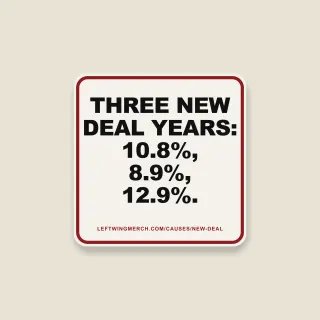 Design proof
 "Three New Deal years: 10.8%, 8.9%, 12.9%." Sticker
$5.00 Design proof
 "Less New Deal caused the 1937 relapse." Tee
$36.00 Design proof
 "Less New Deal caused the 1937 relapse." Sticker
$5.00 Design proof
 "NIRA lasted two years. Growth kept going." Tee
$36.00 Design proof
 "NIRA lasted two years. Growth kept going." Sticker
$5.00 Design proof
 "Arbitrary at the NRA. Fixed rules after it." Tee
$36.00 Design proof
 "Arbitrary at the NRA. Fixed rules after it." Sticker
$5.00Sources
#sourcesPrimary sources
The documents themselves: laws, court opinions, speeches, letters, and the numbers from the agencies that count them.
- National Archives, National Labor Relations Act (reproduces the act's full statutory text alongside historical framing)
- U.S. Bureau of Economic Analysis, Real Gross Domestic Product, Percent Change from Preceding Period (series A191RL1A225NBEA), reproduced by the Federal Reserve Bank of St. Louis (annual growth 1934: 10.8%, 1935: 8.9%, 1936: 12.9%, 1937: 5.1%, 1938: -3.3%, 1939: 8.0%, 1940: 8.8%)
- Christina D. Romer, What Ended the Great Depression, NBER Working Paper 3829 (abstract: nearly all of the observed recovery prior to 1942 traced to monetary expansion)
- Harold L. Cole and Lee E. Ohanian, New Deal Policies and the Persistence of the Great Depression, Journal of Political Economy 112(4), abstract
- NLRB v. Jones and Laughlin Steel Corp., 301 U.S. 1 (1937), opinion text
- Steward Machine Co. v. Davis, 301 U.S. 548 (1937), opinion text
Secondary sources
Written afterward, about the story.
- National Archives, New Deal
- National Archives, New Deal Labor
- U.S. Department of Labor, The Department in the New Deal and World War II
- Social Security Administration, Background and Development of Social Security
- National Archives, African Americans and the American Labor Movement
- National Archives, New Deal Records (a finding aid describing record groups, not the records themselves)
- Library of Congress, New Deal Programs
- Social Security Administration, Historical Background
- Federal Reserve Bank of St. Louis, Economic Episodes in American History, Part 3 (unemployment rate reached a peak of 25 percent in 1933)
- Amity Shlaes, A Chilling Uncertainty, American Enterprise Institute
- Wikipedia, Recession of 1937-1938, citing Maurice W. Lee, Economic Fluctuations (1955), p. 236 (unemployment 14.3 percent in May 1937, 19.0 percent in June 1938)
- Mises Institute, The New Deal Debunked, summarizing Cole and Ohanian (2004) (cartelization policies accounting for about 60 percent of the gap between actual and trend output)