Published
Minimum Wage
The Federal Minimum Wage Started at 25 Cents and Left Millions Out
The 1938 Fair Labor Standards Act set the first lasting federal wage floor, overtime rules, and child-labor limits for covered workers.
The story
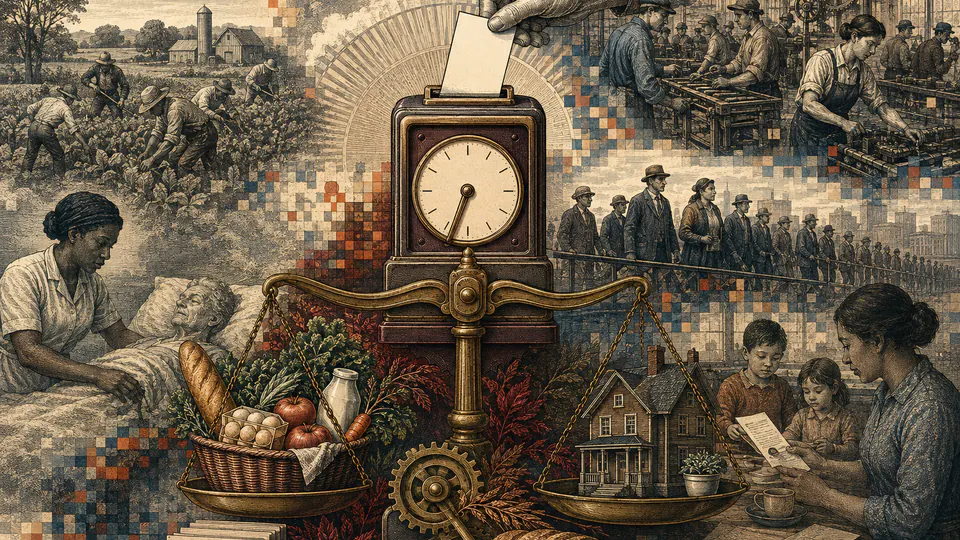
#storyThe first lasting federal minimum wage was 25 cents an hour. Congress spent more than a year fighting over it, and when the Fair Labor Standards Act took effect in October 1938, the Labor Department estimated that only about one-fifth of the workforce was covered. The quarter mattered. So did all the workers the law did not reach.
The act also set a maximum workweek of 44 hours before overtime, with a scheduled reduction to 40, and restricted oppressive child labor. A wage floor, an overtime clock, and a rule against putting children into dangerous production arrived in one bill because each challenged the employer’s claim to set every term alone.
States went first, and courts stopped them
Progressive reformers pursued state wage boards before Congress acted. Early laws usually covered women and minors, reflecting both protective politics and the era’s restricted view of women’s legal equality. Courts often treated wage rules as an unconstitutional interference with freedom of contract.
In 1923 the Supreme Court invalidated a District of Columbia law in Adkins v. Children’s Hospital. The constitutional barrier weakened during the New Deal. In 1937, West Coast Hotel v. Parrish upheld Washington state’s wage law. A hotel chambermaid named Elsie Parrish had sued for the difference between her pay and the state minimum. Constitutional doctrine moved because a worker demanded $216.19.
The first federal attempt collapsed
The National Industrial Recovery Act of 1933 let industries write codes covering prices, wages, and hours. The codes were uneven and often favored larger employers. The Supreme Court struck the whole system down in 1935.
Labor Secretary Frances Perkins had already asked lawyers to prepare wage-and-hour bills that might survive review. Roosevelt sent a broad bill to Congress in 1937. Business groups opposed it. Parts of organized labor feared a statutory minimum might undercut union bargaining or favor lower-wage regions. Southern lawmakers resisted rules that would raise labor costs in a regional economy built on low-paid Black work.
The House sent the bill back to committee in December 1937. A revised version passed in 1938, after compromises narrowed its reach.
What 25 cents bought
Roosevelt signed the Fair Labor Standards Act on June 25, 1938. The first wage floor was 25 cents, scheduled to rise to 30 cents after one year. The overtime threshold started at 44 hours, then moved to 42 and 40. Enforcement went to a new Wage and Hour Division in the Labor Department.
Coverage depended on interstate commerce and statutory definitions. Agriculture, domestic service, many retail and service jobs, and other categories fell outside. Those lines reflected constitutional caution, industry lobbying, and racial politics. Many excluded occupations employed large numbers of Black workers and women.
A floor is different from a bargained wage
The minimum wage makes some pay illegal. It does not decide every wage. A union contract can set higher scales, automatic increases, premiums, and enforcement through a grievance process. State and local laws can set floors above the federal rate. Employers can pay more, though history advises against counting on sudden generosity.
Inflation steadily reduces what a fixed dollar floor buys. Congress has raised the federal rate through amendments rather than an automatic schedule. The rate reached $7.25 on July 24, 2009 under a law enacted two years earlier. The date matters because every year without an increase changes the real value while leaving the number still.
Coverage grew through later fights
Amendments expanded the act to more retail, service, public, and other workers. The 1966 amendments extended coverage to many farmworkers and other employees, though exceptions remained. Separate rules for tipped work created a low direct cash wage when tips are credited, another distinction with a long political argument attached.
The law’s history defeats two easy stories. A national floor did not destroy American business in 1938. It also did not settle the wage question. Congress wrote 25 cents into law, left most workers outside, and opened a fight over the number and the coverage that has never stopped.
The sequence changes the argument
Accounts often compress the minimum wage into one number printed in a statute. The chronology makes a larger claim. Early state wage laws often covered women and minors and were attacked as violations of freedom of contract. The Fair Labor Standards Act created a federal wage floor alongside overtime rules and restrictions on child labor. Neither fact is background decoration. Together they explain why the conflict took the form it did and why participants did not treat patience as a serious answer.
Agricultural, domestic, and other workers were excluded at enactment, with racial consequences that shaped coverage for decades. Congress has raised the federal rate irregularly, allowing inflation to cut its purchasing power between amendments. The work depended on meetings, transportation, money, printed material, trusted messengers, and people willing to absorb retaliation. Public memory usually preserves the microphone or the confrontation. Organization lived in the less photogenic decisions that made a crowd, vote, strike, or policy demand possible.
Power worked through institutions
The central dispute concerned who bears the cost when paid work does not provide a basic income. That question could not be settled by a good argument alone. Employers, public officials, courts, parties, unions, churches, and newspapers controlled different resources. Organizers had to identify which body could change a rule, which ally could move it, and what pressure could make delay more expensive than action.
Tipped work uses a separate federal cash wage so long as employers satisfy the law’s tip-credit rules. Federal law sets a floor while states and cities may establish higher rates for covered work. Those outcomes belong in the same account. A movement can gain public sympathy and still lose an immediate demand. It can win a statute while leaving people outside its coverage. It can build an institution that later becomes cautious. Calling one moment a victory or defeat without naming the measure hides more than it explains.
The limits were part of the result
Enforcement depends on records, complaints, investigations, and workers’ ability to challenge wage theft. Debate about the rate is also a debate about bargaining power, prices, productivity, and public benefits. These limits were not footnotes added by later critics. Participants argued about them at the time, often from unequal positions. Race, gender, citizenship, occupation, geography, and access to money affected who took the greatest risk and who received authority after a campaign became respectable.
This is why coalition should be treated as work rather than a photograph. Groups can share an opponent while wanting different remedies. They can cooperate on a march and disagree about a contract, a party, a war, or the pace of change. The useful question concerns the rules that allowed people to decide together, what resources they shared, and whose objections were easier to ignore.
What the record lets us say
The source trail matters because later retellings reward drama and erase maintenance. Government records show what officials claimed and enforced. Organizational papers show plans, budgets, arguments, and revisions. Oral histories recover work that formal minutes often omit, though memory recorded years later has its own limits. Newspapers capture public language while reflecting the interests and racial habits of editors. Reading those records against one another makes uncertainty visible instead of filling it with a convenient quotation.
The durable lesson of the minimum wage is practical. Rights need procedures, money, institutions, and people able to enforce them after attention moves elsewhere. A law can change the field without ending the contest. A lost campaign can train organizers, expose an alliance, or leave a demand that later movements can use. History becomes more useful when it preserves both the achievement and the bill that remained unpaid.
Argue it
#argue3 claims about Minimum Wage you can make out loud, the best case against each one, and the answer. Every number links to where it came from.
-
Claim 1
Raising the minimum wage did not kill the jobs. Economists went and counted.
The evidence
Doruk Cengiz, Arindrajit Dube, Attila Lindner, and Ben Zipperer went through 138 state minimum wage increases between 1979 and 2016. Five years after each one the total number of low-wage jobs was essentially unchanged, with no measurable loss even at the higher wage levels. David Card and Alan Krueger had found the same thing in 1994: fast-food employment in New Jersey rose 13 percent relative to Pennsylvania after New Jersey raised its floor, the opposite of the textbook prediction.
Their best case
The Congressional Budget Office's 2021 score of a federal increase to $15 by 2025 put the median estimate at 1.4 million fewer jobs, with a two-thirds chance the loss would land between zero and 2.7 million.
The answer
CBO scored a model of one national increase, built on assumptions about how far the floor would rise above local labor markets. Cengiz and his coauthors measured increases that had already happened, which is the thing the model is trying to predict, and the jobs were still there. The same CBO report projected a raise for 17 million workers and 900,000 people lifted out of poverty. That is the trade its own score describes.
-
Claim 2
The Seattle study people quote against raises found its workers ended up with more money.
The evidence
The University of Washington team tracked Seattle workers earning under $19 an hour after the city's minimum reached $13 in 2017. Their wages rose 3.4 percent and their hours fell 7.0 percent. The hours line is the one that got quoted.
Their best case
The UW team's own top-line number is the one that traveled: Seattle's minimum wage cut hours worked by low-wage employees 7.0 percent, reported at the time as the policy taking back in hours what it gave in wages.
The answer
One level down in the same paper, the workers who stayed employed came out about $12 a week ahead, because the wage gain outweighed the lost hours. Then Cengiz, Dube, Lindner, and Zipperer went looking nationally for exactly the kind of local job loss a single-city study can miss, and the low-wage jobs were still there.
-
Claim 3
The tipped minimum wage has been $2.13 an hour since 1991. Seven states stopped waiting.
The evidence
The federal tipped minimum wage has sat at $2.13 an hour since 1991, worth roughly half as much today after inflation. Alaska, California, Minnesota, Montana, Nevada, Oregon, and Washington have eliminated the tip credit entirely and pay tipped workers the full state minimum wage before tips.
Their best case
The National Restaurant Association opposes eliminating the tip credit, citing Federal Reserve Bank of Minneapolis research on that city's ordinance: full-service and limited-service restaurant jobs fell 12 and 18 percent across 2018 and 2019, with worker earnings down 8 and 11 percent.
The answer
Minneapolis is one city in the middle of a phase-in. Two whole states answer the question better. Waiters and waitresses in Massachusetts, where the tipped minimum is $2.63, averaged $12.88 an hour in May 2022. In Washington, where tipped workers get the full state minimum before tips, the average was $13.25. The state that pays a real wage before tips pays more after tips, not less.
What people get wrong
#wrong- The myth
The minimum wage rises automatically with inflation or the cost of living. - The record
There is no federal indexing. Congress has to pass a law for every increase, and the $7.25 set on July 24, 2009 is already the longest stretch without a raise since the law began in 1938.
- The myth
Every U.S. worker is guaranteed at least $7.25 an hour. - The record
The federal tipped minimum wage is $2.13 an hour, unchanged since 1991, on the theory that tips make up the difference. Who is covered at all still runs through the interstate-commerce definitions written into the 1938 act, so some categories of work carry a lower federal floor or none.
The dates that matter
#dates- 1912 Massachusetts enacts an early state minimum-wage law for women and minors.
- 1923 The Supreme Court invalidates a District of Columbia wage law in Adkins v. Children's Hospital.
- 1933 New Deal industry codes set wages and hours under the National Industrial Recovery Act.
- 1935 The Supreme Court strikes down the recovery act.
- 1937 The Court upholds Washington state's minimum-wage law in West Coast Hotel v. Parrish.
- June 25, 1938 Roosevelt signs the Fair Labor Standards Act.
- October 24, 1938 The 25-cent federal wage floor takes effect.
- July 24, 2009 The federal minimum reaches $7.25 under the 2007 amendments.
Questions people ask
#faqsWhen did the federal minimum wage start?
The Fair Labor Standards Act became law on June 25, 1938, and its 25-cent hourly minimum took effect on October 24, 1938.
What else did the 1938 wage law do?
It required overtime after a maximum workweek, restricted oppressive child labor, and created federal enforcement for covered interstate-commerce jobs.
Did the first minimum wage cover every worker?
No. The Labor Department estimated that the original act covered about one-fifth of the labor force. Agriculture, domestic service, retail work, and other categories were excluded or limited.
Can states set a higher minimum wage?
Yes. Federal law sets a floor for covered work. States and localities can require higher wages where their laws permit, and an employee generally receives the highest applicable rate.
The bookshelf
#bookshelfWhere to go next. Buy from an independent bookstore, or find it at your library for nothing.
-
Myth and Measurement: The New Economics of the Minimum Wage David Card and Alan B. Krueger, 2016 primary
The New Jersey study's authors making the whole case, with the data everyone has argued about since.
-
Nickel and Dimed: On (Not) Getting By in America Barbara Ehrenreich, 2001 secondary
A journalist takes the jobs herself and cannot make the math work, years before the $15 movement had a name.
-
$2.00 a Day: Living on Almost Nothing in America Kathryn Edin and H. Luke Shaefer, 2015 secondary
What happens to families the wage floor and the safety net both miss.
Wear it: Minimum Wage
#merchEvery design here links back to this page.
 Design proof
 Emma Tenayuca Collage Tee
$36.00 Design proof
 Frances Perkins Engraved Tee
$36.00 Design proof
 Minimum Wage Engraved Tee
$36.00 Design proof
 "138 real wage hikes. No net job loss." Tee
$36.00 Design proof
 "138 real wage hikes. No net job loss." Sticker
$5.00 Design proof
 "Seattle's workers came out $12 a week ahead." Tee
$36.00 Design proof
 "Seattle's workers came out $12 a week ahead." Sticker
$5.00 Design proof
 "$2.13 an hour since 1991." Tee
$36.00 Design proof
 "$2.13 an hour since 1991." Sticker
$5.00Sources
#sourcesPrimary sources
The documents themselves: laws, court opinions, speeches, letters, and the numbers from the agencies that count them.
- U.S. Department of Labor, Fair Labor Standards Act of 1938
- U.S. Department of Labor, The Department in the New Deal and World War II
- U.S. Department of Labor, History of Changes to the Minimum Wage Law
- Congress.gov, Fair Labor Standards Act of 1938
- U.S. Department of Labor, Minimum Wage
- U.S. Department of Labor, History of Federal Minimum Wage Rates
- U.S. Department of Labor, Fair Labor Standards Act
- Congressional Research Service, Federal Minimum Wage
- Cornell Legal Information Institute, 29 USC 206
- Congressional Budget Office, "The Budgetary Effects of the Raise the Wage Act of 2021" (February 8, 2021)
- Doruk Cengiz, Arindrajit Dube, Attila Lindner, and Ben Zipperer, "The Effect of Minimum Wages on Low-Wage Jobs," NBER Working Paper 25434 (January 2019); Quarterly Journal of Economics 134(3)
- David Card and Alan B. Krueger, "Minimum Wages and Employment: A Case Study of the Fast-Food Industry in New Jersey and Pennsylvania," NBER Working Paper 4509 (1993); American Economic Review (1994)
- Ekaterina Jardim, Mark C. Long, Robert Plotnick, Emma van Inwegen, Jacob Vigdor, and Hilary Wething, "Minimum Wage Increases and Individual Employment Trajectories," University of Washington (2018 update) (Seattle's minimum wage reaching $13 in 2017: wages up 3.4 percent, hours down 7.0 percent for workers earning under $19 an hour)
- Office of Sen. Bernie Sanders, "Bernie Sanders Reminds Americans Tipped Minimum Wage Has Remained $2.13 an Hour for 30 Years"
Secondary sources
Written afterward, about the story.