Published
Emma Tenayuca
Emma Tenayuca Led 12,000 Pecan Workers at Twenty-One
Born December 21, 1916. Died July 23, 1999
Emma Tenayuca organized San Antonio workers through the Depression and led the 1938 pecan shellers strike before political violence drove her out.
The story
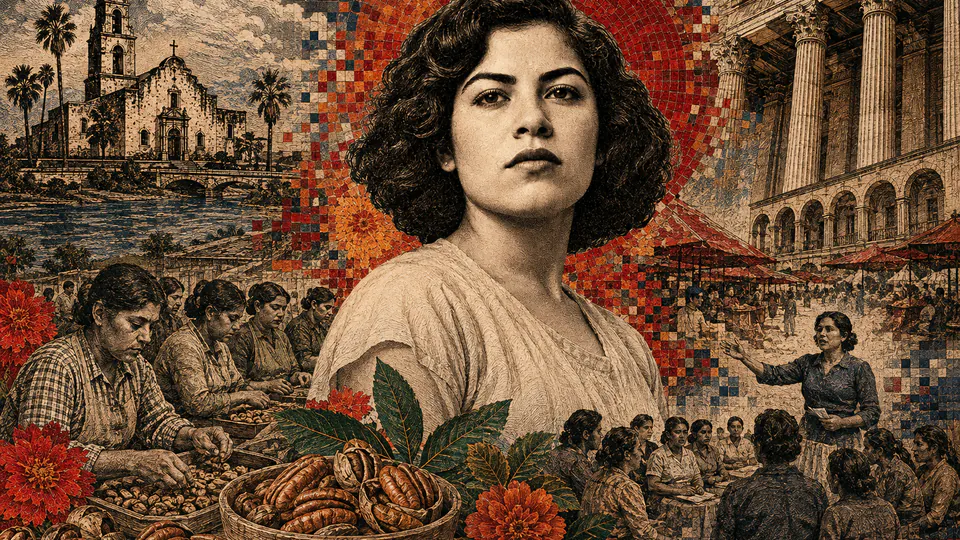
#storyEmma Tenayuca was 21 when about 12,000 San Antonio pecan shellers walked out in 1938. Most were Mexican American women. Many earned two or three dollars a week in rooms where pecan dust hung in the air and tuberculosis rates were high. When plant owners cut already miserable piece rates, the workers stopped the shelling machines.
Tenayuca became the strike’s public leader, speaking for workers while police arrested picketers, broke meetings, and fired tear gas. A city that sold pecans across the country preferred not to advertise how the shells came off.
A teenager in Depression politics
Born in San Antonio on December 21, 1916, Tenayuca grew up in a large Mexican American family and heard political debate at Plaza del Zacate. The Depression made those arguments immediate. She joined picket lines as a teenager and was arrested in 1933 while supporting women cigar workers.
Tenayuca organized unemployed workers and joined the Workers Alliance. She also became a Communist Party member, a fact city officials used to dismiss wage demands as an outside plot even though the workers, wages, and dust were all plainly local.
Thirty-seven days over a wage cut
The pecan industry depended on hand labor concentrated on San Antonio’s West Side. On January 31, 1938, workers struck after Southern Pecan Shelling Company announced a cut in piece rates. Tenayuca and the United Cannery, Agricultural, Packing, and Allied Workers helped coordinate pickets and relief.
Mayor C.K. Quin removed Tenayuca from formal leadership through pressure on the union and directed a heavy police response. Hundreds were arrested. Texas governor James Allred eventually pushed arbitration. The settlement restored much of the cut, recognized the union, and raised wages.
Federal wage law changed the industry soon after. When the 25-cent minimum wage reached pecan processing, owners mechanized or closed shops rather than keep the old hand system. A law can end one form of exploitation while employers decide which jobs survive the correction.
The city drove her out
On August 25, 1939, Tenayuca planned to speak at a Communist Party meeting in the Municipal Auditorium. Thousands of anti-communist protesters gathered outside, broke into the building, and wrecked it. Police evacuated Tenayuca. The attack and blacklist made organizing work in San Antonio nearly impossible, so she left Texas.
Tenayuca lived in California, earned a college degree, and worked as a teacher. She returned to San Antonio in 1968 and died there in 1999.
Her best-known campaign lasted 37 days. Its meaning is larger: Mexican American women in a segregated city forced employers and officials to answer a wage demand during the Depression, and the organizer used as the city’s villain was barely old enough to order a drink.
The sequence changes the argument
Accounts often compress Emma Tenayuca into the young face of one pecan-shellers’ strike. The chronology makes a larger claim. Tenayuca grew up amid poverty and political discussion in San Antonio’s West Side and joined demonstrations while still a teenager. She organized unemployed workers, women workers, and pecan shellers across workplaces where wages were low and employment insecure. Neither fact is background decoration. Together they explain why the conflict took the form it did and why participants did not treat patience as a serious answer.
Pecan processing depended on Mexican American labor performed in dusty sheds for piece rates that employers could cut. Thousands walked out in 1938, and police met pickets with arrests, clubs, and tear gas while city officials tried to discredit the strike. The work depended on meetings, transportation, money, printed material, trusted messengers, and people willing to absorb retaliation. Public memory usually preserves the microphone or the confrontation. Organization lived in the less photogenic decisions that made a crowd, vote, strike, or policy demand possible.
Power worked through institutions
The central dispute concerned how Mexican American women converted neighborhood knowledge into worker organization under police and employer pressure. That question could not be settled by a good argument alone. Employers, public officials, courts, parties, unions, churches, and newspapers controlled different resources. Organizers had to identify which body could change a rule, which ally could move it, and what pressure could make delay more expensive than action.
The Congress of Industrial Organizations assumed formal direction, limiting Tenayuca’s role even as her local credibility helped make the action possible. The settlement restored part of the wage cut, but mechanization soon changed the industry and eliminated many shelling jobs. Those outcomes belong in the same account. A movement can gain public sympathy and still lose an immediate demand. It can win a statute while leaving people outside its coverage. It can build an institution that later becomes cautious. Calling one moment a victory or defeat without naming the measure hides more than it explains.
The limits were part of the result
Anti-communism and a violent disruption of a 1939 meeting forced Tenayuca out of San Antonio and narrowed her public political life. Her later return and recognition cannot erase the cost imposed on a Mexican American woman treated as dangerous for organizing poor workers. These limits were not footnotes added by later critics. Participants argued about them at the time, often from unequal positions. Race, gender, citizenship, occupation, geography, and access to money affected who took the greatest risk and who received authority after a campaign became respectable.
This is why coalition should be treated as work rather than a photograph. Groups can share an opponent while wanting different remedies. They can cooperate on a march and disagree about a contract, a party, a war, or the pace of change. The useful question concerns the rules that allowed people to decide together, what resources they shared, and whose objections were easier to ignore.
What the record lets us say
The source trail matters because later retellings reward drama and erase maintenance. Government records show what officials claimed and enforced. Organizational papers show plans, budgets, arguments, and revisions. Oral histories recover work that formal minutes often omit, though memory recorded years later has its own limits. Newspapers capture public language while reflecting the interests and racial habits of editors. Reading those records against one another makes uncertainty visible instead of filling it with a convenient quotation.
The durable lesson of Emma Tenayuca is practical. Rights need procedures, money, institutions, and people able to enforce them after attention moves elsewhere. A law can change the field without ending the contest. A lost campaign can train organizers, expose an alliance, or leave a demand that later movements can use. History becomes more useful when it preserves both the achievement and the bill that remained unpaid.
In their own words
#wordsWhat Emma Tenayuca actually said, where, and when. Each one links to the page it was checked against.
-
What started out as an organization for equal wages turned into a mass movement against starvation, for civil rights, for a minimum-wage law.
Recalling the 1938 pecan shellers' strike in 1987. libcom.org, "Emma Tenayuca and the 1938 pecan shellers' strike" -
Food! Food.
Interviewed in her 70s on what the goal of her activism had actually been, not an ideology or an abstract concept. National Park Service, Emma Tenayuca -
I was arrested a number of times; I never thought in terms of fear, I thought in terms of justice.
On being repeatedly arrested during her organizing years in San Antonio. Fight Back News, "Vamos a la Huelga: Emma Tenayuca and the San Antonio Pecan Shellers' Strike" -
To my surprise, I return and I find myself some sort of heroine.
On returning to San Antonio after the years anti-communist blacklisting drove her out of Texas. Lynette M. Burrows, "The Passionate One Dared Fight Discrimination and Neglect"
What people get wrong
#wrong- The myth
The 1938 pecan shellers' strike was a communist plot rather than a labor dispute. - The record
San Antonio Police Chief Owen Kilday called the strike a "Red plot," but the walkout began over a wage cut affecting roughly 12,000 mostly Mexican American shellers, and Governor James Allred's state-appointed arbitration ended it with restored pay and union recognition, the resolution of a wage dispute, not a subversion case.
- The myth
Tenayuca's organizing was driven mainly by Communist Party doctrine. - The record
Asked in her 70s what her activism had actually been for, she did not name an ideology. Her answer, on the record in her own words, was two words about food.
The dates that matter
#dates- December 21, 1916 Born in San Antonio, Texas.
- 1933 Arrested while supporting the Finck Cigar Company strike.
- 1936 Helps organize unemployed workers and relief protests.
- January 31, 1938 Pecan shellers walk out after a wage cut.
- March 1938 Arbitration ends the strike with wage increases and union recognition.
- August 25, 1939 A mob attacks a communist meeting at San Antonio's Municipal Auditorium.
- 1952 Earns a degree from San Francisco State College.
- 1968 Returns to San Antonio and teaches.
- July 23, 1999 Dies in San Antonio.
Questions people ask
#faqsWho was Emma Tenayuca?
Emma Tenayuca was a Mexican American labor organizer from San Antonio best known for leading the 1938 pecan shellers strike.
How old was Emma Tenayuca during the pecan strike?
She was 21 when the strike began on January 31, 1938.
What did San Antonio pecan shellers want?
They resisted wage cuts and demanded better pay and recognition. Many worked in dusty rooms for only a few dollars a week.
What happened to Emma Tenayuca after the strike?
Anti-communist violence and blacklisting pushed her out of San Antonio. She lived in California, earned a degree, taught school, and later returned home.
The bookshelf
#bookshelfWhere to go next. Buy from an independent bookstore, or find it at your library for nothing.
-
That's Not Fair/No Es Justo: Emma Tenayuca's Struggle for Justice/La lucha de Emma Tenayuca por la justicia Sharyll Teneyuca and Carmen Tafolla, 2008 secondary
Written by Tenayuca's great-niece with historian Carmen Tafolla, the most accessible account of the strike and its stakes.
-
Labor Rights are Civil Rights: Mexican American Workers in Twentieth-Century America Zaragosa Vargas, 2004 secondary
Places the pecan shellers' strike inside the wider history of Mexican American labor organizing.
-
Women of the Depression: Caste and Culture in San Antonio, 1929-1939 Julia Kirk Blackwelder, 1984 secondary
The standard academic study of the San Antonio labor market Tenayuca organized inside, work, race, and gender together.
Wear it: Emma Tenayuca
#merchEvery design here links back to this page.

Sources
#sourcesPrimary sources
The documents themselves: laws, court opinions, speeches, letters, and the numbers from the agencies that count them.
Secondary sources
Written afterward, about the story.
- National Park Service, Emma Tenayuca
- Texas State Historical Association, Emma Tenayuca
- Wikipedia, Emma Tenayuca
- Texas State Historical Association, Pecan-Shellers’ Strike
- libcom.org, "Emma Tenayuca and the 1938 pecan shellers' strike" (quotes Tenayuca recalling the strike in 1987)
- Fight Back News, "Vamos a la Huelga: Emma Tenayuca and the San Antonio Pecan Shellers' Strike"
- Lynette M. Burrows, "The Passionate One Dared Fight Discrimination and Neglect" (quotes attributed to interviews with Tenayuca, one citing Smithsonian American Art)