Published
A. J. Muste
A. J. Muste Kept Labor Radicalism and Pacifism in the Same Room
Born January 8, 1885. Died February 11, 1967
A. J. Muste moved from ministry to labor education, Marxist organizing, and Christian pacifism while mentoring generations of anti-war activists.
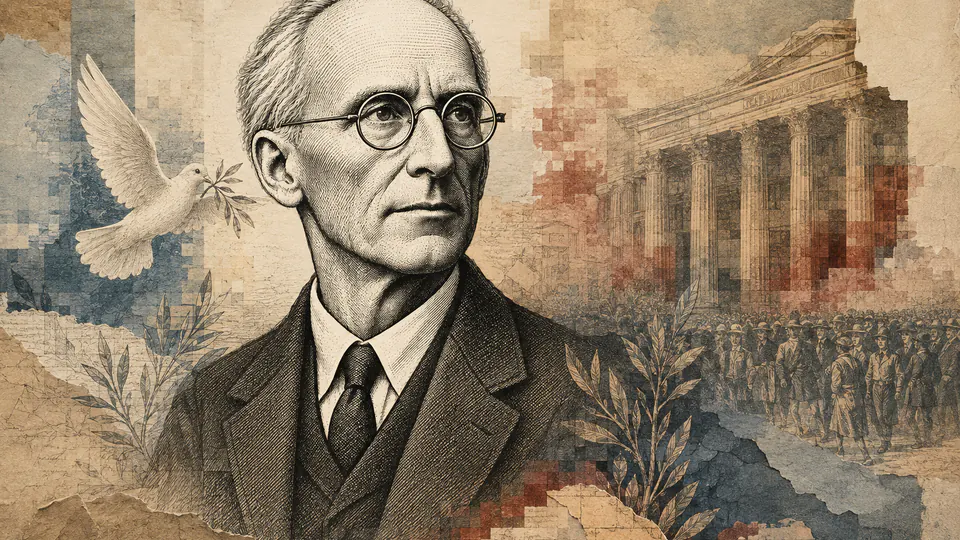
The story
#storyA. J. Muste changed his mind in public. He moved from a Dutch Reformed pulpit to pacifism, labor militancy, Marxist party work, and back to Christian nonviolence. That route can look inconsistent on paper. In practice, he kept testing whether a method reduced domination or reproduced it under a new banner.
Muste opposed U.S. entry into World War I and left his congregation. In 1919 he joined striking textile workers in Lawrence, Massachusetts, and became a central organizer. He later led Brookwood Labor College, which trained workers to study economics, organize shops, and act without waiting for approval from cautious officials.
The organizer behind other organizers
The Depression pulled Muste toward Marxist politics. He helped form the Conference for Progressive Labor Action and then a workers’ party that briefly included Leon Trotsky’s U.S. followers. In 1936 he left party politics and returned to Christian pacifism.
At the Fellowship of Reconciliation, Muste supported conscientious objectors, desegregation, nonviolent direct action, and nuclear disarmament. He advised younger organizers in the civil-rights movement and became a durable presence in anti-war coalitions. He opposed U.S. intervention in Vietnam and met Ho Chi Minh shortly before his death in 1967.
Muste rarely became the face of the movements around him. He trained people, held coalitions together, raised uncomfortable objections, and showed up. His career makes political consistency look less like never changing and more like repeatedly asking what power a strategy creates, and who will have to live under it.
Brookwood shows what that work looked like at ground level. Students were workers and organizers studying economics, labor history, public speaking, and union administration. The school treated education as preparation for decisions inside a movement, not a credential away from one. Its independence drew hostility from conservative leaders in the American Federation of Labor, who feared a center training critics from below. Muste’s later peace work retained that educational method. Nonviolence required workshops, disciplined groups, and plans for conflict rather than faith in spontaneous goodwill.
World War I broke the safe ministerial path
Muste immigrated from the Netherlands as a child and grew up in a Dutch Reformed community in Michigan. He studied for ministry and entered a respectable pastoral career. U.S. entry into World War I forced a conflict between that position and his pacifism.
His congregation did not accept his public opposition, and he resigned in 1917. The decision moved pacifism from belief into livelihood. Muste then worked with religious peace organizations and found himself among radicals whom established churches treated with suspicion.
The experience formed a pattern. He would enter institutions, learn their strengths, and leave when loyalty required silence. Changing organizations did not spare him from responsibility for earlier choices, but it kept institutional belonging from becoming his highest principle.
Lawrence gave him a strike instead of a theory
In 1919, textile workers in Lawrence, Massachusetts, struck over hours and pay. The workforce included many immigrant groups separated by language and job. Police and employers expected those divisions to defeat organization.
Muste emerged as a leading figure in the strike committee. The campaign required translation, food, picketing, negotiations, and a structure in which different groups could act together. His clerical bearing made him useful in public, but workers’ shop knowledge and collective endurance supplied the strike’s force.
The settlement won shorter hours with wage adjustments and brought Muste into national labor work. It also taught him that moral sympathy becomes effective only when workers can stop production and maintain unity under pressure.
Brookwood educated a labor opposition
Brookwood Labor College in Katonah, New York, trained workers in economics, history, public speaking, labor journalism, and administration. Muste directed it through much of the 1920s. Students brought shop-floor experience and expected education to return with them to unions.
The school became a center for progressives dissatisfied with conservative AFL leadership. That independence produced conflict with federation officials. A college that trained members to ask who controlled a union could not remain politically neutral inside labor.
Brookwood also faced the movement’s racial and gender limits. Educating a new layer of organizers mattered only if unions admitted the workers those organizers hoped to reach. Muste’s later coalitions would keep confronting the gap between universal language and segregated institutions.
Party politics tested means against ends
During the Depression, Muste helped form the Conference for Progressive Labor Action, which moved from a left labor network toward a radical party. His organization merged with a Trotskyist group to create the Workers Party of the United States.
The period placed him inside strategic arguments over party discipline, class power, the Soviet Union, and revolution. In 1936 he left Marxist party work and returned to a Christian pacifist commitment. Critics could call the turn retreat; Muste saw it as a refusal to build liberation through coercive means.
He did not abandon labor analysis. He carried its attention to power, organization, and material interest into peace work. Pacifism without such analysis could become a personal purity that left institutions untouched.
Nonviolence required training and conflict
As executive secretary of the Fellowship of Reconciliation, Muste supported conscientious objectors and helped develop nonviolent direct action. FOR staff and members contributed to the Congress of Racial Equality, Journey of Reconciliation, workshops, and civil-rights organizing.
Nonviolence in this tradition was not passivity. Organizers chose a target, prepared participants for assault and arrest, established demands, built support, and returned after an action. Muste served as adviser to younger leaders without claiming ownership of their movements.
He opposed nuclear weapons, civil defense, colonialism, and the war in Vietnam. He could cooperate with liberals, socialists, religious pacifists, students, and radicals while raising objections when coalition convenience dulled the demand.
The final trip kept the channel open
In 1966, Muste joined other activists in Saigon, where authorities detained and deported them. Early in 1967 he traveled to North Vietnam and met Ho Chi Minh. The visit did not make him an agent of either government. It expressed his belief that peace work required contact across a line war had declared closed.
He died in February 1967, soon after returning. His influence survives less through a single organization than through organizers he trained and coalitions he helped hold together. The repeated changes in his life were not evidence that ideas carried no cost. They were the cost of applying one severe test: if a movement copies the domination it opposes, what exactly will victory protect? goodwill.
In their own words
#wordsWhat A. J. Muste actually said, where, and when. Each one links to the page it was checked against.
-
Today totalitarianism, depersonalization, conscription, war, and the conscripting, war-making power-state are inextricably linked together. They constitute a whole, a “system.”
In "Of Holy Disobedience," Pendle Hill Pamphlet No. 64, published January 1952, arguing that conscription and the war-making state cannot be separated from the wider drift toward totalitarianism. A. J. Muste, "Of Holy Disobedience" (Pendle Hill, January 1952) -
The human being, the child of God, must assert his humanity and his sonship again.
In "Of Holy Disobedience" (1952), on the individual's obligation to reclaim moral choice from a conscripting state. A. J. Muste, "Of Holy Disobedience" (Pendle Hill, January 1952) -
If non-resistant pacifists get off the high ground of patiently bowing the neck to Caesar’s yoke, letting Caesar inflict the scourge of civilian conscript service upon them, they are immediately on the low ground of bargaining for indulgence for a small and, in that view, not too principled or brave a minority.
In "Of Holy Disobedience" (1952), rejecting the idea that pacifists should be grateful for government-granted conscientious-objector status. A. J. Muste, "Of Holy Disobedience" (Pendle Hill, January 1952) -
Precisely this individual refusal to “go along” is now the beginning and the core of any realistic and practical movement against war and for a more peaceful and brotherly world.
In "Of Holy Disobedience" (1952), on why individual noncooperation with conscription, not petitioning, is where an antiwar movement has to start. A. J. Muste, "Of Holy Disobedience" (Pendle Hill, January 1952) -
It is of crucial importance that we should understand that for the individual to pit himself in Holy Disobedience against the war-making and conscripting State, wherever it or he be located, is not an act of despair or defeatism.
In "Of Holy Disobedience" (1952), closing his argument that draft resistance is a constructive act, not a retreat. A. J. Muste, "Of Holy Disobedience" (Pendle Hill, January 1952)
What people get wrong
#wrong- The myth
A. J. Muste was a pacifist his whole adult life, with no break in the record. - The record
He left pacifism in the early 1930s. He organized the American Workers Party, formed in December 1933 with Muste as its leader, which merged into the Trotskyist Communist League of America in December 1934. He returned to Christian pacifism around 1936.
- The myth
"Of Holy Disobedience" argued pacifists should accept conscientious-objector status and be grateful the government allowed it. - The record
The pamphlet argues the opposite. Muste wrote that pacifists who treat COs status as a favor from the state end up "bargaining for indulgence," a weaker position than refusing to cooperate with conscription at all.
- The myth
Muste's mentorship of the civil-rights generation he trained was uncomplicated. - The record
As Fellowship of Reconciliation executive secretary, Muste asked Bayard Rustin to resign from the FOR staff in 1953 after Rustin's arrest for homosexual activity, and privately pressed him to suppress his orientation. FOR itself has since named this a failure that coexisted with real mutual respect between the two men.
- The myth
Muste personally founded the Congress of Racial Equality. - The record
CORE was founded in 1942 by Fellowship of Reconciliation members Bayard Rustin, James Farmer, and George Houser. Muste, as FOR's executive secretary, encouraged Farmer and Rustin to organize it but was not one of its founders.
The dates that matter
#dates- January 8, 1885 Born in the Netherlands; his family later settles in Michigan.
- 1917 Resigns from his pastorate after opposing U.S. entry into World War I.
- 1919 Emerges as a leader in the Lawrence textile strike.
- 1921-1933 Leads Brookwood Labor College.
- 1929 Helps found the Conference for Progressive Labor Action.
- 1936 Leaves Marxist party work and returns to Christian pacifism.
- 1940-1953 Directs the Fellowship of Reconciliation.
- February 11, 1967 Dies weeks after a peace mission to North Vietnam.
Questions people ask
#faqsWhat did A. J. Muste organize?
His work included the 1919 Lawrence textile strike, Brookwood Labor College, Conference for Progressive Labor Action, Workers Party, Fellowship of Reconciliation, and later antiwar coalitions.
Was A. J. Muste a pacifist?
Yes, though his path included a period of Marxist organizing. He returned to Christian pacifism in 1936 and became one of its leading U.S. organizers.
How did A. J. Muste influence the civil-rights movement?
Through the Fellowship of Reconciliation, workshops, advice, and close relationships, Muste helped develop nonviolent organizers and supported campaigns against segregation.
How should A. J. Muste be evaluated?
Separate the immediate result from the institutions, tactics, exclusions, and enforcement record that followed it.
The bookshelf
#bookshelfWhere to go next. Buy from an independent bookstore, or find it at your library for nothing.
-
Of Holy Disobedience A. J. Muste, 1952 primary
The Pendle Hill pamphlet where Muste sets out the case for individual refusal against a conscripting state.
-
The Essays of A. J. Muste A. J. Muste, edited by Nat Hentoff, 1967 primary
Muste's own writing across labor, Marxist, and pacifist periods, collected in one volume.
-
Abraham Went Out: A Biography of A. J. Muste Jo Ann Ooiman Robinson, 1981 secondary
The standard biography, tracing the ministry-to-labor-to-Marxism-to-pacifism arc in full.
Wear it: A. J. Muste
#merchEvery design here links back to this page.

Sources
#sourcesPrimary sources
The documents themselves: laws, court opinions, speeches, letters, and the numbers from the agencies that count them.
- Swarthmore College Peace Collection, A. J. Muste Papers
- New York Public Library, A. J. Muste Papers
- Library of Congress, A. J. Muste
- Swarthmore College Peace Collection, Fellowship of Reconciliation records
- University of Michigan, A. J. Muste papers
- A. J. Muste, "Of Holy Disobedience" (Pendle Hill, January 1952)
- Fellowship of Reconciliation, "The Fellowship of Reconciliation and Bayard Rustin: An Amends"
Secondary sources
Written afterward, about the story.