Published
Woody Guthrie
This Machine Kills Fascists: What Woody Guthrie's Guitar Said
Born July 14, 1912. Died October 3, 1967
Woody Guthrie's guitar read This machine kills fascists, dated to a 1943 photo. This Land Is Your Land had two verses radio still skips.
The story
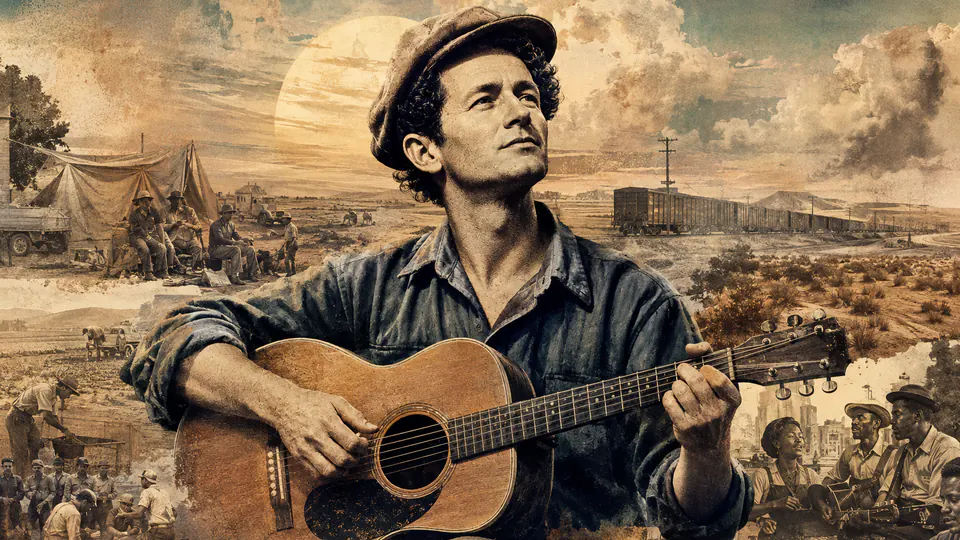
#storyOn March 8, 1943, Al Aumuller, a photographer for the New York World-Telegram, pointed his camera at a folk singer holding a guitar, and the sticker across its face read, in block letters, THIS MACHINE KILLS FASCISTS. That negative, filed today with the Library of Congress, is the earliest dated photograph of the slogan on Woody Guthrie’s guitar. The guitar itself does not survive. Neither does a second one Guthrie marked the same way. A guitar cannot kill anyone, so the claim only ever meant what Guthrie meant by it: that a song could do a soldier’s work.
Okemah to the dust
Woodrow Wilson Guthrie was born July 14, 1912, in Okemah, Oklahoma, the third of five children of Charles and Nora Belle Guthrie. His parents named him for Woodrow Wilson, New Jersey’s governor and, that summer, the Democratic Party’s new presidential nominee. Nora’s own health was already failing in ways nobody in the family had a name for yet. When Woody was fourteen, she was committed to the Oklahoma Hospital for the Insane, and she died there in 1930 from what doctors eventually recognized as Huntington’s disease.
His father sent for him in 1929, and Guthrie left Okemah High School to join him in Pampa, Texas, where he married Mary Jennings in October 1933. Pampa sat near the center of what the country would soon call the Dust Bowl. On April 14, 1935, the worst of the storms, a wall of black dirt that turned noon into night, rolled over the Texas Panhandle. Guthrie later fixed the exact date in a song, Dust Storm Disaster, that opens on that day. Two years after that storm, in 1937, he left his wife and children in Texas and joined the migration west, landing on KFVD radio in Los Angeles as half of the duo Woody and Lefty Lou.
The pact, the firing, and the turn
California gave Guthrie an audience of fellow migrants before it gave him a politics to match, and the trade he settled into, singing for strikers and writing for the movement’s own papers, was the same one Joe Hill had worked three decades earlier on the other side of the country. From May 12, 1939 to January 3, 1940, Guthrie wrote a daily column, Woody Sez, for the People’s World, the Communist Party’s West Coast newspaper, translating current events into the same Dust Bowl vernacular he sang in. He never carried a party card, and historians still argue about how close he came. What the record actually shows is messier than either side of that argument wants: in August 1939 the Soviet Union signed a non-aggression pact with Nazi Germany, and within weeks Germany invaded Poland, with Soviet troops moving into the country’s east soon after. Guthrie wrote a song praising the pact, and KFVD’s owners, no friends of Stalin’s, fired him for it.
The reversal came less than two years later. When Germany broke the pact and invaded the Soviet Union in June 1941, the group Guthrie had just joined in New York, Pete Seeger’s Almanac Singers, dropped the peace songs they had been writing and started writing against fascism instead. The same group also wrote pro-union standards like Union Maid, and Guthrie made sure his own name went on that songwriting credit, he said later, so the royalty checks would reach his children. The photograph Aumuller took in March 1943 caught the same argument painted on wood: a man who had once written the pact’s defense now carried its opposite strapped across his chest.
What the sticker actually said
The words were not entirely Guthrie’s own. A similar slogan reportedly circulated on stickers that American defense-plant machinists stuck to their own lathes and drill presses during the war: the tool does its part too. The story of Guthrie borrowing it is repeated everywhere and pinned down nowhere in particular, which is its own kind of honesty about how slogans travel. What is documented is that by 1943 he had at least two guitars marked with it, one with a printed sticker and one in ragged hand lettering, and that he was rarely photographed without one of them that year.
That June he enlisted in the U.S. Merchant Marine and took his machine to sea. One of his ships, the SS William B. Travis, struck a mine in the Mediterranean. Another, the SS Sea Porpoise, was torpedoed off Utah Beach on July 5, 1944; Guthrie came through both unhurt. The same year he shipped out, 1943, he also published his autobiography, Bound for Glory, telling the Dust Bowl story in prose that the songs had already told in verse.
The verses radio skips
The machine’s biggest target during those years was not overseas. On February 23, 1940, the morning after he checked into the Hanover House hotel on 43rd Street in New York, Guthrie wrote out a song answering Irving Berlin’s God Bless America, which he had heard Kate Smith sing on the radio until he could not stand it anymore. He titled the draft God Blessed America before crossing that out for This Land Is Your Land. The manuscript ran six verses, and two of them never made the version schools teach. One puts a fence in the singer’s path:
There was a big high wall there that tried to stop me. The sign was painted, said ‘Private Property.’ But on the backside, it didn’t say nothing. This land was made for you and me.
The other puts him outside a Depression relief line:
One bright sunny morning in the shadow of the steeple, by the relief office I saw my people. As they stood hungry, I stood there wondering if God blessed America for me.
Guthrie recorded the song, private-property verse included, in April 1944, then more or less forgot about it. The recording sat unheard for decades until Smithsonian Folkways archivists found it while transferring the old acetate to digital in 1997. The relief-office verse never got an official recording at all. By the time songbooks and Pete Seeger had made This Land Is Your Land a standard in the 1950s, the wall and the relief line were already gone, and most Americans singing it have never heard either one.
The other inheritance
Guthrie had grown up watching his mother’s illness get mistaken for a bad temper. His own version, showing up in the late 1940s, first got mistaken for drinking. Doctors did not put a name to it until 1952: Huntington’s disease, inherited from Nora, the same illness that had taken her in 1930. He spent his last decade moving between hospitals, first Greystone Park in New Jersey, later Brooklyn State and Creedmoor in Queens, losing his coordination and then his speech. He died at Creedmoor on October 3, 1967, at fifty-five. His second wife, the dancer Marjorie Mazia, had divorced him years before but stayed his caretaker through all of it, and after his death she founded the Committee to Combat Huntington’s Disease, the organization that grew into the Huntington’s Disease Society of America.
The guitar in Aumuller’s photograph disappeared decades ago, and so did the second one Guthrie marked the same way. What survives is the paper: a 1943 negative at the Library of Congress, a 1940 manuscript with two verses still missing from the songbooks, a 1944 acetate that took more than fifty years to get heard. Guthrie said his machine killed fascists. Most of what the machine actually left behind was aimed closer to home.
In their own words
#wordsWhat Woody Guthrie actually said, where, and when. Each one links to the page it was checked against.
-
The national debt is one thing I caint figger out. I heard a senator on a radio a saying that we owed somebody 16 jillion dollers. I don't know their name, but I remember the price. Called it the national debt. If the nation is the government and the government is the people, then I guess the people owes the people, that means I owe me and you owe you, and I forget the regular fee, but if I owe myself something, I would be a willing just to call it off rather than have the senators argue about it, and I know you would do the same and then we wouldn't have no national debt.
His first Woody Sez column for the People's World, 1939, in his own spelling. Woody Guthrie, "The National Debit," Woody Sez column, People's World (1939) -
There was a big high wall there that tried to stop me. The sign was painted, said 'Private Property.' But on the backside, it didn't say nothing. This land was made for you and me.
One of two verses of This Land Is Your Land, written February 23, 1940, that most recordings and songbooks cut. The Lost Verses of This Land is Your Land, Blackwing Blog -
One bright sunny morning in the shadow of the steeple, by the relief office I saw my people. As they stood hungry, I stood there wondering if God blessed America for me.
The other cut verse of This Land Is Your Land, from the same February 23, 1940 manuscript. The Lost Verses of This Land is Your Land, Blackwing Blog -
THIS MACHINE KILLS FASCISTS
His own label, in block letters across the face of his guitar, documented in a March 8, 1943 photograph by Al Aumuller for the New York World-Telegram. Wikimedia Commons, File: Guthrie guitar this machine kills fascists.jpg
What people get wrong
#wrong- The myth
THIS MACHINE KILLS FASCISTS was a slogan Guthrie invented himself. - The record
A similar line reportedly circulated on stickers that American defense-plant machinists put on their own lathes and drill presses during the war. The path from that shop-floor slogan to Guthrie's guitar is documented in outline but not pinned to a single traceable moment.
- The myth
This Land Is Your Land is a simple, uncomplicated patriotic song. - The record
Guthrie wrote it as a direct answer to Irving Berlin's God Bless America and titled his draft God Blessed America before crossing that out. Two of the six original verses, about a Private Property sign and a Depression relief line, question who the land actually belongs to, and neither made the version most Americans learned.
- The myth
Guthrie was a card-carrying Communist Party member. - The record
He never held a party card, though he wrote a daily column for the Communist Party's West Coast paper, the People's World, from May 1939 to January 1940, and historians still argue about how close he came to formal membership.
The dates that matter
#dates- July 14, 1912 Born Woodrow Wilson Guthrie in Okemah, Oklahoma, the third of five children of Charles and Nora Belle Guthrie.
- 1929 Leaves Okemah High School and joins his father in Pampa, Texas, after his mother's institutionalization.
- October 1933 Marries Mary Jennings in Pampa.
- April 14, 1935 Black Sunday, the worst storm of the Dust Bowl, buries the Texas Panhandle. Guthrie later dates it exactly in his song Dust Storm Disaster.
- 1937 Leaves his family in Texas and joins the migration to California, landing on KFVD radio in Los Angeles.
- May 12, 1939 - January 3, 1940 Writes the daily column Woody Sez for the People's World, a West Coast communist newspaper.
- 1939 Fired from KFVD after writing a song praising the Soviet Union's non-aggression pact with Nazi Germany.
- February 23, 1940 Writes This Land Is Your Land at the Hanover House hotel in New York, answering Irving Berlin's God Bless America.
- 1941 Joins Pete Seeger's Almanac Singers in New York. After Germany invades the Soviet Union that June, the group's songs turn from pacifism to anti-fascism.
- March 8, 1943 Photographed by Al Aumuller for the New York World-Telegram holding a guitar marked THIS MACHINE KILLS FASCISTS.
- June 1943 Enlists in the U.S. Merchant Marine. The same year, he publishes his autobiography, Bound for Glory.
- July 5, 1944 The SS Sea Porpoise, one of his Merchant Marine ships, is torpedoed off Utah Beach. Guthrie is unhurt.
- 1952 Diagnosed with Huntington's disease, the illness that killed his mother in 1930.
- October 3, 1967 Dies at Creedmoor Psychiatric Center in Queens, New York, at fifty-five. Marjorie Mazia Guthrie later founds the Committee to Combat Huntington's Disease.
Questions people ask
#faqsWhat does This machine kills fascists mean?
It was Woody Guthrie's own label for the guitar he carried through World War II, first documented in a March 8, 1943 photograph. The claim was never literal: a guitar cannot kill anyone. Guthrie meant his songs could do a soldier's work, and the line itself may have started as a slogan reportedly used on stickers that defense-plant machinists stuck to their own lathes during the war.
When did Woody Guthrie write This Land Is Your Land?
On February 23, 1940, in a room at the Hanover House hotel on 43rd Street in New York, the morning after he checked in. He wrote it answering Irving Berlin's God Bless America, which he had heard Kate Smith sing on the radio until he could not stand it, and he originally titled the draft God Blessed America.
Was Woody Guthrie a communist?
He never held a Communist Party card, and historians still argue about how close he came. He wrote a column for the People's World, a West Coast communist newspaper, from May 1939 to January 1940, and that same year he lost his KFVD radio job after writing a song that praised the Soviet Union's non-aggression pact with Nazi Germany.
What happened to Woody Guthrie's guitars?
Both guitars he marked with the fascist-killing slogan, one with a printed sticker and one in hand lettering, have disappeared. The clearest surviving record of the sticker is a March 8, 1943 photograph by Al Aumuller, now held by the Library of Congress.
How did Woody Guthrie die?
Huntington's disease, the same illness that institutionalized and then killed his mother in 1930. Doctors diagnosed Guthrie in 1952, and he spent his last decade moving between psychiatric hospitals, dying at Creedmoor Psychiatric Center in Queens, New York, on October 3, 1967, at fifty-five.
The bookshelf
#bookshelfWhere to go next. Buy from an independent bookstore, or find it at your library for nothing.
-
Bound for Glory Woody Guthrie, 1943 primary
His own telling of the Dust Bowl years, in the same voice that wrote the songs.
-
Born to Win Woody Guthrie, edited by Robert Shelton, 1965 primary
A collection of his own prose, poems, and drawings, assembled after his death from papers he left behind.
-
Ramblin' Man: The Life and Times of Woody Guthrie Ed Cray, 2004 secondary
The standard biography, weighing Guthrie's own accounts against the documented record.
Wear it: Woody Guthrie
#merchEvery design here links back to this page.

Sources
#sourcesPrimary sources
The documents themselves: laws, court opinions, speeches, letters, and the numbers from the agencies that count them.
- Wikimedia Commons, File: Guthrie guitar this machine kills fascists.jpg (dates the Al Aumuller photograph to March 8, 1943, Library of Congress, New York World-Telegram and Sun collection)
- The Lost Verses of This Land is Your Land, Blackwing Blog (verbatim text of the private-property and relief-office verses; the 1997 rediscovery of the 1944 recording)
- Woody Guthrie, "The National Debit," Woody Sez column, People's World (1939), reproduced by People's World
Secondary sources
Written afterward, about the story.
- Wikipedia, Woody Guthrie (biography, KFVD firing, Almanac Singers, Merchant Marine service, Huntington's disease diagnosis and death)
- Wikipedia, This Land Is Your Land (composition date, God Bless America connection, the six-verse manuscript, 1944 recording)
- Wikipedia, This machine kills fascists (background on the slogan and Guthrie's wartime anti-fascist writing)
- Wikipedia, Marjorie Mazia Guthrie (founding of the Committee to Combat Huntington's Disease)
- Wikipedia, Dust Bowl Ballads (the April 14, 1935 Black Sunday storm and the 1940 album)
- Where Woody Guthrie Wrote This Land Is Your Land, Chimes Freedom (the Hanover House hotel, February 22-23, 1940)
- Woody Sez: Woody Guthrie's Columns in People's World (column dates and Guthrie's fellow-traveler ambiguity)
- Encyclopedia of Oklahoma History and Culture, Guthrie, Woodrow Wilson (birth family details and the move to Pampa and California)
- The Powerful Messages That Woody Guthrie and Pete Seeger Inscribed on Their Guitar and Banjo, Open Culture (the two marked guitars and their disappearance; Pete Seeger's banjo inscription)
- Woody Guthrie Biography, official Woody Guthrie website (family background and career timeline)