Published
Dorothy Day
Dorothy Day Made Hospitality a Form of Political Refusal
Born November 8, 1897. Died November 29, 1980
Dorothy Day co-founded the Catholic Worker movement, joining houses of hospitality and a penny newspaper to labor organizing, pacifism, and voluntary poverty.
The story
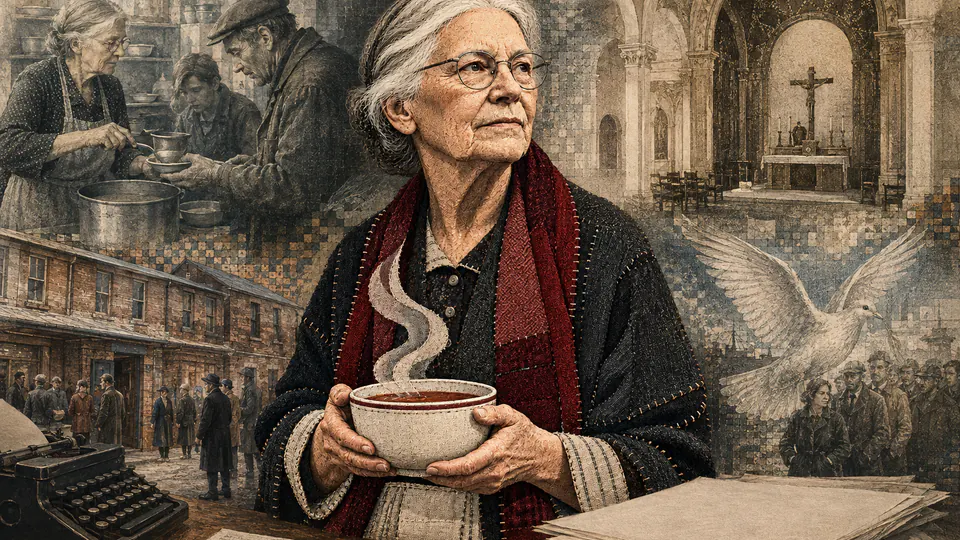
#storyDorothy Day spent her public life refusing a choice between changing institutions and meeting the person at the door. The Catholic Worker supported strikes and condemned capitalism, while its houses served meals and found beds. Neither task excused neglect of the other.
Before converting to Catholicism, Day reported for socialist newspapers, joined suffrage protests, and lived among radicals in New York. In 1933 she met Peter Maurin, a French Catholic thinker who proposed a newspaper for workers and a network of houses and farms. The first issue of The Catholic Worker appeared on May Day and cost a penny.
Pacifism when pacifism cost support
The movement expanded during the Depression. Its decentralized houses practiced hospitality with few resources and no distant headquarters. Day supported unions and later farmworkers, but opposed class hatred and centralized state solutions. That combination kept her at an angle to both liberal charity and party socialism.
Her commitment to anti-war politics was equally inconvenient. The newspaper rejected U.S. entry into World War II, a position that cost circulation and closed houses. During the Cold War, Day refused civil-defense drills that treated nuclear war as manageable. She was arrested repeatedly.
Day distrusted admiration that separated saints from ordinary obligations. The work she left is deliberately unfinished and hard to scale: share resources, resist war, stand with workers, and accept that the person needing help now cannot be postponed until after the system changes.
The Catholic Worker never became a conventional nonprofit chain. Houses were locally run, often unstable, and held together by shared commitments more than administrative control. That independence allowed fast action and protected disagreement, while also producing uneven conditions and permanent scarcity. Day accepted much of that tension as the cost of personal responsibility. Critics can reasonably ask what voluntary poverty means when guests never chose poverty at all. Her answer was practice rather than a system: live near the consequence, surrender comfort, and keep the door open.
Radical journalism came before conversion
Day worked for socialist papers including The Call and reported on strikes, poverty, and political movements. She knew Greenwich Village radicals, opposed World War I, and joined suffragists who picketed the White House. After arrest in 1917, she took part in a hunger strike and endured force-feeding.
Her early life did not follow a smooth path toward religious certainty. It included love affairs, an abortion, marriage, journalism, and a continuing desire for both community and belief. After the birth of her daughter Tamar, Day entered the Catholic Church in 1927. The decision cost personal relationships and did not settle how a Catholic should respond to capitalism.
When she met Peter Maurin in 1932, he offered a program rather than a private answer. Maurin proposed roundtable discussions, houses of hospitality, and agronomic communities. Day supplied editorial skill, discipline, and a willingness to turn the ideas into a newspaper that workers could afford.
A penny paper built an organization without headquarters
The first issue of The Catholic Worker appeared in Union Square on May Day 1933. Its one-cent price made circulation more important than revenue. The paper covered labor conflict, Catholic social teaching, racism, war, and the daily experience of poverty. Readers wrote back, volunteered, sent money, and opened houses in other cities.
The movement developed without a central board controlling every house. Communities used the Catholic Worker name while making local decisions about money, guests, work, and protest. That structure limited bureaucracy and protected local conscience. It also meant a house could fail, become unsafe, or depend too heavily on exhausted people without a national office able to repair it.
Day resisted turning hospitality into a professional service delivered at a distance. She wanted people to share food, rooms, risk, and responsibility. The intimacy could break down the division between helper and recipient. It could also place heavy and unequal burdens on women and long-term residents. The experiment should be judged with both facts in view.
Labor solidarity tested Catholic language
The Catholic Worker supported seamen, auto workers, garment workers, agricultural laborers, and other organizing drives, though Day did not accept every union policy. She reported from picket lines and treated the right to organize as part of human dignity.
Her position differed from both employer charity and a politics that reduced people to class roles. She opposed capitalism’s concentration of property while also criticizing centralized state and party power. Personalism placed responsibility on the person and small community, but did not excuse owners or public officials.
In 1973, at seventy-five, Day was jailed in California while supporting the United Farm Workers. Her presence connected Depression-era worker Catholicism with a movement led by Mexican American and Filipino farmworkers. It also demonstrated that solidarity meant accepting another organization’s discipline rather than arriving only to give a speech.
Pacifism cost the movement members
Day opposed war before, during, and after the conflict most Americans remembered as morally necessary. When The Catholic Worker maintained pacifism during World War II, circulation fell and some houses separated from the movement. Day acknowledged the crimes of fascism while refusing bombing, conscription, and killing as answers.
That position remains the hardest part of her record for many readers. It can sound like moral purity purchased by people not facing occupation. Day answered that the means used in war formed the peace that followed, and that Christians could not suspend the command against killing when a government issued a uniform.
During the Cold War, compulsory civil-defense drills instructed New Yorkers to prepare for nuclear attack. Day and others sat in public rather than take shelter. Their arrests challenged the fiction that nuclear war could be made survivable through obedient practice. Refusal named the drill as political theater.
Race exposed the distance between teaching and institution
Day condemned racism and supported the civil-rights movement, but Catholic institutions and Catholic Worker houses existed inside segregated cities. Publishing against racism was easier than sustaining interracial community under housing exclusion, white hostility, and unequal authority.
The movement’s local independence produced different records from house to house. Black Catholics and civil-rights organizers pressed white co-religionists to treat racial justice as a test of faith, not a special interest. Day’s best writing accepted that test. Admiration should not turn her commitments into evidence that every community consistently met them.
Her resistance to nuclear weapons, support for strikes, and hospitality work shared a premise: no person can be made expendable for an institution’s convenience. War, poverty, and racism each depended on a category of lives whose suffering could be managed rather than ended.
Voluntary poverty was a discipline, not a policy program
Day chose to live with little and criticized the desire for status and possession. That choice distinguished voluntary poverty from deprivation imposed on a guest who could not leave. She knew the difference, though the movement never solved it.
Houses could feed someone tonight without changing rent, wages, disability benefits, or public housing. Day supported structural protest while distrusting administrative solutions that separated professional providers from the people they served. Her work keeps the tension open: a right should not depend on private charity, and a public program does not remove the duty to meet a neighbor as a person.
Day died at Maryhouse in 1980. The Catholic Church later opened a canonization cause, a development she had feared might soften her politics. The useful memorial is less comfortable. It asks whether a movement can oppose the forces producing hunger while still serving the meal, resist the war when resistance is lonely, and live close enough to consequences that theory cannot hide the person at the door.
In their own words
#wordsWhat Dorothy Day actually said, where, and when. Each one links to the page it was checked against.
-
It is right never to be satisfied with the little we can do, but we must remember the "little way" of St. Therese, we must remember the importance of giving even a drink of cold water in the name of Christ.
"Day After Day: More Houses of Hospitality Are Needed," her column in The Catholic Worker, March 1938. Dorothy Day, "Day After Day" (The Catholic Worker, March 1938, DDLW #331) -
We are still pacifists. Our manifesto is the Sermon on the Mount, which means that we will try to be peacemakers. Speaking for many of our conscientious objectors, we will not participate in armed warfare or in making munitions, or by buying government bonds to prosecute the war, or in urging others to these efforts.
Her editorial statement in The Catholic Worker, January 1942, one month after Pearl Harbor and the United States' declaration of war. Dorothy Day, "Editorial" (The Catholic Worker, January 1942, DDLW #868) -
I remember having a nightmare during World War II in which, thinking of our pacifist position, I heard a voice saying "Be kind, Cain," as if such words could ward off the blow that was about to fall.
Her "On Pilgrimage" column in The Catholic Worker, April 1968, reflecting on the cost of holding to pacifism. Dorothy Day, "On Pilgrimage" (The Catholic Worker, April 1968, DDLW #253) -
Cesar Chavez' union of Farm Workers has everything that belongs to a new social order, so my path was clear. I had come to picket where an injunction was prohibiting picketing, and I would spend my weeks in California in jail, not at conferences.
Her diary-style "On Pilgrimage" column in The Catholic Worker, September 1973, describing the trip that led to her arrest supporting the United Farm Workers. Dorothy Day, "On Pilgrimage" (The Catholic Worker, September 1973, DDLW #533)
What people get wrong
#wrong- The myth
Dorothy Day was a lifelong Catholic who came to social justice work through the Church. - The record
The order ran the other way. She worked for socialist newspapers, was jailed at a 1917 suffrage picket outside the White House, and lived among Greenwich Village radicals for years before entering the Catholic Church in 1927, after the birth of her daughter Tamar.
- The myth
The Catholic Worker was a charity that said nothing about politics to protect its tax status and reputation. - The record
Its January 1942 editorial, published one month after Pearl Harbor, stated in print that the paper would not support the war: "we will not participate in armed warfare or in making munitions, or by buying government bonds to prosecute the war." The stand cost the paper readers and closed some houses of hospitality that broke from the movement over it.
- The myth
Dorothy Day's activism was mostly symbolic, limited to writing and speeches. - The record
In 1973, at seventy-five, she was arrested and jailed in California's Central Valley for picketing in defiance of an injunction during the United Farm Workers' grape and lettuce strikes, one of more than half a dozen arrests across her life for civil disobedience, from the 1917 suffrage picket to 1950s civil-defense drill refusals.
The dates that matter
#dates- November 8, 1897 Born in Brooklyn, New York.
- 1917 Jailed after a suffrage protest in Washington, D.C.
- 1927 Enters the Catholic Church after the birth of her daughter Tamar.
- May 1, 1933 Publishes the first issue of The Catholic Worker with Peter Maurin.
- 1930s Catholic Worker houses of hospitality spread to other cities.
- 1950s Repeatedly refuses compulsory civil-defense drills and is arrested.
- 1973 Jailed while supporting farmworkers in California.
- November 29, 1980 Dies at Maryhouse in New York City.
Questions people ask
#faqsWas Dorothy Day a socialist?
She worked in socialist circles and shared much of their critique of capitalism, but her mature politics were rooted in Catholic teaching, personalism, pacifism, and voluntary poverty rather than party membership.
What is the Catholic Worker movement?
It is a decentralized network begun by Day and Peter Maurin in 1933, known for a newspaper, houses of hospitality, farming communities, labor solidarity, and resistance to war.
Is Dorothy Day a Catholic saint?
The Catholic Church has opened her cause for canonization and refers to her as Servant of God, but she has not been canonized.
How should Dorothy Day be evaluated?
Separate the immediate result from the institutions, tactics, exclusions, and enforcement record that followed it.
The bookshelf
#bookshelfWhere to go next. Buy from an independent bookstore, or find it at your library for nothing.
-
The Long Loneliness Dorothy Day, 1952 primary
Her own autobiography, through the conversion, the founding of the paper, and the first houses of hospitality.
-
Dorothy Day: Dissenting Voice of the American Century John Loughery and Blythe Randolph, 2020 secondary
The fullest modern biography, drawing on the Marquette archive and her own diaries.
Wear it: Dorothy Day
#merchEvery design here links back to this page.

Sources
#sourcesPrimary sources
The documents themselves: laws, court opinions, speeches, letters, and the numbers from the agencies that count them.
- Library of Congress, Dorothy Day
- Marquette University, Dorothy Day-Catholic Worker Collection
- Library of Congress, Catholic Worker newspaper
- Dorothy Day, "Day After Day" (The Catholic Worker, March 1938, DDLW #331)
- Dorothy Day, "Editorial" (The Catholic Worker, January 1942, DDLW #868)
- Dorothy Day, "On Pilgrimage" (The Catholic Worker, April 1968, DDLW #253)
- Dorothy Day, "On Pilgrimage" (The Catholic Worker, September 1973, DDLW #533)
Secondary sources
Written afterward, about the story.