Published
Bayard Rustin
Bayard Rustin Organized the March on Washington in Eight Weeks
Born March 17, 1912. Died August 24, 1987
How Bayard Rustin, a Quaker pacifist with two prior convictions, built the 1963 March on Washington in about eight weeks as its deputy director.
The story
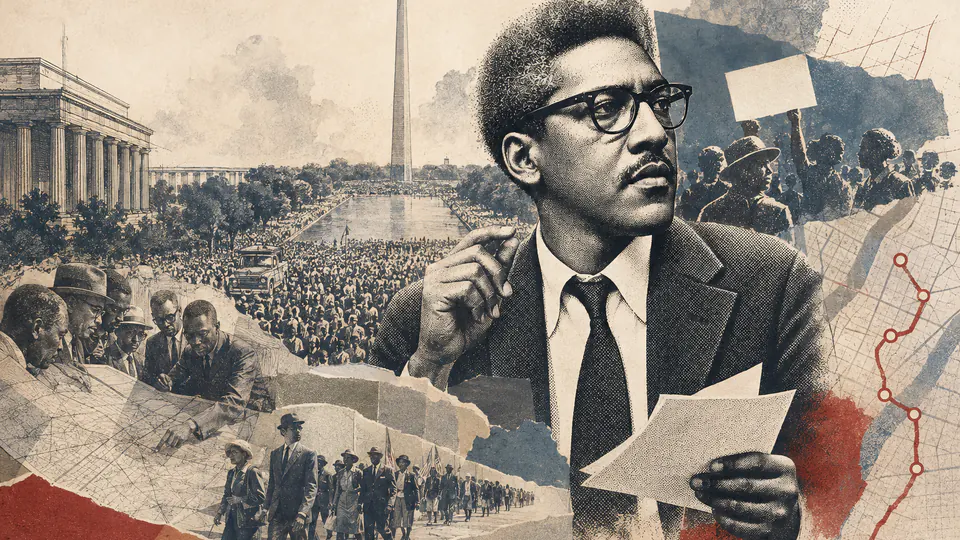
#storyBayard Rustin organized the 1963 March on Washington for Jobs and Freedom in about eight weeks. Six civil rights and labor organizations announced the march on July 2, 1963, named A. Philip Randolph its director, and made Rustin his deputy, the job that actually runs a march: the staff, the sound system, the marshals, the buses, the toilets, the whole apparatus that had to work on August 28 or the day would collapse into chaos on national television. It worked. An estimated 250,000 people, about 190,000 Black and 60,000 white, filled the National Mall that day. Two weeks earlier, a sitting United States senator had taken the Senate floor specifically to try to stop it, by outing Rustin.
A Quaker childhood, and a bus outside Nashville
Rustin was born March 17, 1912, in West Chester, Pennsylvania, and raised by his maternal grandparents. His grandmother, Julia Rustin, was a Quaker and an NAACP member, and the household ran on Quaker discipline: plain speech, direct action, no deference to unjust authority. That shaped the organizer he became decades before anyone outside his hometown had heard of him.
The record shows him practicing it in July 1942, more than a decade before Rosa Parks, when Fellowship magazine published his own account of a bus ride from Louisville to Nashville. Rustin took the second seat instead of the back. When the driver told him to move, citing the law, he answered:
My friend, I believe that is an unjust law. If I were to sit in back I would be condoning injustice.
Police pulled the bus over outside Nashville and beat him pulling him off it. He did not fight back. “There is no need to beat me,” he told them. “I am not resisting you.” At the police station, told he was supposed to be afraid, he answered, “I am fortified by truth, justice, and Christ. There’s no need for me to fear.” The charges did not stick. Apply the belief in public, in the exact spot the law says you cannot, and make the state do something ugly to enforce it: that was the method Rustin ran for the rest of his life.
Two and a half years for refusing the draft
He refined the method in federal prison. Rustin was convicted in January 1944 under the Selective Service Act; as a Quaker conscientious objector he could have taken alternative service through the Civilian Public Service program, and refused that too, unwilling to cooperate with a war fought by segregated armed forces in any capacity at all. He was sentenced to three years and served close to two and a half of them, first at the federal prison in Ashland, Kentucky, then at Lewisburg, Pennsylvania, until his release in June 1946. He spent the time organizing against segregated dining halls, seating, and recreation, teaching an integrated history class, and leading an interracial choir, a rehearsal, inside a federal penitentiary, for the discipline he would later teach a much larger movement.
The first Freedom Ride, and a chain gang
Released in 1946, Rustin spent the next year helping organize the Journey of Reconciliation, a test of the Supreme Court’s ruling in Morgan v. Virginia that segregated seating on interstate buses was unconstitutional. On April 13, 1947, at the bus station in Chapel Hill, North Carolina, he and other riders were arrested for refusing to move to the back. North Carolina courts convicted him and sentenced him to a chain gang; the state supreme court upheld the sentence in 1949, and on March 21 of that year Rustin surrendered at the Hillsborough courthouse and was sent to Roxboro, where he served 22 days of a 30-day sentence, released early for good behavior. He wrote up the conditions afterward, and the New York Post ran his account as a series. In June 2022, seventy-five years after the arrest, a North Carolina Superior Court judge vacated the convictions of Rustin and the other riders. “We failed these men,” said Judge Allen Baddour. “We failed their cause and we failed to deliver justice in our community.”
Pasadena, 1953
Rustin’s other arrest cost him more, and for longer. On January 22, 1953, Los Angeles County convicted him of a misdemeanor after police found him having sex with two men in a parked car in Pasadena, where he was on a speaking tour funded by the American Friends Service Committee. He was sentenced to 60 days and ordered to register as a sex offender, under a charge California’s own pardon certificate would describe nearly 70 years later as one “commonly used to punish gay men for engaging in consensual adult sexual conduct.” The Fellowship of Reconciliation, the pacifist organization he had worked for over a decade, pressured him to resign within weeks. Rustin later said what that cost him plainly: “When I lost my job [with the FOR], some of these nonviolent Christians despite their love and affection for humanity were not really able to express very much affection to me.” The conviction followed him into every civil rights job for the rest of his career, a fact his opponents understood and were prepared to use.
Eight weeks in the summer of 1963
They used it that August. Randolph, who had been threatening a march on Washington since the early years of the war to force action on defense-industry hiring, handed Rustin the operation: a staff of more than 200 organizers coordinating publicity, recruitment, and transportation for a crowd nobody could confidently size in advance, a sound system built to carry a speech to a quarter million people, and marshals trained to keep it peaceful. On August 13, with the march fifteen days out, Senator Strom Thurmond took the Senate floor and read Rustin’s 1953 arrest into the Congressional Record, calling him a draft dodger and worse, in a public attempt to discredit the march through its organizer. Randolph and the rest of the movement’s leadership answered by standing behind Rustin instead of dropping him. The march went ahead on schedule, on August 28, with the crowd, the sound, and the timetable running the way Rustin had built them to.
After the march
Two years later, Rustin and Randolph founded the A. Philip Randolph Institute to make the alliance between civil rights and organized labor permanent instead of occasional. Rustin led it as its first president from 1965 to 1979, working the ground between Black workers and the unions that too often still excluded them, the same fusion he and Randolph had spent decades building toward. It was the argument organizers like Ella Baker were making elsewhere in the movement at the same time, that durable change runs through organizations built to outlast any one leader. Rustin kept organizing afterward, on human rights missions abroad and, before his death, testifying in Albany for New York’s gay rights bill. He died in New York City on August 24, 1987, at 75.
The record catches up
It took decades, but it caught up. In November 2013, President Obama posthumously awarded Rustin the Presidential Medal of Freedom. Its official citation put it plainly: “Thanks to his unparalleled skills as an organizer, progress that once seemed impossible appears, in retrospect, to have been inevitable.” In February 2020, California Governor Gavin Newsom posthumously pardoned the 1953 conviction, writing that Rustin had been “criminalized because of stigma, bias, and ignorance,” and naming the specific damage the record had done, an “injustice that was compounded by his political opponents’ use of the record of this case to try to undermine him, his associates, and the civil rights movement.” Two years after that, North Carolina cleared the 1947 chain gang conviction too. None of it changes the summer of 1963: a war resister, a twice convicted man, openly gay in an era that criminalized it, built the largest demonstration the country had ever seen in eight weeks, and it held.
In their own words
#wordsWhat Bayard Rustin actually said, where, and when. Each one links to the page it was checked against.
-
My friend, I believe that is an unjust law. If I were to sit in back I would be condoning injustice.
To the driver of a bus from Louisville to Nashville, in his own account for Fellowship, July 1942. Bayard Rustin, "Nonviolence vs. Jim Crow," Fellowship (July 1942) -
If I sit in the back of the bus I am depriving that child — I pointed to a little white child of five or six — of the knowledge that there is injustice here, which I believe it is his right to know.
From the same 1942 essay, giving the driver his reason. Bayard Rustin, "Nonviolence vs. Jim Crow," Fellowship (July 1942) -
There is no need to beat me. I am not resisting you.
To police pulling him off the bus outside Nashville, July 1942. Bayard Rustin, "Nonviolence vs. Jim Crow," Fellowship (July 1942) -
I am fortified by truth, justice, and Christ. There's no need for me to fear.
At the police station after the arrest, July 1942. Bayard Rustin, "Nonviolence vs. Jim Crow," Fellowship (July 1942) -
When I lost my job [with the FOR], some of these nonviolent Christians despite their love and affection for humanity were not really able to express very much affection to me
On the 1953 resignation the Fellowship of Reconciliation required of him, in a 1987 interview with Open Hands. Fellowship of Reconciliation USA, "Before It Embraced LGBTQ Rights, the FOR Forced Bayard Rustin to Resign"
What people get wrong
#wrong- The myth
Rustin's sexuality was a minor footnote to his organizing career. - The record
It cost him his job at the Fellowship of Reconciliation in 1953. On August 13, 1963, fifteen days before the March on Washington, Senator Strom Thurmond attacked him from the Senate floor and put it in the Congressional Record.
- The myth
A. Philip Randolph organized the March on Washington largely by himself. - The record
Randolph, as director, handed the day-to-day planning to Rustin, his deputy, who coordinated a staff of more than 200 organizers, the sound system, marshal training, and logistics in less than three months.
- The myth
Rustin was a civil rights organizer, and the labor movement was somebody else's department. - The record
He co-founded the A. Philip Randolph Institute with Randolph in 1965 and was its first president until 1979. The institute's work was the alliance between Black workers and organized labor.
The dates that matter
#dates- March 17, 1912 Born in West Chester, Pennsylvania, and raised by his maternal grandparents; his grandmother Julia Rustin was a Quaker and an NAACP member.
- July 1942 Fellowship magazine publishes his account of refusing to move to the back of a bus from Louisville to Nashville, more than a decade before Rosa Parks.
- 1944-1946 Convicted of violating the Selective Service Act after refusing the WWII draft and the Civilian Public Service alternative; serves close to two and a half years of a three-year sentence at federal prisons in Ashland, Kentucky, and Lewisburg, Pennsylvania, organizing against segregated dining, seating, and recreation.
- April 13, 1947 Arrested at the Chapel Hill, North Carolina bus station during the Journey of Reconciliation, the first Freedom Ride, testing the Supreme Court's ban on segregated interstate buses.
- March 21, 1949 After the North Carolina Supreme Court upholds his sentence, surrenders at the Hillsborough courthouse and is sent to a chain gang at Roxboro, North Carolina, serving 22 days of a 30-day sentence.
- January 22, 1953 Convicted of a misdemeanor in Los Angeles County after his arrest in Pasadena for consensual sex with two men; sentenced to 60 days and forced to register as a sex offender.
- July 2, 1963 A. Philip Randolph names Rustin deputy director of the planned March on Washington for Jobs and Freedom, eight weeks before the date set for the march.
- August 13, 1963 Senator Strom Thurmond attacks Rustin on the Senate floor over the 1953 arrest, two weeks before the march; Randolph and the other organizers publicly back Rustin.
- August 28, 1963 The March on Washington draws an estimated 250,000 people, about 190,000 Black and 60,000 white, to the National Mall.
- 1965 Co-founds the A. Philip Randolph Institute with Randolph and is its first president until 1979.
- August 24, 1987 Dies in New York City at 75.
- November 20, 2013 President Obama posthumously awards him the Presidential Medal of Freedom.
- February 4, 2020 California Governor Gavin Newsom posthumously pardons Rustin's 1953 conviction.
- June 2022 A North Carolina judge vacates the 1947 Journey of Reconciliation convictions, including Rustin's.
Questions people ask
#faqsWho organized the March on Washington?
Bayard Rustin, working as deputy director under A. Philip Randolph, handled the day to day organizing of the August 28, 1963 March on Washington for Jobs and Freedom: the staff, the sound system, the marshals, and the transportation for an estimated 250,000 people, built in about eight weeks.
Was Bayard Rustin gay?
Yes, and openly enough that it shaped his career. He was convicted in 1953 for consensual sex with two men in a parked car in Pasadena, California, forced out of his job at the Fellowship of Reconciliation over it, and attacked on the Senate floor over the same arrest in 1963. California Governor Gavin Newsom posthumously pardoned the conviction in 2020.
Why was Bayard Rustin imprisoned?
Twice, for different reasons. In 1944 he was convicted for refusing the WWII draft and the Civilian Public Service alternative offered to conscientious objectors, and served close to two and a half years of a three-year sentence at federal prisons in Ashland, Kentucky, and Lewisburg, Pennsylvania. In 1947 he helped organize the Journey of Reconciliation, an early Freedom Ride, and was sentenced to a North Carolina chain gang for it; he served 22 days of that sentence in 1949.
What did Bayard Rustin do after the March on Washington?
In 1965 he co-founded the A. Philip Randolph Institute with Randolph and led it as its first president until 1979, building the alliance between the civil rights and labor movements. He kept organizing afterward, including human rights missions abroad and testimony for New York's gay rights bill.
Did Bayard Rustin ever receive official recognition or a pardon?
Yes, decades late. President Obama awarded him a posthumous Presidential Medal of Freedom in 2013. California pardoned his 1953 conviction in 2020, and a North Carolina court vacated his 1947 chain gang conviction in 2022.
The bookshelf
#bookshelfWhere to go next. Buy from an independent bookstore, or find it at your library for nothing.
-
Time on Two Crosses: The Collected Writings of Bayard Rustin Bayard Rustin, edited by Devon W. Carbado and Donald Weise, 2003 primary
His own essays and speeches, collected in one volume.
-
I Must Resist: Bayard Rustin's Life in Letters Bayard Rustin, edited by Michael G. Long, 2012 primary
Decades of his own correspondence, including the years around the 1953 arrest and the march.
-
Lost Prophet: The Life and Times of Bayard Rustin John D'Emilio, 2003 secondary
The standard biography, and the first written from his personal papers.
Wear it: Bayard Rustin
#merchEvery design here links back to this page.

Sources
#sourcesPrimary sources
The documents themselves: laws, court opinions, speeches, letters, and the numbers from the agencies that count them.
- Bayard Rustin, "Nonviolence vs. Jim Crow," Fellowship (July 1942) (reprint of the original essay describing the 1942 bus arrest, quoted verbatim)
- Bayard Rustin, "A Report on Twenty-Two Days on the Chain Gang at Roxboro, North Carolina" (1949), Lillian Goldman Law Library Documents Collection Center, Yale Law School
- State of California, Executive Department, Pardon of Bayard Rustin (February 4, 2020) (the pardon certificate, quoted verbatim)
- The White House (Obama Administration), "Remarks by the President at Presidential Medal of Freedom Ceremony" (November 20, 2013) (source of the official Medal of Freedom citation, quoted verbatim)
- Fellowship of Reconciliation USA, "Before It Embraced LGBTQ Rights, the FOR Forced Bayard Rustin to Resign" (source of Rustin's own quote on losing his FOR job, from the organization's own archives)
Secondary sources
Written afterward, about the story.
- North Carolina Department of Natural and Cultural Resources, "Journey of Reconciliation, 1947 Civil Rights Protest"
- Wikipedia, "Journey of Reconciliation" (source for the March 21, 1949 Hillsborough surrender date)
- The National WWII Museum, "Bayard Rustin and Racial Justice During World War II"
- OutHistory, "Bayard Rustin attacked as sexual pervert by white supremacist U.S. Senator"
- U.S. National Park Service, "March on Washington for Jobs and Freedom"
- PBS NewsHour (AP), "Court posthumously vacates Freedom Riders' 1947 convictions in North Carolina" (June 2022)
- A. Philip Randolph Institute, "Our History"