Published
Norman Thomas
Norman Thomas Ran for President Six Times and Never Confused Losing With Silence
Born November 20, 1884. Died December 19, 1968
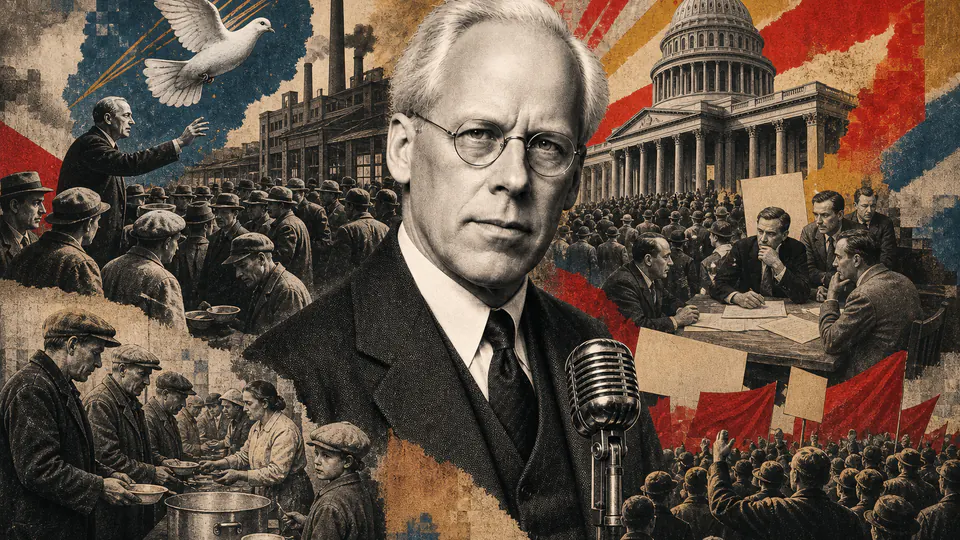
Norman Thomas left a Presbyterian pulpit for pacifism, socialism, civil liberties, and six presidential campaigns from 1928 through 1948.
The story
#storyNorman Thomas ran for president six times as a socialist and lost every state each time. The arithmetic did not embarrass him. Elections gave a national microphone to an anti-war minister arguing for public ownership, civil liberties, racial equality, and economic planning while the two major parties treated most of that program as either impossible or indictable.
Thomas inherited the job Eugene Debs had made famous, but he was no Debs imitation. He came from a minister’s household, went to Princeton, and spoke with the polished voice of the class he spent his career heckling.
A pulpit lost to World War I
Born in Marion, Ohio on November 20, 1884, Thomas graduated from Princeton and Union Theological Seminary. In 1911 he became pastor of East Harlem Presbyterian Church. Settlement work put poverty within walking distance of the pulpit. World War I made the conflict public.
Thomas joined the Fellowship of Reconciliation and the American Union Against Militarism in 1916. After the United States entered the war, he defended conscientious objectors and helped Roger Baldwin organize the Civil Liberties Bureau, a predecessor of the ACLU. His brother Evan was court-martialed after leading a hunger strike among imprisoned objectors. Thomas’s position angered donors and church officials. He left the pastorate in 1918 rather than make his politics easier for the collection plate.
He edited the pacifist magazine The World Tomorrow and joined the Socialist Party that year. The path from Christian pacifism to socialism was direct enough: war sent workers to kill one another while owners and governments set the terms.
Candidate for almost everything
Thomas ran for New York offices through the 1920s. After Debs died in 1926, the party picked Thomas for president in 1928. It picked him again in 1932, 1936, 1940, 1944, and 1948. His 1932 campaign drew 884,781 votes, the high point of his six runs but well below Debs’s 1912 total.
The timing was merciless. Franklin Roosevelt took office in 1933 and passed pieces of the socialist reform program without the socialist label. Social Security, public works, wage rules, and the Wagner Act gave workers protections Thomas supported. He backed the gains and attacked their limits. The Socialist Party, meanwhile, split between factions, lost members, and watched the New Deal occupy much of its electoral ground.
Thomas kept showing up because the campaign let him say what the larger parties avoided. He argued for unemployment relief before it was safe, desegregation before it was routine in national platforms, and civil liberties when federal agents still treated left publications as evidence.
Pacifism met fascism
Thomas opposed U.S. entry into both world wars, but his position during the second was strained by Nazi conquest. He denounced fascism, supported refugees, and opposed the Roosevelt administration’s steps toward war. After Pearl Harbor he did not call for resistance to the war effort in the same manner he had in 1917. Pacifism met a government he despised abroad and a war already underway at home.
His anti-communism was equally firm. Thomas condemned Soviet dictatorship and fought Communist Party influence inside American left organizations. That stance separated his democratic socialism from Moscow, though it also pulled him into factional fights that could consume a meeting faster than any capitalist.
Civil liberties when they were unpopular
Thomas opposed the incarceration of Japanese Americans during World War II and worked with organizations challenging the policy. He attacked colonial rule and U.S. intervention in Latin America. He corresponded with A. Philip Randolph, Bayard Rustin, and civil-rights organizers fighting segregation. The New York Public Library’s 97 linear feet of Thomas papers document how often his work crossed from speeches into other people’s campaigns.
After the Socialist Party’s electoral decline, Thomas increasingly treated socialist organization as education and pressure rather than a plausible third-party route to the White House. He helped form the Union for Democratic Socialism in 1953. Four years later he helped found the National Committee for a Sane Nuclear Policy. In his final years he condemned the escalating Vietnam War as both immoral and politically foolish.
What six defeats bought
Thomas suffered a stroke in 1967 and died on December 19, 1968. He left no elected record to display. He left arguments that entered law through other hands, a civil- liberties apparatus built during wartime repression, and an archive large enough to prove that losing elections was only one line of work.
Third parties are often judged like failed businesses: no market share, no point. Thomas used his six campaigns differently. A ballot line gave him an audience, and he spent it on positions that respectable politics intended to postpone.
The sequence changes the argument
Accounts often compress Norman Thomas into a six-time presidential candidate who always lost. The chronology makes a larger claim. Thomas entered reform politics through the ministry, settlement work, and opposition to the First World War. He defended conscientious objectors and civil liberties when antiwar speech brought surveillance and prosecution. Neither fact is background decoration. Together they explain why the conflict took the form it did and why participants did not treat patience as a serious answer.
As Socialist Party leader, he campaigned for public ownership, labor rights, racial equality, social insurance, and democratic freedoms. His presidential campaigns gave socialist policies a national platform even when his vote totals remained small. The work depended on meetings, transportation, money, printed material, trusted messengers, and people willing to absorb retaliation. Public memory usually preserves the microphone or the confrontation. Organization lived in the less photogenic decisions that made a crowd, vote, strike, or policy demand possible.
Power worked through institutions
The central dispute concerned what a minority socialist party could change through organizing, argument, civil liberties work, and pressure on major parties. That question could not be settled by a good argument alone. Employers, public officials, courts, parties, unions, churches, and newspapers controlled different resources. Organizers had to identify which body could change a rule, which ally could move it, and what pressure could make delay more expensive than action.
New Deal reforms adopted parts of a program socialists had advocated while also weakening the party’s separate electoral base. Thomas opposed Stalinism and defended democratic socialism, positions that put him at odds with communists and some anti-communist liberals. Those outcomes belong in the same account. A movement can gain public sympathy and still lose an immediate demand. It can win a statute while leaving people outside its coverage. It can build an institution that later becomes cautious. Calling one moment a victory or defeat without naming the measure hides more than it explains.
The limits were part of the result
His pacifism changed under the pressure of fascism and the Second World War, revealing conflict between antiwar principle and resistance to dictatorship. He supported civil-rights campaigns and criticized internment while carrying paternal and institutional limits common to his era and movement. These limits were not footnotes added by later critics. Participants argued about them at the time, often from unequal positions. Race, gender, citizenship, occupation, geography, and access to money affected who took the greatest risk and who received authority after a campaign became respectable.
This is why coalition should be treated as work rather than a photograph. Groups can share an opponent while wanting different remedies. They can cooperate on a march and disagree about a contract, a party, a war, or the pace of change. The useful question concerns the rules that allowed people to decide together, what resources they shared, and whose objections were easier to ignore.
What the record lets us say
The source trail matters because later retellings reward drama and erase maintenance. Government records show what officials claimed and enforced. Organizational papers show plans, budgets, arguments, and revisions. Oral histories recover work that formal minutes often omit, though memory recorded years later has its own limits. Newspapers capture public language while reflecting the interests and racial habits of editors. Reading those records against one another makes uncertainty visible instead of filling it with a convenient quotation.
The durable lesson of Norman Thomas is practical. Rights need procedures, money, institutions, and people able to enforce them after attention moves elsewhere. A law can change the field without ending the contest. A lost campaign can train organizers, expose an alliance, or leave a demand that later movements can use. History becomes more useful when it preserves both the achievement and the bill that remained unpaid.
In their own words
#wordsWhat Norman Thomas actually said, where, and when. Each one links to the page it was checked against.
-
Certainly Russia is not a socialist state. It is a totalitarian state under a monolithic party which through the state apparatus appropriates the surplus value of labor as it wills and for its own ends.
"The Moscow Trials," The Modern Monthly, March 1938, his verdict on the Soviet Union after the third Moscow show trial. Norman Thomas, "The Moscow Trials," The Modern Monthly (New York), v. 10, no. 11 (March 1938), pp. 4, 13 -
It has long been my rule, so far as possible in this column, to avoid discussion of Socialist Party controversies. In the present situation, however, it is not only my right but my duty to comment on the NEC decision and the New York situation.
"The Party Controversy," his weekly column "At the Front" in The Socialist Call, January 11, 1936, on a factional fight inside the Socialist Party's New York branch. Norman Thomas, "The Party Controversy," weekly column "At the Front," The Socialist Call (New York), vol. 1, no. 43 (January 11, 1936), p. 16 -
A good Socialist Party must be inclusive. It needs the right wing.
The same January 11, 1936 column, arguing against expelling the party's right-wing Old Guard faction. Norman Thomas, "The Party Controversy," weekly column "At the Front," The Socialist Call (New York), vol. 1, no. 43 (January 11, 1936), p. 16 -
We are as one with the workers of Spain in their struggle for freedom from the Fascist pretenders and invaders; we seek their victory because it will be a victory for the international labor movement, for the world forces for peace, democracy and Socialism.
A letter to the Spanish Republic's Minister of Justice, December 15, 1938, co-signed with Devere Allen and closing under Thomas's title as National Chairman of the Socialist Party. Norman Thomas and Devere Allen, "Justice Triumphs in Spain: a letter About the Trial of the P.O.U.M." (Socialist Party of the U.S.A., December 15, 1938)
What people get wrong
#wrong- The myth
Norman Thomas was sympathetic to the Soviet Union, the way some socialists of his era were. - The record
In his own 1938 essay on the Moscow Trials, Thomas called the trials "the most dreadful single chapter in the story of the degradation of a self-proclaimed socialist movement" and concluded that Russia under Stalin was a totalitarian state, not a socialist one. He spent much of his career fighting Communist Party influence inside American left organizations.
- The myth
Thomas opposed every war on pacifist principle, including the fight against Hitler. - The record
He opposed U.S. entry into both world wars and criticized the Roosevelt administration's steps toward the second one, but he also denounced fascism and supported refugees, and after Pearl Harbor he did not call for resistance to the war effort the way he had in 1917. His pacifism bent under the pressure of a war against fascism.
- The myth
Six lost presidential races meant Thomas's program went nowhere. - The record
Franklin Roosevelt's New Deal enacted pieces of the reform program Thomas ran on, including Social Security, public-works employment, and the Wagner Act's labor protections, without the socialist label attached. Thomas himself said as much, backing the gains while attacking their limits.
The dates that matter
#dates- November 20, 1884 Born in Marion, Ohio.
- 1911 Becomes pastor of East Harlem Presbyterian Church.
- 1916 Joins the Fellowship of Reconciliation and anti-militarist work.
- 1918 Leaves his pastorate, edits The World Tomorrow, and joins the Socialist Party.
- 1928 Runs for president on the Socialist ticket for the first time.
- 1932 Receives 884,781 votes, his largest presidential total.
- 1948 Runs his sixth and final presidential campaign.
- 1957 Helps found the National Committee for a Sane Nuclear Policy.
- 1967 Retires after a stroke.
- December 19, 1968 Dies in Cold Spring Harbor, New York.
Questions people ask
#faqsWho was Norman Thomas?
Norman Thomas was a Presbyterian minister who became a pacifist, Socialist Party leader, writer, and six-time presidential nominee.
How many times did Norman Thomas run for president?
Six times: 1928, 1932, 1936, 1940, 1944, and 1948. He ran for public office fifteen times in total.
Did Norman Thomas ever win an election?
No. His strongest presidential showing came in 1932, when he received 884,781 votes.
Was Norman Thomas a pacifist?
Yes. Opposition to World War I cost him his church position and drew him into civil-liberties and socialist work. He later opposed nuclear weapons and the Vietnam War, while his response to World War II shifted after the attack on Pearl Harbor.
The bookshelf
#bookshelfWhere to go next. Buy from an independent bookstore, or find it at your library for nothing.
-
A Socialist's Faith Norman Thomas, 1951 primary
His own case for democratic socialism, written at the height of the Cold War.
-
Norman Thomas, the Last Idealist W. A. Swanberg, 1976 secondary
The standard biography, from his Presbyterian pulpit through six presidential campaigns.
Wear it: Norman Thomas
#merchEvery design here links back to this page.
Sources
#sourcesPrimary sources
The documents themselves: laws, court opinions, speeches, letters, and the numbers from the agencies that count them.
- New York Public Library, Norman Thomas Papers
- Norman Thomas Archive
- Library of Congress, Radical Pamphlet Collection
- Congressional Record, memorial remarks on Norman Thomas
- New York Public Library, Norman Thomas papers
- Norman Thomas, "The Party Controversy," weekly column "At the Front," The Socialist Call (New York), vol. 1, no. 43 (January 11, 1936), p. 16
- Norman Thomas, "The Moscow Trials," The Modern Monthly (New York), v. 10, no. 11 (March 1938), pp. 4, 13
- Norman Thomas and Devere Allen, "Justice Triumphs in Spain: a letter About the Trial of the P.O.U.M." (Socialist Party of the U.S.A., December 15, 1938) (co-signed letter; Thomas as national chairman, Allen as Committee for International Labor Solidarity chairman)
Secondary sources
Written afterward, about the story.