Published
Martin Luther King Jr.
Martin Luther King Jr. Put Jobs, Peace, and Poverty in the Same Speech
Born January 15, 1929. Died April 4, 1968
Martin Luther King Jr. moved from the Montgomery boycott to voting rights, anti-war work, labor solidarity, and the Poor People's Campaign.
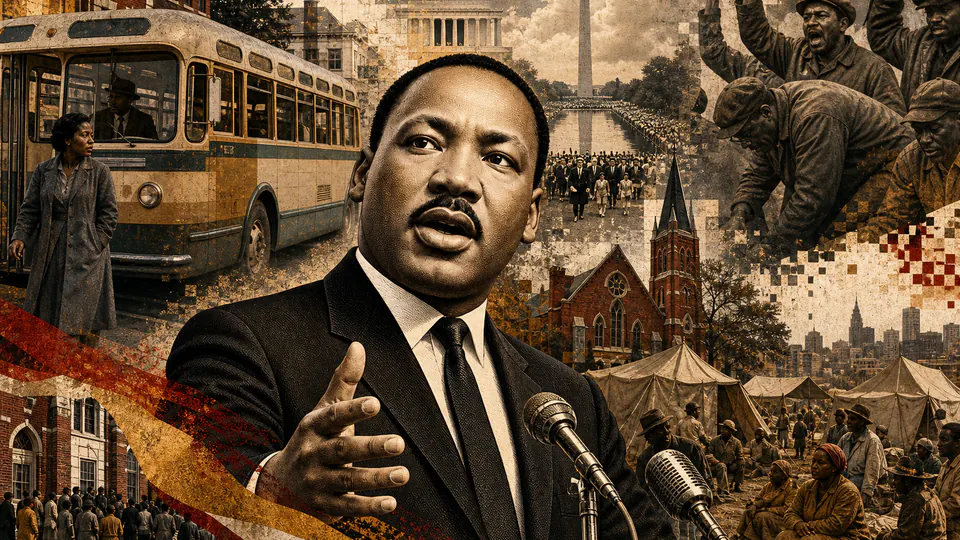
The story
#storyMartin Luther King Jr. organized against segregation, then made the argument larger. By the last year of his life he was opposing the Vietnam War, planning a multiracial campaign against poverty, and standing with striking sanitation workers. The familiar 1963 speech belongs in that record, but freezing him there removes the politics that made powerful allies nervous.
Montgomery built a method
King was born in Atlanta in 1929, studied at Morehouse, Crozer, and Boston University, and became pastor of Dexter Avenue Baptist Church in Montgomery. After Rosa Parks’s arrest, local organizers formed the Montgomery Improvement Association and chose the 26-year-old minister as president.
The Montgomery boycott lasted 381 days. Women’s Political Council organizers, drivers, dispatchers, church networks, and thousands of walkers kept it alive until Browder v. Gayle ended bus segregation. King supplied a public voice to a movement with deep local roots.
Birmingham, Washington, Selma
King helped found SCLC in 1957. The organization joined local campaigns in Albany, Birmingham, St. Augustine, and Selma. Birmingham’s police dogs and fire hoses in 1963 made national television. That August, King addressed the March on Washington, whose demands included jobs, a higher minimum wage, and civil-rights law.
Congress passed the Civil Rights Act in 1964. In 1965, years of local voting-rights work in Selma met state violence on the Edmund Pettus Bridge. The campaign helped force passage of the Voting Rights Act.
North, war, and poverty
King’s Chicago campaign confronted housing segregation and economic inequality in 1966 with fewer clear federal levers. On April 4, 1967, he used the Riverside Church pulpit to oppose the Vietnam War and connect militarism abroad to poverty at home. Newspapers and established allies attacked the speech.
He then planned the Poor People’s Campaign, meant to bring poor people of several races to Washington around jobs, income, and housing. In Memphis, Black sanitation workers were striking after Echol Cole and Robert Walker were crushed in a garbage truck. King supported their union fight.
He was assassinated on April 4, 1968 at the Lorraine Motel. The sanitation workers won recognition and a raise later that month. King’s last campaign went to Washington without him. The record ends in motion, which is exactly why a motionless monument can never tell enough of it.
Montgomery made a spokesperson inside an existing movement
King was born in Atlanta in 1929, entered the ministry, and became pastor of Dexter Avenue Baptist Church in Montgomery. His education in theology and social ethics gave him language for nonviolence, but the bus campaign did not begin as his personal plan.
Black women had challenged bus segregation for years. Jo Ann Robinson and the Women’s Political Council prepared leaflets after Rosa Parks’s arrest, and E. D. Nixon helped bring organizations together. The new Montgomery Improvement Association selected the young pastor as president partly because he was a persuasive speaker without deep ties to local factions.
King became the movement’s best-known voice while the carpool, meetings, fundraising, dispatching, and daily walking kept the boycott alive. His leadership is clearest when placed inside that organization rather than above it.
SCLC turned local campaigns into regional pressure
After the boycott, King and other ministers formed the Southern Christian Leadership Conference. SCLC used church networks, staff organizers, fundraising, and national attention to support campaigns against segregation and disfranchisement.
The model brought resources to local struggles but could create tension over control. Ella Baker criticized leadership centered on prominent ministers and emphasized the capacity of ordinary people. Student organizers later developed SNCC with a more participatory structure.
King learned from these challenges even when the organizations disagreed. The movement needed national spokespeople, local knowledge, student initiative, legal support, and institutions capable of sustaining risk. No one form could perform every task.
Birmingham joined economic pressure to public confrontation
The 1963 Birmingham campaign targeted downtown segregation through boycotts, marches, sit-ins, and arrests. After participation slowed, young people joined demonstrations. Police commissioner Bull Connor’s forces used dogs and high-pressure hoses, and images of the attacks circulated nationally.
King wrote the Letter from Birmingham Jail in response to white clergy urging delay. The letter argued that direct action created a crisis in which negotiation could no longer be postponed. The tactic was planned pressure, not disorder for its own sake.
A negotiated settlement addressed parts of downtown segregation, while bombings and white violence continued. The campaign helped create momentum for federal civil-rights law but did not make the city safe by agreement.
The dream speech belonged to a march for jobs
At the 1963 March on Washington, King delivered the speech most often used to memorialize him. The event’s full title demanded jobs and freedom, and its program included voting, fair employment, desegregation, and a higher minimum wage.
Removing the economic demands turns the speech into a request for personal goodwill. King’s dream challenged law and employment as well as individual prejudice. The march itself emerged from a Black labor tradition associated with A. Philip Randolph and Bayard Rustin.
King’s public appeal could reach a wide audience because it joined national ideals to an indictment of national failure. Consensus came later, after institutions had removed many of the demands that made the address controversial.
Selma demonstrated the need for federal enforcement
SCLC joined a voting-rights struggle in Selma after local organizers had worked for years. The campaign exposed registrars, police, and state officials who blocked Black citizens from voting. The attack on marchers at the Edmund Pettus Bridge on Bloody Sunday created national pressure.
King participated in a second march that turned back while federal court proceedings continued, a decision some activists condemned. The final march proceeded under court authorization and federal protection. The Voting Rights Act followed in August 1965.
The sequence captures King’s strategic position between local organizers demanding action, federal officials seeking control, and a mass audience. Nonviolence still required a government willing to restrain the officials committing violence.
Chicago tested a movement outside southern statute
In 1966, King and SCLC joined Chicago organizers fighting housing segregation and urban inequality. Marchers faced white mobs in neighborhoods where real-estate practice, zoning, finance, and violence maintained separation without the same visible signs as southern Jim Crow.
The campaign produced agreements whose enforcement was weak. It also showed that legal equality could coexist with concentrated poverty, police conflict, and restricted housing markets.
King increasingly criticized a society willing to remove a segregated lunch counter without redistributing power or income. Northern resistance made that criticism more specific and made movement victory harder to narrate as one federal bill.
Vietnam placed him against the administration
At Riverside Church in 1967, King publicly condemned the Vietnam War and connected militarism abroad to racism and poverty at home. Major newspapers, civil-rights allies, and members of the Johnson administration attacked the speech.
King’s opposition threatened relationships with a president who had signed civil-rights legislation. He believed silence would protect access by abandoning both Vietnamese civilians and poor Americans whose needs lost funding to war.
The decision illustrates coalition cost. A leader praised for moral courage after death was condemned for applying that courage beyond the issue political allies had assigned him.
The Poor People’s Campaign widened the unfinished demand
King’s final national project sought work, income, housing, and a federal commitment against poverty across racial lines. He went to Memphis in support of Black sanitation workers whose strike joined union recognition, safety, wages, and dignity.
His assassination on April 4, 1968 froze him in public memory at age thirty-nine. The workers won a settlement, and organizers carried the Poor People’s Campaign to Washington without him.
The later monument cannot decide which King to remember. Montgomery, Birmingham, Selma, Chicago, Riverside, and Memphis form one developing politics. He moved from enforced desegregation toward a deeper confrontation with economic power and war. The record did not close at the point most comfortable for national tribute.
In their own words
#wordsWhat Martin Luther King Jr. actually said, where, and when. Each one links to the page it was checked against.
-
when you are forever fighting a degenerating sense of "nobodiness" — then you will understand why we find it difficult to wait
Written from the Birmingham city jail, April 16, 1963, answering white clergy who had urged him to delay direct action. Martin Luther King Jr., Letter from Birmingham Jail (April 16, 1963), King Institute encyclopedia entry -
we are on the side of the wealthy, and the secure, while we create a hell for the poor
From Beyond Vietnam, delivered at Riverside Church in New York City on April 4, 1967, a year to the day before he was killed. Martin Luther King Jr., Beyond Vietnam: A Time to Break Silence (April 4, 1967), King Institute encyclopedia entry -
a call to black people to amass the political and economic strength to achieve their legitimate goals
From his book Where Do We Go From Here: Chaos or Community?, published in 1967. Martin Luther King Jr., Where Do We Go From Here: Chaos or Community? (1967), King Institute encyclopedia entry -
You are demonstrating that we can stick together. You are demonstrating that we are all tied in a single garment of destiny, and that if one black person suffers, if one black person is down, we are all down
Speaking to striking Memphis sanitation workers and supporters, March 18, 1968, two and a half weeks before his assassination. Martin Luther King Jr., remarks to Memphis sanitation strikers (March 18, 1968), King Institute encyclopedia entry -
I've seen the Promised Land. I may not get there with you. But I want you to know tonight that we, as a people, will get to the Promised Land
From I've Been to the Mountaintop, delivered at Mason Temple in Memphis on April 3, 1968, the night before his assassination. Martin Luther King Jr., I've Been to the Mountaintop (April 3, 1968), quoted in the King Institute's Memphis Sanitation Workers' Strike entry
What people get wrong
#wrong- The myth
The March on Washington was about a dream of racial harmony, not about economics. - The record
Its full name was the March on Washington for Jobs and Freedom. The demands published before August 28, 1963 included a federal Fair Employment Practices Act barring discrimination in all employment and a federal works program to train and place the unemployed, alongside the civil rights bill and voting rights protection.
- The myth
Beyond Vietnam was celebrated at the time as an act of moral courage. - The record
The Washington Post wrote on April 6, 1967 that King had diminished his usefulness to his cause, his country, and his people. The New York Times ran an editorial the next day under the headline Dr. King's Error. The NAACP and Ralph Bunche publicly distanced themselves from his linking of Vietnam to civil rights.
- The myth
King was in Memphis on general civil rights business when he was killed. - The record
He was in Memphis for a strike. AFSCME Local 1733 sanitation workers had walked out for union recognition and safety after Echol Cole and Robert Walker were crushed in a garbage truck. King spoke to them on March 18, 1968 and again on April 3, 1968, the night before he was shot.
The dates that matter
#dates- January 15, 1929 Born in Atlanta, Georgia.
- December 1955 Becomes president of the Montgomery Improvement Association.
- 1957 Helps found SCLC and becomes its first president.
- August 28, 1963 Addresses the March on Washington for Jobs and Freedom.
- December 10, 1964 Receives the Nobel Peace Prize.
- March 1965 Joins the Selma to Montgomery voting-rights campaign.
- April 4, 1967 Delivers Beyond Vietnam at Riverside Church.
- April 4, 1968 Assassinated in Memphis while supporting sanitation workers.
Questions people ask
#faqsWhat did Martin Luther King Jr. fight for?
King organized against segregation and voter suppression and later centered housing, wages, poverty, militarism, and labor rights.
Was Martin Luther King Jr. a socialist?
King criticized capitalism and supported major economic redistribution, but he did not publicly join a socialist party. His private and public language changed over time, so a single label can hide more than it explains.
When did King oppose the Vietnam War?
He criticized the war before 1967 and made his most public break in the April 4, 1967 Beyond Vietnam address at Riverside Church.
Why was King in Memphis in 1968?
He was supporting Black sanitation workers in AFSCME Local 1733, who were striking for union recognition, safety, and dignity.
The bookshelf
#bookshelfWhere to go next. Buy from an independent bookstore, or find it at your library for nothing.
-
Why We Can't Wait Martin Luther King Jr., 1964 primary
His own account of the Birmingham campaign and the case for nonviolent direct action, written in 1963 and 1964.
-
Where Do We Go From Here: Chaos or Community? Martin Luther King Jr., 1967 primary
His last book, arguing for guaranteed income and a restructured economy, not just legal desegregation.
-
Parting the Waters: America in the King Years, 1954-63 Taylor Branch, 1988 secondary
The first volume of Branch's trilogy, and the closest to ground level in Montgomery and Birmingham.
-
Bearing the Cross: Martin Luther King, Jr., and the Southern Christian Leadership Conference David J. Garrow, 1986 secondary
Built on the FBI surveillance files and hundreds of interviews with the organizers around him.
Wear it: Martin Luther King Jr.
#merchEvery design here links back to this page.
Sources
#sourcesPrimary sources
The documents themselves: laws, court opinions, speeches, letters, and the numbers from the agencies that count them.
- Martin Luther King Jr., Letter from Birmingham Jail (April 16, 1963), King Institute encyclopedia entry
- Martin Luther King Jr., Where Do We Go From Here: Chaos or Community? (1967), King Institute encyclopedia entry
- Martin Luther King Jr., remarks to Memphis sanitation strikers (March 18, 1968), King Institute encyclopedia entry
Secondary sources
Written afterward, about the story.
- National Park Service, Martin Luther King Jr.
- King Institute, Montgomery Bus Boycott
- National Park Service, Southern Christian Leadership Conference
- National Park Service, Selma to Montgomery History
- King Institute, Beyond Vietnam
- Wikipedia, Martin Luther King Jr.
- King Institute, March on Washington for Jobs and Freedom