Published
March on Washington
The March on Washington Was for Jobs and Freedom
The 1963 march joined civil-rights law to jobs, union rights, a higher wage floor, integrated schools, and federal enforcement.
The story
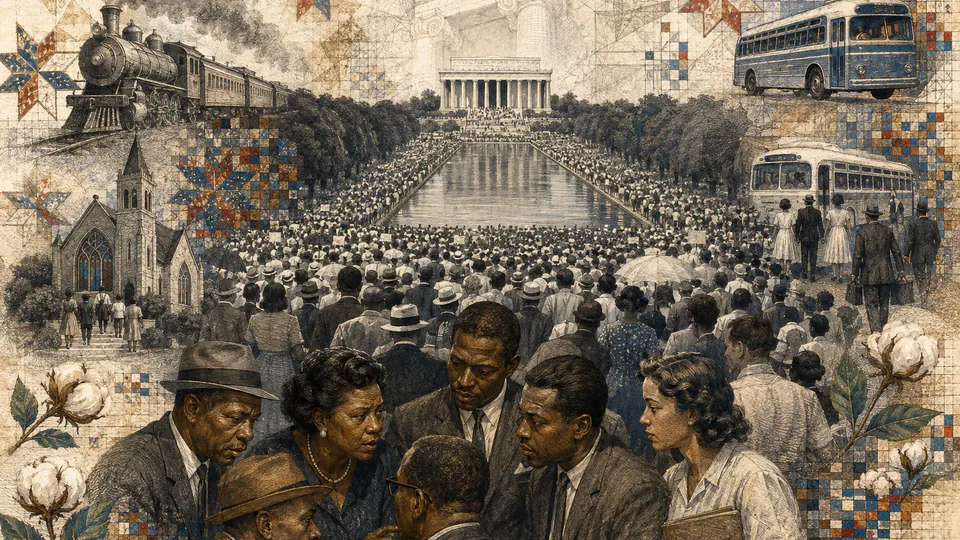
#storyThe 1963 event was the March on Washington for Jobs and Freedom. Its demands included a strong civil-rights bill, integrated schools, voting protection, a federal jobs program, fair employment, a higher minimum wage, and stronger labor rights. The word jobs did not wander into the title by accident.
Randolph had planned the first version in 1941
A. Philip Randolph threatened a mass Washington march in 1941 over discrimination in defense employment. Franklin Roosevelt issued an executive order banning that discrimination, and Randolph canceled the march.
Two decades later Randolph and Bayard Rustin built a broad coalition. Rustin managed transportation, marshals, sound, toilets, signs, and a schedule for an estimated 250,000 people. Labor, religious, and civil-rights groups paid for and filled the buses and trains.
The program showed both coalition and exclusion
John Lewis’s prepared speech was changed after coalition leaders objected to its criticism of the Kennedy administration. Women leaders were honored but denied a major speaking slot, a decision Pauli Murray and others criticized. Martin Luther King Jr.’s final address became the day’s defining recording.
The march helped build pressure for the Civil Rights Act of 1964. Many economic demands remained open. The federal minimum wage rose later, but the jobs program did not arrive in the proposed form. Remembering the complete title keeps the unfinished part audible.
The platform had numbers in it
The organizers demanded a broad civil-rights law, federal action against job discrimination, school desegregation, a public-works program, and a higher federal minimum wage. Those details made the march more than a ceremony of national unity. They put Congress, employers, and the White House on the same list of institutions expected to act.
The program also showed how coalition unity was negotiated. Lewis changed language under pressure from other leaders, while the exclusion of women from major speaking roles survived criticism. These disputes did not cancel the march. They reveal the choices required to keep labor, religious, youth, and civil-rights organizations on one platform. The crowd went home without a bill signed that day, but its scale gave later organizers proof that disciplined mass action could hold a national audience without dropping economic demands.
The organizing manual mattered too. Bayard Rustin’s team assigned transportation, marshals, sound, medical care, signs, toilets, and cleanup. Political theater at that scale rested on logistics precise enough to let a quarter-million people act as one public without becoming one opinion.
The sequence changes the argument
Accounts often compress the March on Washington into one speech delivered to a grateful nation. The chronology makes a larger claim. A. Philip Randolph had threatened a march in 1941, establishing mass pressure on Washington as a labor and civil-rights tactic. Bayard Rustin managed the 1963 operation through transportation plans, volunteer marshals, sound, food, toilets, and a tight program. Neither fact is background decoration. Together they explain why the conflict took the form it did and why participants did not treat patience as a serious answer.
The event’s full name, the March on Washington for Jobs and Freedom, placed employment and wages beside civil rights. The coalition included major civil-rights organizations, labor unions, religious groups, and allies whose priorities did not always match. The work depended on meetings, transportation, money, printed material, trusted messengers, and people willing to absorb retaliation. Public memory usually preserves the microphone or the confrontation. Organization lived in the less photogenic decisions that made a crowd, vote, strike, or policy demand possible.
Power worked through institutions
The central dispute concerned jobs, voting rights, desegregation, fair wages, and federal enforcement backed by organized pressure. That question could not be settled by a good argument alone. Employers, public officials, courts, parties, unions, churches, and newspapers controlled different resources. Organizers had to identify which body could change a rule, which ally could move it, and what pressure could make delay more expensive than action.
Women did much of the organizing but were denied equal speaking time, a conflict that Anna Arnold Hedgeman and others challenged. John Lewis revised language in his prepared address after coalition leaders objected to its sharp criticism of the pending civil-rights bill. Those outcomes belong in the same account. A movement can gain public sympathy and still lose an immediate demand. It can win a statute while leaving people outside its coverage. It can build an institution that later becomes cautious. Calling one moment a victory or defeat without naming the measure hides more than it explains.
The limits were part of the result
The peaceful day was produced by planning, not proof that organizers had asked for little or that the federal government had already agreed. The march increased pressure for federal action, while neither the Civil Rights Act nor Voting Rights Act fulfilled its economic program. These limits were not footnotes added by later critics. Participants argued about them at the time, often from unequal positions. Race, gender, citizenship, occupation, geography, and access to money affected who took the greatest risk and who received authority after a campaign became respectable.
This is why coalition should be treated as work rather than a photograph. Groups can share an opponent while wanting different remedies. They can cooperate on a march and disagree about a contract, a party, a war, or the pace of change. The useful question concerns the rules that allowed people to decide together, what resources they shared, and whose objections were easier to ignore.
What the record lets us say
The source trail matters because later retellings reward drama and erase maintenance. Government records show what officials claimed and enforced. Organizational papers show plans, budgets, arguments, and revisions. Oral histories recover work that formal minutes often omit, though memory recorded years later has its own limits. Newspapers capture public language while reflecting the interests and racial habits of editors. Reading those records against one another makes uncertainty visible instead of filling it with a convenient quotation.
The durable lesson of the March on Washington is practical. Rights need procedures, money, institutions, and people able to enforce them after attention moves elsewhere. A law can change the field without ending the contest. A lost campaign can train organizers, expose an alliance, or leave a demand that later movements can use. History becomes more useful when it preserves both the achievement and the bill that remained unpaid.
What people get wrong
#wrong- The myth
Martin Luther King Jr. organized the March on Washington. - The record
A. Philip Randolph conceived the tactic, first threatening a Washington march in 1941 and reviving the plan in 1962, and Bayard Rustin served as the march's chief organizer, running transportation, marshals, sound, and the schedule for roughly 250,000 people. Randolph telegraphed King in 1963 to join the call; King became the day's most famous speaker but did not initiate or run the march.
- The myth
The march was a civil-rights event with no real economic demands. - The record
The march sponsors issued a list of Ten Demands that included a fair living wage, fair employment policies, and desegregation of school districts alongside a strong civil-rights bill, which is why the event's full name was the March on Washington for Jobs and Freedom.
- The myth
Women spoke on equal footing with the men at the march. - The record
Women helped build the coalition but were not given a major speaking slot. Only singer Marian Anderson and activist Daisy Bates appeared in the program among the women, and no woman held a speaking role comparable to Randolph, Rustin, or King, a gap Pauli Murray and others criticized at the time.
The dates that matter
#dates- 1941 A. Philip Randolph plans a march against defense-industry discrimination; Roosevelt issues Executive Order 8802.
- 1962 Randolph asks Bayard Rustin to prepare a new march plan.
- August 28, 1963 About 250,000 people gather at the Lincoln Memorial.
- July 2, 1964 The Civil Rights Act becomes law.
Questions people ask
#faqsWhat was the full name of the 1963 march?
The March on Washington for Jobs and Freedom.
Who organized the March on Washington?
A. Philip Randolph led it, Bayard Rustin directed operations, and a coalition of major civil-rights, labor, and religious groups sponsored it.
What did the march demand?
Civil-rights law, school desegregation, voting protection, a federal jobs program, a higher minimum wage, fair employment, and stronger labor rights.
How should March on Washington be evaluated?
Separate the immediate result from the institutions, tactics, exclusions, and enforcement record that followed it.
The bookshelf
#bookshelfWhere to go next. Buy from an independent bookstore, or find it at your library for nothing.
-
Time on Two Crosses: The Collected Writings of Bayard Rustin Bayard Rustin, edited by Devon W. Carbado and Donald Weise, 2003 primary
Rustin's own essays and strategy writing, from the man who ran the march's logistics.
-
The March on Washington: Jobs, Freedom, and the Forgotten History of Civil Rights William P. Jones, 2013 secondary
The standard history of the march's labor roots and its unfinished economic program.
-
A. Philip Randolph: A Biographical Portrait Jervis Anderson, 1973 secondary
The life of the man who first threatened this march in 1941 and revived it two decades later.
Wear it: March on Washington
#merchEvery design here links back to this page.
Sources
#sourcesPrimary sources
The documents themselves: laws, court opinions, speeches, letters, and the numbers from the agencies that count them.
Secondary sources
Written afterward, about the story.