Published
Pauli Murray
Pauli Murray Wrote the Argument Before the Supreme Court Used It
Born November 20, 1910. Died July 1, 1985
Pauli Murray attacked Jim Crow and Jane Crow as a lawyer, writer, priest, and strategist whose legal work reached Brown and Reed.
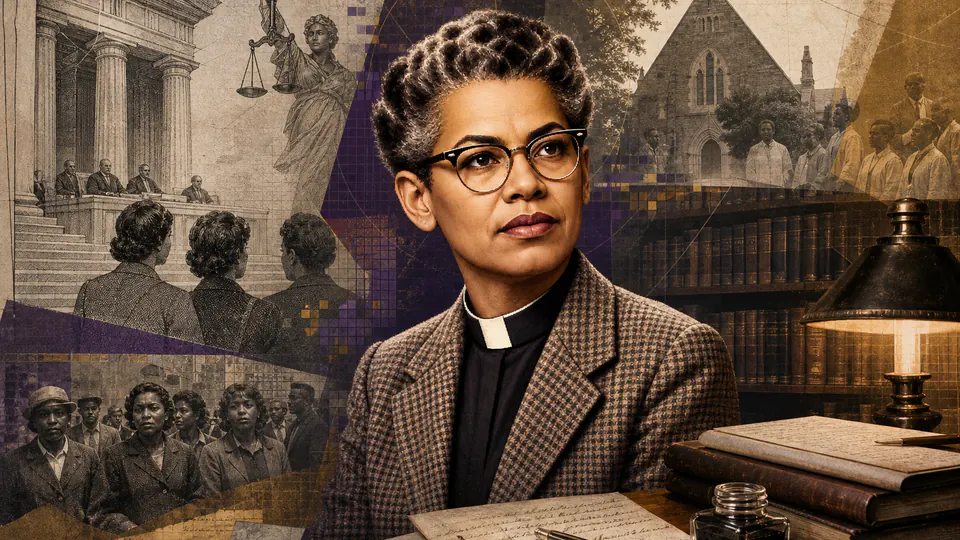
The story
#storyPauli Murray argued in a 1944 Howard University law thesis that Plessy v. Ferguson should be overturned directly. Professors treated the approach as too aggressive. Ten years later, the Supreme Court used that destination in Brown v. Board of Education.
Murray’s career is full of this timing problem: the argument arrived before the institution was ready to admit it needed the argument.
Jim Crow, written state by state
Born in 1910 and raised in Durham, Murray was denied entry to the University of North Carolina because of race. In 1940, Murray and Adelene McBean were arrested after refusing segregated seats on a Virginia bus, years before the Freedom Rides.
At Howard, Murray finished first in the law class but Harvard rejected the usual postgraduate fellowship because Murray was a woman. Murray later earned graduate law degrees elsewhere and compiled States’ Laws on Race and Color in 1951. Thurgood Marshall called the volume useful to civil-rights lawyers, who needed segregation’s many statutes collected in one place before they could dismantle them.
Jane Crow named the combined injury
Murray used Jane Crow to describe sex discrimination joined to racism. The concept grew from direct experience in education and work. Murray helped develop the argument that the Fourteenth Amendment prohibited sex discrimination, a theory Ruth Bader Ginsburg’s team cited in Reed v. Reed in 1971.
Murray criticized the 1963 March on Washington for giving women no major speaking role and helped found the National Organization for Women in 1966. The legal record did not divide itself neatly into race on one day and sex on another, so Murray refused the division.
A private gender record
Murray’s private papers show repeated efforts to obtain hormone treatment or a medical explanation for a persistent male identity. Doctors refused. Scholars describe Murray as queer, gender-nonconforming, or transgender, while noting that today’s language was not available in the same form. The honest approach preserves Murray’s own evidence without pretending a posthumous intake form can settle it.
In 1977 Murray became the first Black woman ordained an Episcopal priest. Murray died in 1985. Law schools now teach doctrines that carry traces of the work, often without the name attached. The name belongs in the citation.
Family history made law personal before law school
Murray was born in Baltimore in 1910 and raised in Durham by relatives after losing both parents. The family carried a history of enslavement, racial violence, education, and property holding. Murray later researched that history in Proud Shoes, treating family records as evidence of the country’s legal and racial structure.
At Hunter College in New York, Murray navigated poverty and gender presentation while developing as a writer and activist. Employment discrimination and the Depression made abstract rights questions immediate.
Murray’s career would cross institutions that each classified identity differently: the southern university, segregated bus, law school, employer, church, and medical office. The connections among them produced the legal imagination later called Jane Crow.
A university rejection became a public campaign
In 1938, the University of North Carolina denied Murray graduate admission because of race. Murray publicized the case and sought support from NAACP lawyers. The organization did not take the case, in part because of strategic and procedural concerns.
The episode taught a hard lesson about movement litigation. A morally strong claim is not automatically the case an organization believes it can win. Lawyers consider jurisdiction, plaintiff history, precedent, and the sequence of a larger campaign.
Murray continued to press beyond the strategic caution of institutions that would later benefit from similar arguments.
The bus arrest anticipated a later tactic
In 1940, Murray and Adelene McBean resisted segregation on a Virginia bus. Police arrested them, and legal strategy avoided a direct constitutional test. The action preceded the better-known Montgomery and Freedom Ride campaigns.
Murray also worked in the labor movement and studied at Howard University, where sexism among classmates and professors compounded segregation outside campus. Graduating first should have brought the Harvard fellowship customarily available to the top graduate. Harvard rejected Murray because of sex.
That sequence gave Jane Crow a precise institutional meaning. Race closed one door; sex closed another; excellence did not provide an exit from either system.
The Howard thesis argued for attacking Plessy directly
Civil-rights litigation often sought to enforce the supposed equality in separate-but- equal doctrine, building evidence that states would not provide equal facilities. Murray argued that lawyers should challenge segregation itself under the Fourteenth Amendment.
Howard professors regarded the position as too ambitious in 1944. A decade later, Brown reached the result Murray had proposed. Many lawyers, plaintiffs, scholars, and local campaigns made that decision possible. Murray’s contribution belongs within that collective record, without turning foresight into sole authorship.
The episode illustrates the cost of being early. Institutions may use an idea after the person who raised it has been denied the authority attached to it.
A reference book made segregation visible as a system
Murray compiled state laws on race for the Women’s Division of the Methodist Church. Published in 1951, States’ Laws on Race and Color gathered statutes governing schools, marriage, transportation, housing, and other fields.
Collection was strategic work. Lawyers needed to see variations across states, choose targets, and understand how rules interacted. The volume converted hundreds of local provisions into evidence of a national order.
Thurgood Marshall’s description of the book as a civil-rights lawyer’s bible reflected its daily usefulness. Research infrastructure rarely receives the public attention of an oral argument, but the argument depends on it.
Jane Crow entered constitutional doctrine
Murray challenged a women’s movement that treated white women’s experience as universal and civil-rights organizations that treated sex discrimination as a distraction. In a 1965 memorandum, Murray and Mary Eastwood argued that the Fourteenth Amendment could reach sex discrimination.
Murray helped found the National Organization for Women in 1966 and pressed for an organization able to make employment law real. Ruth Bader Ginsburg’s team later listed Murray as a coauthor on the brief in Reed v. Reed to acknowledge the intellectual debt.
The credit mattered because legal ideas often move through networks while recognition settles on the person at the final podium.
Gender evidence requires care rather than silence
Murray’s private papers record a persistent sense of being male, efforts to obtain testosterone, and requests for medical explanation. Doctors refused the treatment and framed the problem through the limited categories of their era.
Some scholars use transgender to interpret this record; others emphasize Murray’s own changing language and the impossibility of asking a person to choose a current label after death. Avoiding the evidence entirely is no more accurate than declaring the question settled.
The record shows distress created in part by institutions unwilling to recognize Murray’s account of self. That experience belongs beside, not outside, the work on race and sex classification.
Priesthood joined history to a new vocation
After a long legal and academic career, Murray entered seminary and in 1977 became the first Black woman ordained an Episcopal priest. At the first Eucharist, Murray honored an enslaved ancestor baptized at the same chapel generations earlier.
The moment connected a church once embedded in slavery to a descendant exercising authority it had denied by race and sex. It did not erase the institution’s history; it made that history answer a living claimant.
Murray died in 1985. The papers left behind have changed how scholars understand the public work and private struggle. The legal arguments were not flashes of individual genius detached from life. They came from a person repeatedly classified out of the room who kept studying the rules governing admission.
In their own words
#wordsWhat Pauli Murray actually said, where, and when. Each one links to the page it was checked against.
-
First astonishment, then hoots of derisive laughter, greeted what seemed to me an obvious solution. My approach was considered . . . likely to precipitate an unfavorable decision of the Supreme Court, thus strengthening rather than destroying the force of the Plessy case.
In Song in a Weary Throat (1987), Murray's memoir, describing how her Howard University law seminar reacted to her 1944 proposal to attack Plessy v. Ferguson directly. Pauli Murray, Song in a Weary Throat: An American Pilgrimage (Harper & Row, 1987), p. 286 -
opposition to an idea I cared deeply about always aroused my latent mule-headedness
In Song in a Weary Throat (1987), on why she kept pressing the Plessy argument after her Howard seminar dismissed it in 1944. Pauli Murray, Song in a Weary Throat: An American Pilgrimage (Harper & Row, 1987), p. 286 -
Discriminatory attitudes toward women are strikingly parallel to those regarding Negroes.
In "Jane Crow and the Law: Sex Discrimination and Title VII," the law review article Murray co-wrote with Mary Eastwood, George Washington Law Review, December 1965. Pauli Murray and Mary O. Eastwood, "Jane Crow and the Law: Sex Discrimination and Title VII," George Washington Law Review 34, no. 2 (December 1965) -
A society in which more than half of the population is absent from the formal authority and decision-making processes is a society in dangerous imbalance.
In written testimony to the Senate Judiciary Committee's hearings on the Equal Rights Amendment, September 1970. Pauli Murray, statement to the Senate Judiciary Committee, Equal Rights 1970 hearings, 91st Congress (September 1970)
What people get wrong
#wrong- The myth
Pauli Murray single-handedly wrote the legal strategy that won Brown v. Board of Education. - The record
Murray's 1944 Howard seminar paper argued for attacking Plessy v. Ferguson directly, and her former professor Spottswood Robinson revisited it while helping prepare Brown, with Thurgood Marshall circulating her 1951 compilation States' Laws on Race and Color to the NAACP legal team. Brown was built over years by many lawyers, plaintiffs, and local campaigns; Murray's research was one contribution inside that larger effort, not the whole of it.
- The myth
Harvard rejected Pauli Murray's postgraduate law fellowship because she was Black. - The record
Murray graduated first in her 1944 Howard law class, which normally carried a Harvard fellowship. Harvard's rejection letter named her sex, not her race, telling her plainly that her transcript indicated she was "not of the sex entitled to be admitted to Harvard Law School."
- The myth
Pauli Murray was a lesbian. - The record
Murray's own papers at Harvard's Schlesinger Library document repeated private requests for hormone treatment and a medical explanation for what she described as a male sense of self, requests doctors refused. The Pauli Murray Center, which now stewards her legacy, avoids retrofitting a single modern label onto that record and describes her as a multiracial, LGBTQ+ figure rather than settling the question for her.
The dates that matter
#dates- November 20, 1910 Born in Baltimore, Maryland.
- 1938 Denied admission to the University of North Carolina because of race.
- 1940 Arrested after challenging bus segregation in Virginia.
- 1944 Graduates first in the Howard University law class.
- 1951 Publishes States' Laws on Race and Color.
- 1966 Helps found the National Organization for Women.
- 1977 Becomes the first Black woman ordained an Episcopal priest.
- July 1, 1985 Dies in Pittsburgh, Pennsylvania.
Questions people ask
#faqsWho was Pauli Murray?
Pauli Murray was a lawyer, writer, civil-rights and women's-rights strategist, labor activist, and Episcopal priest.
How did Pauli Murray influence Brown v. Board?
Murray's Howard thesis argued for directly overturning school segregation, and the NAACP legal team later used a copy of Murray's legal compilation in its work. Brown had many lawyers and plaintiffs; Murray's research was part of that larger effort.
What did Jane Crow mean?
Murray used Jane Crow for the combined force of race and sex discrimination, years before intersectionality became a standard legal and academic term.
Was Pauli Murray transgender?
Murray repeatedly sought medical explanations and treatment related to gender and described a male sense of self in private records. Modern labels are applied by scholars with care because Murray did not have today's terminology.
The bookshelf
#bookshelfWhere to go next. Buy from an independent bookstore, or find it at your library for nothing.
-
Proud Shoes: The Story of an American Family Pauli Murray, 1956 primary
Murray's own account of her grandparents' lives under slavery and Reconstruction, and the family history that shaped her legal imagination.
-
Song in a Weary Throat: An American Pilgrimage Pauli Murray, 1987 primary
Murray's memoir, published the year after her death, and the source for her own account of the Howard thesis and Jane Crow.
-
Jane Crow: The Life of Pauli Murray Rosalind Rosenberg, 2017 secondary
The standard biography, built from Murray's papers at the Schlesinger Library.
Wear it: Pauli Murray
#merchEvery design here links back to this page.

Sources
#sourcesPrimary sources
The documents themselves: laws, court opinions, speeches, letters, and the numbers from the agencies that count them.
- Schlesinger Library, Pauli Murray papers
- Pauli Murray, Song in a Weary Throat: An American Pilgrimage (Harper & Row, 1987), p. 286
- Pauli Murray and Mary O. Eastwood, "Jane Crow and the Law: Sex Discrimination and Title VII," George Washington Law Review 34, no. 2 (December 1965)
- Pauli Murray, statement to the Senate Judiciary Committee, Equal Rights 1970 hearings, 91st Congress (September 1970)
- American Civil Liberties Union, "Pauli Murray's Indelible Mark on the Fight for Equal Rights"
Secondary sources
Written afterward, about the story.