Published
Freedom Rides
The Freedom Riders Made the Federal Government Enforce Its Own Ruling
In 1961 interracial riders tested desegregation orders, survived mob attacks and prison, and forced federal interstate-terminal rules.
The story
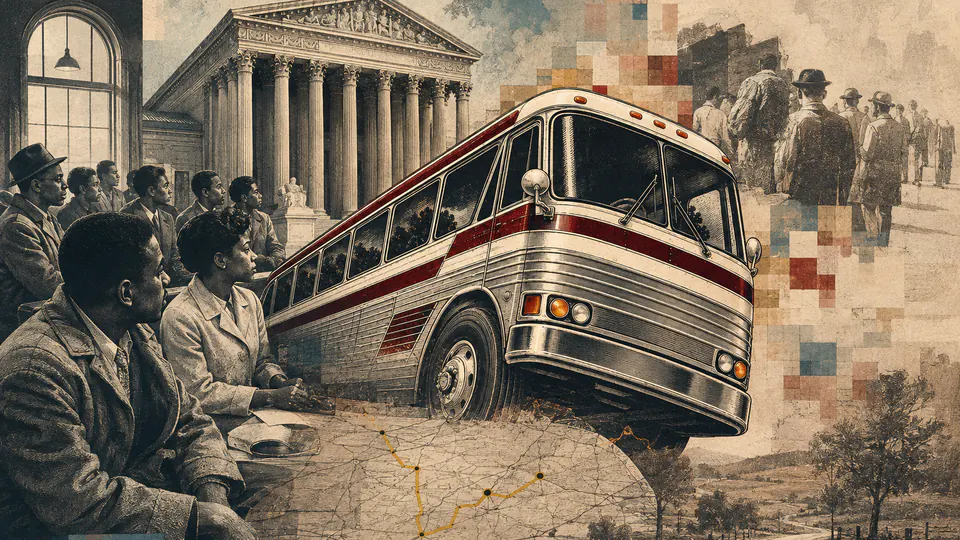
#storyThe Freedom Riders boarded interstate buses in 1961 to test federal law that already barred segregation in interstate travel. Court orders existed. Southern terminals still maintained separate waiting rooms and counters. The ride asked whether the federal government intended its rulings to survive contact with a ticket window.
CORE’s interracial group left Washington on May 4. On May 14, a mob attacked its Greyhound bus in Anniston, Alabama, slashed the tires, followed it outside town, and firebombed it. Riders escaped the burning bus and were beaten. Another group was attacked in Birmingham.
The rides continued because replacements arrived
CORE leaders halted the original ride. Nashville students led by Diane Nash decided that violence could not be allowed to end the tactic. New riders traveled to Montgomery, where a mob attacked them while police protection disappeared. Federal marshals later protected a mass meeting under siege.
Riders reached Jackson, Mississippi and were arrested under breach-of-peace charges. Many went to Parchman prison. Hundreds joined rides during the summer, filling cells and keeping national attention on enforcement.
Attorney General Robert Kennedy petitioned the Interstate Commerce Commission. In September it issued rules requiring integrated terminal facilities and removal of segregation signs. The rules took effect November 1.
The civil-rights victory was administrative as well as moral: a commission finally enforced what courts had said. The riders supplied the missing deadline with their bodies and bus tickets.
The route was designed as a legal test
CORE planned the rides after the Supreme Court’s 1960 Boynton v. Virginia ruling barred segregation in facilities serving interstate passengers. Riders used Greyhound and Trailways routes, testing buses, stations, lunch counters, and waiting rooms rather than one symbolic seat.
The bus burning near Anniston and the Birmingham assault could have ended the project. Nashville student activists, many trained through workshops and lunch-counter sit-ins, traveled to Alabama to continue it. When Mississippi authorities jailed riders under breach-of-peace charges, new volunteers kept arriving and filled the cells at Parchman Farm. The campaign created a choice for federal officials: enforce interstate law or let televised mob violence define it. Riders transformed noncompliance from a local custom into a federal liability that the Interstate Commerce Commission had to answer.
The 1947 Journey of Reconciliation supplied a precedent
The Freedom Rides did not begin with an untested idea. After the Supreme Court ruled against segregation in interstate bus travel in Morgan v. Virginia, CORE and the Fellowship of Reconciliation organized the 1947 Journey of Reconciliation through the upper South. Black and white riders tested the ruling and faced arrests.
That campaign established the legal-test method: identify a federal rule, violate the local custom contradicting it, document the response, and create a case officials could not dismiss as hypothetical. It also showed that a court victory could remain dormant when police, carriers, and terminal operators expected no enforcement.
By 1961, organizers had the additional Boynton decision and years of sit-in training. The new ride would test seats, waiting rooms, restrooms, and lunch counters through which an interstate passenger had to move.
Nonviolence required preparation for predictable violence
CORE selected an interracial group and trained participants in nonviolent discipline. Riders rehearsed insults, blows, and arrest because organizers knew that law did not make the route safe. Preparation could reduce panic and keep a campaign focused; it could not guarantee survival.
At Anniston, attackers slashed the Greyhound bus tires and followed it until it stopped. A firebomb filled the vehicle with smoke, and the mob beat riders as they escaped. In Birmingham, another group encountered attackers who had time to act while police stayed away.
The violence revealed official tolerance, not an unpredictable crowd outside normal government. When local law enforcement creates a space for attack, its absence is a form of participation.
Diane Nash made continuation the strategic center
After the first riders could not continue, Nashville student activists decided to take their place. Diane Nash coordinated from Nashville and argued that allowing violence to stop the ride would teach segregationists how to defeat every future campaign.
New riders traveled into Alabama despite warnings and arrests. In Montgomery, a mob attacked as police again failed to protect the station. John Seigenthaler, a Justice Department representative, was beaten while trying to help. Federal marshals later protected First Baptist Church during a siege.
Nash’s role corrects histories that place decision-making only in national male leadership. The campaign survived because a student network could recruit replacements, coordinate travel, and accept responsibility for a choice carrying grave risk.
Parchman turned imprisonment into another campaign site
Mississippi officials avoided mob scenes by arresting riders in Jackson under breach- of-peace charges. Many refused bail and entered the state penitentiary at Parchman. Prison officials used isolation, humiliation, removal of mattresses, and other abuse to break morale.
Jail-no-bail strategy imposed costs on the state and kept organizers from draining movement funds, but incarcerated people bore the physical cost. Riders sang, organized inside cells, and carried accounts of prison treatment back to the public.
As hundreds volunteered, Mississippi could jail individuals without ending the rides. Replacement became a form of scale. The state had to decide how many cells, trials, and headlines it was willing to produce for a rule it claimed did not matter.
Federal officials moved from delay to administrative action
The Kennedy administration initially viewed the rides as a foreign-policy embarrassment and a disruption of other priorities. Officials tried to negotiate safe passage and pause the action while riders demanded enforcement of existing law.
Attorney General Robert Kennedy petitioned the Interstate Commerce Commission. The ICC issued rules requiring carriers and terminals to remove segregation signs and provide integrated facilities, effective November 1, 1961. The order gave the federal government clearer administrative tools beyond another individual lawsuit.
Courts had stated the principle. Riders exposed defiance. Media showed the consequences. The executive acted, and a regulatory commission translated the demand into operating rules.
The victory did not make interstate travel equal everywhere
Compliance varied, and racial violence did not end at the terminal door. Black travelers still faced discrimination in lodging, restaurants, local transportation, and policing. The campaign nevertheless dismantled a visible system and proved that disciplined direct action could force federal enforcement.
Many riders carried the experience into voter registration, Freedom Summer, anti-war work, and later movements. They also carried injuries and criminal records. Public memory can make the bus into a clean symbol after removing the smoke, blood, fear, and administrative labor that made the result possible.
The Freedom Rides offer a precise definition of direct action. Riders did not substitute personal bravery for policy. They used personal risk to reach the carrier, police department, Justice Department, and commission with authority to change the rule in practice.
What people get wrong
#wrong- The myth
The Freedom Rides were the first attempt to desegregate interstate buses. - The record
CORE and the Fellowship of Reconciliation had already run the Journey of Reconciliation in 1947, testing the Supreme Court's ruling in Morgan v. Virginia through the upper South. SNCC's own history describes the 1961 rides as building on freedom rides going back "as far as 1947."
- The myth
Robert Kennedy and the Justice Department backed the Freedom Rides from the start. - The record
Attorney General Robert Kennedy initially called for a "cooling off period" and pressed CORE to halt the rides, worried about the embarrassment mob violence was causing the United States abroad. His aide John Seigenthaler was sent to persuade riders to stop, and was himself beaten unconscious in Montgomery before the administration moved to protect the rides and petition the ICC.
- The myth
The Freedom Rides ended once the original riders were attacked in Anniston and Birmingham. - The record
CORE halted its own riders after the bus burning, but Nashville students organized by Diane Nash sent replacements into Alabama immediately, and hundreds of volunteers had joined by summer, keeping the rides going until the ICC's new rules took effect November 1, 1961.
- The myth
Boynton v. Virginia and the Freedom Rides were only about where passengers could sit on the bus. - The record
Boynton (1960) covered every facility serving an interstate passenger, and the 1961 riders deliberately tested terminal waiting rooms, restrooms, and lunch counters along with bus seating, not seat assignment alone.
The dates that matter
#dates- December 5, 1960 Boynton v. Virginia bars segregation in interstate bus-terminal facilities.
- May 4, 1961 CORE's first Freedom Ride leaves Washington.
- May 14, 1961 A mob burns the Greyhound bus near Anniston and attacks riders.
- May 20, 1961 A mob attacks riders at the Montgomery bus station.
- May 24, 1961 Riders reach Jackson and are arrested.
- September 22, 1961 The Interstate Commerce Commission orders stronger desegregation rules.
Questions people ask
#faqsWhat were the Freedom Rides?
They were interracial bus trips in 1961 designed to test and enforce federal bans on segregation in interstate travel.
Who organized the Freedom Rides?
The Congress of Racial Equality organized the first ride. After violence interrupted it, Nashville student activists continued, and hundreds of people joined later rides.
Did the Freedom Rides work?
They pushed the Kennedy administration and Interstate Commerce Commission to issue and enforce stronger desegregation rules for interstate bus and rail facilities.
How should Freedom Rides be evaluated?
Separate the immediate result from the institutions, tactics, exclusions, and enforcement record that followed it.
The bookshelf
#bookshelfWhere to go next. Buy from an independent bookstore, or find it at your library for nothing.
-
Freedom Riders: 1961 and the Struggle for Racial Justice Raymond Arsenault, 2006 secondary
The definitive history, rider by rider and terminal by terminal.
-
Walking with the Wind: A Memoir of the Movement John Lewis, with Michael D'Orso, 1998 primary
Lewis rode the second wave of buses into Alabama; this is his own account of why.
-
The Children David Halberstam, 1998 secondary
The Nashville student movement that supplied the replacement riders, including Diane Nash's role.
Wear it: Freedom Rides
#merchEvery design here links back to this page.
Sources
#sourcesSecondary sources
Written afterward, about the story.
- National Park Service, Freedom Riders FAQ
- National Park Service, Greyhound Bus Burning Site
- National Park Service, The Kennedys and the Civil Rights Movement
- National Park Service, Modern Civil Rights Movement in the National Capital Area
- SNCC Digital Gateway, Freedom Rides
- Library of Congress, Freedom Riders
- Smithsonian, Freedom Riders
- Civil Rights Movement Veterans, "Freedom Rides of 1961"