Published
Addie Wyatt
Addie Wyatt Put the Packinghouse Union in the Freedom Movement
Born March 8, 1924. Died March 28, 2012
Addie Wyatt organized meatpacking workers, challenged racial and sex discrimination, built union women's coalitions, and joined labor to civil-rights campaigns.
The story
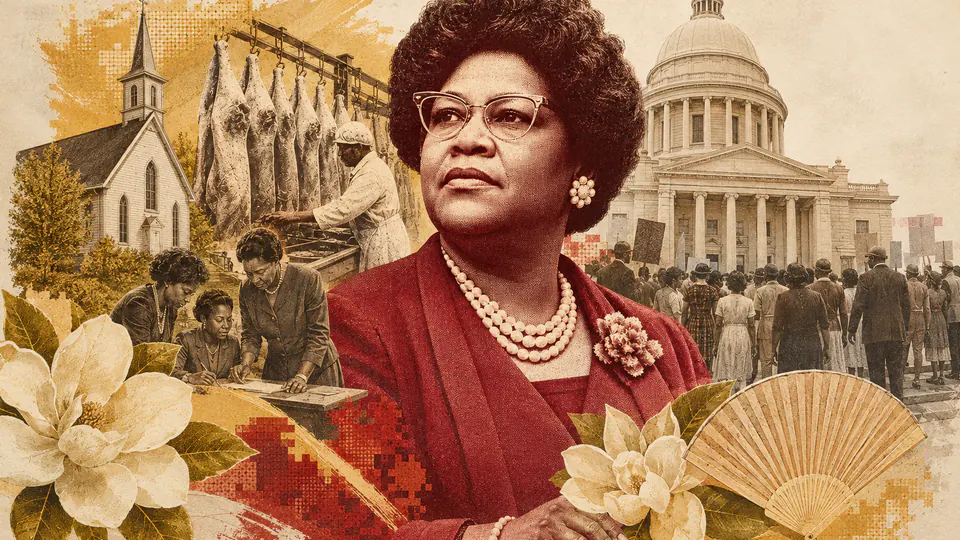
#storyAddie Wyatt applied for a typing job in Chicago in 1941. The employer gave her a production job in a meatpacking plant instead because the office did not hire Black women. That act of discrimination placed her on a factory floor where an interracial industrial union was contesting the rules of the city’s working life.
Wyatt met an insult about race, gender, and class at once, administered by one personnel office. Her labor career grew from that clarity.
The packinghouse floor made solidarity practical
Wyatt was born in Mississippi in 1924 and moved to Chicago with her family during the Great Depression. She entered the workforce while still responsible for younger siblings. The packinghouses offered industrial wages, harsh conditions, and rigid job lines.
The United Packinghouse Workers of America had a stronger record of interracial organization than many unions of its era. That did not erase racism or sexism inside the plants or union. It gave workers a structure in which to challenge both. Wyatt became a shop steward, local officer, and staff representative.
Meatpacking made the stakes easy to see. Employers could assign the worst work by race and sex, use one group to threaten another, and reward individual compliance. A contract limited some of that discretion. A steward who enforced the contract made the limit real.
Equal pay required power inside the union
Wyatt handled grievances involving wages, assignment, promotion, and dignity. Women could not depend on male officers to notice sex discrimination, especially when it was disguised as custom. Black workers could not treat civil rights as a concern that began outside the factory gate.
Her rise through union leadership challenged the idea that the people most affected by discrimination should supply turnout but not policy. After the Packinghouse Workers merged with the Amalgamated Meat Cutters, Wyatt directed women’s affairs and human-rights work. In 1976 she became the first Black woman elected international vice president of a major U.S. union.
The title mattered, but her work below it mattered more. Leadership meant developing women as stewards and negotiators, pressing antidiscrimination claims, and placing family needs on bargaining agendas. It also meant arguing that racial justice strengthened a union because employers lost a reliable way to divide the shop.
Chicago joined the union hall to the street
Wyatt worked with Martin Luther King Jr. and participated in the 1963 March on Washington, the Selma campaign, and the Chicago Freedom Movement. She served in efforts that targeted discriminatory employment and housing, then carried that argument into women’s political equality.
That connection was not a ceremonial alliance between two movements. Industrial unions had members, meeting places, transportation, money, and experience with collective discipline. Civil-rights groups brought organizing networks and a direct challenge to racial power that many unions had evaded. Each could make the other more capable.
The alliance also had limits. Some union leaders supported national civil-rights laws while tolerating exclusion in apprenticeship, promotion, or local leadership. Wyatt’s presence forced those contradictions into union meetings where polite endorsements were insufficient.
Women built their own coalitions
In 1972, Wyatt helped found the Coalition of Black Trade Unionists. In 1974, she helped found the Coalition of Labor Union Women. The two groups answered different exclusions without splitting her politics into separate boxes.
Black trade unionists needed an independent voice when labor institutions failed to confront racism or neglected Black communities. Union women needed a national body to fight sex discrimination, develop leaders, support organizing, and press issues such as child care and equal pay. Wyatt knew that a worker could need both organizations at once.
She was also an early participant in the National Organization for Women. Her labor background tested any feminism centered on professional advancement alone. For a packinghouse worker, equality included a safe line speed, a grievance procedure, affordable care, and the power to refuse a supervisor without losing the rent.
Ministry was another organizing institution
Wyatt and her husband Claude founded Vernon Park Church of God in 1955. Her faith supplied moral language, but the church also supplied rooms, food, relationships, and a base in Chicago’s South Side. She became an ordained minister and continued church leadership alongside union and civil-rights work.
This combination sometimes put her at odds with religious people suspicious of unions and union people suspicious of the church. Wyatt rejected the boundary. If a congregation ignored poverty at its door, worship had become too small. If a union ignored the spiritual and community institutions its members trusted, organizing had become too narrow.
Her coalitions answered the first job refusal
Wyatt retired from full-time union office in the 1980s but continued ministry and public work. She died in 2012. Her career is often summarized through firsts, awards, and prominent colleagues. Those markers can hide the operating principle beneath them.
An employer denied her an office job because she was a Black woman. Wyatt responded by building power where she had been assigned, then moving the fight through a local union, an international union, civil-rights campaigns, women’s organizations, and a church. The discrimination was interconnected. Her organization had to be as well.
Strategy can be measured in resources
Wyatt linked a packinghouse contract to civil rights, feminism, church organization, and the authority of rank-and-file women. The sentence becomes more concrete when translated into resources. Who controlled the meeting room, membership list, printing bill, defense fund, car, telephone, childcare, food, medical help, or legal filing? Who could miss a shift, and who lost rent money by doing so? Those questions explain why an idea that sounded popular might remain weak and why a smaller group with trusted organization could alter an institution.
Opponents performed the same calculation. Delay could drain a strike fund or outlast public attention. Selective concessions could separate a coalition. Arrest or firing could remove a local leader without answering the demand. A hearing could collect testimony while postponing enforcement. A sympathetic statement could preserve an official’s reputation at lower cost than changing a budget or rule. Strategy meant recognizing those moves early enough to answer them.
Her coalitions were powerful because their institutions overlapped, but each carried leadership hierarchies and exclusions that she had to contest. The limit belongs inside the account because it affected the available strategy. People excluded from leadership often saw danger first. They knew which promise could not be enforced, which compromise shifted costs downward, and which supporter would leave after the photograph. Their criticism was organizational knowledge, even when officers treated it as disloyalty.
Three measures help separate durable change from ceremony. Capacity asks whether more people could act together after the campaign. Distribution asks who received money, time, safety, standing, or control. Enforcement asks what happened when an employer, agency, or leader ignored the new rule. A result can score well on one measure and poorly on another. That mixed finding is more informative than forcing the story into triumph or failure.
It also keeps the history alive without pretending the present is identical. The names of agencies, industries, and organizations change. The work of building trust, sharing risk, recording decisions, testing a promise, and preparing for retaliation remains recognizable. Addie Wyatt offers evidence about that work, including evidence of what could not be solved in one campaign or one lifetime.
In their own words
#wordsWhat Addie Wyatt actually said, where, and when. Each one links to the page it was checked against.
-
Would you really believe that at the age of two, I knew that black people were disrespected, unprotected, neglected, rejected, discriminated against. But I did not know until I entered the work place in this country that women were also discriminated against – unprotected – neglected – disrespected.
Speaking at Veteran Feminists of America's "Unfinished Business" event, Chicago, 2004, on when she first understood sex discrimination as distinct from the racism she had known since childhood. Veteran Feminists of America, VFA Pioneer Histories Project, "Interview with Rev. Addie Wyatt" -
Nothing in the world disturbed me more when I became a negotiator in the organized labor movement [than] to hear women being called “girls” and “gals.” And the other names. And what disturbed me even more was to see women smile and take it.
Same 2004 Chicago address, describing contract negotiations after she became a union negotiator. Veteran Feminists of America, VFA Pioneer Histories Project, "Interview with Rev. Addie Wyatt" -
You’ve got to organize. You’ve got to unify yourself with others who also want a better life.
Same 2004 Chicago address, on what she and her husband concluded made change possible. Veteran Feminists of America, VFA Pioneer Histories Project, "Interview with Rev. Addie Wyatt" -
And yes we made a difference in my own union in the year 1950 before it became law in this country we had an equal rights amendment in our company. Women could not be discriminated against because of their sex. We were fighting for women to get equal pay for equal work and we had it in contracts before the law was passed in this country.
Same 2004 Chicago address, on her union's 1950 contract language against sex discrimination. Veteran Feminists of America, VFA Pioneer Histories Project, "Interview with Rev. Addie Wyatt" -
To call you a girl may flatter your ego but it flattens your pay.
Same 2004 Chicago address, on why she pushed women in her union to reject being called "girls" and "gals." Veteran Feminists of America, VFA Pioneer Histories Project, "Interview with Rev. Addie Wyatt"
What people get wrong
#wrong- The myth
Wyatt entered the workforce already organizing around sex discrimination the way she later became known for. - The record
By her own account, she went to work at seventeen for economic reasons, to escape hunger and constant moves, and only recognized workplace sex discrimination after she entered the workforce. She said she had understood racial discrimination since age two but had to learn the shape of sex discrimination on the job.
- The myth
Wyatt's rise to international vice president was an honor handed to her. - The record
In her own telling, women in her local pushed her to run after another leader stepped down, telling her, "You can be the leader. If you will lead we'll do everything that we can to help you." She said she never went to the polls the day of the vote and learned she had won when coworkers met her the next day.
- The myth
Union contracts did not address sex discrimination and equal pay until federal law forced the issue in the 1960s. - The record
Wyatt said her own union had a company agreement barring sex discrimination and guaranteeing equal pay for equal work in 1950, thirteen years before the federal Equal Pay Act of 1963.
- The myth
The Coalition of Labor Union Women formed outside the labor movement to represent women instead of it. - The record
CLUW's founding convention, March 22, 1974 in Chicago, drew 3,200 women already active in their own unions, independent only of the AFL-CIO's own structure, not of organized labor itself. Wyatt, then director of women's affairs for the Amalgamated Meat Cutters, addressed the opening session and was elected the new coalition's vice chair.
The dates that matter
#dates- March 8, 1924 Born Addie Cameron in Brookhaven, Mississippi.
- 1930 Moves with her family to Chicago.
- 1941 Begins work in Chicago's meatpacking industry.
- 1950s Becomes a local union leader and staff representative.
- 1955 Founds Vernon Park Church of God with Claude Wyatt.
- 1960s Works in civil-rights campaigns and union human-rights programs.
- 1972 Helps found the Coalition of Black Trade Unionists.
- 1974 Helps found the Coalition of Labor Union Women.
- 1976 Becomes an international vice president of the Amalgamated Meat Cutters.
- March 28, 2012 Dies in Chicago.
Questions people ask
#faqsWho was Addie Wyatt?
Addie Wyatt was a Chicago packinghouse worker, union officer, civil-rights organizer, women's-rights advocate, and Church of God minister.
What union did Addie Wyatt organize?
She began in the United Packinghouse Workers of America, which later merged with the Amalgamated Meat Cutters and then became part of the United Food and Commercial Workers.
What union milestone did Wyatt reach?
She became the first Black woman elected as an international vice president of a major U.S. labor union.
What organizations did Addie Wyatt help found?
She helped establish the Coalition of Black Trade Unionists in 1972 and the Coalition of Labor Union Women in 1974, and she was an early member of the National Organization for Women.
The bookshelf
#bookshelfWhere to go next. Buy from an independent bookstore, or find it at your library for nothing.
-
Reverend Addie Wyatt: Faith and the Fight for Labor, Gender, and Racial Equality Marcia Walker-McWilliams, 2016 secondary
The standard biography, built on interviews and her union and church papers.
-
"Negro and White, Unite and Fight!": A Social History of Industrial Unionism in Meatpacking, 1930-90 Roger Horowitz, 1997 secondary
The packinghouse union's racial politics, the ground Wyatt organized on.
-
The Other Women's Movement: Workplace Justice and Social Rights in Modern America Dorothy Sue Cobble, 2004 secondary
Places Wyatt among the labor feminists who fought for equal pay and union power years before the women's movement got the credit.
Wear it: Addie Wyatt
#merchEvery design here links back to this page.
Sources
#sourcesPrimary sources
The documents themselves: laws, court opinions, speeches, letters, and the numbers from the agencies that count them.
Secondary sources
Written afterward, about the story.
- National Park Service, Addie Wyatt
- University of Illinois Press, Reverend Addie Wyatt
- Black Women's Religious Activism, Addie Wyatt
- Black Women's Religious Activism, Addie Wyatt research guide
- AFL-CIO, Addie L. Wyatt
- Chicago History Museum, packinghouse workers
- UE News, "Fifty Years Ago, Union Women Founded New Organization to Fight for Equality"