Published
Maida Springer Kemp
Maida Springer Kemp Carried Black Labor Organizing Across the Atlantic
Born May 12, 1910. Died March 29, 2005
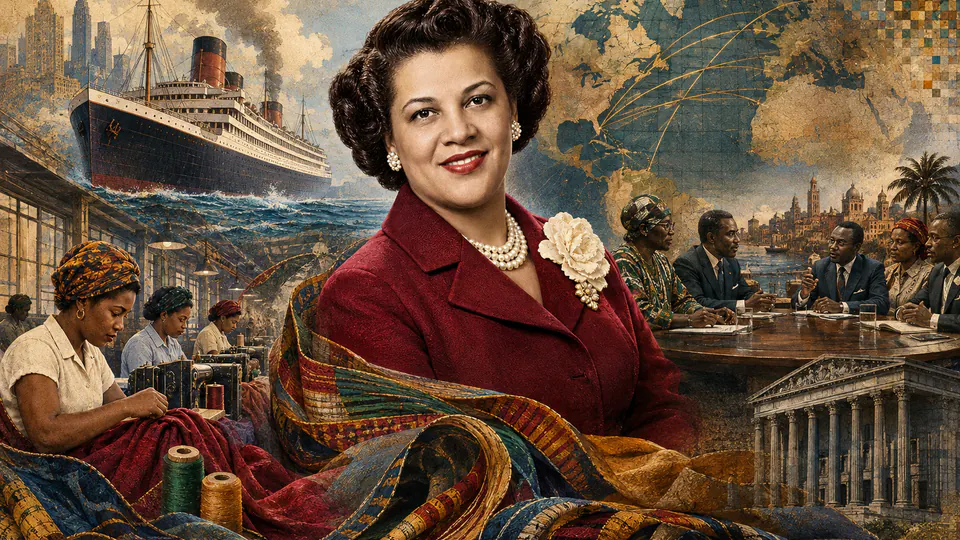
Maida Springer Kemp rose from New York garment work to union education and spent decades connecting African labor movements with Black freedom struggles.
The story
#storyInternational solidarity can collapse into a photograph: a visiting delegate, a row of flags, a speech about workers everywhere. Maida Springer Kemp did the less visible work that makes the phrase mean something. She organized classes, built relationships, learned the politics of particular unions, and returned often enough to be accountable.
Her route began in New York’s garment shops. It eventually connected Black labor organizing in the United States with African trade union movements confronting colonial rule.
Harlem and the garment shop formed her politics
Maida Stewart was born in Panama in 1910 and moved to New York as a child. She grew up in Harlem and entered garment work, an industry built on skilled labor, unstable employment, low pay, and sharp divisions by race, ethnicity, and gender.
She joined Dressmakers’ Local 22 of the International Ladies’ Garment Workers’ Union. Black workers could be present in union membership while still excluded from preferred jobs and leadership. Springer pushed through those barriers as an educator, organizer, and later a business agent.
Worker education was not an ornamental lecture series. Members needed to read a contract, run a meeting, pursue a grievance, understand price controls, and argue policy with their own officers. Education turned a dues payer into someone who could exercise union power.
A union post opened an international route
During World War II, Springer directed education for a garment local and served on a rationing board. In 1945 she traveled to Britain as a labor delegate on a trip connected to the Office of War Information. The assignment made her one of the first Black women to represent U.S. labor abroad.
Britain showed wartime labor organization under bombing and austerity. It also sat at the center of an empire facing independence demands. For a Black American unionist, the connection between racial hierarchy at home and colonial rule abroad was difficult to miss.
Springer later became a business agent in Local 22. That job required daily enforcement: hearing complaints, negotiating with employers, and making the contract apply across a divided workforce. The practical skills traveled with her when international work became the center of her career.
African unions were independence institutions
Across Africa, trade unions did more than bargain over a single workplace. Under colonial rule, they could become mass organizations able to train leaders, circulate information, and challenge authorities. Labor organizing and national independence were related but not identical. A new flag did not guarantee worker control, democratic unions, or equal economic power.
Springer worked with unionists in countries including Ghana, Kenya, Nigeria, Tanganyika, and Uganda. She supported labor schools and leadership development through U.S. and international union programs. She formed relationships with figures such as Tom Mboya in Kenya and labor leaders involved in anticolonial politics.
Her position carried contradictions. U.S. labor institutions operated during the Cold War, when government and union officials sometimes treated overseas labor as a contest for geopolitical loyalty. African organizers had their own priorities and arguments. Springer had to work inside programs funded from abroad without reducing local unions to extensions of U.S. policy.
Race changed the encounter but did not erase power
As a Black woman, Springer could approach African unionists differently from many white U.S. officials. Shared experiences of racism made some conversations possible. They did not make her automatically representative of African workers or free her sponsoring institutions from unequal power.
She understood that solidarity required listening to political conditions country by country. Colonial administrations, employers, nationalist parties, and competing union federations shaped what organizers could do. Training imported without that context would become another instruction manual from the metropole.
Springer’s work also widened Black freedom politics in the United States. The fight against Jim Crow belonged to a larger struggle over colonialism, labor, and economic development. African independence, in turn, could draw strength from organized workers and unions rather than rely only on elite negotiation.
Education was the durable technology
Springer spent decades in labor education, including work connected to the AFL-CIO’s international programs. A school could teach procedure, political economy, organizing, and administration. More importantly, it could gather workers from different regions who would remain connected after the course ended.
That method avoided the fantasy of the visiting expert who solves a movement’s problems in a week. Springer returned, corresponded, arranged exchanges, and helped people gain access to resources. Her archives record travel and prominent meetings, but the substance lies in recurring institutional work.
She also mentored Black unionists and preserved the history of networks that conventional labor accounts often leave at the margins. Her oral histories are especially useful because they show choices, compromises, and disagreements rather than a clean parade of milestones.
Her map of labor was larger than the nation
Springer Kemp died in 2005. By then, formal colonial rule had ended across most of Africa, while debt, corporate power, state repression, and informal work continued to limit worker power. U.S. unions also faced membership decline and arguments over their Cold War record abroad.
Her career does not settle those arguments. It supplies evidence for having them honestly. International labor work could carry institutional agendas and still create relationships of value. Shared racial identity could open trust and still require attention to unequal resources. Education could be used to direct workers or to give them command of their own organizations.
Springer kept choosing the second purpose. She treated knowledge as something workers should possess, use, and pass on. That made solidarity less photogenic and far more durable.
Strategy can be measured in resources
Springer Kemp treated labor internationalism as relationships among workers, educators, and organizers rather than a foreign-policy slogan. The sentence becomes more concrete when translated into resources. Who controlled the meeting room, membership list, printing bill, defense fund, car, telephone, childcare, food, medical help, or legal filing? Who could miss a shift, and who lost rent money by doing so? Those questions explain why an idea that sounded popular might remain weak and why a smaller group with trusted organization could alter an institution.
Opponents performed the same calculation. Delay could drain a strike fund or outlast public attention. Selective concessions could separate a coalition. Arrest or firing could remove a local leader without answering the demand. A hearing could collect testimony while postponing enforcement. A sympathetic statement could preserve an official’s reputation at lower cost than changing a budget or rule. Strategy meant recognizing those moves early enough to answer them.
Cold War institutions supplied resources while narrowing acceptable politics and placing U.S. unions inside contested projects abroad. The limit belongs inside the account because it affected the available strategy. People excluded from leadership often saw danger first. They knew which promise could not be enforced, which compromise shifted costs downward, and which supporter would leave after the photograph. Their criticism was organizational knowledge, even when officers treated it as disloyalty.
Three measures help separate durable change from ceremony. Capacity asks whether more people could act together after the campaign. Distribution asks who received money, time, safety, standing, or control. Enforcement asks what happened when an employer, agency, or leader ignored the new rule. A result can score well on one measure and poorly on another. That mixed finding is more informative than forcing the story into triumph or failure.
It also keeps the history alive without pretending the present is identical. The names of agencies, industries, and organizations change. The work of building trust, sharing risk, recording decisions, testing a promise, and preparing for retaliation remains recognizable. Maida Springer Kemp offers evidence about that work, including evidence of what could not be solved in one campaign or one lifetime.
In their own words
#wordsWhat Maida Springer Kemp actually said, where, and when. Each one links to the page it was checked against.
-
He excited my interest and challenged my mind to think about something besides the prejudice against the Black community.
Recalling A. Philip Randolph's effect on her thinking as a young garment worker, told to biographer Yevette Richards and reported in The Nation, February 4, 2022. Kim Kelly, "Maida Springer Kemp Championed Workers' Rights on a Global Scale," The Nation (February 4, 2022) -
It was an electrifying occasion.
On the 1933 ILGWU dressmakers' general strike in New York, told to biographer Yevette Richards and reported in The Nation, February 4, 2022. Kim Kelly, "Maida Springer Kemp Championed Workers' Rights on a Global Scale," The Nation (February 4, 2022) -
The thing that offended me was that I always felt that I was being patronized. I think they loved me too much.
On Communist Party organizers courting her during her early years in the ILGWU, told to biographer Yevette Richards and reported in The Nation, February 4, 2022. Kim Kelly, "Maida Springer Kemp Championed Workers' Rights on a Global Scale," The Nation (February 4, 2022) -
Our allies in democracy, to ease the burden of criticism of their colonial policies, never let us lose sight of our own color dilemma. Under such circumstances it comes with poor grace to tell Africans communism is worse.
From a 1959 speech on Cold War colonial politics, reported in The Nation, February 4, 2022. Kim Kelly, "Maida Springer Kemp Championed Workers' Rights on a Global Scale," The Nation (February 4, 2022) -
I have an unending love affair with the American labor movement.
Reflecting on her career in the labor movement, reported in The Nation, February 4, 2022. Kim Kelly, "Maida Springer Kemp Championed Workers' Rights on a Global Scale," The Nation (February 4, 2022)
What people get wrong
#wrong- The myth
Springer Kemp was a garment worker who was later handed a diplomatic title. - The record
She was elected and re-elected as a business agent of Dressmakers' Local 22, the first Black woman to hold that post in the ILGWU, and held it for thirteen years before her AFL-CIO international assignments began.
- The myth
Her international work began with Kenya and East Africa in the 1950s. - The record
Her first trip representing American labor abroad was to Britain in 1945, as a wartime labor delegate studying conditions under bombing and rationing, more than a decade before her later postings in Africa.
- The myth
She spoke for the AFL-CIO's Africa policy without pushback from African unionists. - The record
Her own account, given to biographer Yevette Richards, describes African trade unionists directing sharp questions at her about what American workers understood of colonialism, and she spent her career answering to relationships built country by country rather than a single Washington line.
The dates that matter
#dates- May 12, 1910 Born Maida Stewart in Panama.
- 1917 Moves with her mother to New York City.
- 1930s Works in the garment industry and becomes active in ILGWU Local 22.
- 1942 Directs worker education for a garment local and runs for the New York State Assembly.
- 1945 Travels to Britain as a labor delegate studying wartime conditions.
- Late 1940s Becomes a business agent for Dressmakers' Local 22.
- 1950s Expands labor-education work with African unionists.
- 1960s Works with international labor programs during African decolonization.
- 1980s Continues teaching and documenting Black international labor history.
- March 29, 2005 Dies in Pittsburgh.
Questions people ask
#faqsWho was Maida Springer Kemp?
Maida Springer Kemp was a Harlem garment worker, ILGWU organizer, labor educator, and adviser to African trade union movements.
What union did Springer Kemp belong to?
She worked in the International Ladies' Garment Workers' Union, especially Dressmakers' Local 22.
Why did Springer Kemp work in Africa?
She helped develop labor education and union institutions with African organizers during anticolonial and independence struggles.
Was Springer Kemp's international work part of the U.S. government?
Her first wartime trip involved the U.S. Office of War Information, but her longer career ran through unions, labor-education programs, and relationships with African organizers.
The bookshelf
#bookshelfWhere to go next. Buy from an independent bookstore, or find it at your library for nothing.
-
Conversations With Maida Springer: A Personal History of Labor, Race, and International Relations Yevette Richards, 2004 primary
Her own account, in interview form, of the garment shop, the ILGWU, and Africa.
-
Maida Springer: Pan-Africanist and International Labor Leader Yevette Richards, 2000 secondary
The standard biography, built from her papers and decades of interviews.
Wear it: Maida Springer Kemp
#merchEvery design here links back to this page.
Sources
#sourcesPrimary sources
The documents themselves: laws, court opinions, speeches, letters, and the numbers from the agencies that count them.
- Schlesinger Library, Papers of Maida Springer Kemp
- Schlesinger Library, Maida Kemp oral history
- Library of Congress, Maida Springer Kemp photograph
- University of Pittsburgh Press, Conversations with Maida Springer
- Smithsonian, Maida Springer Kemp oral history collection
- Kim Kelly, "Maida Springer Kemp Championed Workers' Rights on a Global Scale," The Nation (February 4, 2022)
Secondary sources
Written afterward, about the story.