Published
A. Philip Randolph
A. Philip Randolph: The Organizer Two Presidents Couldn't Ignore
Born April 15, 1889. Died May 16, 1979
A. Philip Randolph forced Executive Order 8802 in 1941 and Executive Order 9981 in 1948, then directed the 1963 March on Washington at seventy-four.
The story
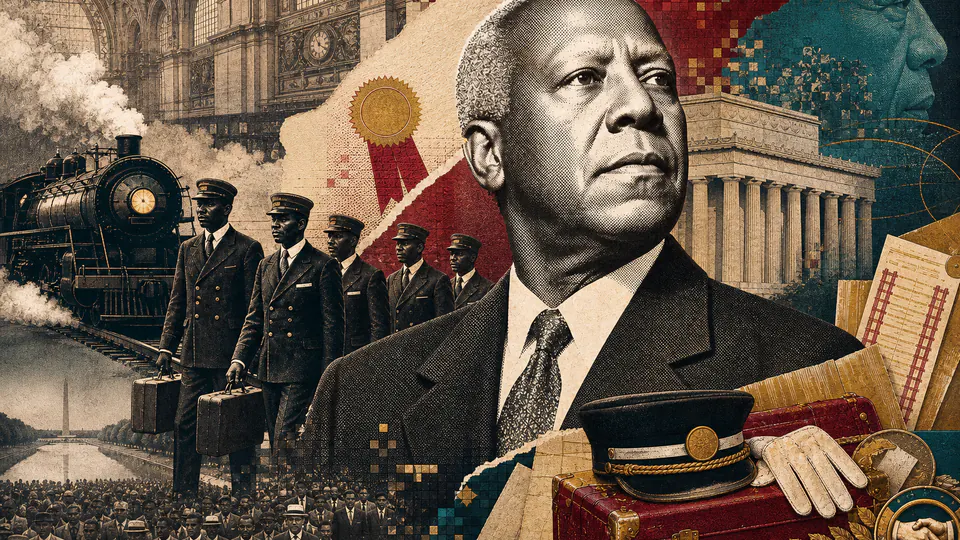
#storyA. Philip Randolph never held elected office, and he moved two American presidents anyway. In 1941 he told Franklin Roosevelt he would put tens of thousands of Black demonstrators on the streets of the capital unless the government opened defense jobs to Black workers on equal terms. Roosevelt signed the order six days before the deadline. In 1948 he told Harry Truman he would counsel Black draftees to refuse military service unless the armed forces desegregated. Truman signed that order four months later. In 1963, at seventy-four, Randolph ran the march itself, and a quarter million people came without being threatened into it.
The magazine that got him arrested
Randolph was born April 15, 1889, in Crescent City, Florida, graduated valedictorian of the Cookman Institute’s class of 1907 in Jacksonville, and moved to Harlem, where he took classes at City College of New York. In August 1917 he and Chandler Owen founded The Messenger, a socialist monthly that opposed American entry into World War I and argued for unions that organized Black and white workers together instead of against each other. The Justice Department’s own assessment of the era’s radical publications described it as among “the most able and the most dangerous” the country’s Black press produced.
The government did not stop at a report. In 1918 Randolph and Owen were arrested in Cleveland and charged under the Espionage Act, the same law that sent Eugene Debs to prison that same year for an antiwar speech. The judge in their case reportedly doubted two young Black men could have written the offending material themselves and suspected a white socialist behind it. Neither man went to prison, and The Messenger kept publishing.
Organizing the men Pullman couldn’t fire
Pullman porters worked the sleeping cars on America’s overnight trains, making beds, shining shoes, minding luggage, and absorbing passengers who called every one of them “George” regardless of his actual name. Some months they worked more than 400 hours for a base wage that assumed tips would cover the rest, and they bought their own uniforms and supplies out of it. Pullman fired anyone who organized. On August 25, 1925, roughly 500 porters met at an Elks hall in Harlem and formed the Brotherhood of Sleeping Car Porters. They picked Randolph to lead it precisely because he was not a porter and Pullman could not fire him.
Pullman fought the union for twelve years. The Brotherhood joined the American Federation of Labor in 1935, and on August 25, 1937, exactly twelve years after that first Elks hall meeting, Pullman signed its first contract with the union: shorter hours, higher pay, and a formal grievance procedure. It was the first agreement between a major American corporation and a union led by Black workers.
A march that never had to happen
By 1940 the country was building warplanes and tanks for a war it hadn’t yet entered, and Black workers were mostly locked out of the jobs. On September 27, 1940, Randolph met President Roosevelt at the White House alongside NAACP leader Walter White and Urban League official T. Arnold Hill to press for desegregating defense production and the armed forces. White brought petitions from eighty-five veterans’ posts. Roosevelt made no commitment. Randolph concluded that asking politely had run its course.
He called for a march on Washington, and by the spring of 1941 he was promising tens of thousands of Black demonstrators in the streets of the capital if the government did not act. Roosevelt met with Randolph on June 18, with New York mayor Fiorello La Guardia mediating, and on June 25, 1941, six days before the march date Randolph had set, he signed Executive Order 8802. The order’s language was plain: “There shall be no discrimination in the employment of workers in defense industries or government because of race, creed, color, or national origin.” It also created the Fair Employment Practice Committee to enforce that line. Randolph called off the march but kept his organization alive to hold the new committee to its word.
Telling Truman he would counsel resisting the draft
The armed forces stayed segregated through the war Executive Order 8802 had helped integrate the factories for. Randolph and fellow activist Grant Reynolds formed the Committee Against Jim Crow in Military Service and Training to press for change, and on March 22, 1948, Randolph told President Truman to his face that if the military stayed segregated, he would advise young Black men to refuse the draft. Four months later, on July 26, 1948, Truman signed Executive Order 9981. Its language matched the demand: “[T]here shall be equality of treatment and opportunity for all persons in the armed services without regard to race, color, religion or national origin.”
Building coalitions inside and outside the AFL-CIO
Randolph kept the Brotherhood’s charter through the 1955 merger of the American Federation of Labor and the Congress of Industrial Organizations and became one of the new federation’s first Black vice presidents. He had already co-founded the Leadership Conference on Civil and Human Rights in 1950 with Roy Wilkins and Arnold Aronson, a coalition built to lobby Congress for civil rights legislation. When the AFL-CIO’s 1959 convention declined to act against segregated union locals, Randolph did not wait on the federation to change its mind. In 1960 he and dozens of other Black trade unionists formed the Negro American Labor Council to keep pressing from outside, and he served as its president until 1966.
Director, age seventy-four
On August 28, 1963, Randolph held the official title of director of the March on Washington for Jobs and Freedom. Bayard Rustin, his deputy director, had the eight weeks between the march’s announcement and the day itself to build the operation that ran the logistics: the buses, the marshals, the sound system that carried the day’s speeches to a crowd historians put at around a quarter million people. Randolph, seventy-four years old, opened the program:
We’re gathered here for the longest demonstration in the history of this nation. Let the nation and the world know the meaning of our numbers. We are not a pressure group, we are not an organization or a group of organizations, we are not a mob. We are the advanced guard of a massive, moral revolution for jobs and freedom.
Martin Luther King Jr. spoke last, that afternoon, and the day is remembered for his speech. Randolph opened it, the way he had opened most of the fights that got the country to that field.
What came after
Lyndon Johnson gave Randolph the Presidential Medal of Freedom on September 14, 1964. In 1965 Randolph and Rustin founded the A. Philip Randolph Institute to keep organizing Black workers inside the labor movement, and in January 1967 the Institute published “A Freedom Budget for All Americans,” a detailed plan for full employment and an end to poverty within a decade. Congress never took it up. Randolph died in New York City on May 16, 1979, at ninety.
In their own words
#wordsWhat A. Philip Randolph actually said, where, and when. Each one links to the page it was checked against.
-
We're gathered here for the longest demonstration in the history of this nation. Let the nation and the world know the meaning of our numbers. We are not a pressure group, we are not an organization or a group of organizations, we are not a mob. We are the advanced guard of a massive, moral revolution for jobs and freedom.
Opening the program of the March on Washington for Jobs and Freedom as its director, August 28, 1963. A. Philip Randolph, address at the March on Washington for Jobs and Freedom (August 28, 1963) -
And we know that we have no future in a society in which 6 million black and white people are unemployed and millions more live in poverty.
Later in the same 1963 March on Washington address. A. Philip Randolph, address at the March on Washington for Jobs and Freedom (August 28, 1963) -
Dear fellow Negro Americans, be not dismayed in these terrible times. You possess power, great power.
Opening "The Call to Negro America to March on Washington," his pamphlet published in Black Worker, May 1941, announcing the original march threat. A. Philip Randolph, "The Call to Negro America to March on Washington," Black Worker (May 1941) -
In this period of power politics, nothing counts but pressure, more pressure, and still more pressure, through the tactic and strategy of broad, organized, aggressive mass action behind the vital and important issues of the Negro.
From the same 1941 call to march, published a month before Roosevelt signed Executive Order 8802. A. Philip Randolph, "The Call to Negro America to March on Washington," Black Worker (May 1941)
What people get wrong
#wrong- The myth
The 1941 March on Washington happened and forced Roosevelt's hand. - The record
The march never took place. Roosevelt signed Executive Order 8802 on June 25, 1941, banning discrimination in defense-industry and federal hiring, six days before the date Randolph had set, and Randolph called the march off. What produced the order was the threat of tens of thousands of marchers.
- The myth
Executive Order 9981 immediately ended segregation in the US military. - The record
The order declared a policy of equal treatment but set no deadline. Integration took years, accelerated by manpower needs during the Korean War, and the Army's last all-Black unit was not disbanded until the end of 1954, more than six years after Truman signed the order.
- The myth
Martin Luther King Jr. organized the 1963 March on Washington. - The record
Randolph held the official title of director, having first proposed a march on Washington in 1941 and revived the idea for 1963, with Bayard Rustin as deputy director running the logistics. King delivered the closing address of the day's program that Randolph opened.
The dates that matter
#dates- April 15, 1889 Born in Crescent City, Florida. Educated at the Cookman Institute in Jacksonville, then moves to Harlem and takes classes at City College of New York.
- August 1917 Founds The Messenger with Chandler Owen, a socialist monthly opposing American entry into World War I.
- 1918 Arrested with Owen in Cleveland and charged under the Espionage Act over material urging Black Americans to resist the draft.
- August 25, 1925 Organizes the Brotherhood of Sleeping Car Porters at an Elks hall in Harlem, with roughly 500 porters attending.
- August 25, 1937 The Pullman Company signs its first contract with the Brotherhood, exactly twelve years after the union's founding meeting.
- September 27, 1940 Meets President Roosevelt at the White House with Walter White and T. Arnold Hill to press for desegregating defense production and the military. Roosevelt makes no commitment.
- June 25, 1941 Roosevelt signs Executive Order 8802, banning discrimination in defense industries and government hiring, six days before Randolph's planned march on the capital.
- March 22, 1948 Tells President Truman he will counsel young Black men to refuse the draft unless the military desegregates.
- July 26, 1948 Truman signs Executive Order 9981, ordering equal treatment in the armed forces.
- 1950 Co-founds the Leadership Conference on Civil and Human Rights with Roy Wilkins and Arnold Aronson.
- December 1955 Becomes one of the AFL-CIO's first Black vice presidents at the founding merger of the AFL and CIO.
- 1960 Founds the Negro American Labor Council after the AFL-CIO's 1959 convention declines to act against segregated union locals. Leads it as president until 1966.
- August 28, 1963 Directs the March on Washington for Jobs and Freedom, opening the program for a crowd of roughly a quarter million.
- May 16, 1979 Dies in New York City at age ninety.
Questions people ask
#faqsWho was A. Philip Randolph?
A. Philip Randolph (1889-1979) was a labor and civil rights organizer who founded the Brotherhood of Sleeping Car Porters in 1925, the first Black-led union to win a contract with a major American company. He spent the next four decades using the threat of mass demonstrations to force federal action on employment and military discrimination, and at seventy-four he served as director of the 1963 March on Washington for Jobs and Freedom.
What did A. Philip Randolph do?
He organized Pullman porters into a union that won its first contract in 1937, forced President Franklin Roosevelt to ban discrimination in defense hiring with Executive Order 8802 in 1941 by threatening a march, pushed President Truman toward desegregating the armed forces with Executive Order 9981 in 1948, and directed the 1963 March on Washington, where Martin Luther King Jr. spoke last.
Did A. Philip Randolph organize the March on Washington?
Yes. Randolph held the official title of director of the March on Washington for Jobs and Freedom on August 28, 1963, with Bayard Rustin as his deputy, running a team of roughly 200 organizers. Randolph opened the day's program, speaking to a crowd historians put at around a quarter million people.
Was A. Philip Randolph a socialist?
Yes, in his younger years. He joined the Socialist Party and, with Chandler Owen, founded the magazine The Messenger in 1917 to argue against American entry into World War I and for interracial unionism. In 1918 the two men were arrested in Cleveland and charged under the same Espionage Act used that year against Eugene Debs.
How did A. Philip Randolph die?
Randolph died in New York City on May 16, 1979, at age ninety.
The bookshelf
#bookshelfWhere to go next. Buy from an independent bookstore, or find it at your library for nothing.
-
For Jobs and Freedom: Selected Speeches and Writings of A. Philip Randolph edited by Andrew E. Kersten and David Lucander, 2014 primary
Seventy-odd pieces in his own words, from The Messenger through the March on Washington.
-
A. Philip Randolph: A Biographical Portrait Jervis Anderson, 1986 secondary
The standard biography, first published in 1973.
-
A. Philip Randolph and the Struggle for Civil Rights Cornelius L. Bynum, 2011 secondary
A newer scholarly account tracing his politics back to the socialism of The Messenger years.
Wear it: A. Philip Randolph
#merchEvery design here links back to this page.
Sources
#sourcesPrimary sources
The documents themselves: laws, court opinions, speeches, letters, and the numbers from the agencies that count them.
- National Archives, "Executive Order 8802: Prohibition of Discrimination in the Defense Industry (1941)" (exact date signed and the order's operative clause)
- National Archives, "Executive Order 9981: Desegregation of the Armed Forces (1948)" (exact date signed and the order's operative clause)
- A. Philip Randolph, address at the March on Washington for Jobs and Freedom (August 28, 1963) (transcript compiled from WGBH audio, originally published by The Florida Times-Union/Jacksonville.com, August 20, 2013)
- A. Philip Randolph, "The Call to Negro America to March on Washington," Black Worker (May 1941)
Secondary sources
Written afterward, about the story.
- National Park Service, Home of Franklin D. Roosevelt National Historic Site, "A. Philip Randolph" (the September 27, 1940 White House meeting)
- Today in Civil Liberties History, "A. Philip Randolph Confronts Truman Over Segregated Military" (the March 22, 1948 warning to Truman)
- Encyclopedia.com, "Brotherhood of Sleeping Car Porters"
- Chicago History Museum, "The Brotherhood of Sleeping Car Porters" (the 1935 AFL admission and pre-contract working conditions)
- Labor Notes, "100 Years Ago, the Brotherhood of Sleeping Car Porters Changed Black Politics"
- Spartacus Educational, "The Messenger"
- Encyclopedia.com, "Negro American Labor Council"
- Leadership Conference on Civil and Human Rights, "Today in Civil Rights History: Birth Anniversary of LCCR Founder A. Philip Randolph"
- Wikipedia, "March on Washington for Jobs and Freedom" (attendance estimates, Randolph and Rustin's titles, speaker order)
- Wikipedia, "A. Philip Randolph" (orientation and biographical dates)
- A. Philip Randolph Institute, "Our History" (the Institute's 1965 founding by Randolph and Rustin)
- National Museum of the United States Army, "Executive Order 9981"