Published
Walter Reuther
Walter Reuther Made the UAW Bargain Beyond the Factory Gate
Born September 1, 1907. Died May 9, 1970
Walter Reuther led the UAW from 1946 to 1970, winning major contracts while putting union money and people behind civil rights.
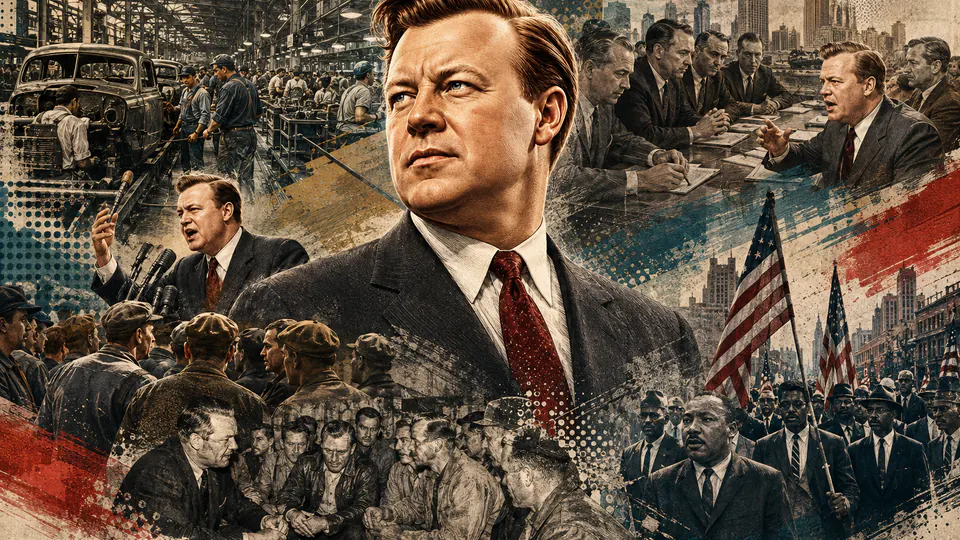
The story
#storyOn May 26, 1937, Walter Reuther and three other United Auto Workers organizers climbed the pedestrian overpass outside Ford’s River Rouge plant to hand out leaflets. Company security men beat them while newspaper photographers watched. Ford employees then seized film and plates, but photographs escaped. The Battle of the Overpass gave the new union exactly the publicity Ford had intended to kick downstairs.
Reuther would lead the UAW from 1946 until 1970. Under him, the union won pay, pensions, health coverage, and a political reach far outside auto plants. That reach helped fund the civil-rights movement, including the 1963 March on Washington for Jobs and Freedom.
Wheeling, Detroit, and the Ford gate
Reuther was born in Wheeling, West Virginia on September 1, 1907. His father Valentine was a brewery worker and socialist who brought union arguments to the dinner table. Walter moved to Detroit in 1927 and became a skilled tool-and-die maker at Ford.
After being dismissed in 1932, Reuther and his brother Victor traveled through Europe and worked in a Soviet auto plant before returning to Detroit. Reuther joined the UAW organizing drive in 1936 and became president of West Side Local 174. Ford remained the hardest target. The company employed spies and a large security force under Harry Bennett. The photographs from the overpass made that system visible in a single frame.
Ford signed with the UAW in 1941, the last of the Big Three automakers to do so.
Bargaining for a larger share
Reuther won the UAW presidency in 1946 after leading a 113-day strike against General Motors. He argued that GM could raise wages without raising car prices by accepting a smaller profit. The company rejected his demand to open its books, but the campaign made corporate pricing a public question instead of a private command.
In 1950 the UAW and GM signed a five-year agreement later nicknamed the Treaty of Detroit. It linked wage changes to the cost of living and productivity, expanded pensions and health benefits, and promised industrial peace for the contract’s term. Similar agreements spread through mass-production industries.
The gains were large, but the bargain had edges. Benefits tied security to a stable job at a large employer. The system left many workers outside, and management kept control of investment and production. Black auto workers also fought discrimination inside factories and unions, sometimes against leaders who praised equality at the podium but moved slowly in the plant.
A union at the March on Washington
Reuther treated union power as political power. The UAW backed national health insurance, public housing, civil-rights law, and stronger social insurance. It also put resources behind organizers. The union supplied money and buses for major civil- rights mobilizations and helped support the March on Washington in 1963. Reuther stood among its speakers before an estimated 250,000 people.
The alliance had history. A. Philip Randolph, Bayard Rustin, Martin Luther King Jr., and labor allies made the march’s full title literal: jobs and freedom. Reuther argued that civil rights and equal economic opportunity belonged to every American. UAW support helped pay the bills behind that sentence.
Reuther also backed the 1965 Selma campaign and Johnson’s War on Poverty. Yet labor’s relationship with the civil-rights left could turn defensive, especially when Black workers challenged discrimination within unionized plants or when the Vietnam War split the coalition. Reuther broke with Lyndon Johnson over the war, but later and more cautiously than many anti-war organizers wanted.
The crash in Michigan
Reuther pushed the labor federation toward broader social planning, then took the UAW out of the AFL-CIO in 1968 after years of conflict with federation president George Meany. He worked on an alliance with the Teamsters and continued advocating national health insurance and environmental rules.
On May 9, 1970, a chartered plane carrying Walter and May Reuther to the union’s education center crashed near Pellston, Michigan. All six people aboard died. Reuther was 62.
His name now sits on a Detroit labor archive whose collections document both his leadership and the rank-and-file movements that argued with it. That is a fitting location. Reuther helped prove that a union contract could move wealth and that a union treasury could move politics. The factory gate was a starting line, not the edge of the job.
The sequence changes the argument
Accounts often compress Walter Reuther into the polished president of a powerful postwar union. The chronology makes a larger claim. Reuther learned tool-and-die work in Detroit and traveled through workplaces in Europe and the Soviet Union before returning to the auto industry. He took part in the UAW’s organizing battles as sit-down strikes and plant actions broke employer resistance. Neither fact is background decoration. Together they explain why the conflict took the form it did and why participants did not treat patience as a serious answer.
The 1945 strike against General Motors demanded a large wage increase without higher car prices, linking bargaining to corporate accounts. As UAW president, he built contracts covering wages, pensions, health benefits, and cost-of-living adjustments. The work depended on meetings, transportation, money, printed material, trusted messengers, and people willing to absorb retaliation. Public memory usually preserves the microphone or the confrontation. Organization lived in the less photogenic decisions that made a crowd, vote, strike, or policy demand possible.
Power worked through institutions
The central dispute concerned how shop-floor militancy became national bargaining power and then an institution with its own limits. That question could not be settled by a good argument alone. Employers, public officials, courts, parties, unions, churches, and newspapers controlled different resources. Organizers had to identify which body could change a rule, which ally could move it, and what pressure could make delay more expensive than action.
He survived assassination attempts that left lasting injuries, evidence of the violence surrounding labor power in Detroit. Reuther backed civil rights and helped mobilize union resources for the 1963 March on Washington. Those outcomes belong in the same account. A movement can gain public sympathy and still lose an immediate demand. It can win a statute while leaving people outside its coverage. It can build an institution that later becomes cautious. Calling one moment a victory or defeat without naming the measure hides more than it explains.
The limits were part of the result
He opposed the Vietnam War later than anti-war members wanted and worked inside Democratic politics even when administrations disappointed labor. The contracts he helped build improved industrial life but were vulnerable when employers moved jobs, automated plants, and attacked union density. These limits were not footnotes added by later critics. Participants argued about them at the time, often from unequal positions. Race, gender, citizenship, occupation, geography, and access to money affected who took the greatest risk and who received authority after a campaign became respectable.
This is why coalition should be treated as work rather than a photograph. Groups can share an opponent while wanting different remedies. They can cooperate on a march and disagree about a contract, a party, a war, or the pace of change. The useful question concerns the rules that allowed people to decide together, what resources they shared, and whose objections were easier to ignore.
What the record lets us say
The source trail matters because later retellings reward drama and erase maintenance. Government records show what officials claimed and enforced. Organizational papers show plans, budgets, arguments, and revisions. Oral histories recover work that formal minutes often omit, though memory recorded years later has its own limits. Newspapers capture public language while reflecting the interests and racial habits of editors. Reading those records against one another makes uncertainty visible instead of filling it with a convenient quotation.
The durable lesson of Walter Reuther is practical. Rights need procedures, money, institutions, and people able to enforce them after attention moves elsewhere. A law can change the field without ending the contest. A lost campaign can train organizers, expose an alliance, or leave a demand that later movements can use. History becomes more useful when it preserves both the achievement and the bill that remained unpaid.
In their own words
#wordsWhat Walter Reuther actually said, where, and when. Each one links to the page it was checked against.
-
We must determine now, once and for all, whether we believe in the United States Constitution.
Speaking at the March on Washington for Jobs and Freedom, August 28, 1963. American Federation of Teachers, "Key Figures Behind the March" (Fall 2013) -
We can make our own freedom secure only as we make freedom universal so that all may share its blessings. We cannot successfully preach democracy in the world unless we first practice democracy at home.
The same August 28, 1963 speech at the March on Washington. American Federation of Teachers, "Key Figures Behind the March" (Fall 2013) -
If we fail, the vacuum created by our failure will be filled with the Apostles of Hatred, who will search for answers in the dark of night, and reason will yield to riot, and the spirit of brotherhood will yield to bitterness and bloodshed, and the fabric of our free society will be torn asunder.
The same 1963 March on Washington speech, warning what would follow if Congress failed to act on civil rights. American Federation of Teachers, "Key Figures Behind the March" (Fall 2013) -
I am not a second-class citizen and I don't intend to start acting like one!
In archival footage of his testimony before the Senate Committee on Campaign Contributions, held by the Walter P. Reuther Library. Walter P. Reuther Library, on Reuther's Senate testimony
What people get wrong
#wrong- The myth
Reuther and the UAW backed the March on Washington from the sidelines, without much involvement. - The record
Reuther was the march's most senior white organizer, helped plan it with A. Philip Randolph and Bayard Rustin, spoke from the platform, and put UAW money and staff behind the mobilization; a stronger line in his prepared remarks criticizing the administration's civil-rights bill as too limited was cut before delivery, showing the alliance had real friction, not none.
- The myth
The Treaty of Detroit gave workers everything they needed and ended labor conflict for good. - The record
The 1950 GM contract won cost-of-living raises, pensions, and health coverage, but it tied security to employment at a large stable employer, left many workers without those protections, and did not end battles over automation, plant closures, or discrimination inside union shops in the decades after.
- The myth
Reuther led the UAW his whole career without serious internal opposition. - The record
He survived assassination attempts tied to internal union and mob conflict in Detroit in the 1940s, took the UAW out of the AFL-CIO in 1968 after years of public conflict with federation president George Meany, and drew criticism from Black auto workers and rank-and-file caucuses who argued the union moved too slowly on discrimination in the plants.
The dates that matter
#dates- September 1, 1907 Born in Wheeling, West Virginia.
- 1927 Moves to Detroit and works as a tool-and-die maker at Ford.
- 1936 Joins the new UAW's organizing work in Detroit.
- May 26, 1937 Ford security men beat Reuther and other organizers at the Battle of the Overpass.
- 1946 Wins election as UAW president.
- 1950 The UAW signs its five-year General Motors agreement, later called the Treaty of Detroit.
- August 28, 1963 Speaks at the March on Washington for Jobs and Freedom.
- 1952-1955 Leads the Congress of Industrial Organizations as its president.
- May 9, 1970 Dies with his wife May and four others in a plane crash in Michigan.
Questions people ask
#faqsWho was Walter Reuther?
Walter Reuther was a Detroit auto worker and organizer who served as president of the United Auto Workers from 1946 until his death in 1970.
What was the Treaty of Detroit?
The phrase describes the UAW's 1950 contract with General Motors, which traded a long agreement and labor peace for wage formulas, pensions, health coverage, and other gains.
What did Walter Reuther do for civil rights?
Reuther marched, spoke, raised money, and committed UAW staff and transportation to civil-rights campaigns. He addressed the 1963 March on Washington and backed major federal civil-rights laws.
How did Walter Reuther die?
Walter and May Reuther died with four other people when their chartered plane crashed near Pellston, Michigan on May 9, 1970.
The bookshelf
#bookshelfWhere to go next. Buy from an independent bookstore, or find it at your library for nothing.
-
Walter P. Reuther: Selected Papers Edited by Henry M. Christman, 1961 primary
His own speeches and writing, collected while he was still UAW president.
-
The Brothers Reuther and the Story of the UAW Victor G. Reuther, 1976 primary
A firsthand account from his brother and closest collaborator, present for the organizing and the aftermath.
-
Walter Reuther: The Most Dangerous Man in Detroit Nelson Lichtenstein, 1995 secondary
The standard biography, from the Ford security files through the Treaty of Detroit to the 1970 plane crash.
Wear it: Walter Reuther
#merchEvery design here links back to this page.

Sources
#sourcesSecondary sources
Written afterward, about the story.
- National Park Service, Walter Reuther
- Detroit Historical Society, Walter Reuther
- Smithsonian National Portrait Gallery, Walter Reuther
- UAW, Walter Reuther and the March on Washington
- Wikipedia, Walter Reuther
- American Federation of Teachers, "Key Figures Behind the March" (Fall 2013), quoting Reuther's August 28, 1963 March on Washington address
- Walter P. Reuther Library, on Reuther's testimony before the Senate Committee on Campaign Contributions