Published
Paul Robeson
Paul Robeson and the Passport the State Department Took Away
Born April 9, 1898. Died January 23, 1976
Paul Robeson was a Rutgers valedictorian and Broadway's record-holding Othello before a disputed Paris quote cost him his passport for eight years.
The story
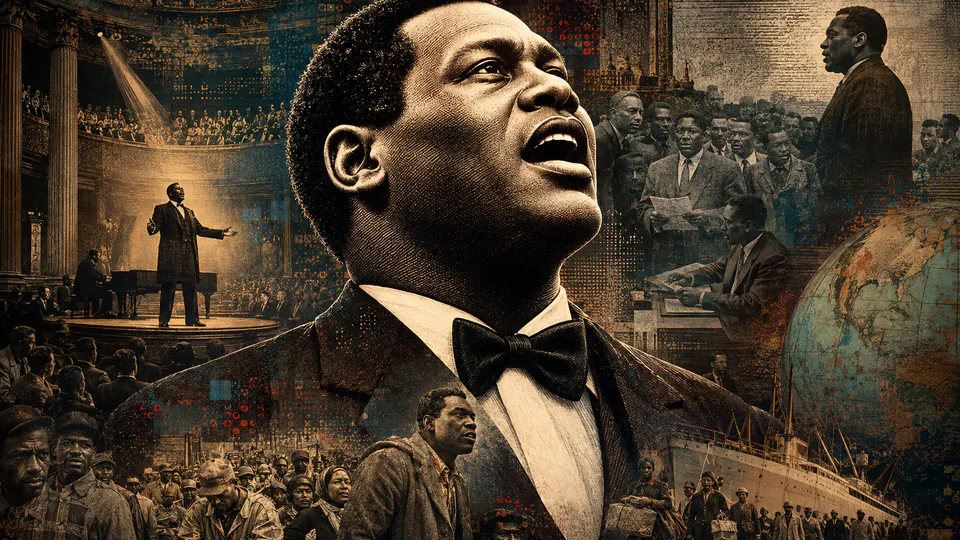
#storyOn September 4, 1949, an estimated 20,000 people climbed a hillside outside Peekskill, New York to hear Paul Robeson sing, eight days after a mob had blocked the same concert before it could start. This time the concert went ahead, and Robeson performed without incident. Then the crowd tried to drive home. Rioters lined the road out of the grounds and threw rocks through car windows as police stood by, and between the two riots, more than 140 people were hurt. Less than a year later, the United States government took Robeson’s passport. He would not get it back for eight years.
The man the country was working this hard to silence was, by any plain measure, one of its own success stories. Paul Robeson was a Rutgers valedictorian, a two-time All-American football player, a Columbia-trained lawyer, and the actor who still holds the record for the longest run of a Shakespeare play on Broadway. What changed was what he started saying, in public, about race, labor, and the Soviet Union.
Rutgers and Columbia
Robeson was born in Princeton, New Jersey on April 9, 1898, the youngest child of Rev. William Drew Robeson, who had escaped slavery in his teens, and Maria Louisa Bustill Robeson. He entered Rutgers College as the third Black student in the school’s history, and in 1919 he graduated its valedictorian, twice named an All-American in football, and inducted into Phi Beta Kappa. He earned a law degree from Columbia in 1923 and took a job at a New York firm the same year. He left that job, and the practice of law altogether, when the firm’s stenographer refused to take dictation from a Black attorney.
Broadway’s record
The theater had already claimed him; he had appeared in the Broadway revue Shuffle Along while he was still in law school. By 1943 he was famous enough to headline a production no one else had attempted: a Broadway Othello with a Black actor in the lead and a white supporting cast. The Theatre Guild’s staging, directed by Margaret Webster, opened in October 1943 and ran 296 performances, a Shakespeare record on Broadway that, per Guinness World Records, has never been matched. He was rewriting the biggest song of his career at the same time. Beginning around 1938, Robeson sang his own ending onto “Ol’ Man River” in concert: where the Show Boat script had him resigned to being tired of living and scared of dying, he swapped in a line about keeping on fighting until the day he died. Robeson kept singing the song for the rest of his career, and kept changing what it said.
Paris, April 1949
By 1949, Robeson was also one of the most prominent Americans defending the Soviet Union in public, and it caught up with him at the Paris Peace Congress that April. The Associated Press’s account of the speech, later reprinted by Smithsonian magazine, had him telling the crowd:
It is unthinkable that American Negros would go to war on behalf of those who have oppressed us for generations against the Soviet Union which in one generation has lifted our people to full human dignity.
Smithsonian’s review of the French transcript of the same speech gives a different quote:
We in America do not forget that it is on the backs of the poor whites of Europe…and on the backs of millions of black people the wealth of America has been acquired. And we are resolved that it shall be distributed in an equitable manner among all of our children and we don’t want any hysterical stupidity about our participating in a war against anybody no matter whom. We are determined to fight for peace. We do not wish to fight the Soviet Union.
The distinction mattered to no one in Washington. By the next day, editorialists and members of Congress were calling him a traitor, and the Peekskill mob followed that August.
The affidavit
The State Department moved in August 1950. It ordered Robeson to surrender his passport, and told him he could have a new one if he signed an affidavit swearing he was not a member of the Communist Party. Robeson refused, sued to get the passport back, and lost: a federal court upheld the State Department’s refusal on August 16, 1955. He never signed the affidavit, and he never publicly confirmed or denied Communist Party membership.
What he would defend, without hedging, was the Soviet Union itself. In 1952, with his American concert income already collapsing, he accepted the International Stalin Prize, the USSR’s highest civilian honor. Seton Hall historian Maxim Matusevich has argued that Robeson’s refusal to ever publicly break with Stalin was a real moral failure on his part, not a footnote to an otherwise clean record.
Before the committee
Congress got its chance to ask him about all of it on June 12, 1956, when Robeson testified before the House Un-American Activities Committee. Asked whether he had praised Stalin on a trip to Moscow, he refused the frame entirely:
Whatever has happened to Stalin, gentlemen, is a question for the Soviet Union, and I would not argue with a representative of the people who, in building America, wasted sixty to a hundred million lives of my people, black people drawn from Africa on the plantations.
Asked why he had not simply stayed in the Soviet Union, he answered:
Because my father was a slave, and my people died to build this country, and I am going to stay here, and have a part of it just like you.
When a committee counsel pressed him about defending a colleague’s patriotism, Robeson turned the question back on the room:
I say that he is as patriotic an American as there can be, and you gentlemen belong with the Alien and Sedition Acts, and you are the nonpatriots, and you are the un-Americans, and you ought to be ashamed of yourselves.
Eight years
None of it moved the State Department. By Smithsonian magazine’s accounting, Robeson’s income fell from more than $150,000 a year before the ban to less than $3,000 a year during it; the concert halls, recording studios, and international audiences that had made him wealthy were simply gone. What finally forced the government’s hand was a case that had nothing to do with him. In Kent v. Dulles, decided June 16, 1958 by a 5 to 4 vote, the Supreme Court ruled that the Secretary of State had no authority to deny an American a passport over political belief or association alone. Robeson had never been a party to that case. The ruling reached him anyway, and he got a new passport that year. He and his wife, Eslanda Robeson, left for London.
Philadelphia
The Robesons came back to the United States. By 1966 he had moved into his sister Marian Forsythe’s home in Philadelphia, where he lived until he died on January 23, 1976, at seventy-seven. His passport had been back in his hands for eighteen years by then, but the American concert bookings and record contracts that dropped him during the blacklist mostly stayed dropped. Eugene Debs went to an Atlanta cell for a wartime speech in 1918. Robeson never spent a day in an American prison for anything he said or sang, and the free speech case against him ran entirely through a passport office instead.
In their own words
#wordsWhat Paul Robeson actually said, where, and when. Each one links to the page it was checked against.
-
You are the un-Americans, and you ought to be ashamed of yourselves.
Washington, D.C., June 12, 1956, HUAC testimony, telling committee counsel Richard Arens the panel belonged "with the Alien and Sedition Acts" after being pressed on defending a colleague's patriotism. Paul Robeson, testimony before the House Un-American Activities Committee -
Because my father was a slave, and my people died to build this country, and I am going to stay here, and have a part of it just like you.
Washington, D.C., June 12, 1956, HUAC testimony, answering Rep. Gordon Scherer's question of why he did not stay in the Soviet Union. Paul Robeson, testimony before the House Un-American Activities Committee -
I invoke the Fifth Amendment.
Washington, D.C., June 12, 1956, HUAC testimony, his direct answer when asked whether he was then a member of the Communist Party. Paul Robeson, testimony before the House Un-American Activities Committee -
I accept the award, therefore, in the name and on behalf of these new millions who are moving into the organized fight for peace in our hemisphere and especially in the United States.
"Thoughts on Winning the Stalin Peace Prize," his own essay in the Daily Worker's Freedom, January 1953, on accepting the International Stalin Prize. Paul Robeson, "Thoughts on Winning the Stalin Peace Prize," Freedom (January 1953) -
I was aware that there was no starvation here, but I was not prepared for the bounding life; the feeling of safety and abundance and freedom that I find here, wherever I turn.
Moscow, quoted in the Daily Worker, January 15, 1935, on his first visit to the Soviet Union. Paul Robeson, "I Am at Home," Daily Worker (January 15, 1935)
What people get wrong
#wrong- The myth
Robeson admitted under oath that he was a member of the Communist Party. - The record
He never did. Asked directly at his June 12, 1956 HUAC hearing whether he was then a Communist Party member, Robeson answered, "I stand upon the Fifth Amendment of the American Constitution," and when pressed again, "I invoke the Fifth Amendment." He also refused the State Department's 1950 affidavit demanding he disclaim membership.
- The myth
Robeson told the 1949 Paris Peace Congress that Black Americans would never fight for the United States against the Soviet Union. - The record
That line comes from the Associated Press's account of the speech, the version that reached Washington and Peekskill. Smithsonian magazine's review of the French transcript of the same speech has him saying instead, "We are determined to fight for peace. We do not wish to fight the Soviet Union," a statement about not wanting war with the USSR, not a pledge against U.S. military service. The two accounts do not match, and the angrier one is the one that stuck.
- The myth
The Supreme Court ruled that Robeson's own passport denial was unconstitutional. - The record
Robeson was never a party to the case that freed him. Kent v. Dulles, decided 5 to 4 on June 16, 1958, was brought by the artist Rockwell Kent over his own passport denial, and the Court held that the Secretary of State had no authority to deny a passport for political belief or association alone. The State Department issued Robeson a passport later that year because the ruling reached his case, not because he had sued and won.
The dates that matter
#dates- April 9, 1898 Born in Princeton, New Jersey, the youngest child of Rev. William Drew Robeson, who had escaped slavery in his teens, and Maria Louisa Bustill Robeson.
- 1915-1919 Attends Rutgers College as the school's third Black student. Graduates in 1919 as class valedictorian, twice named an All-American in football, and inducted into Phi Beta Kappa.
- 1923 Earns a law degree from Columbia. Leaves his first and only law job, and the legal profession, after the firm's stenographer refuses to take dictation from a Black attorney.
- October 1943 to June 1944 Stars in the Theatre Guild's Broadway production of Othello, directed by Margaret Webster, for 296 performances, a still-standing record for the longest run of a Shakespeare play on Broadway.
- April 1949 Speaks at the Paris Peace Congress. The Associated Press's account of the speech, later disputed against the French transcript, ignites accusations that he said Black Americans would not fight the Soviet Union.
- August 27, 1949 A mob blocks a scheduled Robeson concert outside Peekskill, New York before it can start.
- September 4, 1949 A rescheduled Peekskill concert draws an estimated 20,000 people and proceeds without incident, but rioters attack departing cars on the road out, injuring close to 140.
- August 1950 The State Department orders Robeson to surrender his passport, offering a new one only if he signs an affidavit disclaiming Communist Party membership. He refuses.
- 1952 Accepts the International Stalin Prize, the Soviet Union's highest civilian honor, as his American concert income collapses.
- August 16, 1955 A federal court upholds the State Department's refusal to issue Robeson a new passport.
- June 12, 1956 Testifies before the House Un-American Activities Committee, telling the panel it belongs "with the Alien and Sedition Acts" and that its members "are the un-Americans."
- June 16, 1958 The Supreme Court rules 5 to 4 in Kent v. Dulles, a case Robeson was not a party to, that the State Department cannot deny a passport over political belief alone.
- 1958 Receives a new passport. He and Eslanda Robeson leave for London.
- January 23, 1976 Dies at his sister Marian Forsythe's home in Philadelphia, at age seventy-seven.
Questions people ask
#faqsWhy did the government take Paul Robeson's passport?
In August 1950 the State Department ordered Robeson to surrender his passport, following his public criticism of US Cold War policy. It told him he could have a new one if he signed an affidavit swearing he was not a member of the Communist Party, and he refused. The move followed his April 1949 Paris Peace Congress speech, which the Associated Press reported as saying Black Americans would not fight the Soviet Union, and the September 1949 Peekskill riots that targeted one of his concerts.
What did Paul Robeson say to the House Un-American Activities Committee?
Testifying on June 12, 1956, Robeson told the committee, "you gentlemen belong with the Alien and Sedition Acts, and you are the nonpatriots, and you are the un-Americans, and you ought to be ashamed of yourselves." Asked why he had not stayed in the Soviet Union, he answered, "Because my father was a slave, and my people died to build this country, and I am going to stay here, and have a part of it just like you."
What happened at the Peekskill riots?
On August 27, 1949, a mob blocked a scheduled Robeson concert near Peekskill, New York before it could start. A rescheduled concert on September 4 drew an estimated 20,000 people and went ahead without incident, but rioters lined the road out of the grounds and attacked departing cars, and close to 140 people were hurt.
Was Paul Robeson a member of the Communist Party?
He never publicly confirmed or denied it, and he refused to answer the question directly at his 1956 HUAC hearing. He did publicly and repeatedly defend the Soviet Union, and in 1952 he accepted the International Stalin Prize, the USSR's highest civilian honor, at the height of his American blacklisting.
How did Paul Robeson die?
He died on January 23, 1976, at his sister Marian Forsythe's home in Philadelphia, at age seventy-seven. His passport had been restored in 1958, but the American concert bookings and recording contracts lost during the blacklist mostly never came back.
The bookshelf
#bookshelfWhere to go next. Buy from an independent bookstore, or find it at your library for nothing.
-
Here I Stand Paul Robeson, with Lloyd L. Brown, 1958 primary
His own manifesto and memoir, written in 1958 while the blacklist held; the 1988 edition is the one in print.
-
Paul Robeson Speaks: Writings, Speeches, Interviews, 1918-1974 Paul Robeson, edited by Philip S. Foner, 1978 primary
His essays, speeches, and interviews from 1918 to 1974, collected in one volume.
-
Paul Robeson: A Biography Martin Duberman, 2005 secondary
The standard modern biography, built on Robeson's FBI file and the family papers.
Wear it: Paul Robeson
#merchEvery design here links back to this page.
Sources
#sourcesPrimary sources
The documents themselves: laws, court opinions, speeches, letters, and the numbers from the agencies that count them.
- Paul Robeson, testimony before the House Un-American Activities Committee (June 12, 1956) (verbatim exchanges, including the un-Americans and Alien and Sedition Acts statements)
- Paul Robeson, "Thoughts on Winning the Stalin Peace Prize," Freedom (January 1953)
- Paul Robeson, "I Am at Home," Daily Worker (January 15, 1935)
Secondary sources
Written afterward, about the story.
- Guinness World Records, "Longest-running Shakespeare play (Broadway)"
- Smithsonian Magazine, "What Paul Robeson Said" (AP account of the Paris speech versus the French transcript; income figures)
- TIME, "Seizing Their Passports Only Makes Activists More Determined" (passport revocation and restoration)
- Wikipedia, "Peekskill riots"
- Wikipedia, "Kent v. Dulles"
- Wikipedia, "Paul Robeson"
- Rutgers University, "About Paul Robeson"
- Paul Robeson House and Museum, "Paul Leroy Robeson" (father's biography, the stenographer incident, death in Philadelphia)
- Wikipedia, "Ol' Man River" (Robeson's rewritten concert lyrics)
- Maxim Matusevich, "Paul Robeson's Tragic Love of Russia," Seton Hall University
- Zinn Education Project, "Aug. 16, 1955: Paul Robeson Lost Court Appeal"