Published
Angela Davis
Angela Davis: Fired From UCLA, Hunted by the FBI, Acquitted on All Charges
Born January 26, 1944
Angela Davis was forced out of UCLA over her politics, put on the FBI's Ten Most Wanted list in 1970, and acquitted of every charge on June 4, 1972. The sourced record.
The story
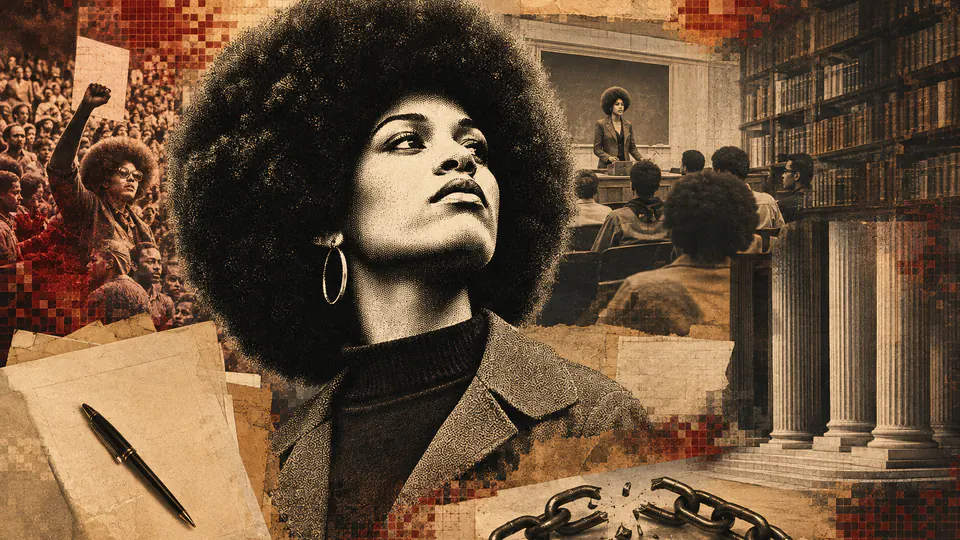
#storyFor two months in 1970 the FBI’s Ten Most Wanted Fugitives list carried the name of a philosophy professor. Angela Yvonne Davis went on it on August 18, at twenty-six, over a courtroom shooting in San Rafael, California, and the poster told anyone who found her that she should be considered armed and dangerous. Agents arrested her on October 13 at a Howard Johnson Motor Lodge in New York City. The Harvard Crimson reported the next morning that she was “unarmed and offered no resistance.”
She was held sixteen months. On June 4, 1972, an all-white jury acquitted her of murder, kidnapping, and conspiracy, all three counts, after thirteen hours of deliberation. She has spent the fifty-four years since teaching, writing, and arguing that prisons are a political question, and she is now Distinguished Professor Emerita at UC Santa Cruz.
Birmingham, on the hill they kept bombing
Davis was born in Birmingham on January 26, 1944, the oldest of four. Her father ran a service station and had briefly taught school; her mother was a schoolteacher. When Angela was four the family moved out of the all-Black projects into a white neighborhood, and white supremacists firebombed the houses around them often enough that the district got a name: Dynamite Hill.
She left the South at fifteen, in 1959, on a scholarship to Elizabeth Irwin High School in New York, then went to Brandeis and took a degree in French literature magna cum laude in 1965. She spent her junior year at the University of Paris, and she was abroad when word came that four girls had been killed in the bombing of Birmingham’s Sixteenth Street Baptist Church in 1963. They were friends of her family.
Graduate philosophy took her to Frankfurt to study under Theodor Adorno and back to the United States in 1967 to work under Herbert Marcuse at UC San Diego. She joined the Communist Party in 1968 and its all-Black Los Angeles branch, the Che-Lumumba Club, and worked with the Black Panther Party in Los Angeles running political education.
The Regents voted her out twice in one year
The UCLA philosophy department hired her as an acting assistant professor in 1969. By UCLA’s own account, the University of California Board of Regents, urged on by Governor Ronald Reagan, tried to fire her over her Communist Party membership before she had taught a single class. Faculty, staff, and students protested, a lawsuit followed, and Superior Court judge Jerry Pacht ruled the firing unconstitutional. Her opening lecture on October 6, 1969 had to be moved into Royce Hall to hold the more than 2,000 people who came, and a request to put television cameras in the room was refused. She taught three courses that year.
The Regents came back in June 1970 and refused to renew her appointment, this time over what she had said in public rather than what card she carried, which moved the case onto free speech ground. The Encyclopedia of Alabama records the stated reason as unprofessional conduct connected to her defense of the Soledad Brothers. Nine months, two votes, and in between them a lecture hall with 2,000 people in it.
August 7, 1970
Seventeen-year-old Jonathan Jackson walked into a Marin County courtroom in San Rafael carrying three guns registered to Davis. James McClain was on trial there for stabbing a prison guard, with Judge Harold Haley presiding. Jackson armed McClain and two San Quentin prisoners, Ruchell Magee and William Christmas, and the group took Haley, deputy district attorney Gary Thomas, and three jurors hostage and walked them out to a van.
In the shooting that followed, Haley, Jackson, McClain, and Christmas were killed. Thomas was paralyzed by a bullet through the spine. Magee was wounded and survived. Jonathan Jackson’s older brother George was one of the Soledad Brothers, and his release was the demand.
California charged Davis with murder, kidnapping, and conspiracy, on the theory that the guns were hers. She said she had no knowledge of the planning. A federal warrant issued on August 14, and four days later J. Edgar Hoover put her on the Ten Most Wanted list, the third woman ever to appear on it. When she was arrested in October, President Nixon congratulated the FBI on its “capture of the dangerous terrorist, Angela Davis.”
What she wrote from the cell
At her arraignment in the Marin County courthouse on January 5, 1971, Davis declared herself innocent of all charges and called the case a political frame-up. California granted no bond in a capital case where the court held the presumption of guilt to be great, so she stayed in.
She used the time. In May 1971, from the Marin County Jail, she wrote the essay Political Prisoners, Prisons, and Black Liberation, published that year in the collection If They Come in the Morning. It sets out the argument she has worked on ever since:
The prison is a key component of the state’s coercive apparatus, the overriding function of which is to ensure social control.
And on what makes a prisoner political:
The political prisoner’s words or deeds have in one form or another embodied political protests against the established order and have consequently brought him into acute conflict with the state.
Free Angela
The campaign around her got very large very fast. More than 200 local committees in the United States and 67 abroad were working for her release by February 1971. Her defense eventually cost an estimated half a million dollars. In East Germany the state ran a postcard drive from 1970 to 1972 under the slogan “A million roses for Angela,” and after the acquittal the GDR received her as a state guest.
Aretha Franklin told Jet she intended to post the bond herself:
Angela Davis must go free. Black people will be free. I’ve been locked up (for disturbing the peace in Detroit) and I know you got to disturb the peace when you can’t get no peace.
John Lennon and Yoko Ono put a song called “Angela” on Some Time in New York City in 1972. The Rolling Stones put “Sweet Black Angel” on Exile on Main St. the same year.
None of it could buy her out while the charge stayed capital. What opened the door was a ruling in a different case entirely. On February 18, 1972, the California Supreme Court held in People v. Anderson that the death penalty violated the state constitution’s ban on cruel or unusual punishment. Time’s reporter explained the mechanics in two sentences:
Then two weeks ago, the death penalty was declared unconstitutional in California. With the case therefore no longer potentially involving capital punishment, her release became possible.
Bail came to $102,500. A thirty-three-year-old white farmer named Rodger McAfee put up 405 acres of his family’s cooperative farm near Fresno to cover $100,000 of it, and the National United Committee to Free Angela Davis covered the rest in cash and bondsman’s fees. McAfee told Time, “I’m just a working man who agrees with the philosophy of Angela Davis.” Davis walked out five days before the trial opened and said this:
This has been a true victory, a people’s victory,not only my release but the abolition of capital punishment.
The trial, February 28 to June 4, 1972
Jury selection began on February 28 before Judge Richard E. Arnason, and the jury seated was all white. Prosecutor Albert Harris told them the state would prove motive, means, opportunity, and consciousness of guilt, and he put the motive in personal terms:
her basic motive was not to free political prisoners, but to free the one prisoner that she loved.
The prisoner he meant was George Jackson, and by the time the jury heard that theory, Jackson was dead: he had been shot to death at San Quentin in what officials described as an escape attempt, six months before the trial opened. Davis delivered her own opening address, and her answer to the state’s theory of that day ran to one sentence:
The evidence will show that there’s absolutely no credible proof of what the precise purpose of August 7 was.
The jury took thirteen hours across three days and came back not guilty on murder, not guilty on kidnapping, not guilty on conspiracy.
Fifty years of the same argument
San Francisco State hired her; she taught there through the 1980s. She ran for vice president on the Communist Party ticket with Gus Hall in 1980 and again in 1984, sixty years after Eugene Debs made his last run for president as a socialist. She left the CPUSA in 1991 and helped start the Committees of Correspondence. That same year UC Santa Cruz hired her, and she taught there in History of Consciousness and Feminist Studies until 2008.
Toni Morrison, then an editor at Random House, brought Angela Davis: An Autobiography into print in 1974. Morrison later described the job as something wider than editing:
Working with Angela was sui generis, and I didn’t just edit her book. I went on her book tour with her; I was her handler
Women, Race and Class and Blues Legacies and Black Feminism followed, and Seven Stories Press published Are Prisons Obsolete? in 2003. In 1997 she helped found Critical Resistance, whose first conference, held in Berkeley in September 1998 under the title Beyond the Prison Industrial Complex, drew more than 3,500 people to nearly 200 panels and workshops.
The University of California hands out a title called Regents’ Lecturer. In the spring of 2014, forty-five years after the Regents tried to get her out of a UCLA classroom, UCLA brought Angela Davis back to teach a graduate seminar in gender studies as one, and she gave the public lecture on May 8.
In their own words
#wordsWhat Angela Davis actually said, where, and when. Each one links to the page it was checked against.
-
The prison is a key component of the state's coercive apparatus, the overriding function of which is to ensure social control.
In "Political Prisoners, Prisons, and Black Liberation," written from the Marin County Jail, May 1971. Angela Y. Davis, "Political Prisoners, Prisons, and Black Liberation" (May 1971), reprinted in Viewpoint Magazine -
The political prisoner's words or deeds have in one form or another embodied political protests against the established order and have consequently brought him into acute conflict with the state.
In the same May 1971 jail essay, defining what makes a prisoner political. Angela Y. Davis, "Political Prisoners, Prisons, and Black Liberation" (May 1971), reprinted in Viewpoint Magazine -
The vicious circle linking poverty, police courts, and prison is an integral element of ghetto existence.
In the same May 1971 jail essay, on the relationship between poverty and incarceration. Angela Y. Davis, "Political Prisoners, Prisons, and Black Liberation" (May 1971), reprinted in Viewpoint Magazine -
At stake has been the collective welfare and survival of a people. There is a distinct and qualitative difference between one breaking a law for one’s own individual self-interest and violating it in the interests of a class or a people whose oppression is expressed either directly or indirectly through that particular law.
In the same May 1971 jail essay, distinguishing an ordinary offense from a political one. Angela Y. Davis, "Political Prisoners, Prisons, and Black Liberation" (May 1971), reprinted in Viewpoint Magazine -
This has been a true victory, a people's victory, not only my release but the abolition of capital punishment.
On walking out of the Santa Clara County jail on bail, five days before her trial opened, February 1972. "Trials: Freed Angela," Time (March 6, 1972)
What people get wrong
#wrong- The myth
Angela Davis was convicted in the courthouse-shooting case. - The record
A jury in San Jose acquitted her on all three counts, murder, kidnapping, and conspiracy, on June 4, 1972, after thirteen hours of deliberation across three days. The jury was all white.
- The myth
Davis was in the courtroom, or fired a weapon, during the August 7, 1970 attack. - The record
She was not present. She was charged on the theory that the three guns Jonathan Jackson carried into the Marin County courtroom were registered in her name. She said she had no knowledge of the plan, and the jury agreed.
- The myth
Angela Davis has stayed a member of the Communist Party throughout her career. - The record
She joined the Communist Party in 1968 and ran for vice president on its ticket in 1980 and 1984, but left the CPUSA in 1991 and helped start the Committees of Correspondence.
- The myth
Davis's prison-abolition work is a recent turn, distinct from her 1970s notoriety. - The record
She was arguing for abolishing the prison system's political function while still in the Marin County Jail in May 1971, and helped found Critical Resistance in 1997, whose first conference in September 1998 drew more than 3,500 people. The throughline runs the length of her public life.
The dates that matter
#dates- January 26, 1944 Born in Birmingham, Alabama, the oldest of four children of a service station owner and a schoolteacher.
- 1965 Graduates Brandeis magna cum laude in French literature, having spent her junior year at the University of Paris.
- 1968 Joins the Communist Party and its all-Black Los Angeles branch, the Che-Lumumba Club.
- September 1969 The UC Regents move to fire her from UCLA over her Communist Party membership before she teaches a class. A court blocks it.
- October 6, 1969 Her opening lecture is moved to Royce Hall for a crowd of more than 2,000.
- June 1970 The Regents refuse to renew her appointment, this time over her public speeches.
- August 7, 1970 Jonathan Jackson takes hostages from a Marin County courtroom with three guns registered to Davis. Judge Harold Haley, Jackson, and two prisoners are killed.
- August 18, 1970 The FBI adds her to its Ten Most Wanted Fugitives list, the third woman ever listed.
- October 13, 1970 Arrested at a Howard Johnson Motor Lodge in New York City, unarmed.
- May 1971 Writes Political Prisoners, Prisons, and Black Liberation from the Marin County Jail.
- February 1972 Released on $102,500 bail, five days before trial, after the California Supreme Court struck down the state's death penalty.
- June 4, 1972 Acquitted on all three counts by an all-white jury after thirteen hours of deliberation.
- September 1998 Critical Resistance, which she helped found the year before, holds its first conference in Berkeley for more than 3,500 people.
- Spring 2014 Returns to UCLA as a Regents' Lecturer, forty-five years after the Regents tried to fire her.
Questions people ask
#faqsWho is Angela Davis?
Angela Yvonne Davis, born January 26, 1944 in Birmingham, Alabama, is an American philosopher, author, and prison abolition scholar. She taught at UCLA in 1969-70, was tried and acquitted in 1972 on charges arising from a California courthouse shooting, taught at San Francisco State University and then at UC Santa Cruz from 1991 to 2008, and is Distinguished Professor Emerita there.
What was Angela Davis charged with?
Murder, kidnapping, and conspiracy, in connection with the August 7, 1970 attempt to take hostages from a Marin County courtroom in San Rafael, California. Three guns registered in her name were used. She said she had no knowledge of the plan.
Was Angela Davis convicted?
No. A jury in San Jose acquitted her on all three counts on June 4, 1972, after thirteen hours of deliberation across three days. The jury was all white.
Why was Angela Davis fired from UCLA?
Twice, for her politics. In September 1969 the University of California Board of Regents, at Governor Ronald Reagan's urging, moved to fire her over her Communist Party membership before she had taught a class, and a court blocked it. In June 1970 the Regents refused to renew her appointment, this time over her public speeches.
What is Angela Davis known for besides the trial?
Prison abolition. She helped found Critical Resistance in 1997, whose September 1998 Berkeley conference drew more than 3,500 people, and wrote Are Prisons Obsolete? (Seven Stories Press, 2003). Her earlier books include Angela Davis: An Autobiography (1974), edited by Toni Morrison, and Women, Race and Class.
The bookshelf
#bookshelfWhere to go next. Buy from an independent bookstore, or find it at your library for nothing.
-
Angela Davis: An Autobiography Angela Y. Davis, 1974 primary
Her own account, edited by Toni Morrison, ending at the acquittal.
-
Are Prisons Obsolete? Angela Y. Davis, 2003 primary
The short, direct case for abolition that grew out of the argument she started writing in a jail cell.
-
The Angela Y. Davis Reader edited by Joy James, 1998 secondary
Her essays and speeches collected with scholarly introductions, useful for the arc between the trial and the professorship.
Wear it: Angela Davis
#merchEvery design here links back to this page.
Sources
#sourcesPrimary sources
The documents themselves: laws, court opinions, speeches, letters, and the numbers from the agencies that count them.
- Angela Y. Davis, "Political Prisoners, Prisons, and Black Liberation" (Marin County Jail, May 1971), reprinted in Viewpoint Magazine (the essay she wrote from her cell; source of both quotations from her writing)
- National Archives, "Angela Davis (January 26, 1944)" (the charges, the FBI listing, sixteen months in custody, the all-white jury)
- "Trials: Freed Angela," Time (March 6, 1972) (contemporary report on the bail: the amount, McAfee's acreage, and why the death-penalty ruling made release possible)
- People v. Anderson, 6 Cal.3d 628 (February 18, 1972) (the California Supreme Court decision that ended the state's death penalty)
- "Angela Davis Arrested in N. Y.; Was On Ten Most Wanted List," The Harvard Crimson (October 14, 1970) (next-morning account of the arrest; source of the unarmed quotation)
- Critical Resistance, "History of Critical Resistance" (founded 1997; the September 1998 Berkeley conference and its attendance)
- Aretha Franklin, interview in Jet (1970), quoted in HuffPost, "Aretha Franklin Offered To Post Angela Davis' Bail In 1970"
- UC Santa Cruz, "Toni Morrison and Angela Davis on friendship and creativity" (October 2014) (Morrison's account of editing the 1974 autobiography)
- UC Santa Cruz campus directory, "Angela Y. Davis" (her current title and the list of her books)
Secondary sources
Written afterward, about the story.
- "Angela Davis Trial: 1972," Great American Trials (Encyclopedia.com) (Judge Arnason, prosecutor Albert Harris, and both opening addresses verbatim)
- HISTORY, "How Angela Davis Ended Up on the FBI Most Wanted List" (the poster language, the Nixon remark, the defense costs)
- Encyclopedia of Alabama, "Angela Davis" (Birmingham, Dynamite Hill, the family's connection to the 1963 church bombing, her education)
- UCLA Newsroom, "Angela Davis returns to UCLA classroom 45 years after controversy" (UCLA's own account of the firing, the Royce Hall lecture, and her 2014 return)
- Kunsthalle im Lipsiusbau, Staatliche Kunstsammlungen Dresden, "A Million Roses for Angela Davis" (the East German postcard campaign of 1970-72 and her reception as a state guest)
- Wikipedia, "Angela Davis" and "Marin County Civic Center attacks" (the courthouse sequence; also the source for the Che-Lumumba Club, the count of Free Angela committees, the two 1972 songs, and the 1980-2008 career dates)