Published
Elizabeth Gurley Flynn
Elizabeth Gurley Flynn: The Rebel Girl Who Got a State Funeral in Moscow
Born August 7, 1890. Died September 5, 1964
Elizabeth Gurley Flynn was an IWW orator at sixteen, inspired Joe Hill's 'Rebel Girl,' served Smith Act prison time, and died in Moscow with a state funeral
The story
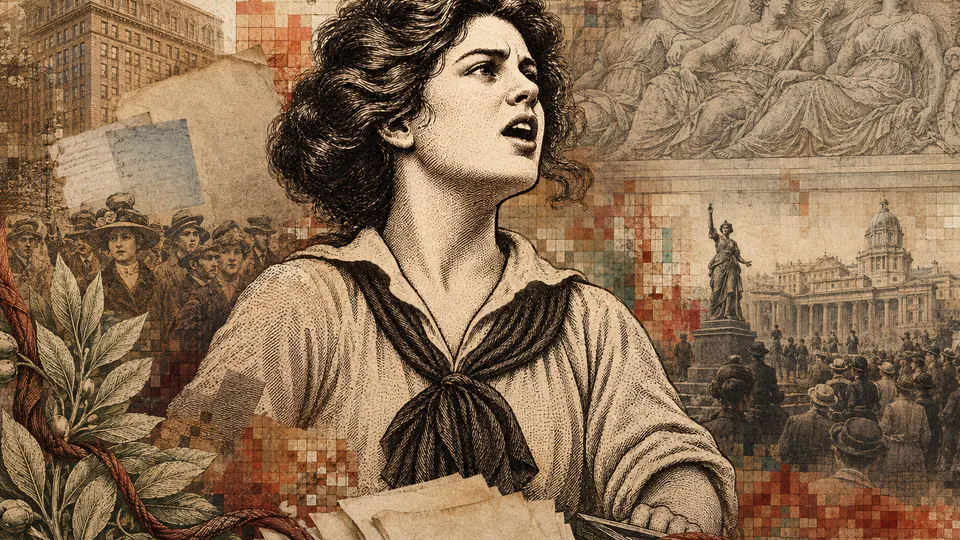
#storyElizabeth Gurley Flynn arrived in Lawrence, Massachusetts in January 1912, twenty-one years old and already five years into full-time organizing for the Industrial Workers of the World, to help lead the strike that put bread and roses into the vocabulary of the American left. She was already one of the union’s best-known speakers. Over the next fifty-two years she would have a song written for her, co-found a civil liberties organization that later expelled her, serve federal time for her politics, chair the Communist Party USA, and die in Moscow with a state funeral in Red Square. To see how a New Hampshire teenager got to that platform in Lawrence, start with the soapbox.
The soapbox at sixteen
Flynn was born August 7, 1890, in Concord, New Hampshire, to Irish immigrant parents who raised her on stories of Ireland’s independence fight; the family moved to the Bronx in 1900. At fifteen she gave her first public speech, “What Socialism Will Do for Women,” to the Harlem Socialist Club. The next year she was speaking from a soapbox on New York street corners, got arrested for it, and left high school before graduating over the same activism. By 1907, still a teenager, she was a full-time IWW organizer, touring the country to speak to restaurant workers, garment workers, and miners the AFL’s craft unions had no interest in signing up.
Missoula and Spokane
Before Lawrence, the IWW sent Flynn into the free speech fights of 1909 and 1910, where the union’s tactic was to fill a city with soapbox speakers until the jails ran out of room. She helped win Missoula, Montana that way in October 1909, then moved on to Spokane, Washington, where hundreds of Wobblies filled the jail that winter. In a December 1909 dispatch for the International Socialist Review, Flynn documented what she found inside: men “herded twenty-eight to thirty at a time in a 6 x 8 cell known as the sweat box,” steam turned on until they were ready to collapse, then locked into an ice-cold cell afterward. Spokane granted the IWW the right to hold street meetings that March.
Lawrence, 1912
The full story of the Bread and Roses strike, and the slogan it left behind, lives at causes/bread-and-roses. Flynn’s part in it was to arrive with Big Bill Haywood and fellow organizer Carlo Tresca and help run the relief effort that kept thousands of immigrant strikers fed through a Massachusetts winter, a strike committee that had to work in more languages than any single organizer spoke. Writing decades later, in a 1939 essay recalling three decades of May Days, Flynn remembered the Lawrence and Lowell mills that year mainly by one image: “Big Bill Haywood in the Syrian Hall,” one of the immigrant meeting halls the strike used to reach workers no English-only leaflet could.
Paterson, and the truth about it
The following year Flynn organized in Paterson, New Jersey, where roughly 25,000 silk workers walked out from February to July 1913 over the mills’ push to a four-loom system that would have cut jobs and sped up the survivors. The strike ended without its demands met, and a year later, on January 31, 1914, Flynn stood before the New York Civic Club Forum to defend the IWW’s record and admitted up front that she was not a neutral witness:
It is rather difficult for me to separate myself from my feelings about the Paterson strike, to speak dispassionately.
She was blunt about what the union actually offered strikers, and what it did not:
We have certain general principles; their application differs as the people, the industry, the time and the place indicate.
And she measured the strike’s failure against a different scale than a signed contract:
What is a labor victory? I maintain that it is a twofold thing. Workers must gain economic advantage, but they must also gain revolutionary spirit, in order to achieve a complete victory. For workers to gain a few cents more a day, a few minutes less a day, and go back to work with the same psychology, the same attitude toward society is to have achieved a temporary gain and not a lasting victory.
Joe Hill’s song
In 1915, IWW songwriter Joe Hill, awaiting execution in a Salt Lake City jail on a murder conviction, wrote The Rebel Girl and dedicated it to Flynn. She confirmed the dedication in her own later writing; her 1955 autobiography carried the nickname as its subtitle, and her full 1973 autobiography took the title outright. That fall she went to Washington and got as far as Woodrow Wilson’s private secretary, Joseph Tumulty, pressing for clemency. Hill was executed by firing squad on November 19, 1915. The rest of his story, and the telegram he sent from his cell, is at figures/joe-hill.
The ACLU cofounds her, then expels her
In 1920 Flynn was among the founders of the American Civil Liberties Union. In 1937 she joined the Communist Party USA. By 1940 the ACLU’s board had adopted what it called the 1940 Resolution, barring from its governing committees or staff anyone “who is a member of any political organization which supports totalitarian dictatorship in any country,” language written with Communists specifically in mind. That May the board applied it to Flynn and voted, by a single vote, to expel her, a decision the ACLU’s own history now names as one of the times the organization violated the free-association principle it exists to defend. The reversal took 36 years. In 1976, the national board voted to rescind the expulsion.
The Smith Act
In June 1951, federal agents arrested Flynn in a second wave of Communist Party prosecutions under the Smith Act, which made it a crime to advocate the violent overthrow of the government. She was convicted after a nine-month trial and sentenced to three years, entering the federal prison at Alderson, West Virginia in January 1955 and walking out in May 1957. Of the sentence, TIME magazine later reported, she said:
I had no reason to reform, repent or recant, so I just reduced.
A passport, then Moscow
In 1961, four years out of Alderson, Flynn became the first woman elected national chair of the Communist Party USA. The federal government had been refusing her a passport under a Cold War statute barring Communists from foreign travel. She sued, and on June 22, 1964, the Supreme Court ruled in her favor in Aptheker v. Secretary of State, holding the travel ban unconstitutional under the Fifth Amendment. Two months later, seventy-four years old and free to travel again, she went to the Soviet Union as a guest of the Soviet government. She died in Moscow on September 5, 1964, of what TIME’s contemporary report described as a clot in the lung artery.
A funeral on two continents
The Soviet state gave her the send-off of a head of state. Her body lay in Moscow’s Hall of Columns before a procession through Red Square reported at more than 25,000 people, with Nikita Khrushchev among the mourners. Her ashes were then split: part interred at the foot of the Kremlin Wall, near where a portion of Big Bill Haywood’s ashes had gone when he died in Moscow in 1928, and the rest flown home to Forest Home Cemetery outside Chicago, the same ground that holds the Haymarket martyrs’ monument and the remainder of Haywood’s own ashes. The teenager who once got herself arrested for talking on a street corner ended up with a grave in two capitals.
In their own words
#wordsWhat Elizabeth Gurley Flynn actually said, where, and when. Each one links to the page it was checked against.
-
Workers must gain economic advantage, but they must also gain revolutionary spirit, in order to achieve a complete victory. For workers to gain a few cents more a day, a few minutes less a day, and go back to work with the same psychology, the same attitude toward society is to have achieved a temporary gain and not a lasting victory.
Defending the IWW's record in the 1913 Paterson silk strike, address to the New York Civic Club Forum, January 31, 1914. Elizabeth Gurley Flynn, "The Truth About the Paterson Strike," address to the New York Civic Club Forum (January 31, 1914) -
Sufficient to say, that the boys have been herded twenty-eight to thirty at a time in a 6 x 8 cell known as the sweat box.
Reporting on jail conditions for arrested IWW members during the Spokane free speech fight, International Socialist Review, December 1909. Elizabeth Gurley Flynn, "The Free Speech Fight at Spokane," International Socialist Review, vol. 10, no. 6 (December 1909) -
I can see Big Bill Haywood in the Syrian Hall in Lawrence surrounded by workers. Smoking their strange pipe, which stood on the floor, the smoke cooled through a fancy water bowl, decorated in spring flowers in honor of Bill.
Recalling the May Day celebration after the 1912 Lawrence textile strike, in a 1939 essay looking back on three decades of May Days. Elizabeth Gurley Flynn, "Mine Eyes Have Seen the Glory," May Day (1939) -
I had no reason to reform, repent or recant, so I just reduced.
On her release from the federal prison at Alderson, West Virginia in May 1957, quoted in TIME's report on her death and career. TIME, "End of the Rebel Girl" (September 18, 1964)
What people get wrong
#wrong- The myth
The ACLU expelled Flynn in 1940 for disloyalty or un-American conduct. - The record
The board's 1940 Resolution barred officers who belonged to "any political organization which supports totalitarian dictatorship," language aimed at Communist Party members, and the board applied it to Flynn by a single vote. The ACLU's own history now calls the expulsion a violation of the free-association principle it exists to defend. The national board rescinded it in 1976.
- The myth
All of Flynn's ashes stayed in the Soviet Union after her Moscow funeral. - The record
TIME's contemporary report says her ashes were placed briefly at the foot of the Kremlin Wall during the state funeral, then were flown to the United States and buried in Chicago's Waldheim Cemetery, now Forest Home Cemetery, beside other IWW and Communist Party dead.
- The myth
Joe Hill's song "The Rebel Girl" and his letters to Flynn describe a romance between them. - The record
In his farewell letter from Utah State Prison, dated September 30, 1915, Hill drew the line himself: "I would like to kiss you good-bye Gurley, not because you are a girl but because you are the original Rebel Girl." He was saluting an organizer.
The dates that matter
#dates- August 7, 1890 Born in Concord, New Hampshire, to Irish immigrant parents; the family moves to the Bronx in 1900.
- 1906 Gives her first speech, "What Socialism Will Do for Women," at fifteen, then is arrested that summer for street-corner organizing and leaves high school before graduating.
- 1907 Becomes a full-time organizer for the Industrial Workers of the World.
- 1909-1910 Takes part in the IWW free speech fights in Missoula, Montana and Spokane, Washington, and is jailed in both.
- 1912 Arrives in Lawrence, Massachusetts with Bill Haywood and Carlo Tresca to help lead the Bread and Roses textile strike.
- 1913 Organizes alongside the Paterson, New Jersey silk strike.
- January 31, 1914 Delivers "The Truth About the Paterson Strike" to the New York Civic Club Forum.
- 1915 Joe Hill dedicates The Rebel Girl to her; she appeals to the Wilson administration for his clemency before his execution on November 19.
- 1920 Co-founds the American Civil Liberties Union.
- 1937 Joins the Communist Party USA; the ACLU's board expels her from its governing committee for that membership in May 1940.
- 1951-1957 Arrested under the Smith Act in June 1951, convicted after a nine-month trial, and imprisoned at Alderson, West Virginia from January 1955 to May 1957.
- 1961 Becomes the first woman to chair the Communist Party USA.
- 1964 Wins her Supreme Court case, Aptheker v. Secretary of State, on June 22, then dies in Moscow on September 5.
- 1976 The ACLU posthumously rescinds her 1940 expulsion.
Questions people ask
#faqsWho was Elizabeth Gurley Flynn?
Elizabeth Gurley Flynn (1890-1964) was an American labor organizer who joined the Industrial Workers of the World as a teenager, helped lead the 1912 Lawrence and 1913 Paterson strikes, co-founded the American Civil Liberties Union in 1920, joined the Communist Party in 1937, and became its first woman national chair in 1961.
Why is Elizabeth Gurley Flynn called the Rebel Girl?
IWW songwriter Joe Hill wrote and dedicated the 1915 song The Rebel Girl to Flynn while he sat in a Salt Lake City jail awaiting execution. Flynn confirmed the dedication in her own writing; her 1955 autobiography carried the nickname as its subtitle, and her full 1973 autobiography took The Rebel Girl as its title outright.
Was Elizabeth Gurley Flynn a communist?
Yes. She joined the Communist Party USA in 1937, sat on its national committee, and in 1961 became the first woman elected the party's national chair, a position she held until her death in 1964.
Why was Elizabeth Gurley Flynn in prison?
She was arrested in June 1951 in a second wave of prosecutions under the Smith Act, which criminalized advocating the violent overthrow of the government. Convicted after a nine-month trial, she served from January 1955 to May 1957 at the federal prison in Alderson, West Virginia.
Where is Elizabeth Gurley Flynn buried?
Her ashes were divided. Part was placed at the foot of the Kremlin Wall in Moscow after her September 1964 state funeral, and part was flown to Forest Home Cemetery outside Chicago, the same cemetery where the Haymarket martyrs are buried.
The bookshelf
#bookshelfWhere to go next. Buy from an independent bookstore, or find it at your library for nothing.
-
The Rebel Girl: An Autobiography, My First Life (1906-1926) Elizabeth Gurley Flynn, 1973 primary
Her own account, first published in 1955 as I Speak My Own Piece.
-
Words on Fire: The Life and Writing of Elizabeth Gurley Flynn Rosalyn Fraad Baxandall, 1987 secondary
A biography built around her own essays and speeches, much of it hard to find elsewhere.
-
Elizabeth Gurley Flynn: Modern American Revolutionary Lara Vapnek, 2015 secondary
The full life, from the soapbox to the Communist Party chairmanship.
Wear it: Elizabeth Gurley Flynn
#merchEvery design here links back to this page.
Sources
#sourcesPrimary sources
The documents themselves: laws, court opinions, speeches, letters, and the numbers from the agencies that count them.
- Elizabeth Gurley Flynn, "The Truth About the Paterson Strike," address to the New York Civic Club Forum (January 31, 1914) (her own account of the 1913 Paterson strike, verbatim)
- Elizabeth Gurley Flynn, "The Free Speech Fight at Spokane," International Socialist Review, vol. 10, no. 6 (December 1909) (her contemporary dispatch on jail conditions during the Spokane free speech fight)
- Elizabeth Gurley Flynn, "Mine Eyes Have Seen the Glory," May Day (1939) (her own recollection of Lawrence and Lowell in 1912)
- TIME, "End of the Rebel Girl" (September 18, 1964) (contemporary report on her death, Moscow funeral, and the disposition of her ashes)
- FindLaw, "Aptheker v. Secretary of State, 378 U.S. 500 (1964)" (the passport case naming Flynn as an appellant, decided June 22, 1964)
- Joe Hill, farewell letter to Elizabeth Gurley Flynn (September 30, 1915)
Secondary sources
Written afterward, about the story.
- American Civil Liberties Union, "The ACLU's Fifth Column?" (the ACLU's own history of the 1940 expulsion, the 1940 Resolution text, and the 1976 reversal)
- Spartacus Educational, "Elizabeth Gurley Flynn"
- Gale Encyclopedia of American Biography, "Flynn, Elizabeth Gurley (1890-1964)", via Encyclopedia.com
- Wikipedia, "The Rebel Girl (song)" (publication details of the 1915 song and Flynn's own confirmation of the dedication in her 1973 autobiography)