Published
Lucy Parsons
Lucy Parsons: The Woman Chicago Police Wanted Silent
Born 1851. Died March 7, 1942
Lucy Parsons organized in Chicago for six decades after police hanged her husband in 1887, fighting a department that wanted her off every stage.
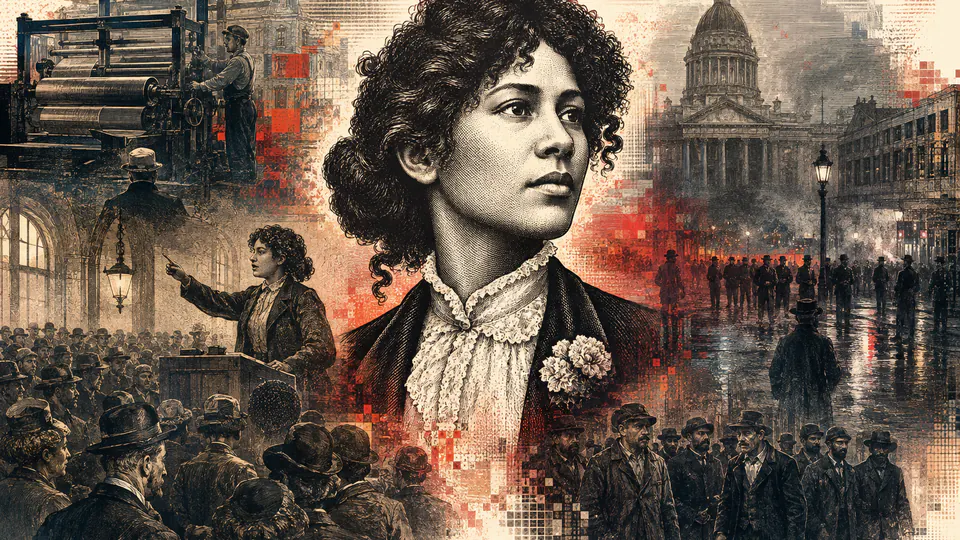
The story
#storyChicago’s police department spent decades trying to keep Lucy Parsons off a stage, and lost most of the rounds. They arrested her, closed halls that booked her, and told the press flatly that she would not be allowed to speak in the city, and she kept organizing there anyway into her eighties. She organized labor’s poor and unemployed from the 1870s until a house fire killed her in 1942, and for most of that time the record shows a police department that treated her talking in public as a problem to be solved.
A childhood she told several different ways
Almost nothing about Lucy Parsons’s early life is settled, including by her own account. The most credible modern biography, Jacqueline Jones’s Goddess of Anarchy, concludes she was born enslaved around 1851, likely in Virginia, to an enslaved mother. The Texas State Historical Association’s biography traces her to an enslaver named Dr. Thomas J. Taliaferro, who moved the family to McLennan County, Texas during the Civil War; after the war her mother, Charlotte, married a freedman named Charlie Carter, and the children took his name. Lucy worked as a seamstress and domestic servant in Waco as a young woman.
None of that is how Lucy Parsons told it. For most of her adult life she told reporters, census takers, and audiences that she was Mexican and Native American, and she denied having any Black ancestry at all, a claim her light skin made possible to sustain in public. Historians disagree about why: self-protection in a country that lynched Black radicals, a genuine belief about her own parentage, or both. The honest answer is that the record holds two different women, the one biographers have reconstructed from Texas court and census documents and the one Parsons insisted on being called, and neither account fully displaces the other.
Texas, then Chicago
Lucy married Albert Parsons, a white former Confederate soldier who had become a Reconstruction-era Republican newspaperman, in September 1872. No marriage record has surfaced; interracial couples in Texas in this period faced both legal risk and mob violence, and by 1873 the two had left for Chicago, where Albert found work as a typesetter and Lucy took in sewing. When the railroad strikes of 1877 spread to Chicago and Albert was blacklisted from print shops for his sympathies, Lucy opened her own dress shop to support the family and helped found the Working Women’s Union, organizing seamstresses and domestic workers around equal pay and suffrage.
Haymarket
By 1886 both Parsonses were prominent voices in Chicago’s anarchist movement, campaigning for the eight-hour workday. On May 1 they marched at the head of a crowd estimated at 80,000. Three days later, on May 4, someone threw a bomb into a police line breaking up a rally at Haymarket Square, killing an officer; the ensuing gunfire killed several more people, officers and civilians both. Albert and seven other men were tried for conspiracy to murder. No evidence at trial tied any of the eight to making or throwing the bomb; a jury convicted all of them anyway. (The full history of that week and the movement it created is at causes/may-day.)
Albert was hanged on November 11, 1887, alongside three co-defendants. That morning, Lucy brought their two children, Albert Jr. and Lulu, to the jail for a last visit. Police cordoning the building turned them away, then arrested all three and held them, stripped, in a cell until the execution was over.
Speaking anyway
Widowed at around thirty-six with two children, Parsons spent the following years touring and fundraising for the Haymarket defense, then built her own career as a writer and organizer that outlasted the movement that made her famous. She edited two anarchist papers of her own, Freedom in the early 1890s and later The Liberator, and kept speaking in halls across the country. Chicago’s police made a standing project of stopping her. By one detailed account of her decades under surveillance, for virtually the entirety of the last forty years of her life the department tried to bar her from making any public speech at all. The line most often attached to her, that police called her “more dangerous than a thousand rioters,” appears in dozens of later tributes and articles, but no one citing it has produced the police document, memo, or dated report it supposedly comes from. What the record does show, with names and dates attached, is arrest after arrest and hall after canceled hall, for most of her adult life.
The department’s most public defeat came in January 1915. With Chicago’s unemployment rate spiking that winter, Parsons helped lead a march of the city’s jobless demanding relief; police arrested roughly twenty marchers, Parsons among them. Jane Addams, the Hull House reformer with little else in common with Parsons politically, posted her bail. Within weeks the city had announced relief jobs, soup kitchens, and shelters.
The only woman on the floor
On June 27, 1905, Parsons was in Chicago for the founding convention of the Industrial Workers of the World, alongside Eugene Debs, Mother Jones, and Big Bill Haywood. (The convention itself, and who else was in the room, is covered at causes/iww and figures/big-bill-haywood.) She was one of only two women among roughly two hundred delegates, and by multiple later accounts the only one who addressed the floor. Speaking from the convention proceedings, she told the assembled unionists that working women were worse off than working men:
We are the slaves of slaves. We are exploited more ruthlessly than men.
She went on to argue for a tactic that would not become common practice for another three decades:
My conception of the strike of the future is not to strike and go out an [sic] starve, but to strike and remain in and take possession of the necessary property of production… .
The sit-down strikes that made her idea famous, most notably the Flint sit-down strike of 1936-37, were still thirty years away.
The last organizing
Parsons kept working into old age. By the 1920s she was active in the International Labor Defense, the Communist-aligned legal aid group that raised money and public pressure for radicals facing prosecution, and was elected to its executive committee in 1927. She had described herself as connected to the Communist Party for years before that; her biographer Carolyn Ashbaugh, drawing on interviews with people who knew her, concluded that she formally joined the party in 1939, three years before she died.
The fire
Parsons died at around ninety-one on March 7, 1942, when her house in Chicago caught fire. Her longtime companion, George Markstall, tried and failed to get her out; he died of his own injuries the next day. Within days, Chicago police searched the wreckage and took what was left of her library, several thousand books and papers on socialism, anarchism, and labor history that she had assembled across a lifetime, and turned custody of it over to the FBI. It was never catalogued publicly, never returned to her comrades who asked for it, and its whereabouts, if any of it survives, are unknown.
They never managed to keep her off a stage while she was alive. The week she died, they finally found a way: they walked into the wreckage and took the argument before anyone else could read it.
In their own words
#wordsWhat Lucy Parsons actually said, where, and when. Each one links to the page it was checked against.
-
We are the slaves of slaves. We are exploited more ruthlessly than men.
Addressing the founding convention of the Industrial Workers of the World on the condition of working women, Chicago, June 27, 1905. Minutes of the 1905 IWW Convention, Tamiment Library, New York University, transcribed for the Lucy Parsons Project by William Loren Katz -
My conception of the strike of the future is not to strike and go out an starve, but to strike and remain in and take possession of the necessary property of production. . . .
Proposing, from the floor of the same 1905 convention, the tactic later known as the sit-down strike. Minutes of the 1905 IWW Convention, Tamiment Library, New York University, transcribed for the Lucy Parsons Project by William Loren Katz -
Can you not see that it is the INDUSTRIAL SYSTEM and not the "boss" which must be changed?
From "To Tramps, the Unemployed, the Disinherited and Miserable," her open letter to Chicago's jobless in the first issue of the anarchist paper The Alarm, October 4, 1884. Lucy E. Parsons, "To Tramps, the Unemployed, the Disinherited and Miserable," The Alarm, vol. 1, no. 1 (October 4, 1884) -
Learn the use of explosives!
The closing line of "To Tramps" in The Alarm, October 4, 1884, urging armed resistance instead of petitions. Lucy E. Parsons, "To Tramps, the Unemployed, the Disinherited and Miserable," The Alarm, vol. 1, no. 1 (October 4, 1884)
What people get wrong
#wrong- The myth
Lucy Parsons was, as she herself claimed, of Mexican and Native American descent with no Black ancestry. - The record
Jacqueline Jones, working from surviving Texas court and census records, concludes she was born enslaved around 1851, likely in Virginia, to an enslaved mother, and brought to Texas as a child. Historians who have gone through the same records largely agree. Parsons held to her own version for the whole of her adult public life.
- Jacqueline Jones, Goddess of Anarchy: The Life and Times of Lucy Parsons, American Radical (Basic Books, 2017)
- Texas State Historical Association, "The Life and Legacy of Lucy Parsons"
- The myth
Lucy Parsons had a hand in the Haymarket bomb. - The record
No evidence at the 1886 trial tied any of the eight defendants, including her husband Albert, to making or throwing the bomb, and a jury convicted them anyway. Lucy herself was never charged in the case; police detained and strip-searched her only on the morning of Albert's execution, November 11, 1887.
- The myth
Workers occupying their workplace instead of walking out began with the 1930s sit-down strikes. - The record
Lucy Parsons proposed exactly that tactic, remaining inside and taking possession of the property of production rather than striking and starving, from the floor of the IWW's founding convention on June 27, 1905, three decades before the wave of sit-down strikes that made the tactic famous.
The dates that matter
#dates- c. 1851 Born, most likely enslaved, in Virginia; the exact year and her parentage are disputed, including by her own conflicting later accounts.
- 1863 Her enslaver, Dr. Thomas J. Taliaferro, moves the family to McLennan County, Texas, during the Civil War.
- September 1872 Marries Albert Parsons, a white former Confederate soldier turned Republican newspaperman, in Texas. No marriage record has ever been found.
- 1873 The couple leaves Texas for Chicago as Democrats retake the state government and their marriage draws threats.
- 1877 Albert is blacklisted from printing work after the national railroad strike that year; Lucy opens a dress shop and helps found the Working Women's Union.
- May 4, 1886 A bomb explodes at a labor rally in Chicago's Haymarket Square, three days after Albert and Lucy marched at the head of some 80,000 workers demanding the eight-hour day.
- November 11, 1887 Albert is hanged with three co-defendants. Police turn Lucy and their two children away from a final visit that morning, then arrest and strip-search all three.
- 1890-1892 Edits her own anarchist paper, Freedom, an anarchist-communist monthly.
- June 27, 1905 Addresses the founding convention of the Industrial Workers of the World in Chicago, one of two women among roughly two hundred delegates.
- January 17, 1915 Helps lead a march of Chicago's unemployed demanding relief; she is one of about twenty people arrested. Jane Addams later posts her bail.
- 1927 Elected to the executive committee of the International Labor Defense, the Communist-aligned legal aid group.
- 1939 Her biographer Carolyn Ashbaugh concludes, from interviews with contemporaries, that she formally joins the Communist Party this year, after roughly a decade and a half of informal alignment with it.
- March 7, 1942 Dies at around 91 in a house fire at her home in Chicago. Her longtime companion, George Markstall, is unable to pull her free and dies of his injuries the next day.
- March 1942 Chicago police search the ruins of the house and remove her library and papers; the FBI later takes custody of the material, which is never returned.
Questions people ask
#faqsWho was Lucy Parsons?
Lucy Parsons (c. 1851-1942) was an anarchist labor organizer, writer, and public speaker in Chicago for nearly seven decades. She rose to national attention defending her husband Albert Parsons during the Haymarket affair, and after his 1887 execution she spent the rest of her life organizing the unemployed, editing radical newspapers, and speaking, over the objections of a police department that arrested her repeatedly for it.
What happened to Lucy Parsons's husband?
Albert Parsons was one of eight men tried for conspiracy to murder after a bomb killed a Chicago police officer at a labor rally in Haymarket Square on May 4, 1886. No evidence tied any defendant to the bomb itself. He was convicted anyway and hanged on November 11, 1887, along with three co-defendants; a later Illinois governor pardoned the three men still living in 1893.
Was Lucy Parsons Black?
Almost certainly, in part. Most historians who have studied the surviving record, including her biographer Jacqueline Jones, conclude she was born enslaved in Virginia to an African-American mother and brought to Texas as a child. Parsons herself spent her adult life telling reporters and census takers she was of Mexican and Native American descent and denied any Black ancestry, a claim she maintained even as her light skin let her pass in public. Her own conflicting accounts are part of the record, not a settled biography.
What did Lucy Parsons do at the founding of the IWW?
At the Industrial Workers of the World's founding convention in Chicago in June 1905, Parsons was one of only two women among roughly two hundred delegates, and by multiple accounts the only one who addressed the floor. She told the convention that working women were 'the slaves of slaves,' argued for equal union treatment for women, and proposed that strikers occupy workplaces rather than walk out and starve, an idea later echoed by the sit-down strikes of the 1930s.
What happened to Lucy Parsons's library after she died?
Parsons died in a house fire in Chicago on March 7, 1942. Within days, Chicago police went through the wreckage and took her library, several thousand books and papers on socialism, anarchism, and radical history that she had built over a lifetime. The FBI took custody of the material afterward. It was never catalogued publicly or returned, and its location today is unknown.
The bookshelf
#bookshelfWhere to go next. Buy from an independent bookstore, or find it at your library for nothing.
-
Lucy Parsons: Freedom, Equality & Solidarity, Writings & Speeches, 1878-1937 Lucy Parsons (edited by Gale Ahrens), 2004 primary
Her own essays and speeches, gathered in one volume.
-
Goddess of Anarchy: The Life and Times of Lucy Parsons, American Radical Jacqueline Jones, 2017 secondary
The modern biography that reopened the case on her birth and early life.
-
The Haymarket Tragedy Paul Avrich, 1984 secondary
The standard scholarly account of the bombing and the trial that followed it.
Wear it: Lucy Parsons
#merchEvery design here links back to this page.

Sources
#sourcesPrimary sources
The documents themselves: laws, court opinions, speeches, letters, and the numbers from the agencies that count them.
- Proceedings of the First Convention of the Industrial Workers of the World (New York Labor News Company, 1905), pp. 167-172 (the "slaves of slaves" line, reproduced in The American Yawp Reader)
- Minutes of the 1905 IWW Convention, Tamiment Library, New York University, transcribed for the Lucy Parsons Project by William Loren Katz (the "strike of the future" line on occupying rather than striking)
- Lucy E. Parsons, "To Tramps, the Unemployed, the Disinherited and Miserable," The Alarm, vol. 1, no. 1 (October 4, 1884)
Secondary sources
Written afterward, about the story.
- Jacqueline Jones, Goddess of Anarchy: The Life and Times of Lucy Parsons, American Radical (Basic Books, 2017) (the standard modern biography; source for her likely enslavement in Virginia and the account of the fire and library seizure)
- Texas State Historical Association, "The Life and Legacy of Lucy Parsons" (family background, the Taliaferro household, the 1872 marriage date)
- Wikipedia, "Lucy Parsons"
- Wikipedia, "Albert Parsons" (his Confederate service, the Waco Spectator, and the move to Chicago)
- Wikipedia, "Industrial Workers of the World" (the June 27, 1905 founding convention date, city, and attendee list)
- Chicago History Museum, "Lucy Parsons: A Fighter for Workers' Rights" (the 1877 blacklisting, the Working Women's Union, and the 1915 arrest and Jane Addams bail)
- Zinn Education Project, "Lucy Gonzales Parsons" (the 1905 convention attendance figures and the library confiscation)
- Keith Rosenthal, "Lucy Parsons: 'More Dangerous Than a Thousand Rioters,'" International Socialist Review (the November 11, 1887 detention of Lucy and her children, and the International Labor Defense and Communist Party dates)
- Patrick Murfin, "Lucy Parsons and the March of the Unemployed Terrified Chicago Plutocrats" (the January 17, 1915 march)