Published
Chris Hedges
Why Chris Hedges Left the New York Times: One Speech and a Written Reprimand
Born September 18, 1956
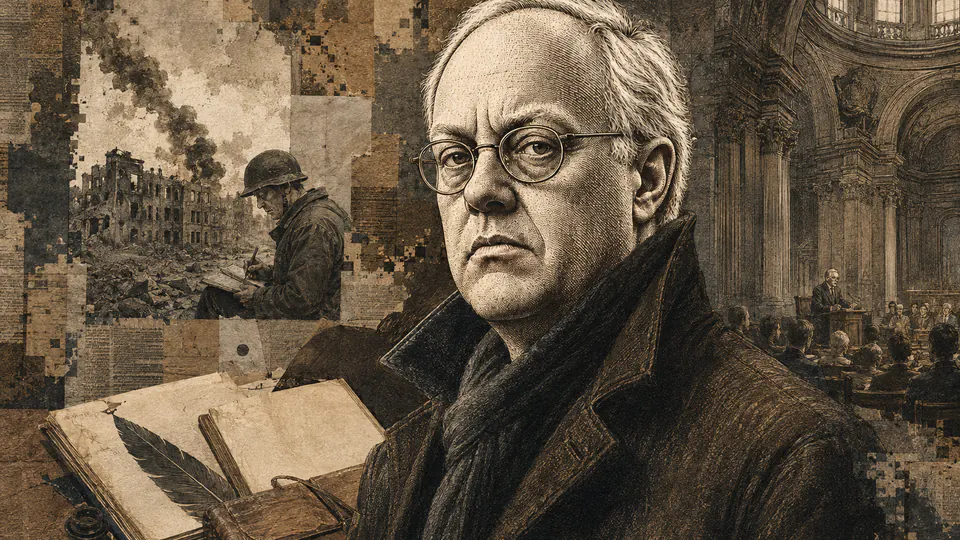
Chris Hedges shared a 2002 Pulitzer, then took a written reprimand for an antiwar commencement speech in 2003 and left the New York Times rather than stop.
The story
#storyTwo months into the Iraq war, Chris Hedges walked to the lectern at the Rockford College commencement in Illinois and opened with one sentence:
I want to speak to you today about war and empire.
He got roughly three minutes before somebody unplugged the microphone. What followed, in front of about 2,000 people including 400 graduates, was booing, foghorns, chanting, backs turned, a second cut to the sound system, an appeal from the college president for academic freedom followed by his suggestion that Hedges wrap it up, and finally graduates in robes trying to climb onto the platform to confront him. Hedges ended the speech at eighteen minutes and campus security walked him off the grounds. The date was May 17, 2003.
What he had been saying when the sound died was that the occupation ahead would cost the country its standing and its alliances, and that prosecuting a war on terror alongside Vladimir Putin and Ariel Sharon had already cost it something. “We have become the company we keep,” he told the graduates.
That is the part people remember. The consequence arrived from New York. The New York Times, which had employed him for thirteen years by then and had shared a Pulitzer Prize with him the year before, handed him a written reprimand telling him to stop speaking publicly about the war. He did not stop. He was gone from the paper by 2005.
What the reprimand actually was
Hedges has told this part the same way for years. Interviewed by Paul Jay of The Real News Network in July 2013, he said the paper called him in and gave him “a formal written reprimand for impugning the impartiality of The New York Times.”
The mechanism mattered more than the wording. Hedges was covered by a Newspaper Guild contract, and he described the process plainly in that interview: the employer issues the reprimand in written form, and the next time the employee violates it, the guild rules permit firing. One more speech and the Times could have ended his job on paperwork it had already filed.
The paper’s side of this has been reported as a matter of impartiality, that public remarks by a reporter could undermine public trust in the coverage. It was, in 2003, an ordinary position for an American newsroom: the correspondent who covers a war does not take sides on it in public. Hedges had run the paper’s Middle East bureau, spoke Arabic, and had been publicly critical of the invasion before Rockford. Those same facts sat on both sides of the argument depending on who was making it.
He chose the speaking. “I was going to be proactive,” he told Jay. “I was going to arrange for a transition to get out before I was fired, but it was clear that I was going to be fired.” He left in 2005 for the Nation Institute, where the constraint did not exist.
American history has a rougher version of the same collision. Eugene Debs got ten years in a federal penitentiary under the Espionage Act for an antiwar speech in Ohio in 1918. Hedges got a piece of paper in a personnel file. Both men were told, in the vocabulary available to the institution doing the telling, to stop talking.
Divinity school, then El Salvador
Hedges was born on September 18, 1956 in St. Johnsbury, Vermont, the son of a Presbyterian minister. He took an English degree at Colgate and went to Harvard Divinity School, finishing a master of divinity in 1983 with every intention of being ordained. He also had a one-way ticket to El Salvador, where by his own account a United States-backed military government was killing between 700 and 1,000 people a month, and he wanted the church to recognize reporting from there as his ministry. Writing about it in 2014, he explained what the church decided:
going to El Salvador as a reporter was not something the Presbyterian Church at the time recognized as a valid ministry, and a committee rejected my ‘call.’
His father’s response to the rejection was to tell him he was “ordained to write.” He went to Central America anyway, freelancing for The Christian Science Monitor and NPR before becoming Central America bureau chief for The Dallas Morning News from 1984 to 1988. The New York Times hired him in 1990. Over the next fifteen years he ran the paper’s Middle East bureau and then its Balkans bureau during the wars in Yugoslavia, and his reporting career took him through more than fifty countries.
In 2002 two things arrived at once. He was part of the Times staff whose coverage of global terrorism took that year’s Pulitzer Prize for Explanatory Reporting, and Amnesty International gave him its Global Award for Human Rights Journalism.
The book that made him famous
PublicAffairs published War Is a Force That Gives Us Meaning in September 2002, and it became the book most readers know him for. It reads as a correspondent’s account of why war works on the people inside it, himself included. War supplies purpose, clarity, and a cause worth dying for, which is what makes it so hard to give up. On the conflicts he had just spent a decade covering, he wrote:
The ethnic conflicts and insurgencies of our time, whether between Serbs and Muslims or Hutus and Tutsis, are not religious wars. They are not clashes between cultures or civilizations, nor are they the result of ancient ethnic hatreds. They are manufactured wars, born out of the collapse of civil societies, perpetuated by fear, greed, and paranoia, and they are run by gangsters, who rise up from the bottom of their own societies and terrorize all, including those they purport to protect.
The National Book Critics Circle made it a finalist for general nonfiction in 2002, in a field Samantha Power won with A Problem from Hell, and the book has since sold more than 400,000 copies. Eight months after it came out, a college in Illinois booked its author to send four hundred graduates into the world, which suggests nobody on the invitation committee read past the title.
After the paper
The second act has been busier than the first. Hedges wrote a column at Truthdig for years, published books at a steady clip, and in January 2012 sued the president of the United States. Hedges v. Obama challenged section 1021 of the National Defense Authorization Act, the provision authorizing indefinite military detention of people who “substantially support” al-Qaeda or associated forces, on the grounds that the wording was vague enough to reach journalists and activists. His co-plaintiffs included Daniel Ellsberg and Noam Chomsky. Judge Katherine Forrest of the Southern District of New York agreed and struck the provision down in September 2012. The Second Circuit reversed her in July 2013 on the ground that the plaintiffs lacked standing, and the Supreme Court declined to take the case in April 2014.
He teaches college-credit courses inside New Jersey prisons, with classes that mix incarcerated students and undergraduates, work he had already been doing for several years by 2014. On October 5, 2014, three decades after the committee turned him down, a church in Elizabeth, New Jersey ordained him as a minister, and his own account of that Sunday puts the prison teaching at the center of the case for it.
The plagiarism allegations
One stretch of the record is contested, and leaving it out would be its own kind of edit. In June 2014 The New Republic published an article by Christopher Ketcham alleging that Hedges had reused other writers’ language without credit, starting with a 2010 manuscript in which a fact-checker at Harper’s found passages tracking a 2009 story by the Philadelphia Inquirer reporter Matt Katz. Ketcham reported a wider pattern involving other authors.
The magazine ran Hedges’s reply on June 17. He called the allegations false and said they were meant to damage him personally and professionally, wrote that a charge of plagiarism was “at once shocking and unwarranted,” and argued that “the final, published material is what counts.” He said inquiries by the Nation Institute, Nation Books and Truthdig had all found no basis for the charges. The New Republic appended its own note disputing his account of how the piece was reported, including his claim that it went unchecked. Both statements sit on the same page, and a reader can weigh them there.
Deleted again, in 2022
From 2016 Hedges hosted On Contact, an interview show, for RT America, the United States arm of the Russian state-funded network. In the spring of 2022, with Russia’s invasion of Ukraine underway, YouTube removed the program’s entire six-year archive. He learned about it the way viewers did. “There was no notice,” he told Democracy Now on April 1, 2022. “There was no warning. There was no inquiry. It just vanished.”
Hold the two erasures next to each other and the mechanisms are opposites. In 2003 an employer wrote him a letter and put it in a file. In 2022 a platform pressed a button and told nobody. Rockford is the odd one out, because the crowd that shouted him down lost: the microphone went dead twice that afternoon, and the transcript of all eighteen minutes is public, posted by the local paper that covered the graduation and reprinted since. It opens with the sentence that started the trouble.
In their own words
#wordsWhat Chris Hedges actually said, where, and when. Each one links to the page it was checked against.
-
I want to speak to you today about war and empire.
Opening line of the Rockford College commencement address, Rockford, Illinois, May 17, 2003. Chris Hedges, Rockford College commencement address (May 17, 2003), transcript reprinted by The Progressive -
We have become the company we keep.
The same Rockford address, on prosecuting a war on terror alongside Vladimir Putin and Ariel Sharon. Chris Hedges, Rockford College commencement address (May 17, 2003), transcript reprinted by The Progressive -
a formal written reprimand for impugning the impartiality of The New York Times
Describing, in his own words, what the paper gave him after Rockford, in an interview with Paul Jay of The Real News Network, July 17, 2013. "Journalism Should Be About Truth, Not Career," Chris Hedges interviewed by Paul Jay, The Real News Network (July 17, 2013) -
I was going to be proactive. I was going to arrange for a transition to get out before I was fired, but it was clear that I was going to be fired.
The same July 17, 2013 interview, on why he chose to leave the Times in 2005 rather than wait for dismissal. "Journalism Should Be About Truth, Not Career," Chris Hedges interviewed by Paul Jay, The Real News Network (July 17, 2013) -
going to El Salvador as a reporter was not something the Presbyterian Church at the time recognized as a valid ministry, and a committee rejected my 'call.'
"Ordained to Write," his own essay for Truthdig, October 13, 2014, on the church committee that turned down his ministry request in 1983. Chris Hedges, "Ordained to Write," Truthdig (October 13, 2014) -
The ethnic conflicts and insurgencies of our time, whether between Serbs and Muslims or Hutus and Tutsis, are not religious wars. They are not clashes between cultures or civilizations, nor are they the result of ancient ethnic hatreds. They are manufactured wars, born out of the collapse of civil societies, perpetuated by fear, greed, and paranoia, and they are run by gangsters, who rise up from the bottom of their own societies and terrorize all, including those they purport to protect.
The opening of War Is a Force That Gives Us Meaning, published by PublicAffairs, September 2002. Chris Hedges, War Is a Force That Gives Us Meaning (PublicAffairs, 2002), excerpt
What people get wrong
#wrong- The myth
The New York Times fired Chris Hedges for his 2003 antiwar speech. - The record
The paper did not fire him. It issued a written reprimand, which under his Newspaper Guild contract meant a second violation could lead to dismissal. Hedges kept speaking publicly against the war, arranged his own exit, and left the paper in 2005, two years after Rockford.
- The myth
Chris Hedges was found to have plagiarized other writers. - The record
The New Republic published Christopher Ketcham's allegations in June 2014. The magazine also ran Hedges's full denial on June 17, in which he called the charge false and said internal reviews by the Nation Institute, Nation Books, and Truthdig found no basis for it. No court or independent panel issued a public finding against him; the magazine's own editor's note disputes his account of how the piece was reported, and the matter remains contested rather than settled.
- The myth
Hedges was only ever a Middle East correspondent. - The record
Over fifteen years at the Times he ran both the Middle East bureau and, during the Yugoslav wars, the Balkans bureau, after earlier work as Central America bureau chief for The Dallas Morning News from 1984 to 1988. His reporting career has taken him through more than fifty countries.
The dates that matter
#dates- September 18, 1956 Born in St. Johnsbury, Vermont, the son of a Presbyterian minister.
- 1983 Finishes a master of divinity at Harvard. A church committee declines to recognize reporting from El Salvador as a call to ministry.
- 1984-1988 Central America bureau chief for The Dallas Morning News, after freelancing from the region for The Christian Science Monitor and NPR.
- 1990 Joins The New York Times, and goes on to head its Middle East bureau and, during the wars in Yugoslavia, its Balkans bureau.
- September 2002 PublicAffairs publishes War Is a Force That Gives Us Meaning, a finalist that year for the National Book Critics Circle Award in general nonfiction.
- 2002 Shares the Times staff Pulitzer for coverage of global terrorism and receives Amnesty International's Global Award for Human Rights Journalism.
- May 17, 2003 Speaks at the Rockford College commencement. The microphone is cut twice, graduates try to climb onto the platform, and security walks him off after eighteen minutes.
- 2003 The Times issues him a written reprimand over his public remarks on the war.
- 2005 Leaves the paper after fifteen years and becomes a senior fellow at the Nation Institute.
- January 13, 2012 Files Hedges v. Obama with Daniel Ellsberg, Noam Chomsky and others, challenging the indefinite-detention section of the National Defense Authorization Act.
- July 2013 The Second Circuit reverses the district court ruling in his favor on standing; the Supreme Court declines the case in April 2014.
- June 2014 The New Republic publishes Christopher Ketcham's plagiarism allegations, then runs Hedges's denial on June 17 with an editor's note disputing his account.
- October 5, 2014 Ordained a Presbyterian minister at a church in Elizabeth, New Jersey, on the strength of his work teaching in prisons.
- March 2022 YouTube deletes the entire six-year archive of On Contact, the show he hosted for RT America, without notice.
Questions people ask
#faqsWhy did Chris Hedges leave the New York Times?
Because he would not stop speaking against the Iraq war. After his May 2003 commencement address at Rockford College, the Times gave him a formal written reprimand, which he has described as being issued for impugning the paper's impartiality. Under the Newspaper Guild contract covering him, a written reprimand was the step before firing. He continued to speak, arranged an exit, and left the paper in 2005 for the Nation Institute.
What did Chris Hedges say at Rockford College?
He opened with the line "I want to speak to you today about war and empire" and argued that the occupation of Iraq would cost the United States its standing and its allies, telling the crowd that in fighting terrorism alongside Vladimir Putin and Ariel Sharon, "We have become the company we keep." The transcript of all eighteen minutes was published by the Rockford Register Star and reprinted since.
Did Chris Hedges win a Pulitzer Prize?
He shares one. Hedges was part of the New York Times reporting team whose coverage of global terrorism won the 2002 Pulitzer Prize for Explanatory Reporting, a staff prize rather than an individual one. The same year he received Amnesty International's Global Award for Human Rights Journalism.
Has Chris Hedges been accused of plagiarism?
Yes. In June 2014 The New Republic published a piece by Christopher Ketcham alleging that Hedges had lifted passages from other writers, beginning with a manuscript a Harper's fact-checker flagged in 2010. The magazine ran Hedges's denial on June 17. He called the allegations false and the charge shocking and unwarranted, and said inquiries by the Nation Institute, Nation Books and Truthdig found no basis for them. The New Republic attached a note disputing his account of the reporting.
What does Chris Hedges do now?
He writes The Chris Hedges Report on Substack, has published books including The Greatest Evil Is War (2022) and A Genocide Foretold (2025), and teaches college-credit courses in New Jersey prisons. He was ordained a Presbyterian minister in 2014.
The bookshelf
#bookshelfWhere to go next. Buy from an independent bookstore, or find it at your library for nothing.
-
War Is a Force That Gives Us Meaning Chris Hedges, 2002 primary
His best-known book, on why war supplies purpose even to the people it destroys.
-
Empire of Illusion: The End of Literacy and the Triumph of Spectacle Chris Hedges, 2009 primary
His argument that celebrity culture and corporate spectacle have replaced a functioning public sphere.
-
Days of Destruction, Days of Revolt Chris Hedges and Joe Sacco, 2012 primary
Reporting from Camden, the coalfields of West Virginia, the Pine Ridge reservation, and Zuccotti Park, with Sacco's illustrations.
Wear it: Chris Hedges
#merchEvery design here links back to this page.
Sources
#sourcesPrimary sources
The documents themselves: laws, court opinions, speeches, letters, and the numbers from the agencies that count them.
- Chris Hedges, Rockford College commencement address (May 17, 2003), transcript reprinted by The Progressive (full text, from the Rockford Register Star transcript)
- "Journalism Should Be About Truth, Not Career," Chris Hedges interviewed by Paul Jay, The Real News Network (July 17, 2013) (his own account of the reprimand, the guild rules, and his exit)
- Chris Hedges, "Ordained to Write," Truthdig (October 13, 2014) (the rejected call, his father's line, and the 2014 ordination)
- National Book Critics Circle, 2002 awards (confirms the general nonfiction finalist listing)
- Chris Hedges, War Is a Force That Gives Us Meaning (PublicAffairs, 2002), excerpt
- Chris Hedges, "Chris Hedges Responds to Accusations of Plagiarism," The New Republic (June 17, 2014) (his denial in full, with the magazine's dissenting editor's note attached)
- Democracy Now, "Disappeared: Chris Hedges Responds to YouTube Deleting His 6-Year Archive of RT America Shows" (April 1, 2022)
Secondary sources
Written afterward, about the story.
- Paul Hond, "Fighting Words," Columbia Magazine (Winter 2006-07) (source for the crowd size and the eighteen-minute length of the speech)
- Type Investigations, "Chris Hedges" (reporter biography) (career summary, the Pulitzer and Amnesty awards, prison teaching)
- Poynter, "New Republic reports plagiarism allegations against Pulitzer-winner Chris Hedges" (June 12, 2014)
- Wikipedia, "Hedges v. Obama" (case chronology, plaintiffs, and the appellate outcome)
- Wikipedia, "Chris Hedges" (orientation; source for the birth date and the reported wording of the Times reprimand)