Published
The IWW
The Wobblies: Inside the IWW's One Big Union
Founded in Chicago in 1905, the IWW pushed one union for every worker instead of dozens split by trade, and fought to prove it in court and on the street.
The story
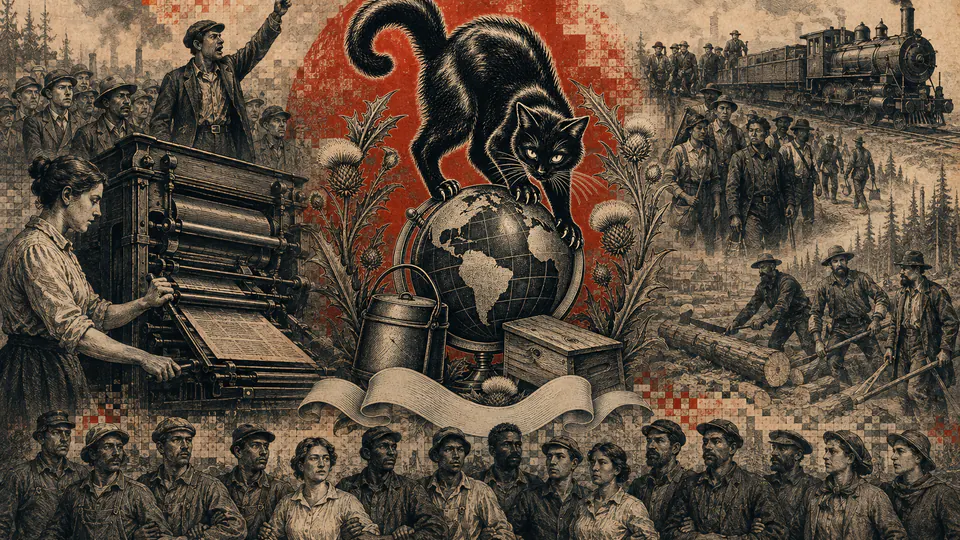
#storyThe Industrial Workers of the World set out to do one specific thing: put every worker in an industry into a single union, skilled and unskilled together, instead of splitting them the way the American Federation of Labor did, trade by trade. Delegates founded it in Chicago on June 27, 1905. It went on to run free speech fights that overflowed small-town jails, print a songbook built to outsing the street preachers competing for the same corner, and watch the federal government convict 101 of its own leaders in a single 1918 trial. It never disbanded.
The convention in Chicago, June 1905
A manifesto called the convention five months earlier. On January 4, 1905, twenty-six socialists, radical-union officers, and editors meeting in Chicago signed a call for “one great industrial union embracing all industries,” to convene that June and build it. Big Bill Haywood, secretary-treasurer of the Western Federation of Miners, signed it. So did Mother Jones, already the best-known agitator in American mining country. Eugene Debs’s name does not appear on that first printed manifesto. It shows up in a slightly different version of the document reprinted two months later.
Debs was in the hall regardless. 203 delegates representing 43 organizations gathered at Brand’s Hall on June 27, and Haywood, presiding, opened with the line the union still quotes:
This is the Continental Congress of the working class. We are here to confederate the workers of this country into a working class movement that shall have for its purpose the emancipation of the working class from the slave bondage of capitalism.
Two days later, on June 29, Debs took the floor and told delegates that “the old form of pure and simple unionism has long since outgrown its usefulness.”
Mother Jones and Lucy Parsons, widow of hanged Haymarket defendant Albert Parsons, were among the few women in the hall, and Parsons took the floor. Her remarks, preserved in the convention minutes at NYU’s Tamiment Library, called women “the slaves of slaves” and put a strike tactic on the record thirty-one years before autoworkers tried it in Flint, Michigan:
My conception of the strike of the future is not to strike and go out an starve, but to strike and remain in and take possession of the necessary property of production.
One card, not forty
The dispute with the AFL was structural, not personal. Craft unionism meant a single railroad yard could carry separate unions for firemen, brakemen, machinists, and switchmen, each running its own contract on its own schedule, so a strike by one trade left the others working. The IWW wrote the opposite premise into its opening line:
The working class and the employing class have nothing in common.
Where the AFL’s older unions worked under the motto “a fair day’s wage for a fair day’s work,” the IWW’s preamble named its actual goal as “abolition of the wage system.” It aimed to organize the workers craft unions mostly did not, unskilled laborers, immigrants, women, and minorities among them, on one card, in one industry, regardless of trade.
Free speech in Spokane
The IWW’s most famous free speech fight is also a story about the men who used to sell jobs for a living. In late 1908 the union ran a “Don’t Buy Jobs” campaign against Spokane’s employment agencies, which charged migratory workers a fee for placements that sometimes lasted a single day, after which the worker paid another agency for the next one. The agencies leaned on the city council, which passed an ordinance banning street meetings outright. The IWW complied for most of a year, watched the council carve out an exemption for the street preachers who competed with Wobbly organizers for the same corners, and on November 2, 1909 declared Free Speech Day, calling on members everywhere to come fill Spokane’s jail.
Police arrested 150 men in a single day. Within twenty days the count reached 400, and the city ran out of cells, stacking overflow prisoners into the Franklin School and Fort Wright. Elizabeth Gurley Flynn, nineteen years old, chained herself to a lamppost to slow her own arrest, then used her trial to charge that police were running the jail’s women’s section as a brothel. She was acquitted; her co-defendant was not. The city settled on March 4, 1910: street speaking allowed, prisoners released, and the licenses of 19 employment agencies revoked. Filling the jail had been the plan from the start, and it worked.
Songs to fan the flames
The same Spokane locals who ran the free speech fight also built the union’s most durable piece of propaganda. In 1909 a committee there published the first edition of what the labor movement still calls the Little Red Songbook, titled in full Songs of the Workers, on the Road, in the Jungles, and in the Shops, Songs to Fan the Flames of Discontent. Wobbly songwriters set new labor lyrics to the same hymn tunes traveling evangelists used to draw a crowd on those same street corners, on the theory that a soapbox organizer sharing a corner with a competing preacher needed a tune that could carry over his. Joe Hill, the Swedish-born songwriter Utah later executed, added his first contributions starting with the 1911 third edition. Thirty-eight editions came out between 1909 and 2010, small enough to carry in a shirt pocket.
The raids and the trial
The government moved on the union in the middle of a war. On September 5, 1917, Justice Department agents raided every IWW office in the country within a single 24-hour span, 48 local offices plus the national headquarters in Chicago, hauling out five tons of paper from the Chicago office alone. A grand jury indicted 166 IWW leaders; dismissals and unlocated defendants brought the number who actually stood trial in Chicago, starting April 1, 1918, down to 101, Big Bill Haywood among them, before Judge Kenesaw Mountain Landis, who became Major League Baseball’s first commissioner in 1920 while continuing to sit as a federal judge until 1922. On August 17, 1918 the jury convicted every one of the 101 defendants after 65 minutes of deliberation. Landis sentenced them on August 31: 15 got the legal maximum of 20 years, 33 got 10 years, 31 got 5, and 18 got less, with fines totaling more than $2 million.
Still chartering members
Membership never came back to its wartime scale. Between 1912 and 1917 total membership had approached 150,000, though only 5,000 to 10,000 workers were ever paid up and active at any one time, since dues lapsed the moment a migratory worker’s job did. The union’s own paper, Solidarity, printed its most reproduced image, a fist built from massed workers’ hands over the words “One Big Union,” on June 30, 1917. Ten weeks later, federal agents were carrying that same paper’s files out the door in boxes.
The IWW never disbanded. It still organizes under the same preamble, one shop at a time, without waiting for an employer’s permission to call itself a union. Nobody claims today’s roster comes close to 1917’s, by any count.
What people get wrong
#wrong- The myth
The 1918 Chicago trial proved the IWW committed sabotage and violence during the war. - The record
Prosecutors never tried to prove the specific acts named in the indictment. Instead they read inflammatory passages from IWW newspapers, circulars, and pamphlets to the jury, building the case from "official statements, policy declarations, newspaper articles, and personal expressions of opinion," not documented sabotage. The government's own case rested on rhetoric and a wartime public image of the IWW as bomb-throwers, not on proven deeds.
- The myth
The 1918 convictions destroyed the IWW, which no longer exists. - The record
The union never disbanded. It survived the trial, the sentences, and the collapse of its wartime membership, and it still organizes workplace by workplace today under the same 1905 preamble, with a current international membership in the low five figures.
- The myth
Eugene Debs founded the IWW. - The record
Debs's name is missing from the January 4, 1905 Industrial Union Manifesto that called the founding convention; Big Bill Haywood and Mother Jones signed it, and Haywood presided over the June convention and delivered its opening address. Debs addressed the delegates on June 29, urging them on, but he did not sign the founding call and held no office in the union afterward.
The dates that matter
#dates- January 4, 1905 An Industrial Union Manifesto is signed in Chicago calling for a June convention. Big Bill Haywood and Mother Jones sign it; Eugene Debs's name is missing from this first printed version.
- June 27, 1905 The founding convention opens at Brand's Hall in Chicago. 203 delegates represent 43 organizations. Haywood calls it "the Continental Congress of the working class."
- June 29, 1905 Debs addresses the convention, telling delegates that pure and simple craft unionism has outgrown its usefulness.
- 1905 Lucy Parsons addresses the convention, describing a strike that occupies the workplace instead of walking out of it.
- 1909 Spokane locals publish the first edition of what becomes known as the Little Red Songbook.
- November 2, 1909 Spokane Wobblies declare "Free Speech Day" and call for members nationwide to fill the city jail in protest of a street-speaking ban.
- March 4, 1910 Spokane settles: street speaking is allowed, prisoners are released, and the licenses of 19 employment agencies are revoked.
- September 5, 1917 Justice Department agents raid every IWW office in the country within a single 24-hour span.
- April 1 to August 17, 1918 101 IWW members stand trial in Chicago under the Espionage Act before Judge Kenesaw Mountain Landis; the jury convicts all of them.
- August 31, 1918 Landis hands down sentences up to the legal maximum of 20 years, plus more than $2 million in fines.
Questions people ask
#faqsWhat was the IWW?
The Industrial Workers of the World, founded in Chicago on June 27, 1905, was a labor union built on "One Big Union": every worker in an industry on a single card, skilled and unskilled together, instead of the dozens of separate craft unions the American Federation of Labor ran. Members were called Wobblies. The union never disbanded and still exists today, though at a fraction of its early size.
Who founded the IWW?
203 delegates from 43 organizations met at Brand's Hall in Chicago in June 1905, called there by a January manifesto signed by Big Bill Haywood of the Western Federation of Miners and Mother Jones, among others. Eugene Debs's name does not appear on that first printed manifesto, but he spoke to the convention on June 29. Lucy Parsons, widow of hanged Haymarket defendant Albert Parsons, addressed the floor as well.
What is the difference between the IWW and the AFL?
The AFL organized workers by craft, so a single workplace could have separate unions for each trade with separate contracts, which let employers fight them one at a time. The IWW organized by industry, putting every worker in a shop into the same union regardless of skill, and it aimed to include unskilled workers, immigrants, women, and minorities that many AFL unions excluded. The IWW's preamble also named its goal as "abolition of the wage system," not the AFL's older motto of a fair day's wage for a fair day's work.
What was the Spokane free speech fight?
In 1909, Spokane, Washington banned street speaking after employment agencies pressured the city council to silence the IWW's campaign against their fees. On November 2, 1909 the union declared "Free Speech Day" and called on members to fill the jail; police arrested 150 people in a single day and 400 within twenty days. The city settled on March 4, 1910, allowing street speaking, freeing prisoners, and revoking 19 employment-agency licenses.
Does the IWW still exist?
Yes. The union never disbanded, even after a 1918 federal trial convicted all 101 of its leaders who were tried. It continues to organize workplace by workplace under the same 1905 preamble, though nobody claims its current membership comes close to the roughly 150,000 its rolls approached across 1912-1917.
The bookshelf
#bookshelfWhere to go next. Buy from an independent bookstore, or find it at your library for nothing.
-
Big Bill Haywood's Book: The Autobiography of Big Bill Haywood William D. Haywood, 1929 primary
The IWW's first secretary-treasurer on founding the union and running it through its hardest years.
-
Rebel Voices: An IWW Anthology Joyce L. Kornbluh, editor, 2011 primary
Convention minutes, songs, cartoons, and trial documents reprinted from the union's own record.
-
We Shall Be All: A History of the Industrial Workers of the World Melvyn Dubofsky, 2000 secondary
The standard archive-based history of the union, from the 1905 convention through the wartime trials.
Wear it: The IWW
#merchEvery design here links back to this page.
Sources
#sourcesPrimary sources
The documents themselves: laws, court opinions, speeches, letters, and the numbers from the agencies that count them.
- Industrial Union Manifesto (January 4, 1905) (the call to the June convention; Mother Jones and Big Bill Haywood are among the signers, Debs is not)
- Founding Convention of the Industrial Workers of the World, First Day (June 27, 1905) (Haywood's opening address, verbatim, from the convention proceedings)
- Eugene V. Debs, "Speech at the Founding Convention of the Industrial Workers of the World" (June 29, 1905)
- Lucy Parsons's 1905 speech to the IWW founding convention (text drawn from the convention minutes held at NYU's Tamiment Library)
Secondary sources
Written afterward, about the story.
- Tim Acott, "Annotated Preamble to the IWW Constitution"
- Wikipedia, "First Convention of the Industrial Workers of the World"
- PBS American Experience, "The Industrial Workers of the World"
- Wikipedia, "Free speech fights" (Spokane 1909-1910 dates, arrest counts, and settlement terms)
- libcom.org, "1908-10: Spokane Free Speech Fight"
- Wikipedia, "Little Red Songbook"
- Wikipedia, "Joe Hill (activist)" (his songbook contributions starting with the 1911 third edition, and his execution)
- IWW History Project, University of Washington, "The Justice Department Campaign Against the IWW, 1917-1920"
- Wikipedia, "Kenesaw Mountain Landis" (1918 trial start and verdict dates; his 1920 move to baseball commissioner)
- Encyclopedia.com, "Wobblies" (peak membership figures, 1912-1917)
- Wikipedia, "Workers' International Industrial Union" (the 1908 split over political action and the rival union De Leon's faction founded)
- Wikipedia, "Big Bill Haywood" (his 1921 bail jump and flight to Soviet Russia)
- Wikipedia, "Industrial Workers of the World" (the union's welcome of women, immigrants, African American, and Asian workers)