Published
Symbols of the left
The Rose, the Fist, and the Three Arrows: A Field Guide to the Symbols of the Left
Where the socialist rose, the red flag, the raised fist, the three arrows, and the IWW's black cat actually come from. Every symbol has a birthday and most have an author.
The story
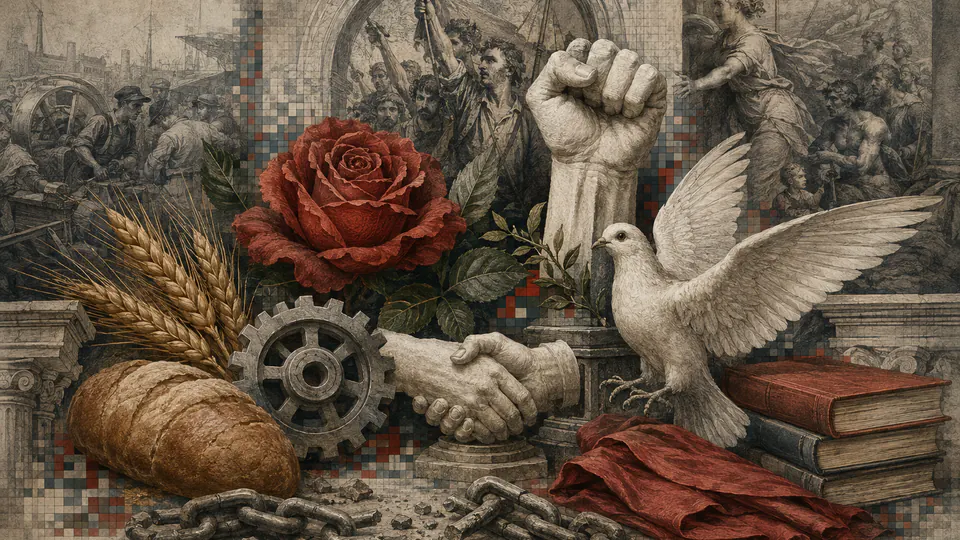
#storyEvery symbol on a leftist shirt has a birthday, and most of them have an author with a name. The rose was drawn in Paris in 1969. The three arrows were drawn in Berlin in 1932, shaped so a brush could drag them straight over a swastika. The raised fist has an American paper trail running back to a union cartoon from 1917. This is the documentation, symbol by symbol.
The red flag came first
The color has a street address. In July 1791, Paris authorities raised a red flag, then the standing legal signal for martial law, before the National Guard fired on a crowd at the Champ de Mars. The movement took the emblem of the massacre for its own banner, and the inversion stuck: the warning flag of the state became the flag of the people it had fired on. Red crossed Europe on the barricades of 1848 and flew over the Paris Commune for 72 days in 1871.
By 1889 the flag had an anthem. Jim Connell, an Irish dockworker and journalist in London, wrote The Red Flag that year amid the dock strike agitation, and British Labour conferences have sung it ever since:
Then raise the scarlet standard high. Within its shade we’ll live and die, Though cowards flinch and traitors sneer, We’ll keep the red flag flying here.
Bread and roses, 1911-1912
The rose entered the movement’s vocabulary through a slogan before it entered any logo. “Bread for all, and roses too” was circulating in American suffrage and labor circles by 1911, and James Oppenheim built his poem Bread and Roses around it in The American Magazine that December:
Hearts starve as well as bodies; give us bread, but give us roses
The following month, January 1912, some 20,000 textile workers struck in Lawrence, Massachusetts, and the strike has carried the poem’s name ever since. Honesty about the record requires one footnote: the famous picket-line banner reading “We want bread, and roses too” has never turned up in a contemporary photograph or news report from Lawrence. The historian Jim Zwick, who traced the slogan’s history, found it rooted in the suffrage movement before the strike and found the banner story attached to Lawrence only decades later. What the record does hold, from the same year, is union organizer Rose Schneiderman telling a Cleveland audience, “The worker must have bread, but she must have roses, too.” The claim under the slogan needed no banner: workers deserve beauty and dignity along with the wage.
The fist and the rose, 1969
The emblem itself is younger than most people guess. The fist holding a rose was drawn in Paris in 1969, credited to the designer Marc Bonnet, and the refounded French Socialist Party adopted it in 1971. Through the Socialist International the mark spread to social-democratic and socialist parties on every continent, from Spain’s PSOE to parties across Latin America and Europe.
English-speaking politics took the flower and often dropped the fist. The British Labour Party retired the red flag as its emblem in favor of a red rose at its 1986 conference under Neil Kinnock. In the United States, Democratic Socialists of America carried the rose from its founding in 1982, and during the membership surge after 2016 the rose emoji in a social bio became the shorthand for democratic socialist. A century-long chain, slogan to poem to logo to emoji, and every link in it documented.
The raised fist
The fist is older than any one movement and belongs to several. Its clearest American ancestor ran in the IWW newspaper Solidarity on June 30, 1917: a cartoon titled The Hand That Will Rule the World, showing a colossal fist rising out of a crowd, each knuckle built from massed workers’ hands, over the caption One Big Union. That is the same IWW that Helen Keller backed in those exact years, and the graphic argument is the union’s whole theory in one image: separately, hands; together, a fist.
The clenched-fist salute traveled through the European left between the wars, becoming the greeting of the Spanish Republic’s defenders in 1936. And on October 16, 1968, American sprinters Tommie Smith and John Carlos raised gloved fists on the medal stand in Mexico City, an image that cost them their Olympic careers and became one of the century’s most reproduced photographs. The fist on a shirt today draws on all of it: the union, the republic, the podium.
The three arrows
The three arrows are the most specific symbol on this list, and carry the sharpest history. In 1932, with the Weimar Republic in its last year, the Iron Front (a defense coalition of the Social Democratic Party, the free trade unions, the Reichsbanner veterans’ league, and workers’ sport clubs) needed a mark that could fight the swastika on walls. Sergei Chakhotin, a Russian-born scientist running the coalition’s propaganda, designed three parallel arrows striking diagonally downward, drawn so activists could paint them directly over swastikas in the street. The arrows named the front’s three declared enemies: the Nazis, the Communists of the KPD, and the reactionary monarchists.
The Iron Front lost, and the arrows went down with the republic in 1933. That defeat is exactly why the mark keeps coming back: anti-fascists from Europe to the United States have revived the three arrows as a symbol with an unambiguous record, a mark whose entire meaning is opposition to the thing it was drawn to cover.
The black cat
The Wobblies drew the strangest entry in the field guide: an arch-backed black cat, teeth out, nicknamed the sabo-tabby and associated with IWW artist Ralph Chaplin, the same Chaplin who wrote the union anthem Solidarity Forever in 1915. The cat stood for direct action on the job, the pressure workers apply without waiting for permission. The name matches the deed: a strike launched from the shop floor without official union authorization is called a wildcat strike, and the cat on a shirt still signals that impatience.
Reading the shirt
Put the birthdays together and the symbols sort themselves. The red flag and the fist are the old, broad marks of the whole workers’ movement. The rose is the social-democratic and democratic-socialist branch, drawn in 1969 and worn today by everyone from European governing parties to DSA members. The three arrows are specifically anti-fascist, with a 1932 record behind them. The black cat is the direct-action strain, labor’s feral wing. None of these arrived from nowhere; someone wrote the song, drew the fist, designed the arrows, inked the cat. The left’s symbols hold up to sourcing, which is fitting, and this page will keep citing the sources.
What people get wrong
#wrong- The myth
Strikers at the 1912 Lawrence mill strike carried a banner reading 'We want bread, and roses too.' - The record
The historian Jim Zwick, who traced the slogan's history, found it rooted in the suffrage movement before the strike and found the famous banner story attached to Lawrence only decades later; it has never turned up in a contemporary photograph or news report from the strike itself.
- Jim Zwick, "Bread and Roses: The Lost Histories of a Slogan and a Poem"
- The myth
The fist-and-rose is an old socialist emblem, as old as the movement itself. - The record
The drawn emblem dates to 1969, credited to the designer Marc Bonnet in Paris, and the refounded French Socialist Party adopted it in 1971. The rose as a slogan is older, but the logo on today's shirts and pins is younger than most of the people wearing it.
- The myth
The three arrows symbol belongs to Communist iconography. - The record
Sergei Chakhotin designed the three arrows in 1932 specifically for the Iron Front, a coalition of the Social Democratic Party, free trade unions, and republican veterans, and one of its three arrows named the Communist KPD as one of the coalition's three declared enemies, alongside the Nazis and the reactionary monarchists.
- The myth
The raised-fist salute began with Tommie Smith and John Carlos at the 1968 Olympics. - The record
American labor's fist imagery predates 1968 by half a century: the IWW paper Solidarity printed the cartoon The Hand That Will Rule the World on June 30, 1917, and the clenched-fist salute already belonged to the defenders of the Spanish Republic in the 1930s. Smith and Carlos made the gesture a global image; they did not invent it.
- "The Hand That Will Rule the World: One Big Union," Solidarity (June 30, 1917)
- HISTORY, "The 1968 Olympics Black Power salute"
The dates that matter
#dates- 1791 A red flag, the standing signal of martial law, is turned into a protest banner after troops fire on a crowd at the Champ de Mars in Paris.
- 1848 The red flag spreads across Europe's revolutions as the banner of the workers' movement.
- 1871 The Paris Commune flies the red flag over the city for 72 days.
- 1889 Jim Connell writes the anthem The Red Flag; British socialists still sing it.
- December 1911 James Oppenheim's poem Bread and Roses runs in The American Magazine.
- 1912 Rose Schneiderman tells a Cleveland audience the worker must have bread, but she must have roses, too.
- June 30, 1917 The IWW paper Solidarity prints The Hand That Will Rule the World, a fist made of massed workers' hands.
- 1932 Sergei Chakhotin designs the three arrows for the German Iron Front to strike through swastikas.
- October 16, 1968 Tommie Smith and John Carlos raise gloved fists on the Olympic podium in Mexico City.
- 1969-1971 The fist and rose is drawn in Paris and adopted by the refounded French Socialist Party; the Socialist International later takes it worldwide.
- 1986 The British Labour Party swaps the red flag for a red rose under Neil Kinnock.
Questions people ask
#faqsWhat does the rose mean in socialism?
The rose stands for the claim that workers deserve beauty and dignity along with wages, an idea the labor movement attached to the phrase bread and roses in 1911-1912. As a drawn emblem, the fist holding a rose dates to 1969-1971, when the French Socialist Party adopted it; the Socialist International spread it worldwide, and groups like the Democratic Socialists of America carry the rose today.
What do the three arrows stand for?
The three arrows were designed in 1932 by Sergei Chakhotin for the Iron Front, a German coalition defending the republic in the last year before Hitler took power. The arrows stood for the fight against the movement's three enemies: the Nazis, the Communists, and the reactionary monarchists. The mark was drawn so it could be painted straight over a swastika.
Where does the raised fist come from?
No single origin, but the American lineage runs through the IWW, whose paper Solidarity printed the cartoon The Hand That Will Rule the World in June 1917: a giant fist made of massed workers' hands. Anti-fascists in 1930s Spain used the clenched-fist salute, and Tommie Smith and John Carlos made it a global image at the 1968 Olympics.
Why is red the color of the left?
The line the movement tells runs through Paris: a red flag flown as a protest banner after the Champ de Mars shootings of 1791, across the barricades of 1848, and over the Paris Commune of 1871. By the time Jim Connell wrote the anthem The Red Flag in 1889, the color and the cause were the same thing.
What does the black cat symbol mean?
The arch-backed black cat, nicknamed the sabo-tabby and associated with IWW artist Ralph Chaplin, was the Wobblies' emblem for direct action on the job. The related term is still standard labor vocabulary: a strike launched by workers without official union authorization is called a wildcat strike.
The bookshelf
#bookshelfWhere to go next. Buy from an independent bookstore, or find it at your library for nothing.
-
Rebel Voices: An IWW Anthology Joyce L. Kornbluh, editor, 1964 primary
The union's own songs, cartoons, and pamphlets, including the black cat and the raised-fist graphics, collected from the source.
-
Joe Hill: The IWW & the Making of a Revolutionary Workingclass Counterculture Franklin Rosemont, 2003 secondary
The deepest history of how the Wobblies built a visual and musical culture, sabo-tabby included.
-
Fire in the Minds of Men: Origins of the Revolutionary Faith James H. Billington, 1980 secondary
A history of insurgent movements that traces how their flags, songs, and emblems carried the argument.
Wear it: Symbols of the left
#merchEvery design here links back to this page.
Sources
#sourcesPrimary sources
The documents themselves: laws, court opinions, speeches, letters, and the numbers from the agencies that count them.
- James Oppenheim, "Bread and Roses," The American Magazine (December 1911) (the poem, published the month before the Lawrence strike began)
- Rose Schneiderman, 1912 Cleveland speech, quoted in Life and Labor (September 1912) (source of the bread-and-roses line as she actually said it)
- "The Hand That Will Rule the World: One Big Union," Solidarity (June 30, 1917) (the IWW's raised-fist cartoon)
- Jim Connell, "The Red Flag" (1889) (the anthem, written after the London dock strike agitation of that year)
Secondary sources
Written afterward, about the story.
- Wikipedia, "Fist and rose" (the 1969 emblem and its international adoptions)
- Wikipedia, "Red flag (politics)"
- Wikipedia, "Three Arrows" (the Iron Front emblem of 1932)
- CRW Flags, "Socialist rose emblem"
- Zinn Education Project, "The Bread and Roses Strike Story"
- Jim Zwick, "Bread and Roses: The Lost Histories of a Slogan and a Poem" (the research tracing the slogan to the suffrage movement and testing the Lawrence banner story)
- HISTORY, "The 1968 Olympics Black Power salute"