Published
Helen Keller
Was Helen Keller Really a Socialist? (Yes, and the IWW Loved Her)
Born June 27, 1880. Died June 1, 1968
Helen Keller joined the Socialist Party in 1909, backed the IWW by 1916, defended Eugene Debs, and helped found the ACLU. The documented radical politics the textbooks leave out.
The story
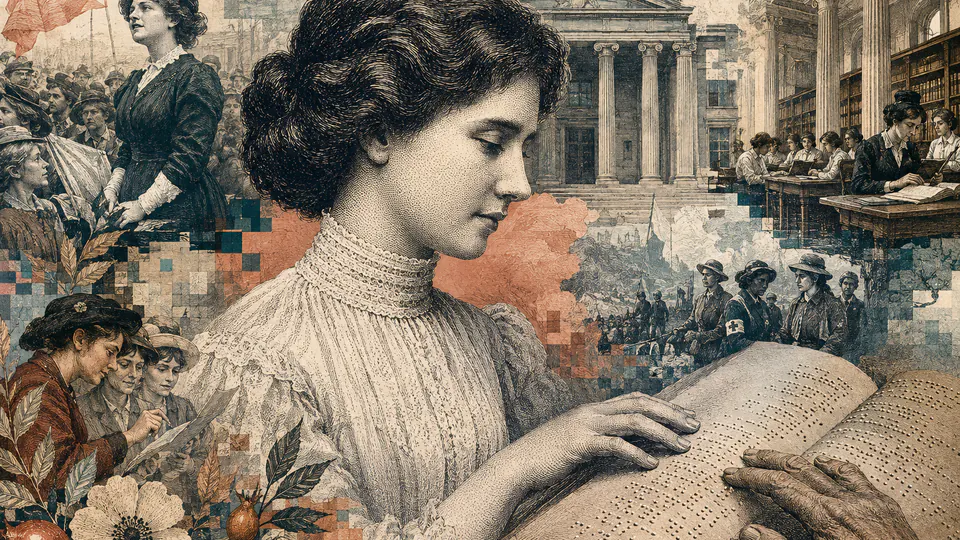
#storyYes. Helen Keller joined the Socialist Party of Massachusetts in 1909, wrote and lectured for socialism for years, moved further left to open support for the Industrial Workers of the World by 1916, campaigned against American entry into World War I, defended Eugene Debs while he sat in federal prison, helped found the ACLU in 1920, and stayed a woman of the left until her death in 1968. None of this is hidden or disputed; her political essays sit in public archives anyone can read. It just never made the textbook.
The story everyone knows stops at age seven
The version taught in school runs from Tuscumbia, Alabama, where Keller was born on June 27, 1880, through the illness at nineteen months that left her deaf and blind, to the water pump in April 1887 where Anne Sullivan spelled w-a-t-e-r into one hand while water ran over the other. It is a true story and a great one, and it ends with eighty-one years of her life still to go.
James Loewen opened Lies My Teacher Told Me (1995) with this exact case. Surveying American history textbooks, he found Keller compressed into an inspirational child, the disability conquered, the politics gone. The adult Keller noticed the same treatment in her own lifetime. Endorsing Robert La Follette’s third-party presidential run in 1924, she wrote to him: “So long as I confine my activities to social service and the blind, they compliment me extravagantly, calling me ‘arch priestess of the sightless,’ ‘wonder woman,’ and a ‘modern miracle.’” The compliments, she went on, ran out the moment she talked about poverty.
How she got there
Keller graduated from Radcliffe cum laude in 1904, the first deafblind person to earn a bachelor of arts. Her route to socialism ran through her own cause. Working on the prevention of blindness, she kept finding that blindness in America tracked poverty: industrial accidents that maimed workers, diseases that spread where families were poor, and treatable conditions among people who could afford no treatment. She concluded that the misfortune she had been assigned to personify was, much of the time, manufactured by economic arrangements, and she said so in print for the rest of the decade. She joined the Socialist Party in 1909 and published her political essays as Out of the Dark in 1913.
The press that had spent twenty years celebrating her turned fast. The Brooklyn Eagle, whose editor had praised her extravagantly before, now wrote that her political mistakes sprang from “the manifest limitations of her development.” Her reply, in the essay How I Became a Socialist in the New York Call of November 3, 1912, is the best thing ever written about being condescended to:
Oh, ridiculous Brooklyn Eagle What an ungallant bird it is Socially blind and deaf, it defends an intolerable system, a system that is the cause of much of the physical blindness and deafness which we are trying to prevent.
“The Eagle and I are at war,” she added, and she meant it. She read her socialism in three languages, in braille and in books spelled into her hand, and she was done letting anyone claim her disability as an argument against her conclusions.
The IWW years
By 1916 the Socialist Party’s patient electoral road had lost her. In January of that year she sat for an interview with Barbara Bindley of the New York Tribune, published under the title Why I Became an IWW, and explained the move in the plainest terms available:
I became an IWW because I found out that the Socialist Party was too slow. It is sinking in the political bog.
The Industrial Workers of the World, the one big union of the era’s radical left, embraced her, and she spent the war years at full volume. At Carnegie Hall on January 5, 1916, speaking against the preparedness campaign that was walking the country toward war, she told the crowd:
Strike against war, for without you no battles can be fought
The same years held the rest of her politics. She supported women’s suffrage and birth control. In 1916, an Alabama-born white woman, she sent the NAACP money and a public letter of support that ran in The Crisis, its magazine. And when Eugene Debs was imprisoned under the Espionage Act for his Canton speech, she wrote to him on March 11, 1919, in a letter preserved in her collected writings, that she would count it an honor to share the charge:
I write because I want you to know that I should be proud if the Supreme Court convicted me of abhorring war, and doing all in my power to oppose it.
The two of them are the twin poles of this site’s Debs biography: the orator who went to prison for the speech, and the most famous woman in America saying she wished the indictment had named her too.
The long second act
In 1920 Keller was among the founders of the American Civil Liberties Union, alongside Roger Baldwin and Crystal Eastman, an organization built in direct response to the wartime prosecutions that had caged Debs. From 1924 she worked with the American Foundation for the Blind, the job the later, safer version of her fame was built on: decades of testimony, fundraising, and travel to dozens of countries for blind welfare. The radical did not retire so much as get edited. The FBI kept a file on her connections to the left, and J. Edgar Hoover’s bureau was still noting her name on petitions in the 1940s and 1950s.
Lyndon Johnson gave her the Presidential Medal of Freedom in 1964. She died at home in Easton, Connecticut on June 1, 1968, twenty-six days short of her 88th birthday, and the obituaries led with the water pump.
Why the erasure matters
Keller’s socialism was the reasoned conclusion of the most documented education in American history, and cutting it from her story rewrites her from an author into a mascot. She saw the edit coming a century before the textbooks finished it, which is why the La Follette letter reads the way it does. The record is all still there: the 1912 essay, the Tribune interview, the Carnegie Hall speech, the letter to Debs. She wrote it down so it could be quoted. Quote her.
In their own words
#wordsWhat Helen Keller actually said, where, and when. Each one links to the page it was checked against.
-
The Eagle and I are at war. I hate the system which it represents, apologizes for and upholds.
"How I Became a Socialist," New York Call, November 3, 1912, replying to a Brooklyn Eagle editorial that dismissed her politics as a product of her disability. Helen Keller, "How I Became a Socialist," New York Call (November 3, 1912) -
I became an IWW because I found out that the Socialist party was too slow.
Interviewed by Barbara Bindley for the New York Tribune, published January 16, 1916 under the title "Why I Became an IWW." Barbara Bindley, "Why I Became an IWW" (interview with Helen Keller), New York Tribune (January 16, 1916) -
Strike against war, for without you no battles can be fought.
"Strike Against War," a speech at Carnegie Hall, New York, January 5, 1916, delivered under the Women's Peace Party and the Labor Forum. Helen Keller, "Strike Against War," Carnegie Hall speech (January 5, 1916) -
I should be proud if the Supreme Court convicted me of abhorring war, and doing all in my power to oppose it.
A letter to Eugene Debs while he was imprisoned under the Espionage Act, published in the New York Call, April 29, 1919. Helen Keller, "To Eugene V. Debs" (1919) -
So long as I confine my activities to social service and the blind, they compliment me extravagantly, calling me 'arch priestess of the sightless,' 'wonder woman,' and a 'modern miracle.'
A letter to Senator Robert M. La Follette endorsing his 1924 presidential campaign, collected in Helen Keller: Her Socialist Years. Helen Keller, letter to Senator Robert M. La Follette (1924), reprinted in Helen Keller: Her Socialist Years: Writings and Speeches, ed. Philip S. Foner (1967)
What people get wrong
#wrong- The myth
Keller's socialism was naive, something others talked her into because of her disability, rather than a conclusion she reasoned her way to. - The record
In her own account, "How I Became a Socialist," Keller describes reading political theory in three languages and in braille and books spelled into her hand over several years before joining the party in 1909. She names and answers this exact accusation in the essay, replying to a Brooklyn Eagle editorial that attributed her views to "the manifest limitations of her development."
- The myth
Keller's radical politics were a brief phase she dropped once she settled into her later career as a disability advocate. - The record
Keller helped found the American Civil Liberties Union in 1920, after her socialist and anti-war years, and Kim Nielsen's political biography traces her left commitments continuing alongside her foundation work for decades afterward; there is no public statement in the record renouncing her earlier politics.
- James W. Loewen, Lies My Teacher Told Me (The New Press, 1995), ch. 1, "Handicapped by History"
- PBS American Masters, "Helen Keller Studied Socialism"
- The myth
Helen Keller was a card-carrying, formally enrolled member of the IWW. - The record
What the record documents firmly is her public advocacy: the January 1916 interview where she said she had turned to the IWW because the Socialist Party was too slow, and her later 1918 writings defending the organization. None of the sources here include a membership card or enrollment record, so the formal-membership claim goes further than the documented support.
The dates that matter
#dates- June 27, 1880 Born in Tuscumbia, Alabama; an illness at nineteen months leaves her deaf and blind.
- April 1887 Anne Sullivan spells water into her hand at the pump. This is where the textbook version ends.
- 1904 Graduates Radcliffe cum laude, the first deafblind person to earn a bachelor of arts.
- 1909 Joins the Socialist Party of Massachusetts.
- November 3, 1912 The New York Call publishes her essay How I Became a Socialist, including her reply to the Brooklyn Eagle.
- 1913 Publishes Out of the Dark, a collection of her socialist writing.
- January 5, 1916 Delivers the Strike Against War speech at Carnegie Hall.
- January 1916 Tells the New York Tribune she has moved past the Socialist Party toward the IWW.
- 1916 Sends the NAACP a donation and a public letter of support, printed in The Crisis.
- March 11, 1919 Writes to Eugene Debs in prison, saluting him for opposing the war.
- 1920 Among the founders of the American Civil Liberties Union.
- 1924 Begins her decades of work with the American Foundation for the Blind.
- 1964 Receives the Presidential Medal of Freedom from Lyndon Johnson.
- June 1, 1968 Dies at her home in Easton, Connecticut, weeks before her 88th birthday.
Questions people ask
#faqsWas Helen Keller a socialist?
Yes. She joined the Socialist Party of Massachusetts in 1909, wrote the essay How I Became a Socialist for the New York Call in 1912, published the political collection Out of the Dark in 1913, and supported socialist and labor causes for decades afterward.
Was Helen Keller in the IWW?
She publicly supported the Industrial Workers of the World and in a January 1916 New York Tribune interview explained that she had turned to the IWW because the Socialist Party was, in her words, too slow and sinking in the political bog. Her surviving writing on the IWW is a matter of record; the depth of her formal membership is less documented than her open support.
Why do textbooks leave out Helen Keller's politics?
James Loewen opened Lies My Teacher Told Me (1995) with exactly this question. American textbooks compress her into an inspirational childhood story that ends at the water pump and skip the adult who spent fifty years on the organized left, because the childhood sells and the politics complicate the icon publishers want.
What did Helen Keller do besides socialism?
She was the first deafblind person to earn a bachelor of arts, graduating Radcliffe cum laude in 1904. She wrote more than a dozen books, worked for the American Foundation for the Blind from 1924 on, toured dozens of countries for blind welfare, and received the Presidential Medal of Freedom in 1964.
The bookshelf
#bookshelfWhere to go next. Buy from an independent bookstore, or find it at your library for nothing.
-
Helen Keller: Her Socialist Years: Writings and Speeches Helen Keller, edited by Philip S. Foner, 1967 primary
Her own essays and speeches collected in one place, the Brooklyn Eagle reply and the Debs letter included.
-
The Radical Lives of Helen Keller Kim E. Nielsen, 2004 secondary
A political biography built to answer exactly the question this page answers, with the archival footnotes to back it.
-
Helen Keller: A Life Dorothy Herrmann, 1998 secondary
The fuller biography, Annie Sullivan and the whole 88 years included.
Wear it: Helen Keller
#merchEvery design here links back to this page.

Sources
#sourcesPrimary sources
The documents themselves: laws, court opinions, speeches, letters, and the numbers from the agencies that count them.
- Helen Keller, "How I Became a Socialist," New York Call (November 3, 1912) (her own account, including the Brooklyn Eagle exchange)
- Helen Keller Reference Archive, Marxists Internet Archive (collected political writings, including the 1919 letter to Debs)
- Barbara Bindley, "Why I Became an IWW" (interview with Helen Keller), New York Tribune (January 16, 1916) (source of the too-slow quote; reprinted in the Marxists archive)
- Helen Keller, "Strike Against War," Carnegie Hall speech (January 5, 1916) (delivered under the auspices of the Women's Peace Party and the Labor Forum)
- Helen Keller, letter to Senator Robert M. La Follette (1924), reprinted in Helen Keller: Her Socialist Years: Writings and Speeches, ed. Philip S. Foner (1967) (source of the arch priestess of the sightless passage)
- Helen Keller, "To Eugene V. Debs" (1919)
Secondary sources
Written afterward, about the story.
- Keith Rosenthal, "The politics of Helen Keller," International Socialist Review #96
- PBS American Masters, "Helen Keller Studied Socialism"
- The Indypendent, "Helen Keller's Forgotten Radicalism" (2023)
- James W. Loewen, Lies My Teacher Told Me (The New Press, 1995), ch. 1, "Handicapped by History" (documents the textbook erasure of her politics)
- Britannica, "Helen Keller"