Published
Democratic socialism
What Is Democratic Socialism? (And How It's Different From Communism)
Democratic socialists want voters, not a single party, to run the economy. What DSA and Bernie Sanders mean by the term, and how it differs from communism.
The story
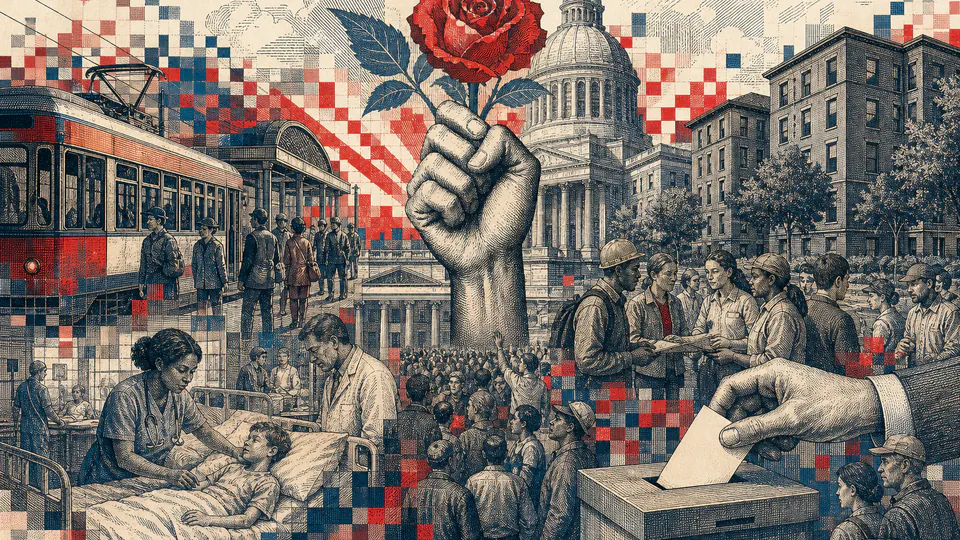
#storyDemocratic socialism means the economy answers to voters, elected the ordinary way, rather than to a single party that has already decided the answer for everyone. Bernie Sanders put the plainest version of that claim on the record at Georgetown University on November 19, 2015:
Democratic socialism means that we must create an economy that works for all, not just the very wealthy.
Nothing in that speech asked the government to run the auto industry, seize farmland, or ban a rival party. The gap between what democratic socialists actually propose and what people assume they propose is wide, because the word socialism spent most of the twentieth century standing next to the Soviet Union in newspaper photographs.
What democratic socialists actually want
DSA’s own definition, posted on its website, describes an economy and a society both run democratically, aimed at meeting public needs rather than producing profit for a narrow ownership class. Sanders drew the same line from the opposite direction, ruling out the version most Americans picture when they hear the word:
I don’t believe government should own the means of production, but I do believe that the middle class and the working families who produce the wealth of America deserve a fair deal.
That sentence carries the weight. Factories, banks, and firms stay privately owned under the democratic socialism practiced in American politics today; what changes is the floor guaranteed to everyone standing near them: health care as a right, a stronger union movement, higher taxes on large fortunes, public investment where private markets underfund basic needs. In the same speech, Sanders pointed to Franklin Roosevelt’s record as precedent, noting that programs now taken for granted, Social Security, the minimum wage, unemployment insurance, and the forty-hour work week, were denounced as socialist when Roosevelt proposed them.
How it differs from a Nordic welfare state
People reach for Denmark and Sweden as the model, and the countries are relevant, just not for the reason usually given. Denmark and Sweden are social democracies: capitalist economies with heavy taxation funding a strong welfare state, most businesses staying in private hands, no plan on the table to change that arrangement. Democratic socialists want similar protections but treat them as a stop along a longer road rather than the destination; the stated aim is an economy run democratically at the level of ownership too, through cooperatives, public ownership of specific sectors, and workplace democracy. In practice, in the United States in 2026, the two camps back nearly identical near-term policy: universal health care, higher minimum wages, stronger unions. The disagreement sits further down the road, past the next bill.
How it differs from communism
The older, plainer comparison sits inside American labor history itself. The Socialist Party of America, the party of Eugene Debs’s presidential campaigns, held together until September 1919, when the Bolshevik Revolution’s example pulled its left wing away. Members convinced that Lenin’s model, a single vanguard party seizing state power and then running the economy through central planning with no legal opposition, was the answer walked out and founded the rival parties that, through further mergers, became the Communist Party USA, aligned with Moscow’s Communist International. The members who stayed decided that elections, a free press, and more than one legal party were not obstacles to socialism but requirements for it. That 1919 argument is still the argument. Democratic socialism keeps competitive elections and civil liberties as non-negotiable; the Marxist-Leninist states that followed the other model, from the Soviet Union to Cuba to North Korea, have run a single party controlling both government and economy, with dissent criminalized.
Where the American version came from
The Socialist Party never recovered its footing after the 1919 split, and what remained of it spent decades shrinking; by 1972 the remnant had renamed itself Social Democrats, USA, chasing a foothold inside the Democratic Party’s coalition instead of running its own candidates. Michael Harrington, whose 1962 book The Other America helped push the Kennedy administration toward an anti-poverty agenda, broke from that renamed group in a dispute over how fully it should back the 1972 McGovern campaign and ally with the era’s civil rights, feminist, and anti-war movements, and founded the Democratic Socialist Organizing Committee that October. In 1982, DSOC merged with the New American Movement, a separate group that had grown out of the New Left, and the combined organization took the name it still carries: the Democratic Socialists of America, founded at a convention in Detroit on March 20-21, 1982, with about 6,000 members, Harrington leading the merged group from the start. The rose on DSA’s own materials arrived by a different road: the fist and rose drawn in Paris in 1969 and spread worldwide through the Socialist International (the full account, and the rest of the left’s symbols, is at /causes/symbols-of-the-left).
How popular is it
Gallup has asked Americans about socialism periodically since 2010, and the number barely moves: 39 percent rated it positively in Gallup’s August 2025 survey, against 54 percent for capitalism, a capitalism figure that was 60 percent as recently as 2021. The partisan split accounts for most of the gap. Self-identified Democrats rated socialism positively at 66 percent in that same survey, ahead of their own 42 percent rating for capitalism, while Republicans rated socialism at 14 percent. That single word carries a century of connotation, which is why democratic socialists spend so much energy on definitions instead of slogans.
The DSA today, and who’s in it
Sanders remains the country’s best-known democratic socialist and has never joined the organization that shares his label. A Niskanen Center analysis of the movement states the fact plainly: “He has never been a DSA member.” He has spent his congressional career as a registered independent, caucusing with Democrats, even as DSA’s National Political Committee voted 11 to 4 to endorse his 2020 campaign on March 21, 2019, after a member poll in which three-quarters of participants said yes.
Alexandria Ocasio-Cortez’s membership record runs the opposite way: she joined DSA in 2018, let the membership lapse in 2019, and DSA confirmed in August 2026 that she had rejoined, seven years later, as speculation grew about a 2028 run. Zohran Mamdani’s record has no gap: he joined the New York City chapter in 2017, three years before winning a State Assembly seat and eight years before winning the mayoralty of New York City on November 4, 2025. At his ceremonial inauguration outside City Hall on January 1, 2026, in front of a crowd reported in the tens of thousands, the person administering his oath a second time, for the public ceremony, was Sanders, still not a member of Mamdani’s own organization:
You showed the world the most important lesson that can be learned today , and that is that when working people stand together, when we don’t let them divide us up, there is nothing we cannot accomplish.
DSA passed 120,000 members six months later, on July 4, 2026, and said so in terms that made the historical comparison explicit: the organization called itself the largest socialist organization in United States history, ahead of what it described as the Socialist Party’s 1912 peak of roughly 113,000 dues-paying members under Debs. A movement Debs’s own party could not sustain past one bad decade passed its old high-water mark in a country that, per Gallup, still tells pollsters it prefers capitalism by fifteen points.
Argue it
#argue4 claims about Democratic socialism you can make out loud, the best case against each one, and the answer. Every number links to where it came from.
-
Claim 1
The Nordic countries start with roughly the same poverty rate we do and end with half of it.
The evidence
In 2011 the Nordic countries cut poverty by an average of 18.7 percentage points through taxes and transfers, from a pre-tax rate near 26 percent down to between 6 and 9.7 percent. The United States cut 10.9 points that year, from 28.3 percent down to 17.4.
Their best case
The White House Council of Economic Advisers' 2018 report "The Opportunity Costs of Socialism" estimated that adopting the Nordic countries' 1970s-era policies would shrink long-run U.S. GDP by at least 19 percent, about $11,000 a year per person, and put current Nordic living standards at roughly 15 percent below American ones.
The answer
The CEA priced the Nordic policies of the 1970s, before Denmark, Sweden, and Norway ran the market reforms that now put them near the top of the Heritage Foundation's economic freedom index. Its living-standards gap measures output, not what the taxes buy. A country that turns the same starting poverty rate into half the American one is spending the difference on something.
-
Claim 2
Denmark is one of the freest market economies on earth and two-thirds of its workers carry a union card.
The evidence
Union membership ran 67.0 percent in Denmark and 65.2 percent in Sweden in 2019, against 9.9 percent in the United States. Both countries leave most businesses in private hands, which is social democracy rather than democratic socialism.
Their best case
The Heritage Foundation's Index of Economic Freedom ranks the Nordic countries among the freest market economies on earth, Denmark 7th and Norway 8th in the world in the 2026 index, arguing their prosperity flows from property rights and light regulation rather than from anything socialist.
The answer
Heritage and DSA agree on the fact underneath: the Nordic countries are capitalist. The index scores property rights, trade, and regulation. It scores nothing about union density, paid leave, or who pays the doctor, which are the parts democratic socialists point at. A free-market ranking and a two-thirds union rate sit in the same country without a quarrel.
-
Claim 3
Paying for universal benefits Nordic-style raises middle-class taxes. That is the design, not the fine print.
The evidence
Denmark's top personal income tax rate of 55.9 percent applies to every krone above 1.3 times the average wage, and its 25 percent VAT raises 9.1 percent of GDP. The U.S. top rate does not start until 8.8 times the average wage, and sales taxes here raise 2.1 percent of GDP.
Their best case
The Tax Foundation's comparison of Scandinavian government financing shows these countries fund their welfare states through broad taxes that land on the middle class, VAT and payroll contributions, rather than mainly on the wealthy or on corporations. Nordic-style programs are not paid for by someone else.
The answer
True, and the Nordic countries say so out loud. The tax bill replaces bills American families already pay privately: the U.S. spent $14,775 a person on health care in 2024, more than any other country, and still left millions uninsured. A family covering premiums, tuition, and day care out of pocket is already paying it. The money just goes to a different address.
-
Claim 4
DSA has more dues-paying members than any socialist organization in American history.
The evidence
DSA passed 120,000 dues-paying members on July 4, 2026, above the Socialist Party's 1912 peak of roughly 113,000 under Eugene Debs. Dues mean signing up and then paying every month, which is a different act from answering one question from a pollster.
Their best case
Manhattan Institute economist Charles W. Calomiris argues that young Americans favor socialism mainly because they are "ignorant about the history and economics of the systems they favor or condemn," pointing to the 51 percent of young adults who tell Gallup they view socialism favorably.
The answer
Gallup has put this question to adults under 30 since 2010, and the favorable share has sat in the same band the whole time: 51 percent in 2010, 49 in 2012, 55 in 2016, 51 in 2018. That is not the shape of an opinion moving with a news cycle. Calomiris also never engages DSA's own definition, which rules out the government-ownership model his argument assumes its members are endorsing by mistake. Paying dues every month is a more expensive answer than picking up a phone.
What people get wrong
#wrong- The myth
Democratic socialism means the government would own and run private businesses. - The record
DSA's own definition calls for an economy and society run democratically to meet public needs, and Sanders told Georgetown in 2015 he does not believe government should own the means of production. Neither the organization's stated goal nor the current bills its members back nationalize a single industry.
- The myth
Denmark and Sweden already are democratic socialist countries, so the model has already been tried. - The record
The Heritage Foundation ranks both among the world's freest market economies. They are capitalist countries with heavy taxation and large public programs, and ownership of the economy has not changed hands, which is what DSA's definition sets as the eventual goal. Democratic socialists treat the Nordic welfare state as a stop on the road, not the destination.
- The myth
DSA is basically the same organization as the Communist Party USA, or a front for it. - The record
The two trace to a single split. In September 1919, Bolshevik-inspired members left the Socialist Party of America's left wing to found what became CPUSA, aligned with Moscow. The members who stayed kept competitive elections as a requirement, which is still the line in DSA's definition and the one the Marxist-Leninist model rejected.
The dates that matter
#dates- 1901 The Socialist Party of America forms through a merger of Eugene Debs's Social Democratic Party with other socialist groups.
- 1912 The Socialist Party peaks at roughly 113,000 dues-paying members, the same year Debs wins just over six percent of the presidential vote.
- September 1919 Members convinced the Bolshevik Revolution had settled the question split from the Socialist Party's left wing and founded rival parties that, through further mergers, became the Communist Party USA.
- 1972 What remains of the Socialist Party renames itself Social Democrats, USA, chasing a foothold inside the Democratic Party's coalition.
- October 1973 Michael Harrington breaks from Social Democrats, USA and founds the Democratic Socialist Organizing Committee.
- March 20-21, 1982 DSOC merges with the New American Movement at a convention in Detroit, founding the Democratic Socialists of America with about 6,000 members.
- November 19, 2015 Bernie Sanders defines democratic socialism at length in a speech at Georgetown University.
- March 21, 2019 DSA's National Political Committee votes 11 to 4 to endorse Sanders for the 2020 Democratic primary.
- November 4, 2025 Zohran Mamdani, a DSA member since 2017, wins the New York City mayoral election.
- January 1, 2026 Bernie Sanders, still not a DSA member himself, administers Mamdani's ceremonial oath outside City Hall.
- July 4, 2026 DSA announces it has passed 120,000 members, by its own count the largest socialist organization in US history.
- August 2026 DSA confirms that Alexandria Ocasio-Cortez has rejoined after a seven-year lapse in her membership.
Questions people ask
#faqsWhat is democratic socialism?
A political tradition that wants elections, civil liberties, and a free press to stay exactly as they are, while the economy is run for public benefit rather than for owners alone. DSA's own definition calls for both the economy and society to be run democratically; Bernie Sanders has put it as building an economy that works for everyone, not just the wealthy. Neither definition calls for the government to own factories outright.
What is the difference between democratic socialism and communism?
The split runs through American history: in September 1919, members who wanted to copy the Bolshevik model split from the Socialist Party of America's left wing and founded what became the Communist Party USA, aligned with Moscow. The Marxist-Leninist states that followed that model ran a single party controlling both government and economy, with no legal opposition. Democratic socialists kept competitive elections and a free press as non-negotiable instead, a distinction that still separates the two traditions today.
Is Bernie Sanders a member of the DSA?
No. Sanders has never joined the Democratic Socialists of America. A Niskanen Center analysis of the movement puts it directly: he has never been a DSA member. He has spent his congressional career as a registered independent who caucuses with Democrats, even though DSA's National Political Committee voted to endorse his 2020 presidential campaign.
Is democratic socialism the same thing as socialism?
Democratic socialism is one branch of a broader family. It differs from Marxist-Leninist communism in keeping elections and civil liberties as core commitments rather than accepting one-party rule, and it differs from social democracy in aiming to eventually change who owns the economy rather than taxing a capitalist economy more heavily and calling that the finished project.
How many people belong to the DSA?
DSA announced on July 4, 2026 that it had passed 120,000 members, a figure the organization says makes it the largest socialist organization in United States history, ahead of the Socialist Party's 1912 peak of roughly 113,000 dues-paying members. DSA started with about 6,000 members at its 1982 founding in Detroit.
The bookshelf
#bookshelfWhere to go next. Buy from an independent bookstore, or find it at your library for nothing.
-
The Other America: Poverty in the United States Michael Harrington, 1962 primary
Harrington founded the organization that became DSA in 1982. Twenty years earlier he wrote this, on the poverty the country had stopped seeing.
-
The Socialist Manifesto: The Case for Radical Politics in an Era of Extreme Inequality Bhaskar Sunkara, 2019 secondary
The case for the label, made from inside the movement, for readers who have not picked a side.
-
The Nordic Theory of Everything: In Search of a Better Life Anu Partanen, 2016 secondary
A Finnish journalist living in America on what the Nordic welfare state changes about daily life, and what it does not.
-
American Dreamers: How the Left Changed a Nation Michael Kazin, 2011 secondary
Where today's democratic socialism sits inside two centuries of American left movements that came before it.
Wear it: Democratic socialism
#merchEvery design here links back to this page.
 Design proof
 Alexandria Ocasio-Cortez Pixel Tee
$36.00 Design proof
 Bayard Rustin Collage Tee
$36.00 Design proof
 Bernie Sanders Pixel Tee
$36.00 Design proof
 Eugene V. Debs Engraved Tee
$36.00 Design proof
 Helen Keller Engraved Tee
$36.00 Design proof
 Karl Marx Engraved Tee
$36.00 Design proof
 Rosa Luxemburg Engraved Tee
$36.00 Design proof
 W. E. B. Du Bois Engraved Tee
$36.00 Design proof
 Zohran Mamdani Pixel Tee
$36.00 Design proof
 Democratic socialism Pixel Tee
$36.00 Design proof
 Michael Harrington Pixel Tee
$36.00 Design proof
 Norman Thomas Collage Tee
$36.00 Design proof
 Thomas Paine Collage Tee
$36.00 Design proof
 Upton Sinclair Pixel Tee
$36.00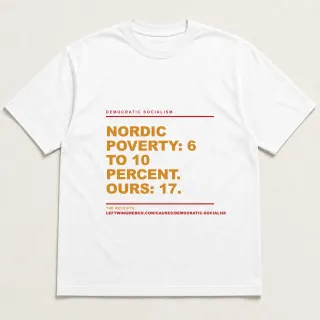 Design proof
 "Nordic poverty: 6 to 10 percent. Ours: 17." Tee
$36.00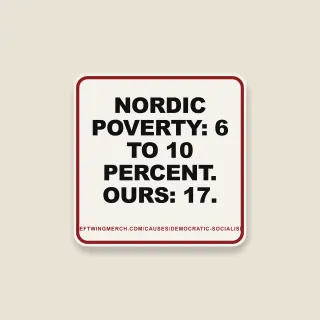 Design proof
 "Nordic poverty: 6 to 10 percent. Ours: 17." Sticker
$5.00 Design proof
 "Denmark: free market, 67 percent union." Tee
$36.00 Design proof
 "Denmark: free market, 67 percent union." Sticker
$5.00 Design proof
 "Higher taxes swap for premiums you already pay." Tee
$36.00 Design proof
 "Higher taxes swap for premiums you already pay." Sticker
$5.00 Design proof
 "120,000 people paid to join. That is not a poll." Tee
$36.00 Design proof
 "120,000 people paid to join. That is not a poll." Sticker
$5.00Sources
#sourcesPrimary sources
The documents themselves: laws, court opinions, speeches, letters, and the numbers from the agencies that count them.
- Democratic Socialists of America, "What Is Democratic Socialism?" (the organization's own working definition)
- Bernie Sanders, "Democratic Socialism in the United States," Georgetown University (November 19, 2015) (full transcript of the speech)
- Gallup, "Image of Capitalism Slips to 54% in U.S." (September 8, 2025)
- White House Council of Economic Advisers, "The Opportunity Costs of Socialism" (October 2018) (executive summary, pages 1 to 2: at least 19 percent, about $11,000 per year, at least 15 percent lower)
- Heritage Foundation, 2026 Index of Economic Freedom, Executive Highlights (world rankings table: Denmark 7th at 79.0, Norway 8th at 78.8)
- Gallup, "Democrats More Positive About Socialism Than Capitalism" (August 13, 2018) (the 18 to 29 series: 51 percent positive on socialism in 2010, 49 in 2012, 55 in 2016, 51 in 2018)
Secondary sources
Written afterward, about the story.
- Wikipedia, "Democratic socialism" (the distinction from social democracy and from Marxist-Leninist states)
- Wikipedia, "Democratic Socialists of America" (founding convention, membership figures)
- Wikipedia, "Democratic Socialist Organizing Committee" (Michael Harrington's 1973 split from Social Democrats, USA)
- Wikipedia, "Communist Party USA" (the 1919 split from the Socialist Party's left wing)
- The Daily Signal, "DSA Says It Now Has More Members Than Any Socialist Organization in US History" (July 6, 2026) (quotes DSA's own July 4, 2026 membership announcement)
- VTDigger, "Bernie Sanders Swears In Zohran Mamdani as New York City Mayor" (January 2, 2026)
- NOTUS, "AOC Officially Rejoins DSA as 2028 Speculation Heats Up" (August 2026)
- Wikipedia, "Zohran Mamdani" (DSA membership since 2017, election and inauguration dates)
- Niskanen Center, "Inside the Democratic Socialist Uprising" (source for Sanders never having been a DSA member)
- Wikipedia, "Nordic model," citing OECD and Luxembourg Income Study poverty comparisons (2011 pre- and post-tax/transfer poverty rates by country)
- Tax Foundation, "How Scandinavian Countries Pay for Their Government Spending"
- Peterson-KFF Health System Tracker, "How does health spending in the U.S. compare to other countries?"
- Charles W. Calomiris, "Socialism: The Opiate of the Corrupt and Ignorant," Manhattan Institute