Published
Rosa Luxemburg
Rosa Luxemburg: "Socialism or Barbarism" and the Murder That Followed
Born March 5, 1871. Died January 15, 1919
Rosa Luxemburg wrote "socialism or barbarism" in a 1915 prison cell, credited it to Engels, and was murdered by Freikorps soldiers four years later.
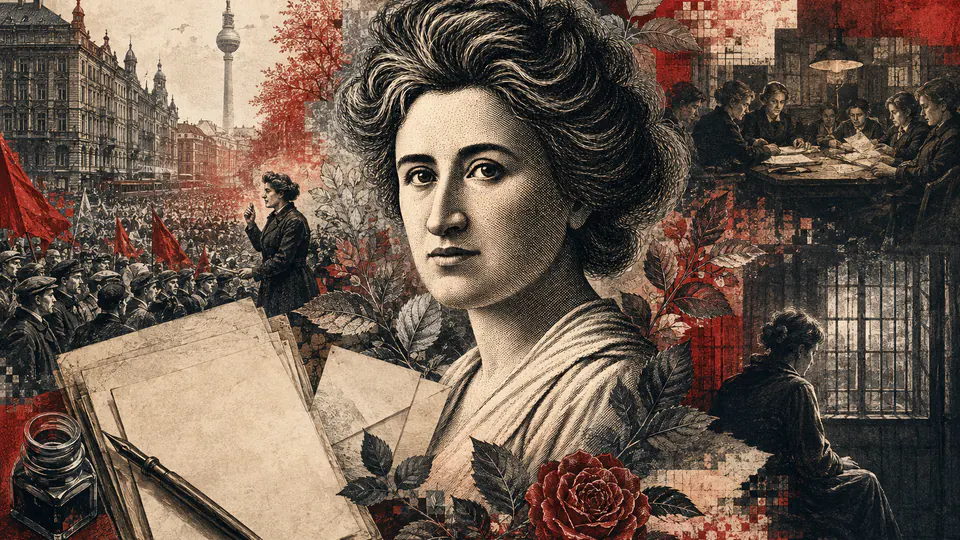
The story
#storyBourgeois society stands at the crossroads, either transition to socialism or regression into barbarism.
Rosa Luxemburg wrote that line in a German prison cell in 1915 and credited it to Friedrich Engels. She was a Polish-born Marxist theorist, one of the sharpest minds in the world’s largest socialist party, and four years after writing it she was beaten with a rifle butt, shot in the head, and thrown into a Berlin canal by soldiers acting with the tacit backing of her own country’s government. The line about barbarism turned out to be wrong in a smaller way too: nobody has ever found it anywhere in Engels’s actual writing.
Zamość to Berlin
Luxemburg was born on March 5, 1871, in Zamość, then part of Russian-ruled Poland, the youngest of five children in a Jewish timber-trading family. Tsarist police were already watching her for socialist organizing by her teens, and in 1889 she fled to Switzerland and enrolled at the University of Zurich, where in 1897 she earned a doctorate in political economy with a dissertation on Poland’s industrial development. Zurich gave her a degree, not a country to organize in. In 1898 she arranged a marriage of convenience with a German named Gustav Lübeck, purely for the citizenship it carried, and moved to Berlin to join the Social Democratic Party (SPD), by then the largest socialist party in the world.
The fight against her own party
She picked her first public fight within a year of arriving. SPD theorist Eduard Bernstein was arguing that capitalism was stabilizing itself and that socialists should trade the goal of taking power for a program of steady reform inside it. Luxemburg answered in 1899 with Social Reform or Revolution?, using Bernstein’s own economic claims against him: reforms were worth winning, she argued, but as tools for building working-class strength, not substitutes for the larger fight. The pamphlet made her, in her twenties and newly arrived from Poland, one of the party’s most feared debaters, and it set a pattern. She spent the rest of her career defending Karl Marx’s economics against people on her own side trying to soften it, a habit that cost her allies as often as it won her arguments.
Germany had already jailed her once by then, for undermining the Kaiser’s authority, and it kept doing so. In December 1905 she smuggled herself into Russian Poland to join that year’s uprising against the Tsar; Warsaw’s political police arrested her within the year and held her in the Warsaw Citadel until her family paid her bail. Out of that experience came The Mass Strike, the Political Party, and the Trade Unions (1906), arguing that a strike large enough could function as a weapon in its own right, an idea this site’s explainer on the general strike still traces back to debates like hers.
The vote that split the socialists
On August 4, 1914, the SPD’s Reichstag delegation voted, unanimously, for the Kaiser’s war credits, the money to fight what became World War I. Karl Liebknecht had argued against it in the party’s private caucus and lost; when the roll was called, he voted yes anyway, for the sake of party discipline. Luxemburg considered the vote a betrayal of everything the party’s socialist tradition claimed to stand for, and so, eventually, did Liebknecht: on December 2, 1914, he broke ranks and cast the Reichstag’s only vote against renewing the war credits. By the end of 1915 he and Luxemburg had built a small opposition group, and in 1916 it took the name it kept, the Spartacus League, after the slave who led a doomed revolt against Rome.
The pamphlet and the line she got wrong
Luxemburg had already been convicted once, for a 1913 speech urging German soldiers to refuse orders to fire on French or Russian workers, and in February 1915 she went to prison to serve the year that sentence carried. Inside, without her books, she wrote the piece she is still best known for. The Junius Pamphlet, smuggled out of prison and published under the pseudonym “Junius” in 1916, opens with the sentence about barbarism, presented as a direct quotation from Engels. Ian Angus, tracing the line’s history in 2014, found no such sentence anywhere in Engels’s surviving work. What he found instead was Karl Kautsky, the SPD’s own leading theorist, writing in 1892 that socialists faced a choice to move forward into socialism or fall back into barbarism, in a commentary that sold across Europe for two decades before Luxemburg picked up the idea. Writing from memory in a cell with no way to check a citation, she handed Engels credit for Kautsky’s sentence, and the mistake became the standard attribution.
The government released her in February 1916 and re-arrested her that July under wartime “protective custody,” no trial required, holding her in prisons in Berlin, Wronki, and Wrocław until November 9, 1918, the day the German Revolution forced the Kaiser to abdicate.
Nine days in Berlin
Luxemburg walked out of prison into a country coming apart and helped found the Communist Party of Germany (KPD) on January 1, 1919, still arguing that the party should compete in the coming elections rather than seize power in the street. She lost that argument. On January 4, the government fired Berlin’s police chief, and the next day Liebknecht and other KPD leaders called for an armed uprising, convinced the city’s soldiers would join them. Luxemburg thought the timing was a mistake and told the party so, then stood with the workers who took up the fight regardless. Freikorps units, paramilitary forces raised by the same SPD government Luxemburg had spent her career fighting from the left, crushed the rising within a week, killing at least 156 people in the streets, by the count of the Prussian parliamentary committee that investigated afterward.
On January 14, with the Freikorps in control of Berlin and the government’s own papers declaring the left finished, Luxemburg wrote one more piece for the party’s newspaper, Die Rote Fahne:
“Order prevails in Berlin” You foolish lackeys Your “order” is built on sand. Tomorrow the revolution will “rise up again, clashing its weapons,” and to your horror it will proclaim with trumpets blazing: I was, I am, I shall be
The Eden Hotel
She was captured the next evening at an apartment in Berlin’s Wilmersdorf district, along with Liebknecht, and both were brought to the Eden Hotel, then serving as the Freikorps unit’s headquarters, where Captain Waldemar Pabst identified them and gave the order to have them killed. A rifleman named Otto Runge struck Luxemburg in the head with his rifle butt as she was led out to a waiting car, and she was shot once in the head before the car reached Moabit Prison, where she had been told she was being taken. Her body was thrown into the Landwehr Canal.
For decades the official account named Lieutenant Kurt Vogel as the shooter. He was the one a military court-martial convicted, on May 14, 1919, but the sentence he received, two years and four months, was for disposing of a corpse and filing a false report, not for a killing. The fuller account came out only in 1959, when Pabst himself said in an interview that the man who had jumped onto the running board and fired was a young naval officer named Hermann Souchon. Souchon denied firing the shot for the rest of his life, and no court ever held him to account for the killing. Her body was not found until May 31, 1919, when it surfaced in the canal and was identified after an autopsy at the Charité hospital, four and a half months after she disappeared.
Her verdict on the Bolsheviks
Luxemburg did not live to see her name attached to the state that grew out of the Bolshevik revolution she is now often filed under. In prison in 1918 she wrote a manuscript her own party did not publish until three years after her death. She opened it in praise: “Their October uprising was not only the actual salvation of the Russian Revolution; it was also the salvation of the honor of international socialism.” Then she spent most of the rest of it taking Lenin and Trotsky apart for suppressing elections, opposition parties, and a free press. Paul Levi, who had been Luxemburg’s lawyer in political cases since 1913 and went on to lead the KPD, published The Russian Revolution in 1922, a year after the party expelled him over his own break with its tactics. Her sharpest line in it reads, in the standard English translation: “Freedom is always and exclusively freedom for the one who thinks differently.” She meant it as a warning aimed at a revolution she otherwise admired, and every wing of the international left that has claimed her since, Leninist, social-democratic, and everything between, has had to argue around that sentence rather than through it.
On June 13, 1919, more than 100,000 people turned out for her funeral at Berlin’s Friedrichsfelde cemetery, where she is buried beside Liebknecht. The government that let her killing happen and the party she co-founded two weeks before her arrest have both had reason to reckon with her since, for opposite failures: one for the order it gave, the other for the certainties she kept refusing to let it keep.
In their own words
#wordsWhat Rosa Luxemburg actually said, where, and when. Each one links to the page it was checked against.
-
Bourgeois society stands at the crossroads, either transition to socialism or regression into barbarism.
The Junius Pamphlet, written in prison and published under the pseudonym "Junius," 1915-1916, crediting the line to Engels. Rosa Luxemburg, "The Junius Pamphlet" (1915), Chapter I -
But if one admits with Bernstein that capitalist development does not move in the direction of its own ruin, then socialism ceases to be objectively necessary.
Social Reform or Revolution?, her 1899 answer to Eduard Bernstein's case for gradual reform over revolution. Rosa Luxemburg, "Social Reform or Revolution?" (1899), Chapter I -
Their October uprising was not only the actual salvation of the Russian Revolution; it was also the salvation of the honor of international socialism.
The Russian Revolution, a manuscript written in prison in 1918 and published by her party three years after her death. Rosa Luxemburg, "The Russian Revolution" (written 1918, published 1922), Chapter I -
Without general elections, without unrestricted freedom of press and assembly, without a free struggle of opinion, life dies out in every public institution, becomes a mere semblance of life, in which only the bureaucracy remains as the active element.
The Russian Revolution, 1918, criticizing the Bolsheviks' suppression of elections, opposition parties, and the press. Rosa Luxemburg, "The Russian Revolution" (written 1918, published 1922), "The Problem of Dictatorship" -
"Order prevails in Berlin" You foolish lackeys Your "order" is built on sand. Tomorrow the revolution will "rise up again, clashing its weapons," and to your horror it will proclaim with trumpets blazing: I was, I am, I shall be
Her last article, written for the party newspaper Die Rote Fahne on January 14, 1919, the day before her murder. Rosa Luxemburg, "Order Prevails in Berlin," Die Rote Fahne (January 14, 1919)
What people get wrong
#wrong- The myth
Luxemburg supported the Bolsheviks without reservation. - The record
In a manuscript written the same year as the October Revolution, she praised the uprising as the salvation of the revolution's honor, then spent most of the piece criticizing Lenin and Trotsky for suppressing elections, opposition parties, and a free press.
- The myth
Luxemburg started the Spartacist uprising. - The record
She told her own party the January 1919 rising was mistimed and argued against it, then stood with the workers once they had already taken it up. The rising was called by other KPD and Berlin militant shop-steward leaders after the government fired the city's police chief.
- The myth
Her killer was brought to justice. - The record
A 1919 court-martial convicted Lieutenant Kurt Vogel of disposing of her body and filing a false report, a sentence of two years and four months, not of murder. The naval officer named in 1959 as the actual shooter, Hermann Souchon, denied it until his death and was never charged.
The dates that matter
#dates- March 5, 1871 Born in Zamość, then part of Russian-ruled Poland, the youngest of five children in a Jewish timber-trading family.
- 1889 Flees to Switzerland after Tsarist police take an interest in her socialist organizing.
- 1897 Earns a doctorate in political economy from the University of Zurich.
- 1898 Marries Gustav Lübeck for German citizenship, moves to Berlin, and joins the Social Democratic Party (SPD).
- 1899 Publishes Social Reform or Revolution? against party theorist Eduard Bernstein's case for gradual reform over revolution.
- December 1905 Smuggles herself into Russian Poland to join that year's revolution; arrested within the year and held in the Warsaw Citadel.
- 1914 The SPD's Reichstag delegation votes unanimously for war credits on August 4. Karl Liebknecht breaks ranks on December 2 and casts the chamber's only No vote.
- 1915-1916 Writes the Junius Pamphlet in prison; it is published under the pseudonym "Junius" in 1916, the year her opposition group with Liebknecht takes the name Spartacus League.
- July 1916 to November 9, 1918 Held in "protective custody" without trial; released as the German Revolution forces the Kaiser's abdication.
- January 1, 1919 Co-founds the Communist Party of Germany (KPD).
- January 5-12, 1919 The Spartacist uprising in Berlin, which she opposed on timing but stood behind once it began.
- January 15, 1919 Captured in Wilmersdorf and murdered by Freikorps officers at the Eden Hotel; her body is thrown into the Landwehr Canal.
- May 31, 1919 Body found in the canal and identified after an autopsy at Berlin's Charité hospital.
- June 13, 1919 Buried at Friedrichsfelde cemetery in Berlin; more than 100,000 people attend.
Questions people ask
#faqsWho was Rosa Luxemburg?
Rosa Luxemburg (1871-1919) was a Polish-born Marxist theorist who became one of the German Social Democratic Party's most prominent thinkers, then broke with the party over World War I. She co-founded the Spartacus League and the German Communist Party (KPD) and was murdered by right-wing paramilitary soldiers days after the KPD's founding.
How did Rosa Luxemburg die?
On January 15, 1919, Freikorps soldiers captured Luxemburg and Karl Liebknecht at an apartment in Berlin's Wilmersdorf district and brought them to the Eden Hotel. A rifleman beat her with his rifle butt on the way to a waiting car, and she was shot in the head before the car reached its destination. Her body was thrown into Berlin's Landwehr Canal and not found for more than four months.
What does "socialism or barbarism" mean?
The phrase, from Luxemburg's 1915 Junius Pamphlet, frames a choice between workers taking power and society collapsing into war and reaction; she wrote it while imprisoned for anti-war activity and pointed to World War I as the barbarism already underway. She credited the formulation to Friedrich Engels, but no such sentence has been found in his writing. It traces instead to a similar line by the SPD theorist Karl Kautsky in 1892.
Was Rosa Luxemburg a communist?
She co-founded the Communist Party of Germany on January 1, 1919, two weeks before her death. She was also a sharp critic of the Bolsheviks in power: her manuscript The Russian Revolution, written the same year and published after her death, condemned Lenin and Trotsky's suppression of elections, opposition parties, and the press.
Who killed Rosa Luxemburg, and were they punished?
A military court-martial convicted Lieutenant Kurt Vogel in May 1919, but the sentence, two years and four months, was for disposing of her body and filing a false report, not for the murder. In 1959, the officer who had ordered the operation said that a naval officer named Hermann Souchon had fired the fatal shot; Souchon denied it until his death, and no court ever held him to account for the killing.
The bookshelf
#bookshelfWhere to go next. Buy from an independent bookstore, or find it at your library for nothing.
-
The Accumulation of Capital Rosa Luxemburg, 1913 primary
Her major work of economic theory, written the decade before her death.
-
The Letters of Rosa Luxemburg Rosa Luxemburg, edited by Georg Adler, Peter Hudis, and Annelies Laschitza, 1978 primary
Her correspondence, in translation.
-
Rosa Luxemburg Elzbieta Ettinger, 1986 secondary
A standard English-language biography.
Wear it: Rosa Luxemburg
#merchEvery design here links back to this page.

Sources
#sourcesPrimary sources
The documents themselves: laws, court opinions, speeches, letters, and the numbers from the agencies that count them.
- Rosa Luxemburg, "The Junius Pamphlet" (1915), Chapter I (the passage crediting the "socialism or barbarism" line to Engels)
- Rosa Luxemburg, "The Russian Revolution" (written 1918, published 1922), Chapter I (the passage praising the October uprising)
- Rosa Luxemburg, "The Russian Revolution" (written 1918, published 1922), "The Problem of Dictatorship" (source of the freedom-for-dissent line, trans. Bertram Wolfe)
- Rosa Luxemburg, "Order Prevails in Berlin," Die Rote Fahne (January 14, 1919)
- Rosa Luxemburg, "Social Reform or Revolution?" (1899), Chapter I
Secondary sources
Written afterward, about the story.
- Wikipedia, "Rosa Luxemburg"
- Wikipedia, "Spartacist uprising"
- Wikipedia, "Kurt Vogel (German officer)" (the 1919 conviction and the 1959 Souchon revelation)
- Wikipedia, "Karl Liebknecht" (the Wilmersdorf capture and the Eden Hotel)
- Wikipedia, "Paul Levi" (Levi as Luxemburg's lawyer from 1913 and his 1921 KPD expulsion)
- EBSCO Research Starters, "Assassination of Rosa Luxemburg"
- Rosa-Luxemburg-Stiftung, "The Life of Rosa Luxemburg"
- Rosa-Luxemburg-Stiftung, "Places in Berlin" (burial at Friedrichsfelde, June 13, 1919)
- Stanford Encyclopedia of Philosophy, "Rosa Luxemburg" (the Zwickau imprisonment and the Warsaw Citadel arrest)
- Ian Angus, "'Socialism or Barbarism': An Important Socialist Slogan Traced to Its Unexpected Source," Links International Journal of Socialist Renewal (2014) (traces the line to Karl Kautsky, 1892)