Published
General strike
What Is a General Strike, and Has One Ever Worked in the US?
What a general strike actually is, the handful the US has had since 1919, and why federal law made another one hard to organize after 1947.
The story
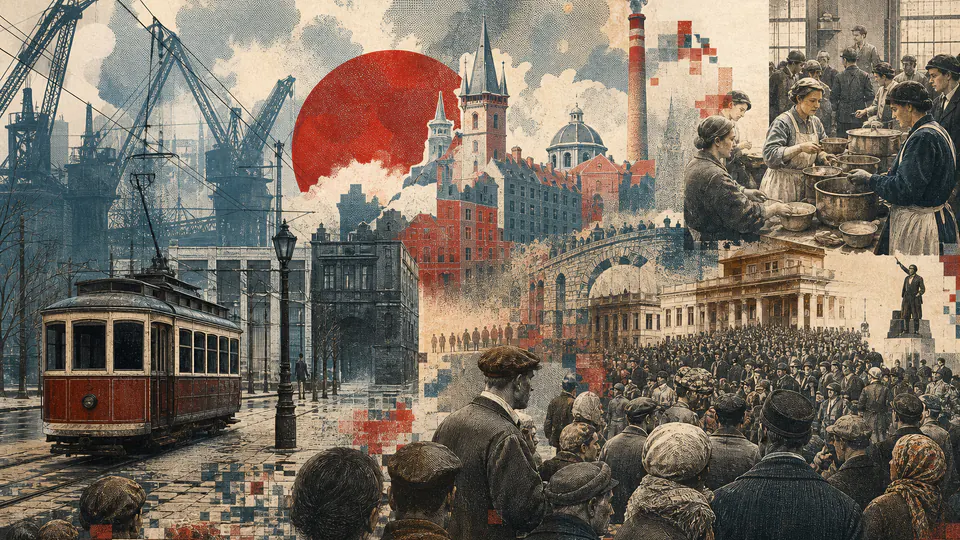
#storyAt 10 a.m. on February 6, 1919, Seattle’s streetcars stopped running, its stores closed, and cooks, laundry workers, and teamsters across the city put down their tools together. Roughly 65,000 workers from 110 local unions walked out at the same hour, not against any employer of their own but in support of 35,000 shipyard workers who had already been on strike for a raise since January 21. That is the definition in practice: a general strike crosses employers and whole industries at once, called in solidarity with a fight that one union cannot win by itself. The University of Washington’s own labor history project calls Seattle’s the first twentieth-century solidarity strike in the country to be proclaimed a general strike. It ran six days, and it did not get the shipyard men their raise.
The country has tried this only a handful of times since, and the search engine’s question deserves an answer up front: no American general strike has forced a city to grant its central demand while the walkout itself was still running. What happened next, in every case, is a longer and stranger story, and it starts with a telegram that went to the wrong office.
The telegram that should never have arrived
Seattle’s shipyards ran on one wage agreement covering every craft, negotiated for the yard owners as a bloc by the Metal Trades Council. When the owners tried to split the union by offering skilled workers a raise and unskilled workers nothing, 35,000 shipyard men walked out on January 21, 1919. Then Charles Piez, head of the federal Emergency Fleet Corporation, wired the owners a threat: raise wages and Washington would pull their shipbuilding contracts. The telegram was addressed to the Metal Trades Association, the owners’ group. It was delivered instead to the Metal Trades Council, the union, whose name was one word off.
Reading the federal government’s own bargaining position in a misdirected telegram turned a shipyard wage dispute into a citywide grievance against Washington itself. The shipyard workers appealed to the Seattle Central Labor Council for a sympathy strike. A hundred and ten unions were polled, almost unanimously in favor, and the date was set for February 6.
What a walkout that size actually requires
Two days before the strike, the Seattle Union Record printed an editorial by columnist Anna Louise Strong that the city’s business class would quote back at the strikers for years. Strong’s real argument was about logistics, not doctrine: the strike would win, she wrote, only if the workers proved they could run the city better than the owners could, by feeding it and keeping it clean for as long as the walkout lasted.
And that is why we say that we are starting on a road that leads - NO ONE KNOWS WHERE
The Strike Committee built exactly that machine. Twelve central kitchens, the number Strong’s editorial had promised, ran alongside improvised dining stations that together served as many as 30,000 meals a day, 25 cents for strikers and 35 cents for the general public. Milk wagon drivers, denied dairy access by their own employers, set up 35 neighborhood milk stations of their own. Laundry workers kept handling hospital linens, firemen stayed on duty, and garbage still got collected, each exemption stamped by the committee itself. An unarmed group of ex-servicemen calling itself the Labor War Veteran’s Guard patrolled the streets using, in its own words, persuasion only. Seattle’s regular police made no arrests connected to the strike at all.
Mayor Ole Hanson answered a peaceful city with force anyway: 950 sailors and Marines stationed by February 7, 600 added police, and 2,400 special deputies, mostly University of Washington students. He threatened to replace every striking worker with 1,500 police and 1,500 troops, a bluff the strikers correctly read as empty. By February 11, the Strike Committee itself gave up, citing pressure from national union officers and the sheer difficulty of running a shut-down city. Thirty-nine IWW members were arrested afterward as “ringleaders of anarchy,” charges later dropped, the same union whose 1905 founding convention in Chicago Eugene Debs had addressed. Hanson resigned within months and spent the next several touring the country lecturing on the danger of “domestic Bolshevism.” He earned $38,000 in seven months doing it, five times his mayor’s salary.
Two strikes, one summer, 1934
Fifteen years later, two more cities got general strikes out of disputes that started somewhere else entirely.
On the docks, West Coast longshoremen struck on May 9, 1934, for a closed shop, one coastwide contract, and a union-run hiring hall to replace the “blue book” system, under which an employer-run union alone decided who worked each day. In San Francisco on July 5, police fired into a crowd of strikers at Steuart and Mission streets, killing longshoreman Howard Sperry and Nick Bordoise, a cooks’ union member volunteering in the strikers’ kitchen. Thousands marched behind their coffins down Market Street the next day, and on July 16 the San Francisco Labor Council put the city’s own unions to a vote: some 150,000 workers walked out.
The committee running that walkout, though, was more cautious than the men on the docks who had started it. Its leaders steered both sides toward arbitration over the objection of the longshoremen’s own Harry Bridges, and after four days the Labor Council voted to end the general strike and recommended arbitration instead. The board did not rule until October 12, but when it did, the longshoremen got the hiring hall, with the union choosing its own dispatcher.
Minneapolis that same summer was smaller in scope and just as violent. General Drivers Local 574, a Teamsters local that had grown from 75 members to roughly 3,000 in a matter of months, struck the city’s trucking companies on May 16, and other trades’ unions began honoring the picket lines rather than crossing them, the sympathy action that got the dispute filed in the history books as a general strike even though its core was one union’s contract fight. On July 20, “Bloody Friday,” police shot 67 pickets in a downtown truck battle and killed two, Henry Ness and John Belor. A state investigation ordered by Governor Floyd Olson later found that police had fired directly at the pickets to kill and that the pickets carried no weapons. Olson declared martial law six days later and sent in 4,000 National Guardsmen. The strike ended in a settlement on August 22 that gave Local 574 the recognition, seniority protections, and reinstatement of fired strikers it had struck for in the first place.
Oakland’s fifty-four hours
UFCW Local 324, a retail and grocery workers’ union, still calls this one “the last general strike to occur in the United States.” It ran December 3 to 5, 1946, and it started with department store clerks. Some 400 workers, mostly women, had been on strike at Kahn’s and Hastings for a month over a fired union organizer when the stores’ trade association tried to break the picket lines with non-union delivery trucks from Los Angeles. The city sent roughly 250 police to cordon off six blocks and escort the trucks through, carrying machine guns and tear gas.
Oakland’s streetcar operators saw the police cordon and treated it as a picket line of their own: they stopped their cars at the police lines, pulled the control handles out, and joined the strikers in the street. The Alameda County labor federation called a “work holiday” on the spot. Estimates of how many workers answered range from Wikipedia’s count of 50,000 to the union federation’s own count of nearly 130,000, across 142 AFL unions, and for 54 hours downtown Oakland ran without them. The city ended the standoff by promising police would never again escort strikebreakers, and the walkout stopped; the department store clerks’ own strike ran another five months before it was settled separately.
Occupy Oakland shut the port down for a shift on November 2, 2011, and Democracy Now headlined its report “First General Strike in City Since 1946.” The label sticks most naturally to the citywide, multi-industry shutdowns of 1919 through 1946; 2011’s version was smaller and shorter, a day of marches and one port closure rather than a citywide walkout, and it borrowed the name and the tactic on purpose.
Why the tactic mostly disappeared
The short legal answer arrived on June 23, 1947, when Congress overrode President Truman’s veto and enacted the Taft-Hartley Act. Among its provisions, the National Labor Relations Board’s own history of the law notes, Taft-Hartley “prohibited secondary boycotts, making it unlawful for a union that has a primary dispute with one employer to pressure a neutral employer to stop doing business with the first employer.”
A general strike is, structurally, thousands of workers doing exactly that at once: pressuring their own employer, neutral to the dispute, over a fight that legally belongs to somebody else’s union. Add the no-strike clause that almost every American union contract carries for its own term, and joining someone else’s walkout breaches your own agreement on top of the federal ban, on a day your own union has no legal cover to strike at all. Coordinating a citywide walkout after 1947 means either breaking the law together or arranging, years in advance, for every contract involved to expire on the identical day.
The plan for 2028
That second option is the one being tried now. In 2023 the United Auto Workers negotiated new contracts with Ford, General Motors, and Stellantis, covering 146,000 workers, timed to expire on May 1, 2028, International Workers’ Day itself, a story this site tells in full at May Day. UAW president Shawn Fain has spent the time since asking the rest of the labor movement to match that date.
We want a general strike. We want everybody walking out just like they do in other countries.
Fain said that at the UAW’s national political conference in January 2024, and he has been careful to temper it since: a general strike, he has said, “isn’t going to happen on a whim” or “over social media,” and will take “mass coordination” first. The American Federation of Teachers, representing 1.8 million members, passed a resolution backing the May 1, 2028 alignment; the American Postal Workers Union and locals inside several other unions have done the same. Nothing has been struck yet, and no contract can be forced to expire on a date its own union did not choose.
Has one ever worked?
Not on its own terms. Seattle’s six days won nothing for the shipyard workers who started it. Oakland’s 54 hours ended with a police promise and left the retail clerks to finish their own fight five months later, alone. The two 1934 strikes that also produced a real contract for the union that started them, San Francisco’s longshoremen and Minneapolis’s Teamsters, got there only once the general strike gave way to something else: arbitration in San Francisco’s case, weeks into martial law in Minneapolis’s. A general strike, on the American record so far, buys a smaller and already-organized union time and room to negotiate; it has never by itself forced a city to grant the demand written on the picket signs. Whether 146,000 autoworkers with a contract built to expire on the same day changes that arithmetic in 2028 is a question for the labor movement to answer, not this article.
What people get wrong
#wrong- The myth
General strikes are flatly illegal in the United States today. - The record
The Taft-Hartley Act bans secondary boycotts and solidarity strikes, and most union contracts carry a no-strike clause for their own term. Neither rule stops a walkout that begins the day a union's own contract legally expires, which is the loophole the UAW's 2028 plan is built on.
- The myth
The 1919 Seattle General Strike was an attempted Bolshevik uprising. - The record
Mayor Ole Hanson framed the strike as a fight between "Americanism" and "Bolshevism" and spent months afterward touring the country warning of "domestic Bolshevism." The Strike Committee's own program was feeding the city, running milk stations, and keeping hospital laundry and fire service going, and Seattle's police made no arrests connected to the strike at all.
- The myth
Occupy Oakland's 2011 action was a repeat of the 1946 Oakland general strike. - The record
Democracy Now's own headline called it the city's first general strike since 1946, but 2011 was a single day of rallies and marches, with police estimating 7,000 marchers and organizers claiming more, plus one evening shift shut at the port. The 1946 strike ran 54 hours across 142 unions.
- The myth
A US general strike has forced an employer or city to grant the strikers' demand while the walkout itself was still running. - The record
None has. Seattle's shipyard workers never got their raise. Oakland's department store clerks settled their own strike separately, five months later. The two 1934 walkouts that did produce a contract, San Francisco's longshoremen and Minneapolis's Teamsters, won it only after the general strike itself had ended, through arbitration in San Francisco and a settlement reached under martial law in Minneapolis.
The dates that matter
#dates- January 21, 1919 35,000 Seattle shipyard workers strike for a uniform wage increase, after a federal telegram meant for the yard owners is delivered to the union by mistake.
- February 4, 1919 The Seattle Union Record prints Anna Louise Strong's editorial warning that the coming strike leads, in her words, NO ONE KNOWS WHERE.
- February 6-11, 1919 The Seattle General Strike: roughly 65,000 workers from 110 unions walk out in support of the shipyard men.
- May 9, 1934 West Coast longshoremen strike for a union-run hiring hall, setting off the chain that leads to San Francisco's general strike.
- May 16, 1934 Minneapolis Teamsters Local 574 strikes the city's trucking companies, drawing other trades into sympathy walkouts.
- July 5, 1934 "Bloody Thursday": San Francisco police kill longshoreman Howard Sperry and strike-kitchen volunteer Nick Bordoise.
- July 16-19, 1934 The San Francisco General Strike: some 150,000 Bay Area workers walk out before the Labor Council calls it off.
- July 20, 1934 "Bloody Friday" in Minneapolis: police shoot 67 pickets and kill Henry Ness and John Belor.
- August 21-22, 1934 The Minneapolis strike ends in a contract recognizing Local 574.
- October 12, 1934 An arbitration board awards San Francisco's longshoremen a union-run hiring hall.
- December 3-5, 1946 Oakland's "work holiday": tens of thousands of workers from 142 AFL unions walk out over police escorting strikebreakers.
- June 23, 1947 Congress overrides Truman's veto and enacts the Taft-Hartley Act, banning solidarity strikes and secondary boycotts.
- November 3, 2011 Occupy Oakland shuts down the port for a shift; Democracy Now headlines it the city's first general strike since 1946.
- January 2024 UAW president Shawn Fain tells the union's political conference, "We want a general strike."
Questions people ask
#faqsWhat is a general strike?
A general strike is a work stoppage that crosses many employers and industries in a city or country at once, rather than one union striking one employer. In the American pattern it has usually been a sympathy walkout, called to back a narrower strike that could not win on its own, such as Seattle's shipyard workers in 1919 or San Francisco's longshoremen in 1934.
Has the United States ever had a general strike?
Yes, several: Seattle in February 1919 (roughly 65,000 workers), San Francisco and Minneapolis in the summer of 1934, and Oakland in December 1946. Occupy Oakland shut down the port for a shift in 2011 and revived the label, though most historians treat it as smaller and shorter than the earlier four.
Are general strikes illegal in the United States?
The Taft-Hartley Act of 1947 made solidarity strikes and secondary boycotts illegal under federal law, and most union contracts carry a no-strike clause for their own term. A strike that begins the day a union's own contract legally expires breaks neither rule; coordinating many unions to expire on the same day, which is what the UAW is organizing for 2028, is the legal route around the ban.
What was the Seattle General Strike of 1919?
A six-day walkout, February 6 to 11, by roughly 65,000 Seattle workers in support of 35,000 shipyard workers striking for a raise. The Strike Committee ran food, milk, and hospital-laundry service for the city; the strike ended without the shipyard men winning their raise, and 39 IWW members were arrested afterward as "ringleaders of anarchy."
What is the UAW's plan for a general strike in 2028?
UAW president Shawn Fain has asked other unions since 2023 to time their own contract expirations to May 1, 2028, International Workers' Day, so a coordinated walkout becomes possible on the same day the UAW's own Big Three contracts expire. The American Federation of Teachers and other unions have passed resolutions supporting the alignment; nothing has been struck yet.
The bookshelf
#bookshelfWhere to go next. Buy from an independent bookstore, or find it at your library for nothing.
-
I Change Worlds: The Remaking of an American Anna Louise Strong, 1935 primary
The Seattle Union Record editorialist's own memoir, written by the strike's most quoted voice.
-
The Seattle General Strike Robert L. Friedheim, 1964 secondary
The standard academic history of the 1919 strike, still the source most other accounts build on.
-
Strike! Jeremy Brecher, 2014 secondary
A labor history built around America's general strikes, Seattle through Occupy, in one volume.
-
Revolutionary Teamsters: The Minneapolis Truckers' Strikes of 1934 Bryan D. Palmer, 2013 secondary
How a Trotskyist-led local built the strike that martial law eventually settled.
Wear it: General strike
#merchEvery design here links back to this page.
Sources
#sourcesPrimary sources
The documents themselves: laws, court opinions, speeches, letters, and the numbers from the agencies that count them.
- Anna Louise Strong, "No One Knows Where," The Seattle Union Record (February 4, 1919) (transcribed at the Anna Louise Strong Reference Archive)
- Democracy Now, "Video Report from Streets of Oakland: First General Strike in City Since 1946 Shuts Down Major Port" (November 3, 2011)
- National Labor Relations Board, "1947 Taft-Hartley Substantive Provisions"
- The Nation, "The Call Is Out for Mass, Simultaneous Strikes in 4 Years" (October 14, 2024)
- UAW, "May Day 2028"
- Eugene V. Debs, "Speech at the Founding Convention of the Industrial Workers of the World" (June 29, 1905) (Marxists Internet Archive)
Secondary sources
Written afterward, about the story.
- University of Washington, "Seattle General Strike Project"
- Wikipedia, "Seattle General Strike"
- Wikipedia, "1934 West Coast waterfront strike"
- Global Nonviolent Action Database, Swarthmore College, "U.S. west coast longshoremen strike for union recognition and San Francisco general strike, 1934"
- Wikipedia, "Minneapolis general strike of 1934"
- Wikipedia, "1946 Oakland general strike"
- UFCW Local 324, "Oakland General Strike: A Workers' Holiday"
- Wikipedia, "Taft-Hartley Act"
- Wikipedia, "2011 Oakland general strike" (police and organizer crowd estimates, one-shift port shutdown)