Published
Disability rights
The 504 Sit-In: 26 Days That Won Disability Rights
How disabled activists occupied a federal building in San Francisco for 26 days in 1977, fed daily by the Black Panther Party, until the government signed.

The story
#storyOn April 5, 1977, roughly 150 disabled people rolled, walked, and were carried into the fourth-floor regional office of the U.S. Department of Health, Education, and Welfare at 50 United Nations Plaza in San Francisco, and refused to leave. They stayed 26 days. It is still credited, including by San Francisco State University’s Longmore Institute on Disability, as the longest occupation of a federal building in U.S. history, and it forced the federal government to sign the first regulations that made disability rights enforceable as law.
The rule nobody would sign
Section 504 of the Rehabilitation Act, which Congress passed in 1973, said something simple: no program that receives federal money can discriminate against a person because of disability. Schools, hospitals, transit systems, universities: if federal dollars touched it, Section 504 covered it. The law had no teeth without regulations spelling out what compliance actually required, and for four years, across the rest of the Nixon administration, all of Gerald Ford’s, and into Jimmy Carter’s, no HEW secretary signed them. The American Coalition of Citizens with Disabilities set a deadline of April 4, 1977. It passed with no signature.
One building held out
The next day, disabled activists occupied HEW regional offices in ten U.S. cities at once. Most of those sit-ins broke up within hours or days. San Francisco’s held. Organizers Judy Heumann and Kitty Cone kept somewhere between 120 and 150 people inside the building for nearly a month, among them people who were blind, deaf, or used wheelchairs, including Mary Jane Owen and Hale Zukas, sleeping on office floors while Mayor George Moscone arranged for mobile showers to be brought in. Ed Roberts, then California’s director of vocational rehabilitation, visited the building regularly and later testified inside it. Roberts had contracted polio at fourteen in 1953 and was left paralyzed from the neck down; in 1962 he became the first student with a significant disability admitted to UC Berkeley, and in 1972 he helped found Berkeley’s Center for Independent Living, one of the first disability services run and controlled by disabled people themselves, before Governor Jerry Brown appointed him to run the state rehabilitation department in 1976. He later co-founded the World Institute on Disability and was named a MacArthur Fellow in 1984.
The Black Panthers kept them fed
An occupation that size does not feed itself, and its most documented outside support came from the Black Panther Party. The connection ran through Brad Lomax, a member who had helped found the party’s Washington, D.C. chapter before multiple sclerosis brought him to the Bay Area, where he also became active in the independent living movement. For all 26 days, Oakland Panthers drove hot meals across the bay into the building. Kitty Cone remembered that Glide Memorial Church and the party together “sent many delicious meals that nourished us between days of coffee and doughnuts.” Corbett O’Toole, another occupier, put it more bluntly years later: “Black Panthers saved the 504 sit-in.” One occupier who had planned to fast in solidarity gave up the moment the smell reached her floor: “I couldn’t stand it when I saw those bar-be-qued ribs.”
A hearing, and a phrase everyone recognized
During the sit-in, Bay Area Representatives Phil Burton and George Miller convened a congressional hearing inside the occupied building. Gene Eidenberg, the HEW official sent from Washington, told the room the department was still weighing changes to the regulations that would let schools and hospitals build separate facilities for disabled people instead of integrating them: he used the actual words “separate but equal,” the same language the civil rights movement had spent decades dismantling. Kitty Cone later wrote that the testimony from Heumann, Roberts, Debby Kaplan, Phil Newmark, and others “was so compelling, that the representative from HEW got up and locked himself in an office.” Heumann herself, testifying, did not let the phrase pass:
We will no longer allow the government to oppress disabled individuals. We want the law enforced We want no more segregation
Twenty-six days, then a signature
Califano signed the regulations on April 28, 1977, as written, without the exemptions his own department had floated. Occupiers left the building on April 30, 26 days after they walked in. It was the first time the federal government had put a legal definition behind the idea that failing to build a ramp, hire a blind teacher, or interpret for a deaf student could be discrimination, not simply an oversight.
Why the ADA still had to happen
Section 504 only reached programs that took federal money. It did not touch a private employer, a shopping mall, or a bus line that ran without federal funds, and closing that gap took another thirteen years. On March 12, 1990, activists with ADAPT (Americans Disabled for Accessible Public Transit) left their wheelchairs and crutches at the bottom of the U.S. Capitol’s front steps and pulled themselves up the marble by hand, dozens of them, while roughly 1,000 supporters who had marched from the White House looked on. The climbers included eight-year-old Jennifer Keelan, the youngest person there; she had been turning out for disability protests since she was six. The day after the “Capitol Crawl,” Capitol police arrested 104 ADAPT protesters inside the rotunda.
Congress moved. On July 26, 1990, President George H.W. Bush signed the Americans with Disabilities Act on the White House lawn, extending Section 504’s protections to private employers, public accommodations, transportation, and telecommunications nationwide, no federal funding required. He closed his remarks with a line the movement had spent thirteen years earning:
Let the shameful wall of exclusion finally come tumbling down.
San Francisco State University’s Longmore Institute on Disability now documents the 1977 occupation in a permanent project it calls Patient No More, named for what the protesters had been demanding the entire time: enforceable rights, not charity.
Helen Keller had spent decades arguing that blindness in America tracked poverty as much as fate, working for the American Foundation for the Blind from 1924 until her death. The people inside 50 United Nations Plaza in 1977 turned that kind of argument into a federal regulation: one hearing, one signature, and 26 days of Panther-cooked dinners, delivered every single day until the government gave in.
Argue it
#argue4 claims about Disability rights you can make out loud, the best case against each one, and the answer. Every number links to where it came from.
-
Claim 1
Employers still call disabled applicants back less often, and the gap is smallest exactly where the ADA applies.
The evidence
A 2015 field experiment sent 6,016 job applications to real accounting postings, disclosing a spinal cord injury or Asperger's syndrome in two-thirds of the cover letters. Disabled applicants got 26 percent fewer expressions of employer interest overall, but the gap concentrated among small private employers exempt from the ADA, and the researchers found evidence the ADA itself, not comparable state laws, reduced the hiring gap.
Their best case
Economists Daron Acemoglu and Joshua Angrist found that after the ADA took effect, employment rates fell sharply for disabled men of every working age and disabled women under 40, with the steepest drops in hiring, not firing, concentrated in medium-size firms. Their reading: employers avoided the accommodation and litigation costs the law attached to hiring someone with a disability.
The answer
The 1990s employment drop Acemoglu and Angrist measured in census data was real. A National Academies panel that reviewed the wider literature called the overall picture mixed and inconclusive: Kruse and Schur found the subgroup most likely covered by the ADA's hiring provisions gained employment while others lost it, and Jolls and Prescott found no lasting link between the ADA and the decline once the short-run adjustment period passed. Stapleton and Burkhauser traced more of the 1990s drop to the expansion of disability benefit programs than to the ADA. A law that scared employers off hiring disabled workers would do its worst damage where it applies, and the 2015 experiment found the gap concentrated where the ADA does not reach.
-
Claim 2
The ADA itself pays a private plaintiff no damages. The money in ADA lawsuits comes from state law.
The evidence
More than 103,000 ADA cases were filed nationwide from January 2009 through April 2023, over 80 percent of them by plaintiffs who file eight or more suits a year, and nearly 75 percent concentrated in just three states: California, New York, and Florida. Eighteen law firms filed roughly 45,000 of those cases, 44 percent of all filings between 2009 and 2021, with one firm alone responsible for more than 13,000.
Their best case
The U.S. Chamber of Commerce's Institute for Legal Reform, in its 2023 report "Preserving Protections, Curbing ADA Litigation Abuse," argues that a small group of plaintiffs' firms exploits the ADA for quick settlements, filing thousands of boilerplate claims, many against small businesses, and often through so-called drive-by suits where the plaintiff never enters the property.
The answer
The Chamber's numbers are accurate, and the concentration among a small number of serial filers is real. Title III of the ADA gives a private plaintiff only injunctive relief and attorney's fees for a business's violation; it authorizes no money damages at all. The settlement incentive is layered on by state law. California's Unruh Civil Rights Act converts any ADA violation into a state civil rights violation carrying a minimum of $4,000 in statutory damages per occurrence, an amount that can multiply per visit, and California is one of the three states where, by the Chamber's own count, nearly three-quarters of the disputed cases land.
-
Claim 3
For thirteen years, the government measured whether its own contractors hired disabled workers. In 2026 it stopped counting.
The evidence
A rule the Office of Federal Contract Compliance Programs published September 24, 2013 required federal contractors to invite employees to self-identify as disabled and to measure their workforce against a 7 percent utilization benchmark. OFCCP's own compliance guidance describes that figure as a benchmark, not a quota; a contractor who falls short faces no hiring penalty, only a required review of its outreach and the barriers it hasn't addressed. On August 21, 2026, OFCCP published a final rule ending both the self-identification invitation and the utilization-goal measurement, most of it effective September 21, 2026.
Their best case
OFCCP's August 21, 2026 final rule states that the disability self-identification requirement and the utilization goal are inconsistent with the Americans with Disabilities Act, and rescinds both.
The answer
Section 503's underlying ban on disability discrimination and its reasonable-accommodation duty for federal contractors are not part of what changed, and OFCCP says so in the same rule. What ends is thirteen years of voluntary self-reporting measured against a benchmark the agency's own guidance took pains to distinguish from a quota, one a contractor could miss without penalty beyond reviewing its own practices. The rule calls the self-identification invitation an employer-initiated disability inquiry the ADA forbids, and says the benchmark could in practice induce quotas, while acknowledging the regulations themselves prohibited quotas. What the count gave was the only economy-wide before-and-after read on whether federal contractors hire disabled workers at a different rate than everyone else, and it ends with the most recent annual count, for 2025, showing 22.8 percent of people with a disability employed against 65.2 percent of people without one.
-
Claim 4
The Supreme Court said states must move disabled people out of institutions if a waiting list moves at a reasonable pace. Autistic people now wait more than five years.
The evidence
As of November 2025, more than 600,000 people sat on Medicaid home and community-based services waiting lists across 41 states, up 14 percent from a year earlier. The average wait ran 32 months overall, but 63 months, more than five years, for people with autism and 37 months for people with an intellectual or developmental disability.
Their best case
Justice Ruth Bader Ginsburg's majority opinion in Olmstead v. L.C. (June 22, 1999) built a defense into the ADA's integration mandate: a state meets its duty if it shows "a comprehensive, effectively working plan for placing qualified persons with mental disabilities in less restrictive settings" backed by "a waiting list that moved at a reasonable pace not controlled by the State's endeavors to keep its institutions fully populated."
The answer
The Court did not order every list cleared overnight; it wrote this defense so a state could manage limited resources without an instant, unfunded mandate. The defense carries a condition, reasonable pace, and a state has to keep meeting it rather than invoke it once. A wait averaging sixty-three months for autistic applicants is not the pace Olmstead was written to permit.
What people get wrong
#wrong- The myth
Accommodating a disabled employee costs a business a lot of money. - The record
Usually it doesn't. In a Job Accommodation Network survey of employers who contacted it for help between 2019 and 2024, 61 percent reported the accommodation they made cost nothing at all; the median one-time expense among those who paid something was $300, and the median ongoing annual cost was $2,400. A separate 2019 research brief found anticipated cost is one of the biggest reasons small businesses give for not hiring disabled workers, even though the same brief found nine in ten who did reported higher productivity and better retention.
- The myth
Suing under the ADA usually means a big payday for the person who sues. - The record
Published court decisions in ADA employment cases favored the employer roughly 94 percent of the time in one appellate study, and plaintiffs' overall success rate in published decisions ran from under 8 percent in the 1990s down to about 3 percent in the early 2000s, according to a National Academies review of the research. Of more than 200,000 charges filed with the EEOC in the decade after the law took effect, an estimated 27,725 ever became a lawsuit; most of the rest were resolved administratively, withdrawn, or abandoned.
- The myth
The 2026 rule change means federal contractors no longer have to follow disability rules. - The record
Section 503's core ban on disability discrimination and its reasonable-accommodation requirement for federal contractors did not change in the August 21, 2026 rule. What ended was the requirement that contractors invite employees to self-identify as disabled and measure their workforce against a 7 percent benchmark, the only economy-wide count of whether federal contractors employ disabled workers at a different rate than other employers.
- Office of Federal Contract Compliance Programs, "Modifications to the Regulations Implementing Section 503 of the Rehabilitation Act of 1973, as Amended," final rule, Federal Register document 2026-17115 (August 21, 2026)
- DirectEmployers Association, "OFCCP to Publish Final Section 503 Rule Aug. 21, Ending Disability Self-ID and Utilization Goal Requirements"
The dates that matter
#dates- 1973 Congress passes the Rehabilitation Act. Section 504 bars discrimination against disabled people in any program that receives federal money, but no one writes the regulations to enforce it.
- April 4, 1977 A deadline set by disability organizations for HEW Secretary Joseph Califano to sign the Section 504 regulations passes with no signature.
- April 5, 1977 Disabled activists occupy HEW regional offices in ten U.S. cities at once. Only the San Francisco occupation, at 50 United Nations Plaza, lasts past the first few days.
- April 1977 Representatives Phil Burton and George Miller convene a congressional hearing inside the occupied San Francisco building.
- April 28, 1977 Califano signs the Section 504 regulations as written, without the exemptions HEW had floated.
- April 30, 1977 Occupiers leave the San Francisco building after 26 days.
- March 12, 1990 ADAPT activists leave their wheelchairs at the bottom of the U.S. Capitol steps and pull themselves up the marble by hand, pressuring Congress to move the stalled Americans with Disabilities Act.
- July 26, 1990 President George H.W. Bush signs the Americans with Disabilities Act into law.
Questions people ask
#faqsWhat was the Section 504 sit-in?
In April 1977, disabled activists occupied the San Francisco office of the U.S. Department of Health, Education, and Welfare to demand the government finally write the enforcement regulations for Section 504, a 1973 law banning disability discrimination in any program that receives federal money. The occupation lasted 26 days and forced Secretary Joseph Califano to sign the regulations on April 28, 1977.
How long did the 504 sit-in last?
The San Francisco occupation, at the HEW regional office at 50 United Nations Plaza, ran from April 5 to April 30, 1977: 26 days. It is still cited by disability historians, including San Francisco State University's Longmore Institute on Disability, as the longest occupation of a federal building in U.S. history.
Did the Black Panther Party really help disabled protesters in 1977?
Yes. Brad Lomax, a Black Panther Party member who had multiple sclerosis, connected the occupiers with the Oakland-based Panthers, who delivered a hot meal to the protesters every day of the 26-day sit-in. Organizer Corbett O'Toole later said plainly that the Panthers saved the sit-in.
What is the difference between Section 504 and the ADA?
Section 504 (1973) only covers programs and activities that receive federal money: public schools, federally funded hospitals, and the like. The Americans with Disabilities Act, signed July 26, 1990, extended similar protections to private employers, public accommodations, transportation, and telecommunications nationwide, regardless of federal funding.
What was the Capitol Crawl?
On March 12, 1990, ADAPT activists including eight-year-old Jennifer Keelan left their wheelchairs and mobility aids at the bottom of the U.S. Capitol steps and pulled themselves up by hand in front of roughly 1,000 supporters, to pressure Congress on the stalled Americans with Disabilities Act. Congress passed the ADA later that year.
The bookshelf
#bookshelfWhere to go next. Buy from an independent bookstore, or find it at your library for nothing.
-
Being Heumann: An Unrepentant Memoir of a Disability Rights Activist Judith Heumann and Kristen Joiner, 2020 primary
Written by the organizer who slept on the floor of 50 United Nations Plaza for 26 days and later helped negotiate the ADA.
-
No Pity: People with Disabilities Forging a New Civil Rights Movement Joseph P. Shapiro, 1993 secondary
The standard journalistic history of the movement that produced the 504 sit-in and the ADA.
-
Disability Visibility: First-Person Stories from the Twenty-First Century edited by Alice Wong, 2020 primary
Contemporary disabled writers in their own words, on what the law changed and what it still hasn't.
-
Demystifying Disability: What to Know, What to Say, and How to Be an Ally Emily Ladau, 2021 secondary
A plain-language guide to the etiquette and policy questions the ADA's history leaves open.
Wear it: Disability rights
#merchEvery design here links back to this page.
 Design proof
 Helen Keller Engraved Tee
$36.00 Design proof
 Disability rights Collage Tee
$36.00 Design proof
 "Bias drops where the ADA applies." Tee
$36.00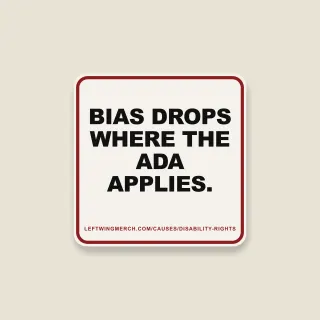 Design proof
 "Bias drops where the ADA applies." Sticker
$5.00 Design proof
 "Suits cluster where states add damages." Tee
$36.00 Design proof
 "Suits cluster where states add damages." Sticker
$5.00 Design proof
 "In 2026 the government stopped counting." Tee
$36.00 Design proof
 "In 2026 the government stopped counting." Sticker
$5.00 Design proof
 "Reasonable pace, Olmstead said. Now: 5 years." Tee
$36.00 Design proof
 "Reasonable pace, Olmstead said. Now: 5 years." Sticker
$5.00Sources
#sourcesPrimary sources
The documents themselves: laws, court opinions, speeches, letters, and the numbers from the agencies that count them.
- Kitty Cone, "Short History of the 504 Sit-in," Disability Rights Education and Defense Fund (first-person account by one of the sit-in's organizers)
- George H.W. Bush, remarks on signing the Americans with Disabilities Act, July 26, 1990, Miller Center Presidential Speeches Archive
- Daron Acemoglu and Joshua Angrist, "Consequences of Employment Protection? The Case of the Americans with Disabilities Act," NBER Working Paper 6670 (July 1998); published in the Journal of Political Economy 109(5) (October 2001) (finds disabled men's and disabled women's employment fell sharply after the ADA, driven by reduced hiring in medium-size firms)
- Mason Ameri, Lisa Schur, Meera Adya, F. Scott Bentley, Patrick McKay, and Douglas Kruse, "The Disability Employment Puzzle: A Field Experiment on Employer Hiring Behavior," NBER Working Paper 21560 (2015); published in ILR Review 71(2) (2018) (6,016 job applications; disabled applicants got 26 percent fewer employer expressions of interest, with the gap concentrated at employers exempt from the ADA)
- 42 U.S.C. § 12188, Americans with Disabilities Act, Title III enforcement (private plaintiffs may recover injunctive relief and attorney's fees only; money damages are available solely in Attorney General enforcement actions)
- California Civil Code Section 52, Unruh Civil Rights Act (minimum $4,000 in statutory damages per violation, on top of actual damages and attorney's fees)
- Office of Federal Contract Compliance Programs, "Modifications to the Regulations Implementing Section 503 of the Rehabilitation Act of 1973, as Amended," final rule, Federal Register document 2026-17115 (August 21, 2026) (effective September 21, 2026 except the part 60-30 amendment, effective December 21, 2026)
- U.S. Bureau of Labor Statistics, "Persons with a Disability: Labor Force Characteristics, 2025" (22.8 percent of people with a disability were employed in 2025, against 65.2 percent of people without one)
- Olmstead v. L.C., 527 U.S. 581 (1999), majority opinion
- Job Accommodation Network, "Costs and Benefits of Accommodation"
Secondary sources
Written afterward, about the story.
- National Park Service, "504 Protest: Disability, Community, and Civil Rights"
- "Virtual Tour," Patient No More, Paul K. Longmore Institute on Disability, San Francisco State University
- "The 504 Protests and the Black Panther Party," Disability Social History Project
- "Judy Heumann: Mother of the Disability Rights Movement," New Mobility
- "Disability History: The 1977 504 Sit-In," Disability Rights Florida
- "Section 504 Sit-Ins," COVE (Collaborative Organization for Virtual Education)
- "April 28, 1977: Disability Rights Sit-Ins Force Enactment of Section 504," Zinn Education Project
- "March 12, 1990: Disability Rights Activists' Capitol Crawl for the ADA," Zinn Education Project
- HISTORY, "When the 'Capitol Crawl' Dramatized the Need for the Americans with Disabilities Act"
- Minnesota Governor's Council on Developmental Disabilities, "Ed Roberts, Activist"
- Wikipedia, "504 Sit-in" (orientation and the building address; not used as sole source for any quote)
- Wikipedia, "Center for Independent Living" (1972 founding date; not used as sole source for any quote)
- Institute of Medicine, "The Employment Discrimination Provisions of the Americans with Disabilities Act: Implementation and Impact," in The Future of Disability in America (National Academies Press, 2007)
- U.S. Chamber Institute for Legal Reform, "Preserving Protections, Curbing ADA Litigation Abuse" (June 2023) (103,172 ADA cases filed 2009 to April 2023; over 80 percent by high-volume filers; nearly 75 percent in California, New York, and Florida)
- DirectEmployers Association, "OFCCP to Publish Final Section 503 Rule Aug. 21, Ending Disability Self-ID and Utilization Goal Requirements" (OFCCP states the self-ID and utilization-goal requirements are inconsistent with the ADA; most changes effective September 21, 2026)
- DirectEmployers Association, "What is Section 503 and How Do I Comply? A Guide for Federal Contractors" (describes the 7 percent figure as a benchmark, not a quota; a shortfall requires a review of outreach and barriers, not a hiring number)
- U.S. Government Accountability Office, GAO-14-167R, review of OFCCP's Section 503 regulations (documents the 7 percent utilization goal as established in OFCCP's rule published September 24, 2013)
- KFF, "A Look at Waiting Lists for Medicaid Home- and Community-Based Services from 2016 to 2025" (November 20, 2025)
- ADA National Network (University of Illinois at Chicago), "Small Business and the ADA," research brief (2019)