Published
Joe Hill
Joe Hill: The Songwriter Utah Shot
Born October 7, 1879. Died November 19, 1915
Joe Hill wrote the IWW's best-known songs, was convicted of a Salt Lake City murder on a gunshot wound he refused to explain, and was shot by Utah in 1915.
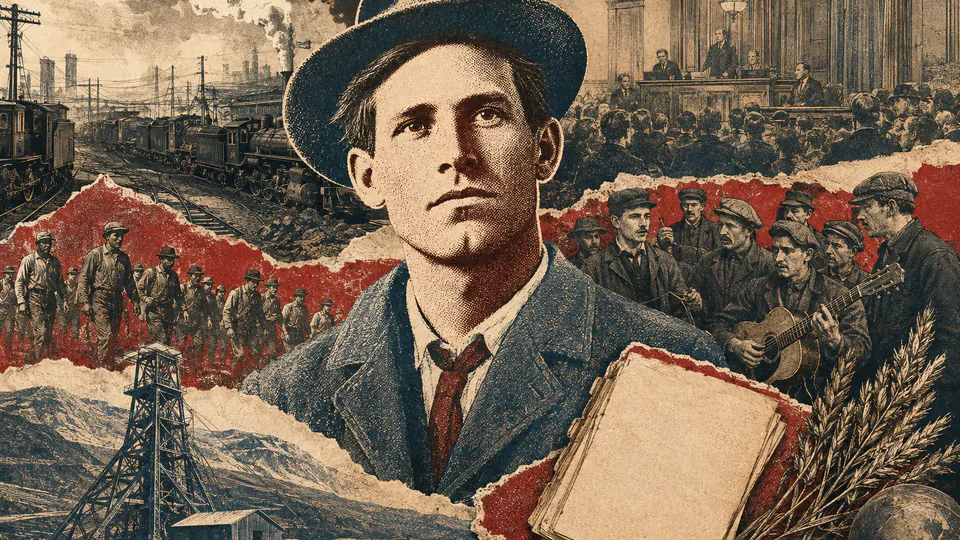
The story
#storyThe night before his execution, Joe Hill wired the Industrial Workers of the World’s general secretary, Bill Haywood:
Goodbye, Bill, I die like a true blue rebel. Don’t waste any time mourning. Organize
He sent a second telegram right after, about the one thing he still had a say in:
Could you arrange to have my body hauled to the state line to be buried? I don’t want to be found dead in Utah.
At dawn on November 19, 1915, a firing squad at the Utah State Penitentiary carried out the sentence a Salt Lake City jury had handed him for a double murder he denied to the end. He was thirty-six. The phrase from that telegram escaped the case: “don’t mourn, organize” is still the line unions reach for at a funeral, most of the time with no idea it started as an actual wire from an actual man a few hours from being shot.
Gävle to San Pedro
Joe Hill was born Joel Hägglund in Gävle, on Sweden’s eastern coast, on October 7, 1879, the fourth of six surviving children of a railroad conductor. His father died in 1887, and the children left school to work. Hill took a job in a rope factory and then as a fireman on a steam crane, shoveling coal into a boiler for money instead of an education. He emigrated to the United States with his brother Paul, arriving in New York on October 28, 1902, and spent the next several years drifting through odd jobs under the name Joseph Hillström, which he eventually shortened to Joe Hill.
By around 1910 he had landed in San Pedro, California, where he joined the Industrial Workers of the World and became secretary of its local. San Pedro is also where he started writing songs for the union’s Little Red Songbook, built on hymn tunes because every migrant worker in a boxcar or a mining camp already knew the melody and only needed new words.
“Pie in the sky” and “The Rebel Girl”
His first songbook contribution, in 1911, was “The Preacher and the Slave,” a parody of the hymn “In the Sweet By-and-By” aimed at street preachers who told hungry workers their reward was waiting for them in heaven. The song is where “pie in the sky” entered the language: a promise that only pays off after you’re dead. Hill kept writing through the following years, and his most enduring song came out of his last stretch of freedom. In 1915 he wrote “The Rebel Girl” for Elizabeth Gurley Flynn, the IWW organizer the rank and file already called by that nickname; Flynn confirmed the dedication herself, in her own memoir, decades later.
The night John Morrison died
On January 10, 1914, two armed men walked into a Salt Lake City grocery run by John G. Morrison, a former police officer, and shot him and his teenage son Arling to death. A younger son, thirteen-year-old Merlin, survived by hiding. That same night, Hill showed up at the office of Dr. Frank McHugh with a bullet hole through his chest. He said he’d been shot in a dispute over a woman, refused to say which woman, and refused for the rest of his life to say anything more. Salt Lake City police arrested him three days later.
A trial with no weapon, no witness, no motive
The trial ran through June 1914 before Judge Morris L. Ritchie, and it never produced a weapon tied to Hill, an eyewitness who identified him, or a motive. The state’s whole case was the coincidence of the wound and the silence around it, at a moment when Utah’s mining and business interests were openly hostile to the IWW, and labor papers across the country called the case a frame-up. Hill grew so frustrated with his own lawyers’ handling of a witness that he tried to fire them mid-trial; the judge let him try, he relented, and he still never took the stand to explain the one fact that might have freed him. The jury convicted him of first-degree murder on June 28, 1914. At sentencing on July 8, offered a choice between hanging and the firing squad, Hill picked the squad, telling the court he’d “been shot a few times” already and could stand it again.
The clemency campaign that failed
Utah’s Board of Pardons refused to commute the sentence in September 1915, by which point the case had become an international cause. Sweden’s minister to Washington appealed on Hill’s behalf, so did the American Federation of Labor, and so did Helen Keller, already the country’s best-known socialist. President Woodrow Wilson wired Governor William Spry twice, the second time two days before the execution. Spry granted one stay of the original October 1 execution date, then held to a single condition: he would order a new trial only if someone produced evidence that Hill was innocent, evidence Hill was still not offering. At dawn on November 19, 1915, five deputies with rifles faced him at the penitentiary. He was pronounced dead within minutes, and his body went by train to Chicago, where thousands attended a funeral and he was cremated on November 26.
The alibi he protected
What Hill would not say became clear, or as clear as it will get, ninety-six years after his death. In his 2011 biography The Man Who Never Died, journalist William M. Adler found a 1949 letter from Hilda Erickson, the young woman in whose family’s house in Murray, Utah, Hill had boarded. Erickson wrote that Hill privately told her the man who shot him that night was Otto Appelquist, a friend who had also been courting her. Appelquist left town before Hill’s arrest and was never charged with anything. Adler’s best guess, since Hill left no explanation of his own, is that he protected Erickson’s reputation rather than his own neck, and that she stayed silent for the same reason while he was still alive to ask it of her. Adler names a career criminal, Magnus Olson, who used a string of aliases and matched the description police circulated before they settled on Hill, as his candidate for who actually killed the Morrisons. None of this reached a courtroom while it could have done Hill any good.
Every state but Utah
The IWW followed his second telegram to the letter, and then some. Hill’s ashes went into roughly six hundred small envelopes, printed with his photograph and the caption “Murdered by the Capitalist Class.” Bill Haywood handed some out to delegates at the union’s November 1916 convention and mailed the rest to sympathizers in every state but Utah and to unions on several continents. The popular version, that all of it was scattered together on May Day 1916, does not hold up: the documented ceremonies happened later and separately, among them a Work People’s College assembly in Duluth in February 1917, a lakeside gathering in Cleveland that March, and a scattering on the graves of the Everett Massacre dead in Seattle that May. One envelope never reached anyone. A Chicago postmaster intercepted it in the mail on October 11, 1917, reportedly damaged by a canceling machine and flagged under the wartime mail restrictions the government was using against the IWW, and it disappeared into Post Office files and then the National Archives for seven decades, until a Utah researcher named Lori Taylor turned it up in the 1980s. On November 18, 1988, a day before the execution’s 73rd anniversary, the archives released it to IWW representatives and the folk singer Utah Phillips, who scattered most of what remained across several countries and kept a pinch of it inside the body of one of his guitars.
Why he’s still on the shirt
In 1936 the composer Earl Robinson set Alfred Hayes’s poem about Hill’s ghost to music, and “I Dreamed I Saw Joe Hill Last Night” has been performed since by Paul Robeson, Pete Seeger, and Joan Baez, among others. The case against him is still argued over in Utah archives and biography footnotes, a century on, without a verdict anyone can call final. What isn’t in dispute is the telegram: a man about to be shot for a crime he never explained, using his last hours to tell the people he organized with to skip the part where they cried about it.
In their own words
#wordsWhat Joe Hill actually said, where, and when. Each one links to the page it was checked against.
-
Goodbye, Bill, I die like a true blue rebel. Don't waste any time mourning. Organize.
Wired to IWW general secretary Bill Haywood from the Utah State Penitentiary, November 18, 1915, the night before his execution. The Salt Lake Tribune, "Who was Joe Hill?" -
You will eat, bye and bye, / In that glorious land above the sky; / Work and pray, live on hay, / You'll get pie in the sky when you die.
The chorus of "The Preacher and the Slave," written in 1911 for the IWW's Little Red Songbook. Songs of the Workers, 15th edition (Industrial Workers of the World, 1919), "The Preacher and the Slave" -
That's the Rebel Girl, that's the Rebel Girl! To the working class she's a precious pearl.
The opening lines of the chorus of "The Rebel Girl," written in 1915 for IWW organizer Elizabeth Gurley Flynn. Songs of the Workers, 15th edition (Industrial Workers of the World, 1919), "The Rebel Girl" -
My will is easy to decide, / For there is nothing to divide. / My kin don't need to fuss and moan— / "Moss does not cling to a rolling stone." / My body? Ah, If I could choose, / I would to ashes it reduce, / And let the merry breezes blow / My dust to where some flowers grow. / Perhaps some fading flower then / would come to life and bloom again. / This is my last and final will.
Written in his cell at the Utah State Penitentiary on November 18, 1915, the night before his execution, and published as "Joe Hill's Last Will" in the IWW's Little Red Songbook. Songs of the Workers, 15th edition (Industrial Workers of the World, 1919), "Joe Hill's Last Will" -
Let it go, fire.
His last words before the firing squad at the Utah State Penitentiary, November 19, 1915, as reported by the Salt Lake Herald-Republican. The Salt Lake Tribune, "Who was Joe Hill?" (reproducing the Salt Lake Herald-Republican's contemporary report)
What people get wrong
#wrong- The myth
Joe Hill was born with that name. - The record
He was born Joel Hägglund in Gävle, Sweden, on October 7, 1879. He emigrated in 1902, went by Joseph Hillström through his years of drifting for work in the American West, and shortened that to Joe Hill around 1910, after he reached San Pedro, California.
- The myth
The trial proved Joe Hill murdered John and Arling Morrison. - The record
The prosecution never produced a murder weapon, never got a witness who placed him inside the store, and never established a motive. The only tie was the coincidence of a gunshot wound the same night and Hill's silence about how he got it. The Utah Supreme Court and Board of Pardons let the conviction stand anyway.
- The myth
All of Joe Hill's ashes were scattered together on May Day, 1916. - The record
The roughly six hundred envelopes of his ashes went out starting in 1917, a year later than the popular story has it, and the documented ceremonies happened separately: a Work People's College gathering in Duluth in February 1917, a lakeside scattering in Cleveland that March, and ashes spread on the graves of the Everett Massacre dead in Seattle that May.
The dates that matter
#dates- October 7, 1879 Born Joel Hägglund in Gävle, Sweden, the fourth of six surviving children of a railroad conductor.
- 1887 His father dies. The children leave school to work; Hill takes a job in a rope factory, then as a fireman on a steam crane.
- October 28, 1902 Emigrates to the United States with his brother Paul, arriving in New York.
- circa 1910 Settles in San Pedro, California, joins the IWW, and becomes secretary of its local there.
- 1911 Writes "The Preacher and the Slave" for the IWW's Little Red Songbook, coining the phrase "pie in the sky."
- January 10, 1914 Grocer John G. Morrison and his son Arling are shot dead in Salt Lake City. Hill is treated the same night for a gunshot wound he will not explain.
- January 13, 1914 Arrested in Salt Lake City.
- June 28, 1914 Convicted of first-degree murder.
- July 8, 1914 Sentenced to death; chooses the firing squad over hanging.
- 1915 Writes "The Rebel Girl," dedicated to IWW organizer Elizabeth Gurley Flynn.
- September-November 1915 President Wilson wires Governor William Spry twice, the second time on November 17; Spry grants one stay, then refuses a new trial.
- November 19, 1915 Executed by firing squad at the Utah State Penitentiary, hours after wiring Bill Haywood not to waste time mourning him.
- 1916-1917 His ashes, mailed in small envelopes, reach IWW locals and sympathizers in every U.S. state but Utah and on multiple continents.
- November 18, 1988 The National Archives releases a surviving envelope of his ashes, seized in the mail in 1917, to the IWW and folk singer Utah Phillips.
Questions people ask
#faqsWho was Joe Hill?
Joe Hill (born Joel Hägglund, 1879-1915) was a Swedish-American songwriter for the Industrial Workers of the World, best known for "The Preacher and the Slave" and "The Rebel Girl." A Salt Lake City jury convicted him of a January 1914 double murder on circumstantial evidence, and Utah executed him by firing squad on November 19, 1915.
Why was Joe Hill executed?
A jury convicted him of murdering grocer John G. Morrison and his son Arling in Salt Lake City on January 10, 1914. The evidence was a gunshot wound Hill got the same night, which he refused to explain beyond saying it involved a woman. No weapon, eyewitness, or motive tied him to the killings, but the Utah Supreme Court and Board of Pardons let the conviction stand, and Governor William Spry refused clemency.
Did Joe Hill really say "don't mourn, organize"?
Yes. In a telegram to IWW general secretary Bill Haywood the night before his execution, he wrote that he died like a true blue rebel and told Haywood not to waste time mourning him, to organize instead. The line has circulated as a standalone slogan ever since, usually without the telegram it came from.
Was Joe Hill actually guilty?
The trial evidence never rose above circumstantial: a matching gunshot wound and his silence about how he got it. In 2011, biographer William M. Adler published a 1949 letter in which a woman named Hilda Erickson said Hill privately told her his friend Otto Appelquist shot him that night in a dispute over her, not John Morrison. No one was ever tried for that version of events.
What happened to Joe Hill's ashes?
The IWW mailed small envelopes of his ashes to sympathizers in every U.S. state except Utah, per his own telegram request, and to unions abroad. One envelope, seized from the mail in 1917 under wartime restrictions on IWW materials, sat in the National Archives until the union reclaimed it on November 18, 1988.
The bookshelf
#bookshelfWhere to go next. Buy from an independent bookstore, or find it at your library for nothing.
-
I. W. W. Songs to Fan the Flames of Discontent: A Facsimile Reprint of the Nineteenth Edition (1923) of the "Little Red Song Book" Industrial Workers of the World, 1923 primary
The songbook itself, the one "The Preacher and the Slave" and "The Rebel Girl" were written for.
-
The Man Who Never Died: The Life, Times, and Legacy of Joe Hill, American Labor Icon William M. Adler, 2011 secondary
The biography that surfaced Hilda Erickson's 1949 letter and makes the case for Hill's innocence.
-
Joe Hill Gibbs M. Smith, 1969 secondary
The first full biography, written before Erickson's letter surfaced. Still the closest reading of the trial.
-
Joe Hill: The IWW and the Making of a Revolutionary Workingclass Counterculture Franklin Rosemont, 2003 secondary
The Wobbly culture around Hill: the songs, the art, and the movement that made him a martyr.
Wear it: Joe Hill
#merchEvery design here links back to this page.
Sources
#sourcesPrimary sources
The documents themselves: laws, court opinions, speeches, letters, and the numbers from the agencies that count them.
- Utah Division of Archives and Records Service, "State of Utah vs. Joe Hill"
- Deseret News, "Union Heirs Reclaim Ashes of Joe Hill" (December 5, 1988)
- The Salt Lake Tribune, "Who was Joe Hill?"
- Songs of the Workers, 15th edition (Industrial Workers of the World, 1919), "The Preacher and the Slave"
- Songs of the Workers, 15th edition (Industrial Workers of the World, 1919), "The Rebel Girl"
- Songs of the Workers, 15th edition (Industrial Workers of the World, 1919), "Joe Hill's Last Will"
Secondary sources
Written afterward, about the story.
- Wikipedia, "Joe Hill (activist)"
- Peter Carlson, Roughneck: The Life and Times of Big Bill Haywood (W. W. Norton, 1983), p. 235 (source for the exact wording of Hill's telegrams to Haywood)
- Utah Division of State History, "Hill, Joe" (History to Go)
- The Salt Lake Tribune, "The Trial of Joe Hill"
- The Salt Lake Tribune, "Reduced to Ashes, Joe Hill Still Inspires"
- The Salt Lake Tribune, "If Joe Hill Was Innocent, Who Killed the Morrisons? Author Has a Suspect"
- Encyclopedia.com, "Joe Hill Trial: 1914"
- Wikipedia, "The Rebel Girl" (source for the 1915 dedication to Elizabeth Gurley Flynn, which Flynn confirmed in her own memoir)
- Wikipedia, "Joe Hill (song)" (the 1936 tribute song by Alfred Hayes and Earl Robinson)
- William M. Adler, The Man Who Never Died: The Life, Times, and Legacy of Joe Hill, American Labor Icon (Bloomsbury, 2011) (the biography that surfaced Hilda Erickson's 1949 letter; summarized here via the Salt Lake Tribune's coverage of the book)